
Adaptive Stay — An AI Agent That Makes Shared Spaces Work
Inspiration
Smart homes are becoming more intelligent, but most assistants still treat requests individually: one person asks for something, and the system responds.
Real homes and short-term rentals are more complicated.
What happens when two guests sharing an air-conditioning zone want different temperatures? What if multiple guests need hot water at the same time, but the property has limited capacity? What happens when an AI creates a plan, only for the underlying conditions to change before it is activated?
These aren't simply automation problems. They require coordination, reasoning, and an understanding of the physical environment.
We built Adaptive Stay to explore a different kind of intelligent home assistant: one that can understand competing needs, find workable solutions, verify them before acting, and adapt when circumstances change.
Our guiding principle was simple:
An AI agent should be able to propose a solution, but it should never be the sole authority deciding whether that solution is safe or achievable.
What It Does
Adaptive Stay is an Alexa+-oriented, MCP-native AI experience designed to personalize shared guest stays while coordinating the property's available resources.
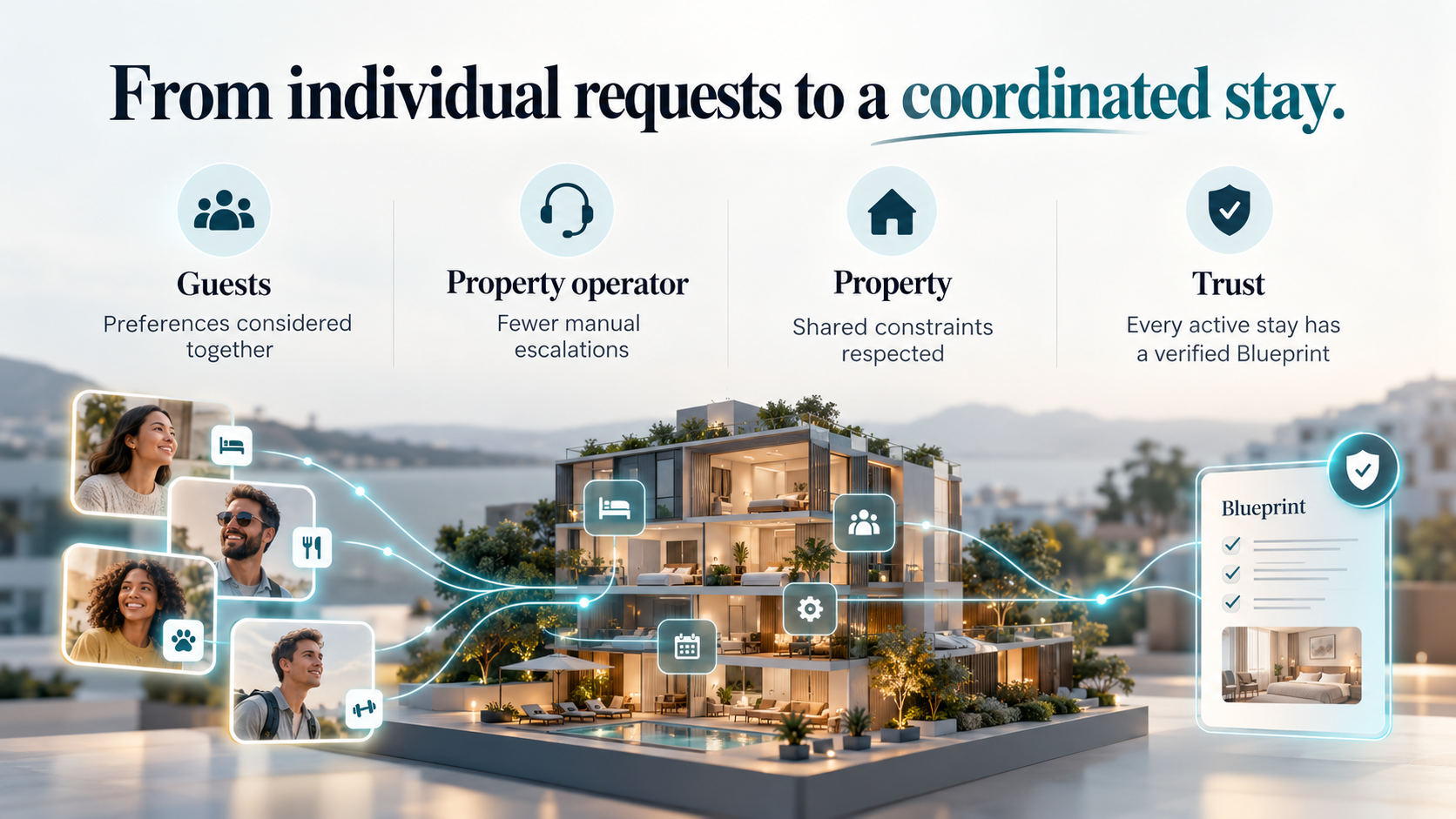
Instead of controlling devices independently, Adaptive Stay considers the requirements of the entire stay.
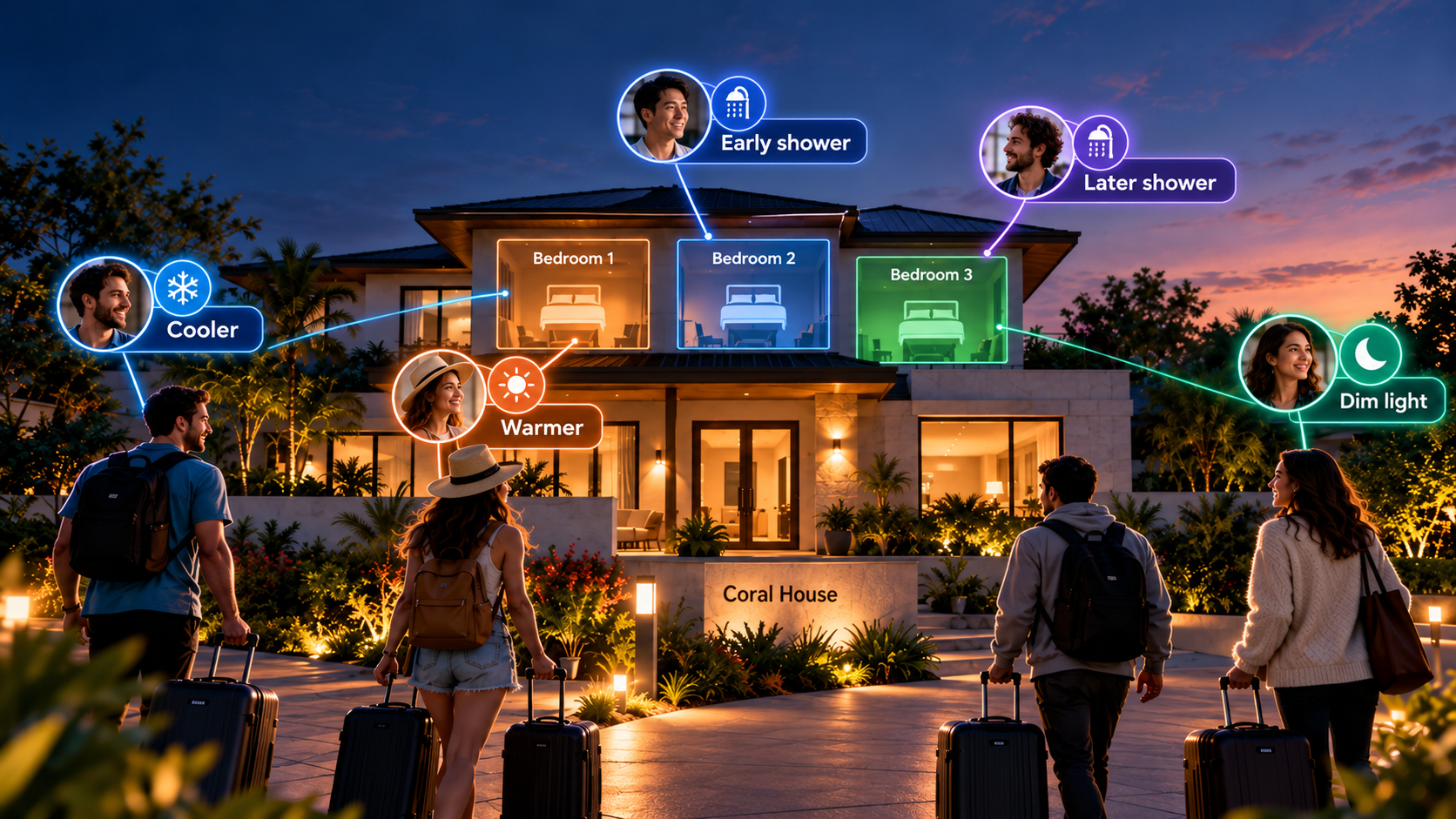
For example, at our demonstration property, Coral House:
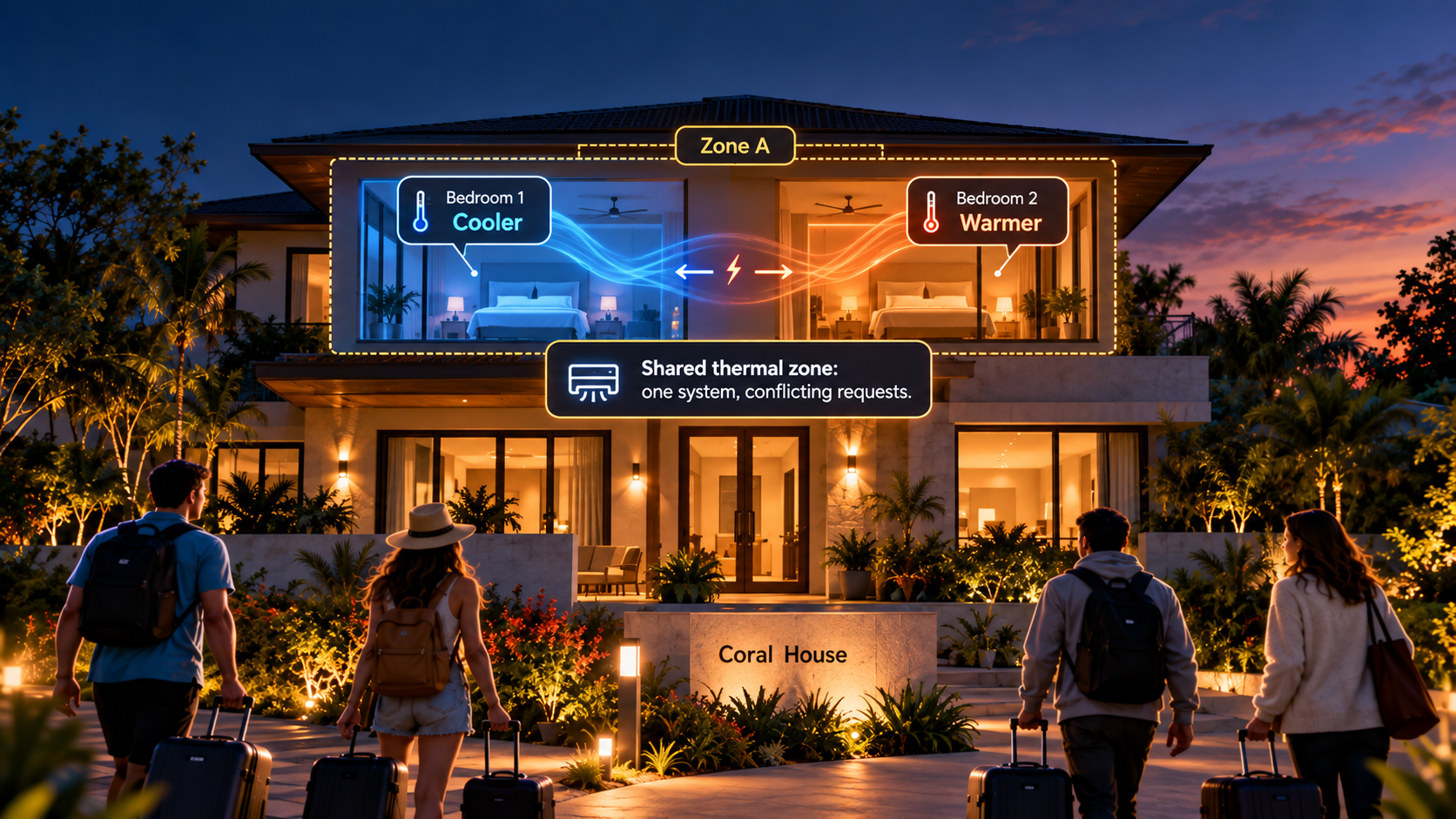
- Maya wants her bedroom cooler.
- James wants his bedroom warmer.
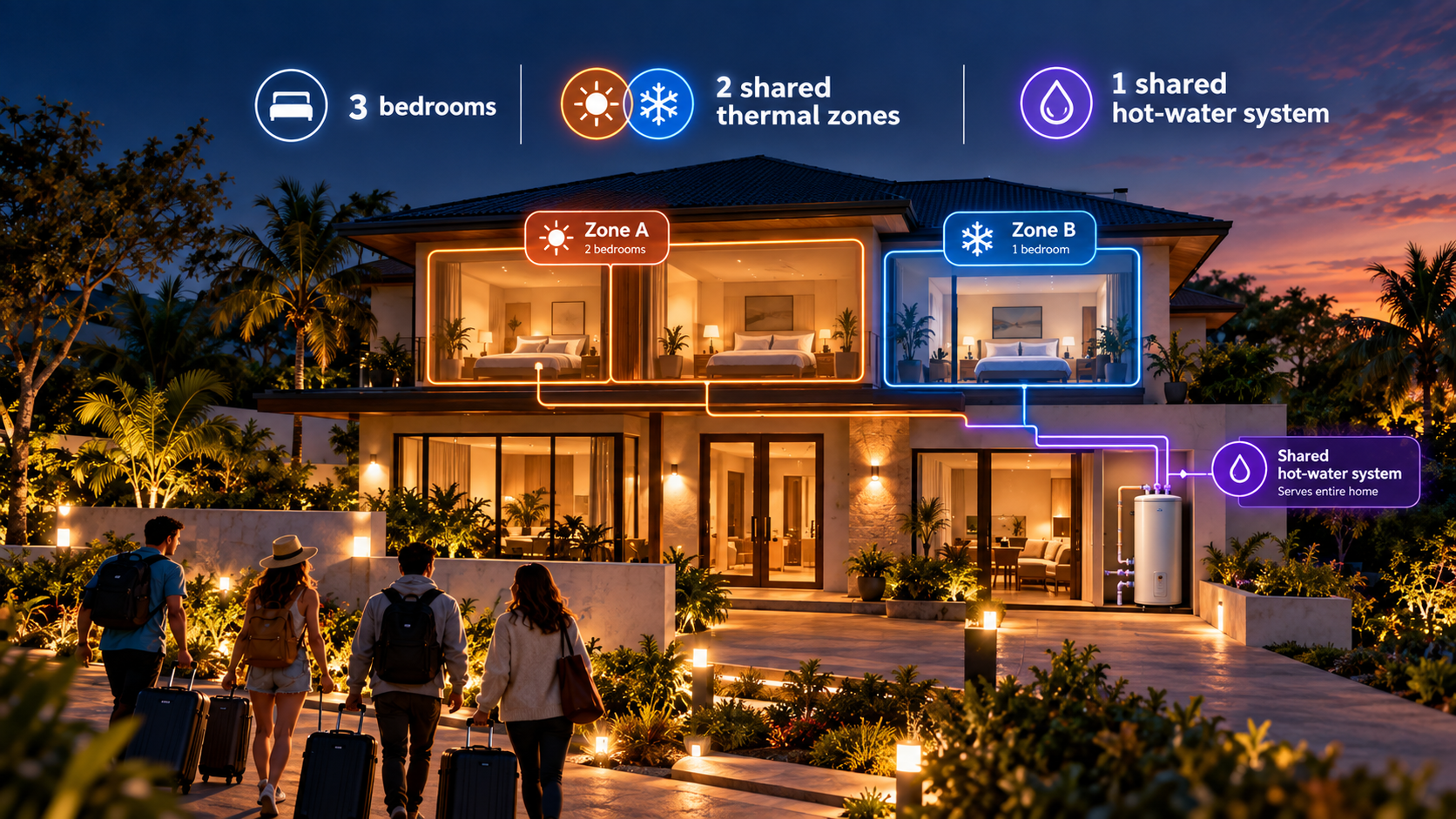
- Both bedrooms share the same climate zone.
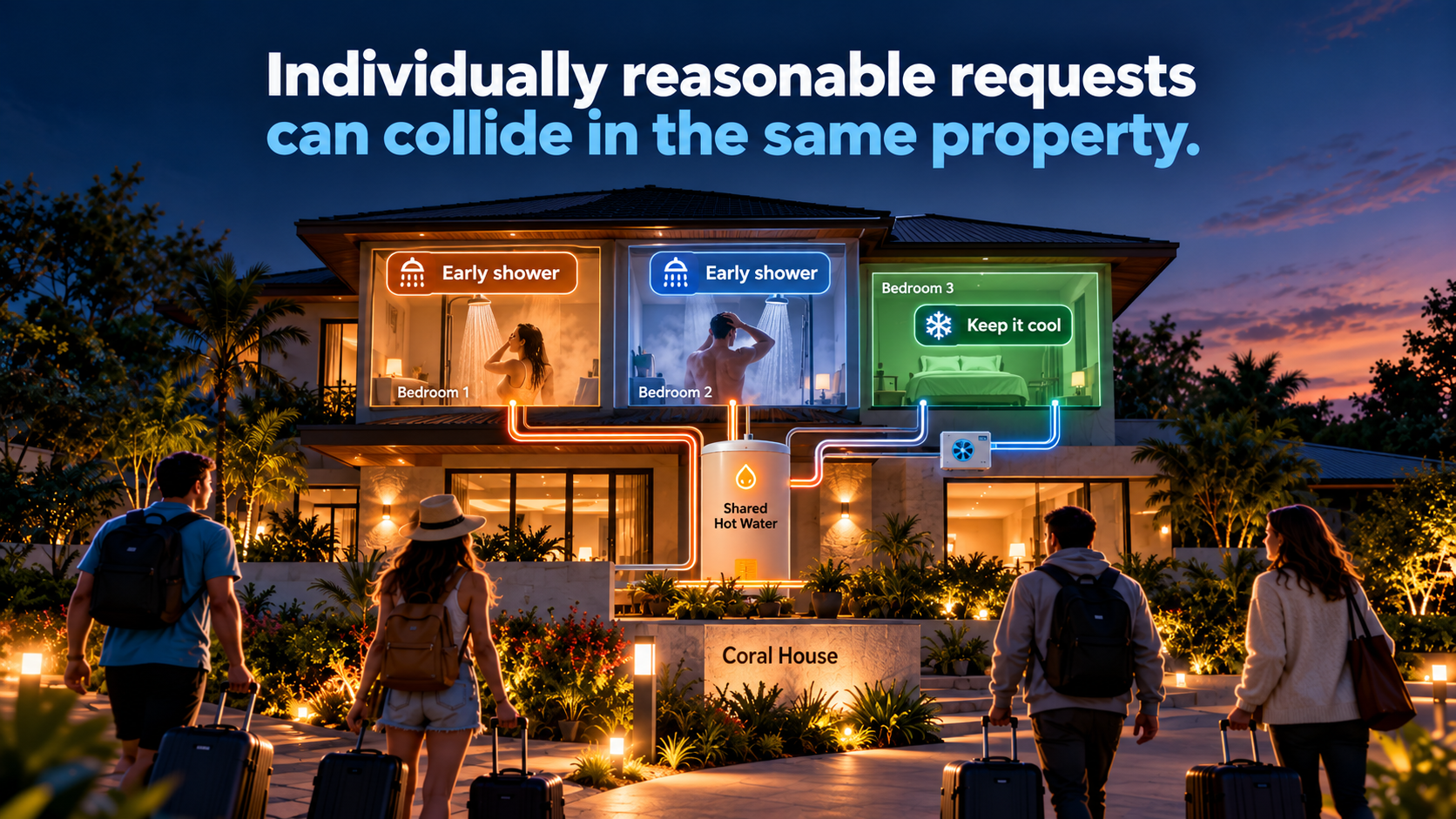
- Two guests request showers at the same time, exceeding the available hot-water capacity.
A conventional automation system might process these requests independently, potentially creating conflicting commands or unrealistic expectations.
Adaptive Stay takes a different approach.
1. Understand the stay
The assistant combines guest preferences, room assignments, shared resources, and the property's available capabilities into one coordinated view.
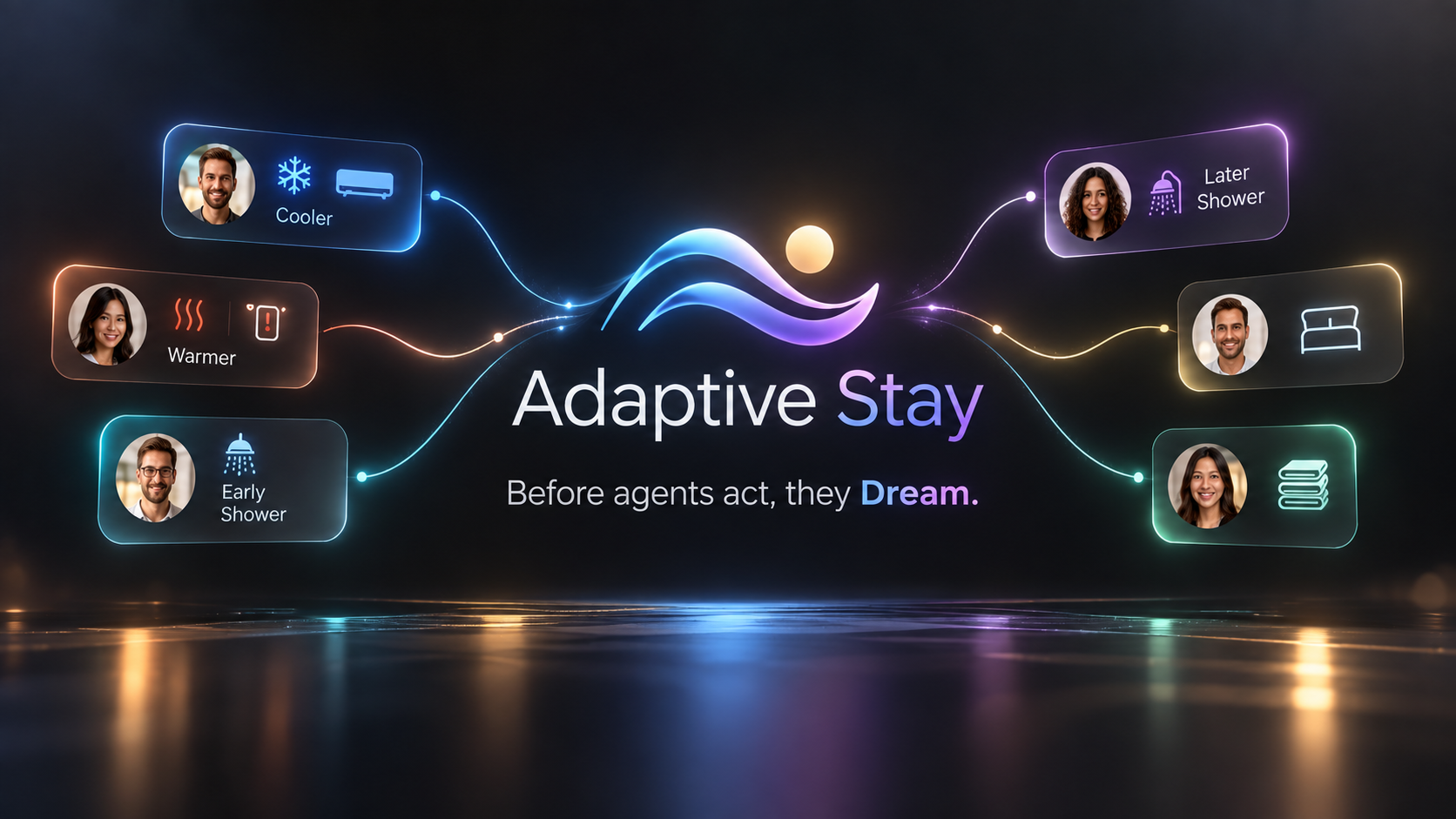
2. Dream a solution
Using Amazon Bedrock and the Strands Agents SDK, Adaptive Stay reasons across the competing requirements and proposes a configuration that could satisfy the stay.
3. Independently verify
A deterministic verification engine evaluates the proposed configuration against the actual property model and shared-resource constraints.
Only a configuration that passes verification can become a Verified Stay Blueprint.
4. Adapt when reality changes
A Blueprint is linked to the exact circumstances under which it was created.
If guest preferences, resources, or relevant property conditions change, Adaptive Stay detects that the existing Blueprint is stale and prevents outdated activation. The updated situation can then be processed through Dream again.
5. Activate and verify
Once a current Blueprint is authorized, a simulated Home State Gateway applies the configuration and independently reads back the resulting state.
The system reports successful activation only after that verification succeeds.
The result is an agent that doesn't just recommend what should happen. It checks whether its proposed solution works and whether the intended result was achieved.
How We Built It
Adaptive Stay combines agentic AI reasoning with deterministic operational control.
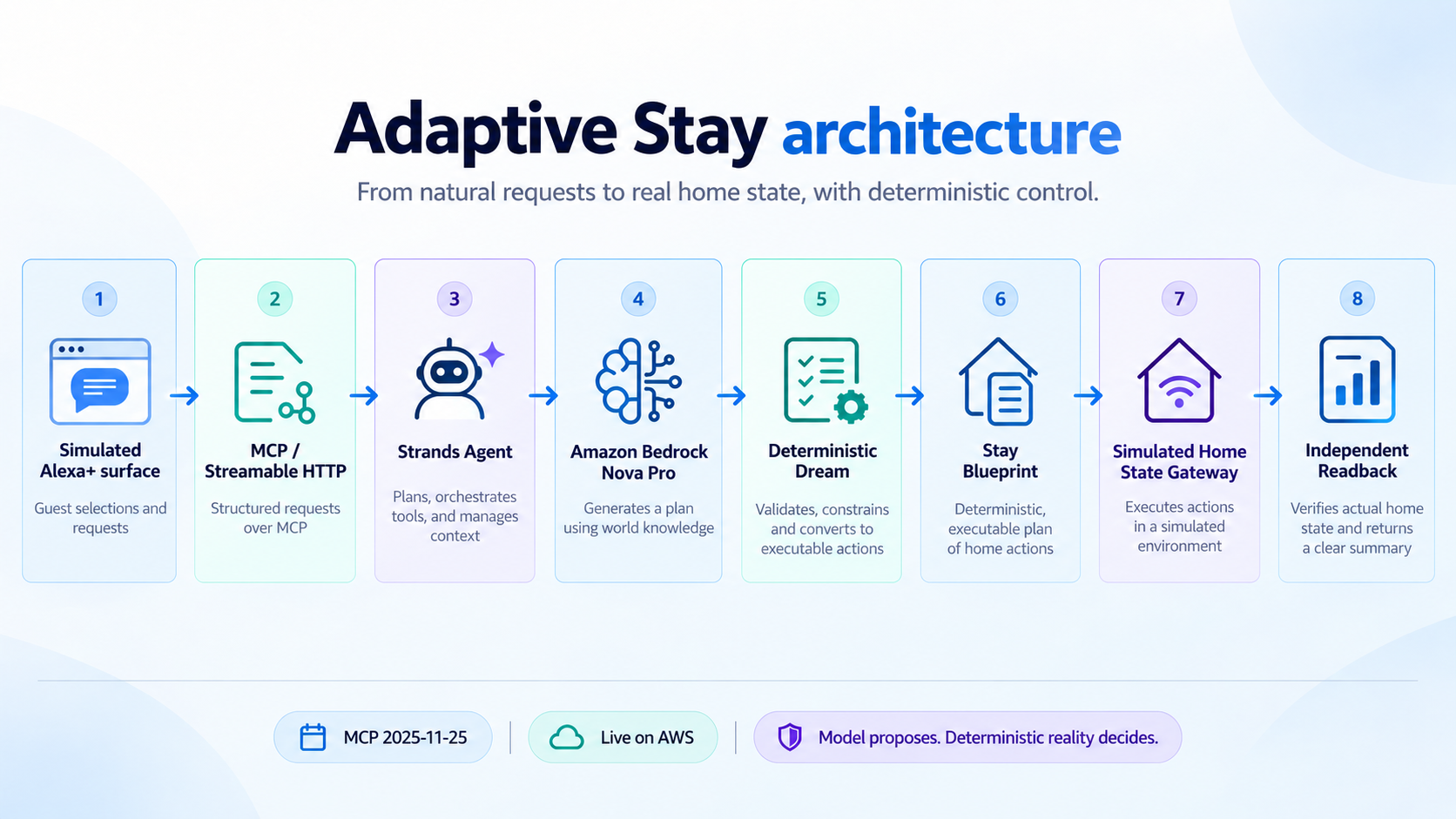
Our architecture follows this flow:
Alexa+-style Experience → MCP → Strands Agents → Amazon Bedrock → Dream Verification → Stay Blueprint → Home State Gateway → Independent Readback
Amazon Bedrock (Nova Pro) powers the reasoning process, proposing ways to coordinate guest requirements within the available property capabilities.
Strands Agents SDK orchestrates the model interaction and read-only grounding tools, allowing the agent to work with the actual simulated property configuration rather than relying on generic assumptions.
Model Context Protocol (MCP) provides the standardized interface for retrieving stay information, proposing preferences, initiating Dream, managing Blueprints, activating configurations, and checking out.
Deterministic Dream verification independently evaluates proposed configurations. The AI can suggest a strategy, but it cannot approve its own proposal or bypass constraints.
Stay Blueprint provides a verifiable representation of the accepted configuration, bound to the guest preferences, property capabilities, and resource conditions used to create it.
Simulated Home State Gateway applies authorized configurations to a simulated property environment and independently verifies the resulting state.
The application is written in Python, using the official MCP Python SDK, FastMCP, Strands, Amazon Bedrock, and AWS SDK components.
It is deployed publicly using Amazon ECS Express Gateway.
The browser experience simulates the Alexa+-style interaction surface. Physical device actuation is deliberately simulated; the project does not claim to control real home hardware.
Challenges We Faced
Coordinating competing needs
The central challenge was moving beyond individual preferences to whole-stay coordination.
A shared climate zone or limited hot-water system means that satisfying one guest can affect another. We needed to model these relationships explicitly so that Dream could reason about feasible configurations rather than merely issue device commands.
Separating AI reasoning from decision authority
Large language models can propose plausible solutions that do not satisfy all constraints.
We addressed this by separating the agent's proposal from deterministic verification. A strategy must pass independent checks before it becomes an actionable Blueprint.
Handling stale plans
A valid plan can become invalid when circumstances change.
We implemented Blueprint freshness checks so that updated preferences or resource conditions trigger re-evaluation rather than allowing an outdated configuration to proceed.
Verifying execution
Accepting a valid plan is not the same as proving it was applied.
We built a simulated Home State Gateway with independent state readback, ensuring activation is based on observed results rather than an agent's assertion of success.
Deploying an end-to-end AWS agent
We also encountered practical challenges involving AWS authentication, IAM permissions, ECS Express Gateway deployment commands, and deployment-status visibility.
Resolving these issues helped us move from a locally functioning prototype to a publicly accessible service.
Accomplishments We're Proud Of
Our biggest accomplishment is demonstrating an agent that can move from competing human preferences to a verified, actionable configuration without allowing the model to bypass physical constraints.
The working prototype demonstrates:
- Multiple simultaneous conflicts across different shared-resource types.
- Live AI reasoning using Amazon Bedrock and Strands.
- Independent verification of AI-proposed configurations.
- Explicit failure when no feasible strategy can be verified.
- Detection of stale Blueprints and re-Dreaming after changes.
- Authorized activation with independent simulated-state verification.
- A publicly deployed MCP-native application on AWS.
These capabilities demonstrate a central architectural principle:
AI proposes. Deterministic checks verify. Authorized execution follows.
What We Learned
The most valuable lesson was that building reliable agents requires more than adding intelligence to existing automation.
The difficult part is defining what the agent is allowed to decide, what must be independently verified, and how to respond when the real-world state changes.
We also learned that shared-resource coordination creates a meaningful opportunity for AI beyond conventional smart-home routines.
Rather than handling each command separately, an agent can evaluate multiple human needs together and identify solutions that conventional isolated automations may miss.
What's Next
Adaptive Stay currently demonstrates these capabilities using a simulated property environment.
Our next development priorities are:
- Integrating with an actual Alexa+ interaction environment and supported smart-home systems.
- Expanding to multi-property management for short-term rental operators.
- Supporting more shared resources, equipment capabilities, and guest preferences.
- Introducing persistent stay history, operational monitoring, and management insights.
- Exploring how verified agent decisions could reduce manual guest-service interventions and improve resource coordination.
The longer-term vision is an intelligent hospitality environment that adapts to changing guests while respecting physical constraints, operational boundaries, and human control.
Adaptive Stay is a step toward AI agents that don't simply respond to requests — they coordinate real-world needs, verify their solutions, and adapt responsibly.
Built With
- amazon-bedrock
- amazon-ecs
- amazon-nova-pro
- amazon-web-services
- boto3
- fastmcp
- model-context-protocol
- pydantic
- python
- starlette
- strands-agents-sdk

Log in or sign up for Devpost to join the conversation.