-
 GIF
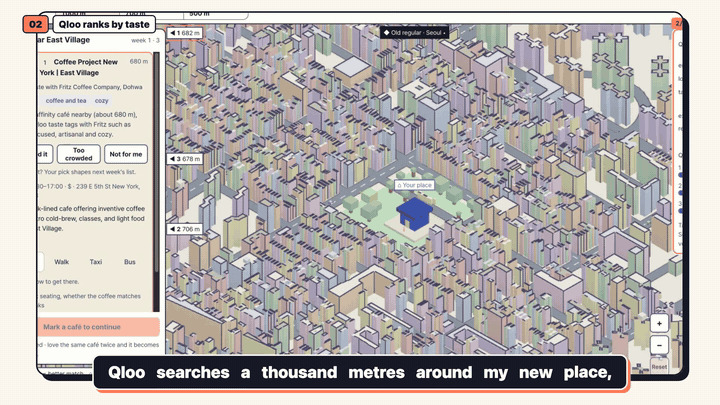
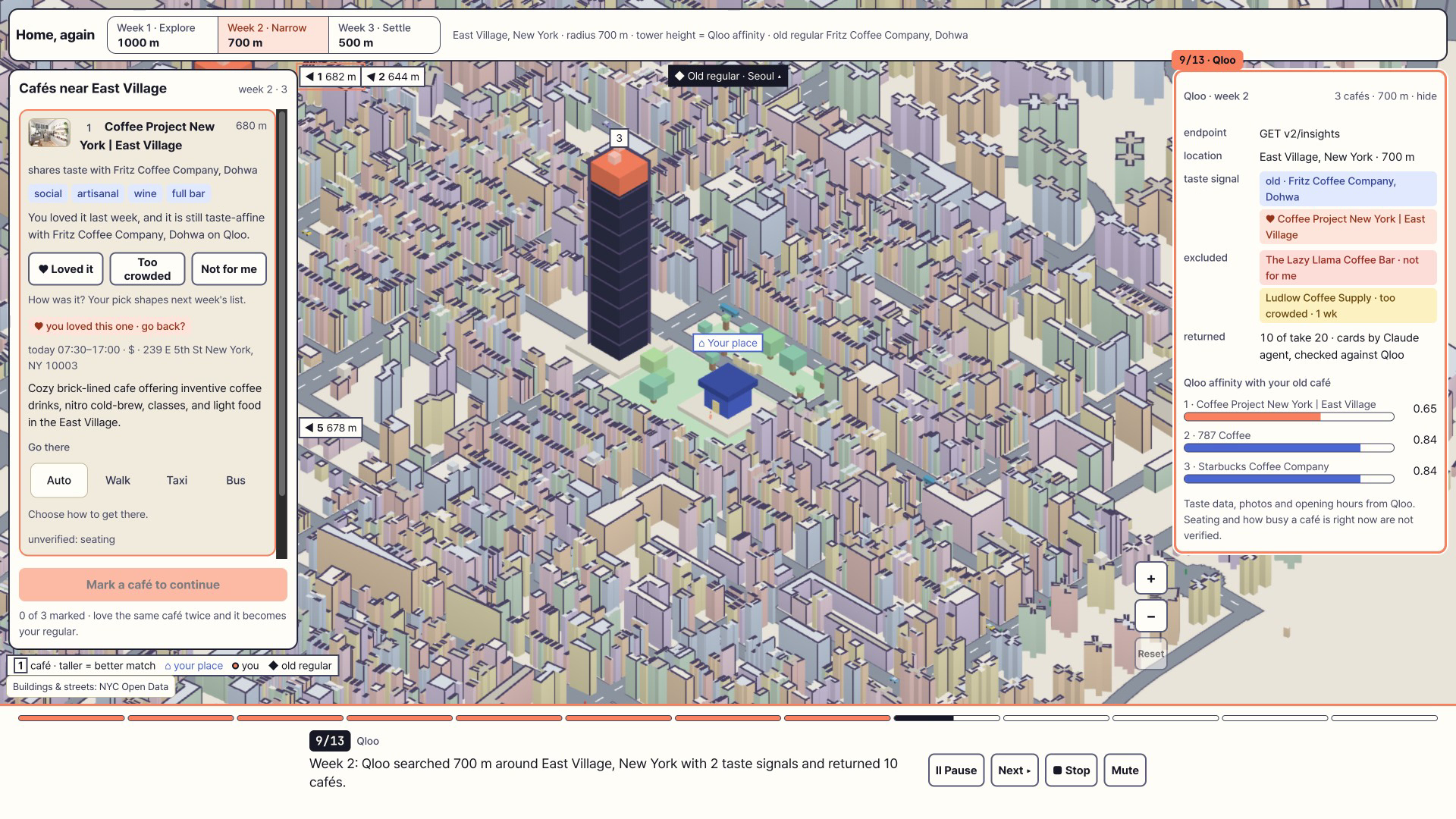
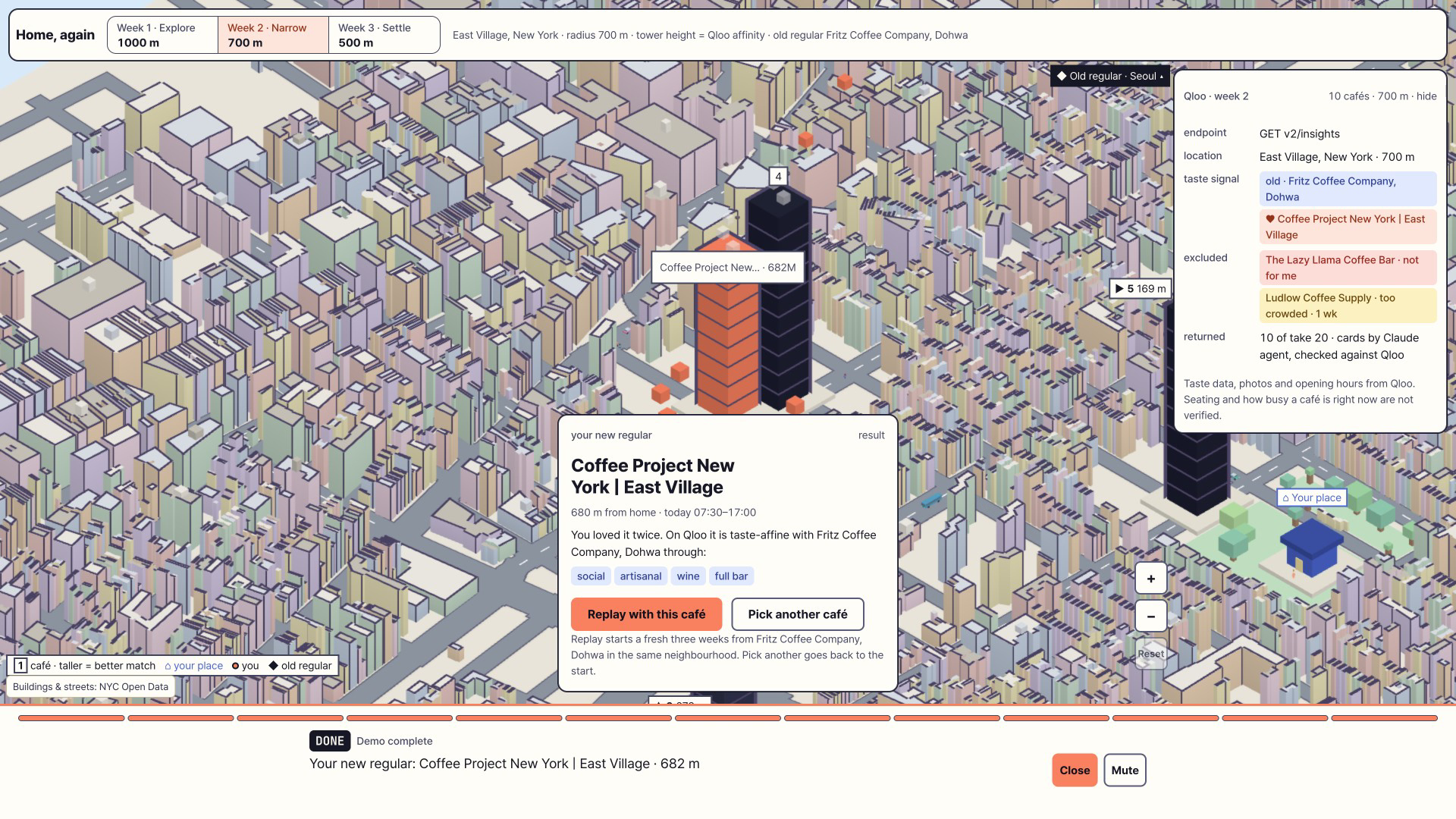
12 seconds from the narrated demo: Qloo ranks cafés by taste, and each card says why it matches.
-
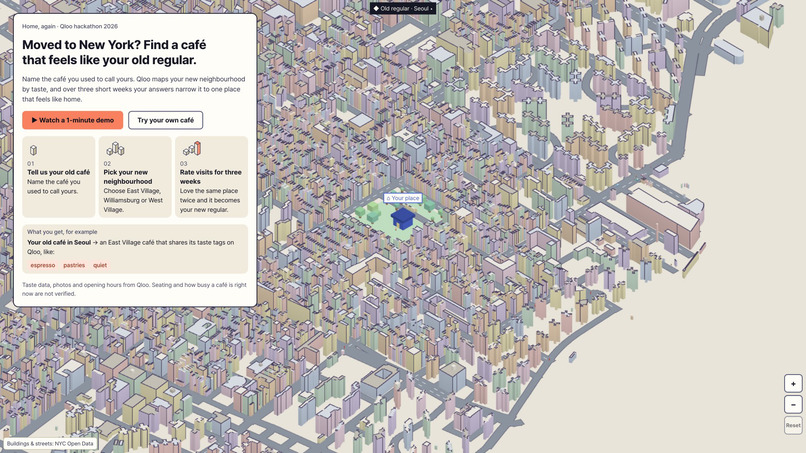
Start: the real East Village from NYC Open Data, with how it works in three steps.
-
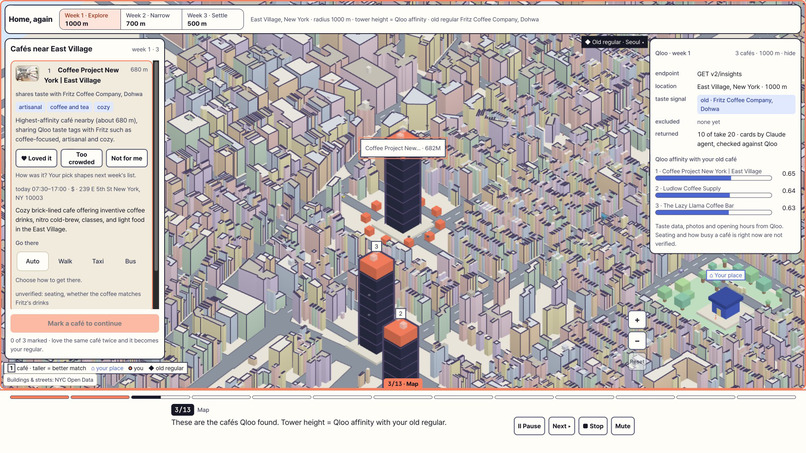
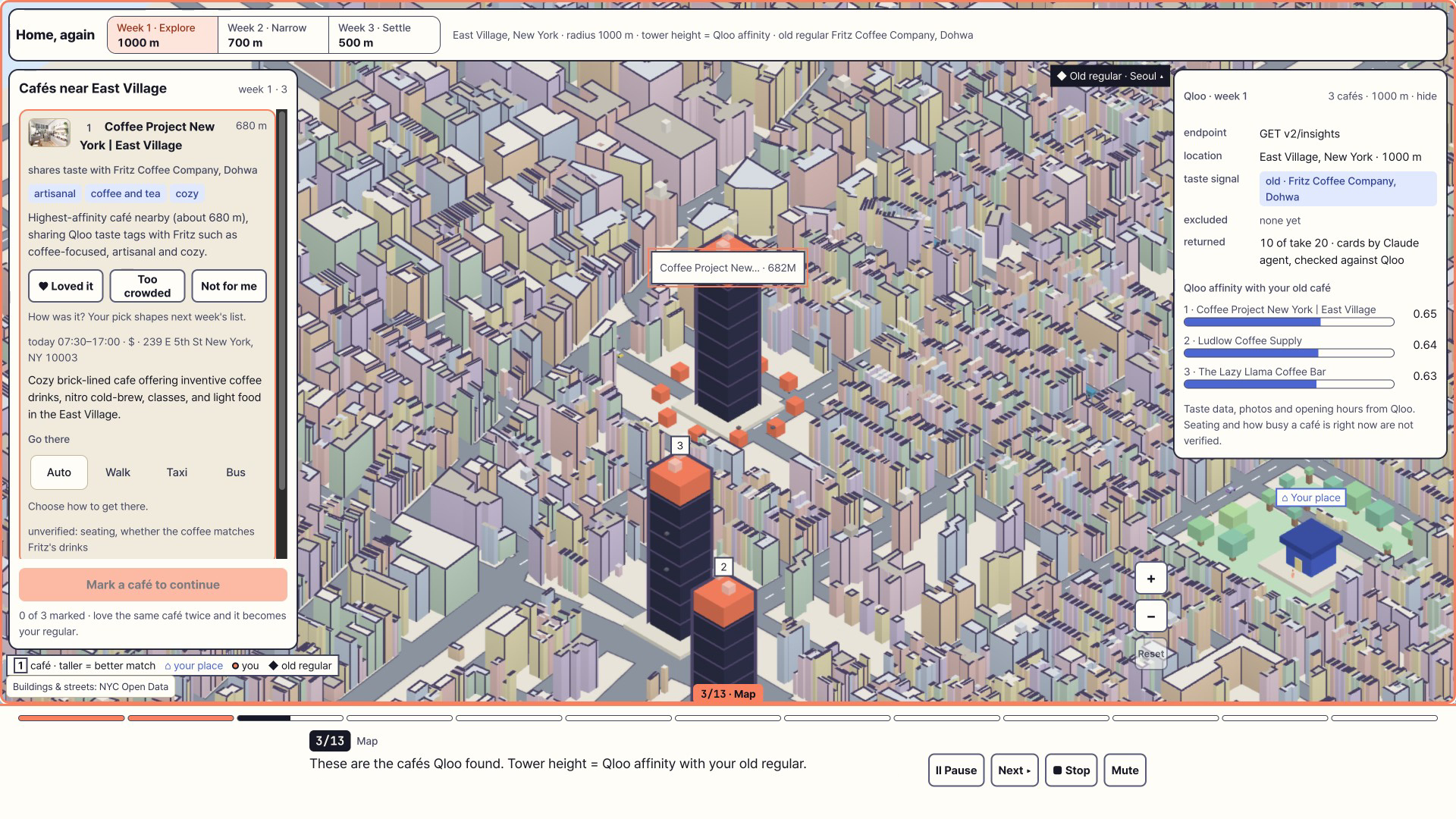
Cafés Qloo found stand as towers; taller means closer in taste to your old regular.
-
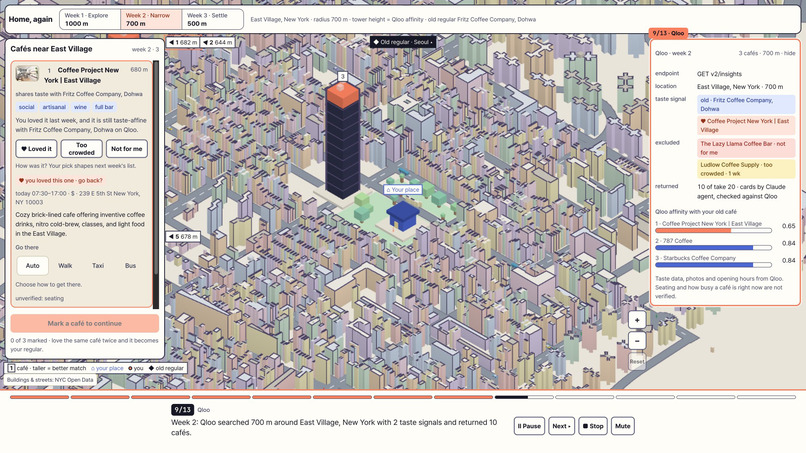
The live Qloo request: your loved café joins the taste signal, rejected ones are excluded.
-
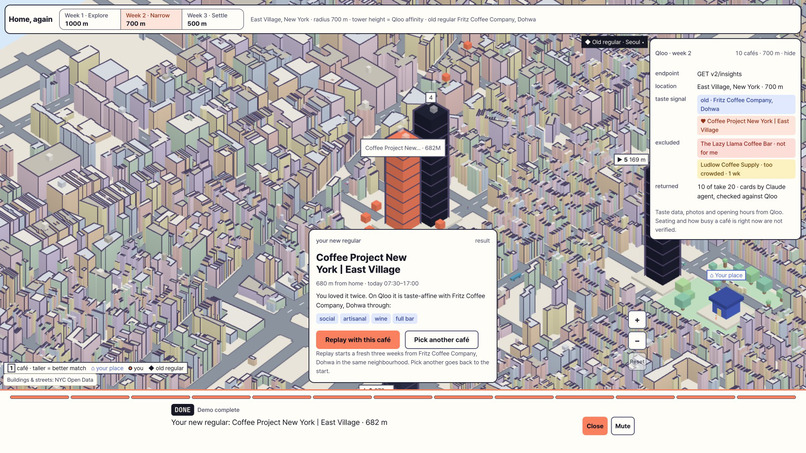
Loved twice: your new regular, with the taste tags it shares on Qloo.
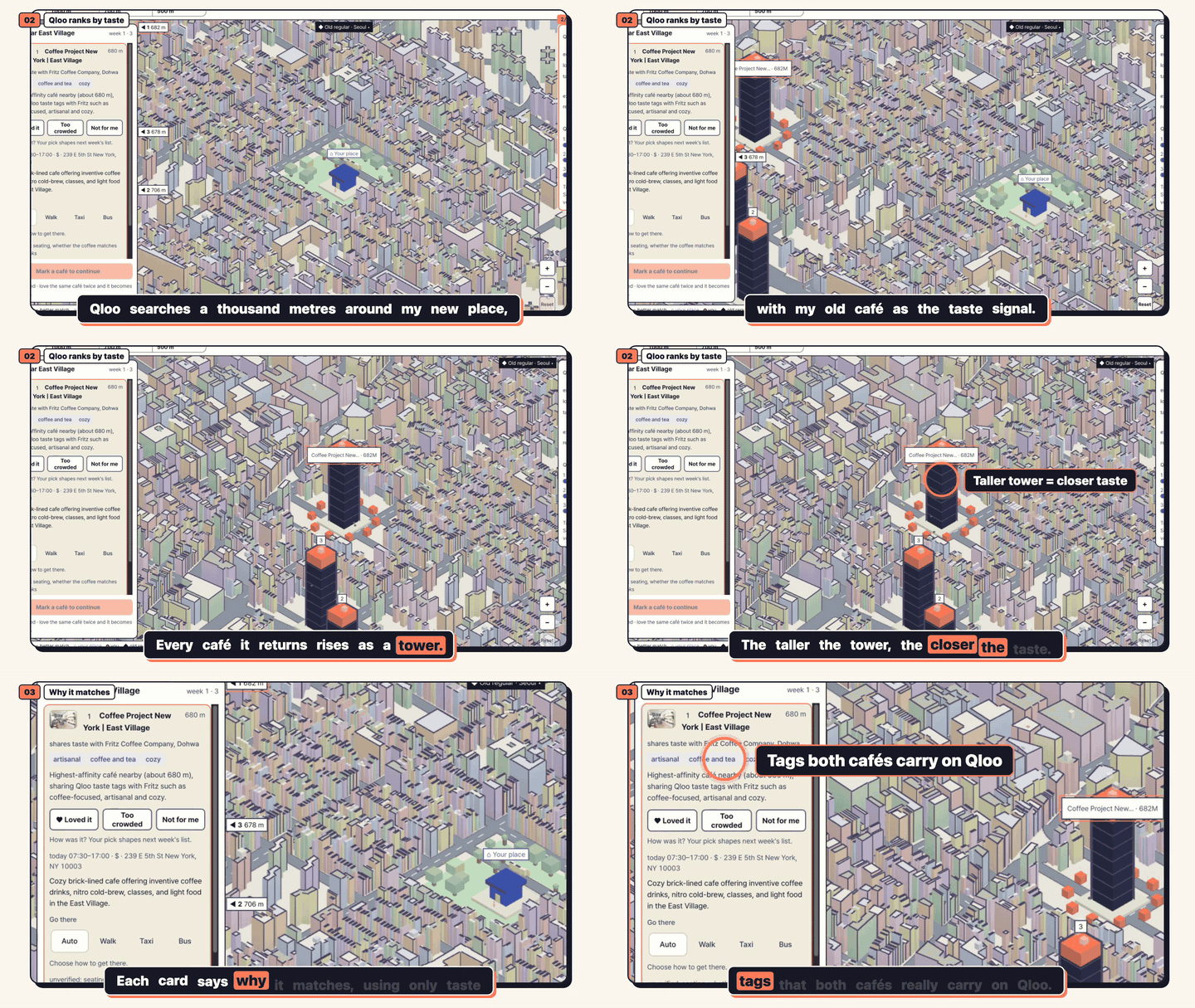
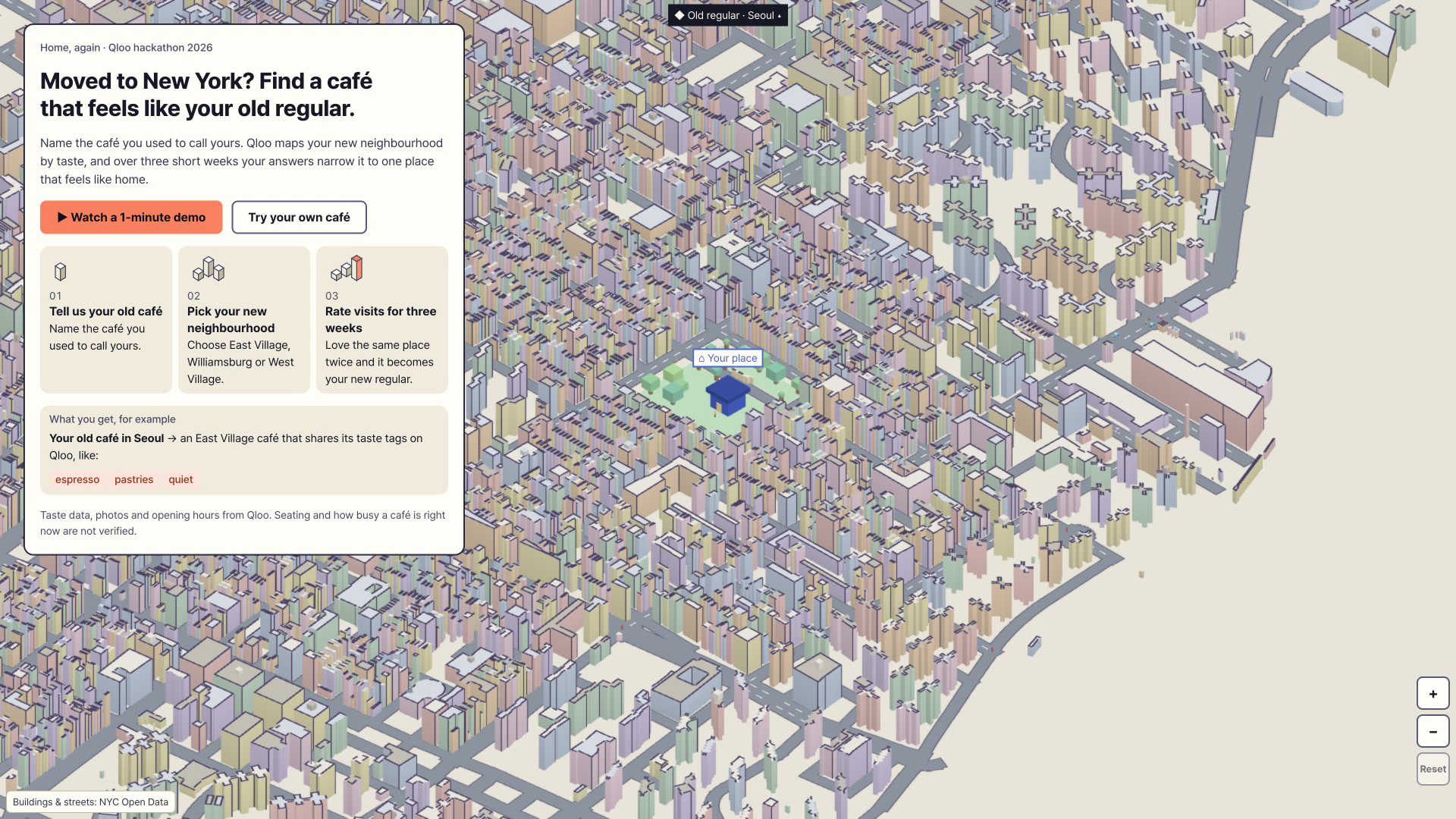
▶ Watch the narrated 1:30 demo video, or try it live at home-again-gamma.vercel.app.
Inspiration
Moving cities means losing your regular café. Map apps list every café nearby, but none says which one will feel like the place you left.
How to judge it in 60 seconds
Press ▶ Watch a 1-minute demo: a narrated three-week journey on real Qloo data. Tower height is each café's Qloo affinity with your old regular, the Qloo panel shows the exact request behind every round, and the verdict buttons change the next request.
What it does
Tell us the café you left behind and your new block, and Home, again finds the café there that tastes like it, and shows its work.
- Enter the old café (name plus city); Qloo
/searchresolves it. Pick a new neighbourhood: East Village, Williamsburg or West Village. - A 3D map of the real neighbourhood appears, built from NYC Open Data building footprints and street centerlines stored with the app (no map key). Each café Qloo suggests stands as a tower with height equal to its Qloo affinity with your old café. Tap a tower for its card: taste tags both cafés share on Qloo, plus Qloo's photo, today's hours, price, a short description and distance. Your character walks or rides there by taxi or bus along the real streets.
- Give a verdict on each card: Loved it, Too crowded or Not for me. Loved cafés join the taste signal for the next Qloo request; crowded ones sit out a week; rejected ones are gone for good. The search circle tightens each week (1000 m, 700 m, 500 m), and an empty round offers to look 1500 m out. Love the same café twice within three weeks and it becomes your new regular.
Three things make the recommendations checkable. First, every reason on a card is checked by code: each cited taste tag must be one both cafés carry on Qloo, crowd and payment tags are excluded from cards, claims about what other people like are rejected, and the card's café must be one Qloo returned this round. After two failed answers the app falls back to Qloo's top three by affinity. Second, a live panel shows the exact Qloo request behind every round: endpoint, radius, taste signal, exclusions with reasons, cafés returned and top affinity. Third, your verdicts change the next request, so the panel reads differently in weeks two and three.
How we built it
- Next.js on Vercel with two server routes; journey state lives in the browser, validated with zod on every request.
- Qloo
/searchresolves the old café;/v2/insightswith five café genre ids, a point location plus radius, taste signals and exclusions returns 20 candidates per round with affinities. - A Claude Haiku agent (
claude-haiku-5-5) callsfind_candidates, thensubmit_cards; code validates every card before display. - Qloo answers cache for 24 hours; calls cap at 8 per session and 300 per day; each session gets 6 model rounds before the deterministic fallback.
- The map is three.js over stored NYC Open Data snapshots (
public/geo, built byscripts/fetch-geo.mjs), with a flat top-down fallback for missing WebGL or reduced motion. The interface follows a locked friendly-pastel kit. - 404 Vitest tests cover journey rules, the validator, street routing and the guided demo.
- If Qloo is unreachable during the guided demo, it offers to finish on clearly labelled sample data instead of stopping.
Challenges
- Café genre ids need exact values: a guessed id returns an empty list with HTTP 200 instead of an error. We confirmed the ids against
/v2/tagsbefore building on them. - Each Qloo place carries around a hundred tags, many about crowds or logistics. We restricted taste links to eleven ambience, decor, drinks and menu types, so a card never claims anything about people.
- Distances are recomputed in code from coordinates rather than read from Qloo's response, so the card and the map always agree.
What we learned
Qloo owns the candidates and evidence; the model only chooses and explains. The validator, not the prompt, keeps the explanation honest.
What's next
- More neighbourhoods and free-text locations.
- Seating and live busyness, which Qloo does not carry today.
- A taste-bridge view that draws old café → shared tags → new regular.
Built With
- anthropic
- claude
- next.js
- nyc-open-data
- qloo
- react
- three.js
- typescript
- vercel
- vitest
- zod

Log in or sign up for Devpost to join the conversation.