Inspiration
Over 55 million people live with dementia. Most are cared for at home by family. One of the hardest moments is when someone you love looks at you across the dinner table and isn't sure who you are.
Reminiscence, meaning looking back at real photos, songs and stories, is one of the most widely used non-drug approaches in dementia care. But doing it well takes a trained person, a box of photos and a free afternoon. Families rarely have all three. The apps that do exist are mostly brain-training games with scores, so the person keeps failing tests. We wanted something closer to a quiet visit home: built from their life, in their family's voices, with nothing they can get wrong.
What it does
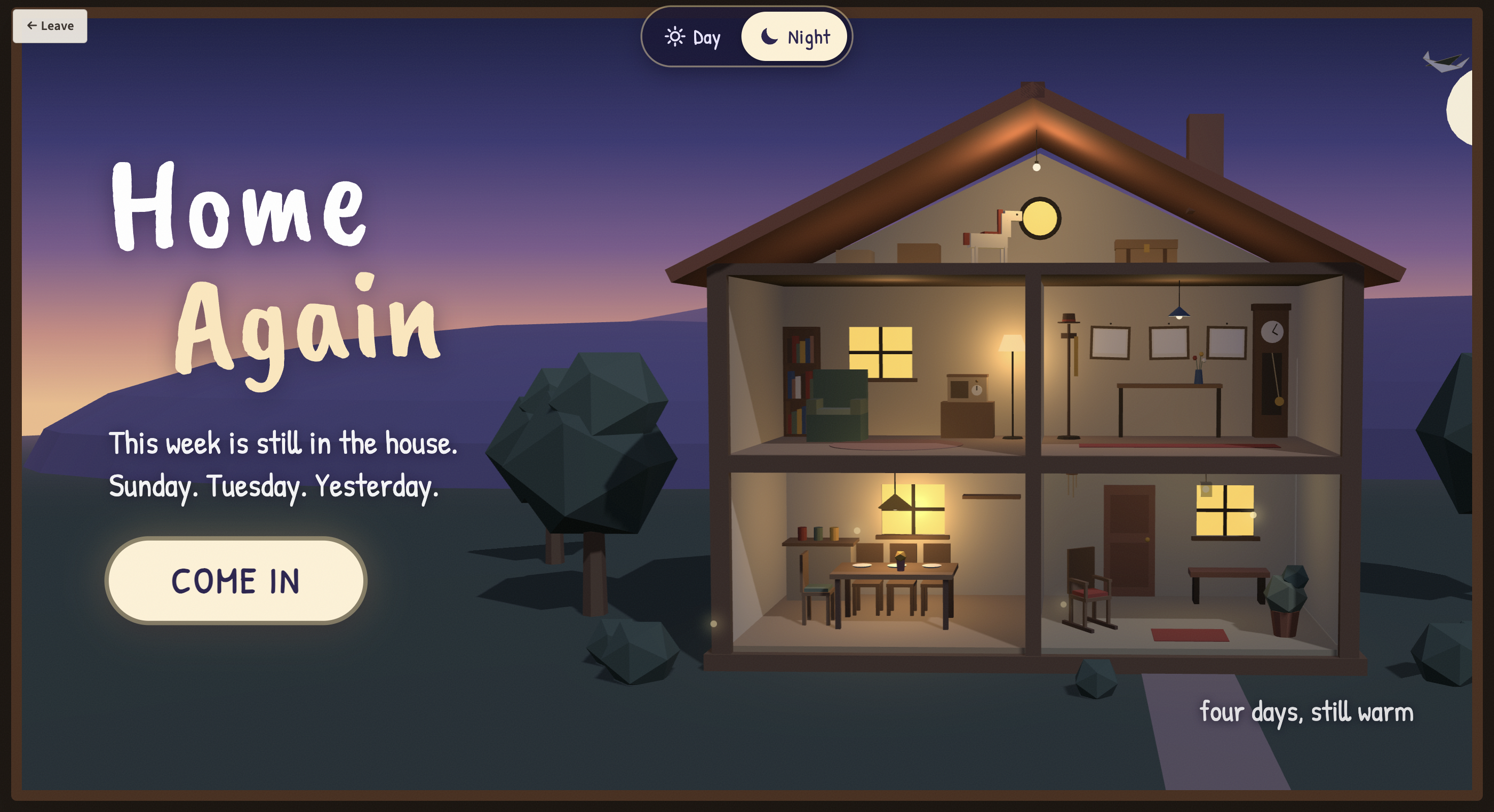
Home Again turns a family's memories into a gentle, playable house.
- Setup is a conversation. A family member chats with an AI guide powered by Gemini that walks through their loved one's life story one warm question at a time. It looks at uploaded photos, picks out and remembers faces, collects a meaningful song and short voice messages, and asks early on whether anything should be avoided.
- Each room holds one kind of remembering:
- Kitchen: seat family members around the table by their faces. A wrong tap gets a kind hello from the person tapped, not an error.
- Radio: turn the dial until their song comes in.
- Porch: talk about a photo; their story is recorded for the family.
- Attic: lay three photos out from earlier to later. Every order is accepted.
- Today: a family letter, read aloud in warm, natural voices (real family recordings, or voices made with ElevenLabs), plus a simple journal of the day.
- The album grows as they play. Every room they finish adds a page with its photos, and everything is kept safely in TigerData.
- Calm by design: no scores, no timers, nothing to fail, big tap targets, captions on every voice line, and a dusk mode for late afternoons.
- The family gets a gentle view of how play is going. Snowflake turns quiet play events into weekly trends (who's found easily at the table, when things get harder), and Snowflake Cortex writes a plain-language summary. These are trends, not test results.
How we built it
Gemini: the guide and the game builder
- A family member sets everything up by chatting with a Gemini-powered guide. Following a life-story interview structure, it asks one warm question at a time and looks at each uploaded photo to react to what's really in it. It also listens to voice messages and saves what it learns through tool calls: people, photos, songs, stories, and anything to avoid.
- When the album is ready, Gemini turns everything the family shared into the game's content (kitchen seating, the radio song, the porch photo, the attic order and the family letter) using a strict JSON schema. The model writes content ahead of time, but it never talks to the player live.
ElevenLabs: warm, natural voices
- We used ElevenLabs to generate the narrator's lines and the demo family's voices as pre-recorded clips. Every line the player hears sounds calm, slow and human, never robotic.
- Real family recordings take priority wherever the family has them, and the browser's built-in speech is the fallback, so a voice moment never fails silently.
TigerData: the family's album, safely shared
- The album, the guide conversation, the built game and the player's journal live in TigerData (hosted Postgres) as JSON documents, one row per family.
- Every album change runs in a transaction that locks that row. The guide, the album page and a shared upload link can all edit at once without overwriting each other, across any number of servers.
- We connect over verified TLS using TigerData's own certificate authority rather than turning verification off. Photos and voices go to an S3-compatible bucket, with only their paths stored in TigerData.
Snowflake: gentle insights for the family
- While the player moves through the house, the game logs quiet play events, such as how long it takes to find each person at the table, skips and time of day. These stream into Snowflake through its SQL REST API.
- Snowflake rolls them up into weekly trends, and Snowflake Cortex writes a short, plain-language summary for the family. That gives an ongoing view of how play is going without ever testing the person.
Everything else
- Front end: vanilla HTML, CSS and JavaScript with no build step. A three.js dollhouse is the home screen, and the camera glides into rooms on a fixed path so the player never has to steer.
- Faces: face-api runs in the browser to detect and match family faces in photos.
- Server: a small Node server keeps all API keys off the browser.
- Offline fallback: without the cloud services, everything falls back to local files, so the demo still runs offline.
Built with: Gemini · ElevenLabs · TigerData · Snowflake (Cortex) · three.js · face-api · Node.js · JavaScript
Challenges we ran into
- Keeping the AI away from the player. People living with dementia shouldn't be exposed to the mistakes generative AI can make. We set a firm rule: Gemini works for the family, ahead of time. Everything the player hears is stored, structured content (pre-generated ElevenLabs voices or real family recordings), and every voice moment has a fallback.
- Designing out failure. Matching faces at a table looks like a quiz. We spent a lot of time on wording and flow so a wrong tap becomes a warm reunion instead of a mistake.
- Concurrent edits. The guide, the album page and a shared upload link can all change the same family album at once. We solved it with transactional, row-locked updates in TigerData.
- Insights without scores. Logging play for Snowflake without turning it into a test meant choosing carefully which events to keep, and asking Cortex to describe what happened, never how well.
- Real-world infrastructure: TigerData's own certificate authority, which we chose to trust explicitly rather than turn verification off; database connections that hung on event Wi-Fi; and speech recognition that's unreliable on some tablets.
Accomplishments that we're proud of
- It feels like a place, not an app: a warm house, real photos and real voices.
- A family can go from an empty album to a playable, personalized game just by having a conversation with Gemini.
- Four platforms work together as one product: Gemini understands the family's story, ElevenLabs gives it a voice, TigerData keeps the album safe and shared, and Snowflake turns play into gentle insight.
- We got safety right by construction: no scores, no live AI, family approval of what the player sees, and an "avoid" list gathered before anything else.
What we learned
- In healthcare, the most important design choices are often what you don't build: no assessment, no free-form chatbot, no surprises.
- Constraining an LLM with schemas and tools makes Gemini far more trustworthy than prompting alone.
- Voice matters enormously for older adults. A calm, natural ElevenLabs voice holds attention in a way robotic text-to-speech never does.
- A real database matters even for a hackathon. Once several people edit one album, TigerData's transactions stop a lot of quiet data loss.
- Measuring engagement without testing the person is a real design problem. Snowflake and Cortex let us show trends in kind words instead of numbers that feel like grades.
What's next for Home Again
- Testing with real families and memory-care staff, measuring mood, engagement and caregiver-reported calm rather than cognition.
- Memory-care facilities: activity staff run reminiscence sessions every day. TigerData's one-row-per-family design and Snowflake's trends across many residents would let a single site run Home Again for everyone in its care.
- Family voices with consent: use ElevenLabs to let a family member record a few lines once and have new letter pages read in their own voice.
- A growing album: family replies and new photos arrive as new pages, so there's always something fresh.
- More rooms and life chapters, such as childhood, young adulthood and family life, alongside "this week."
- Privacy hardening: clear consent flows, one-tap delete, and options that keep the data on the device.
Built With
- anthropic
- elevenlabs
- face-api
- gemini
- javascript
- node.js
- snowflake
- three.js
- tigerdata

Log in or sign up for Devpost to join the conversation.