Inspiration
The concept for HoloMind Narratives was born from the realization that our emotional states are often overlooked and unexplored, yet they have a significant impact on our creativity and the way we view the world. I wanted to create a platform that turns internal feelings into interactive experiences using a combination of storytelling, AI and 3D visualization. Drawing on concepts from emotional AI, narrative psychology and immersive games, we wanted to develop an application that would allow users to experience their feelings in a dynamic environment, making introspection, creative expression and emotional consciousness concrete and entertaining.
What it does
HoloMind Narratives is a AI based emotion driven narrative creator that:
- Uses NLP and affective computing techniques to extract emotions from written text or voice.
- Produces narratives that mirror emotional states of the user.
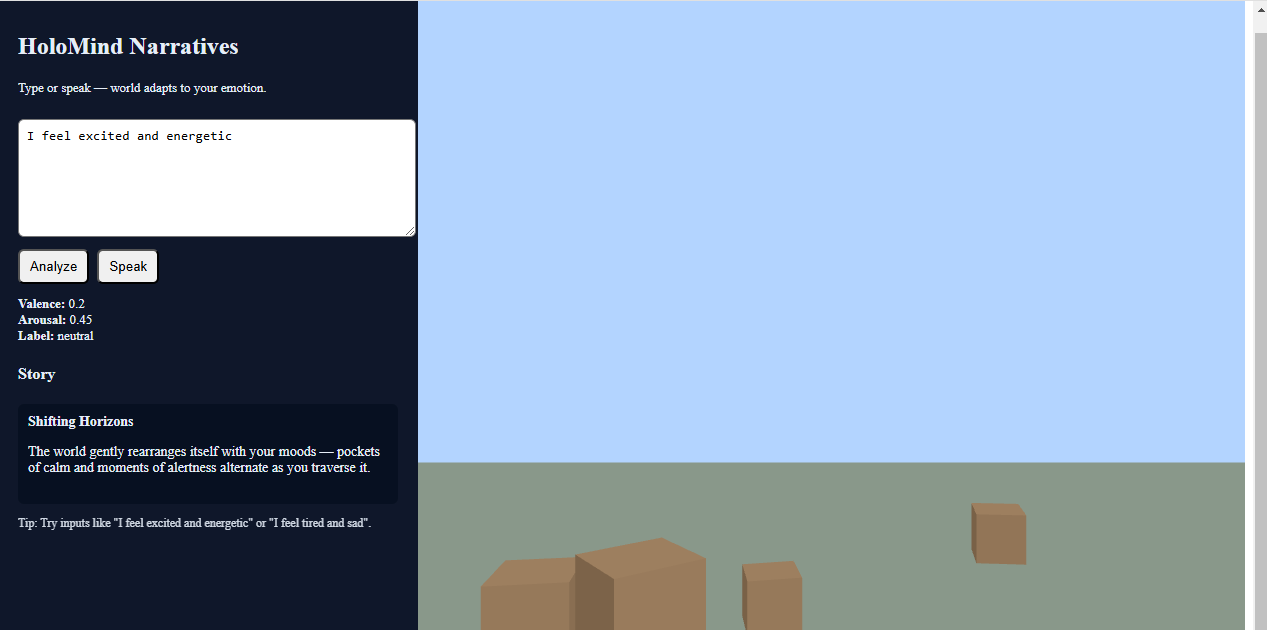
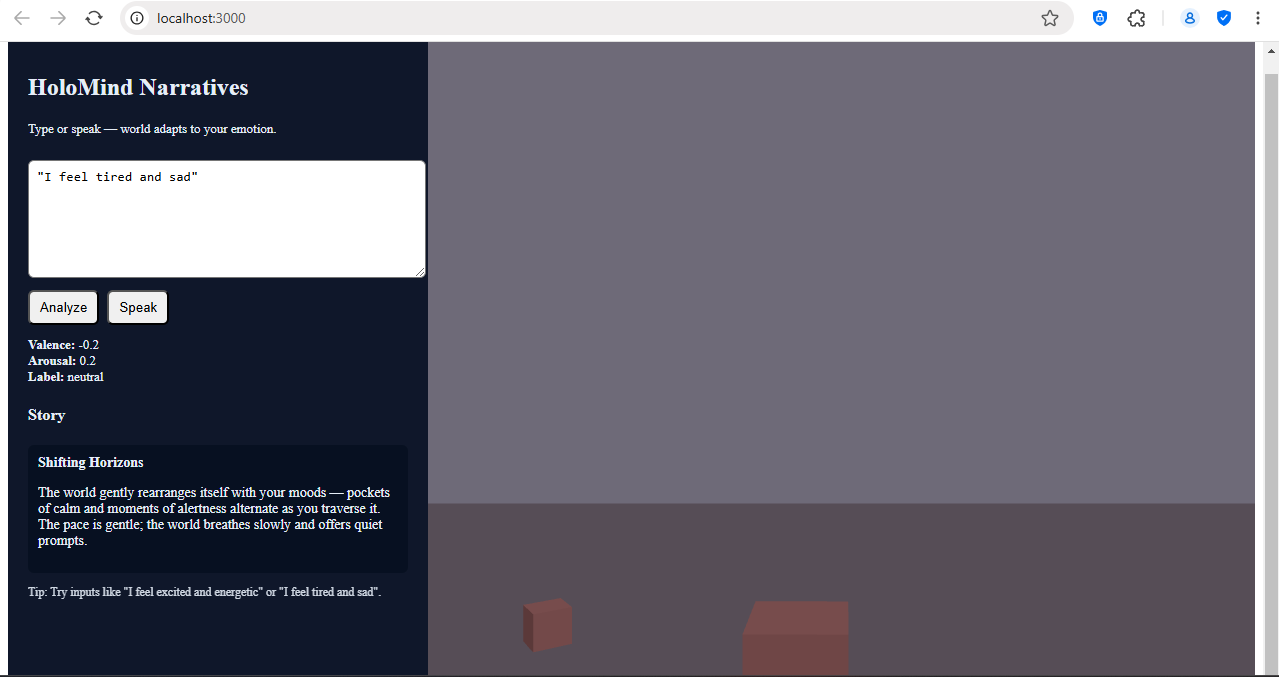
- GENERATES 3D ADAPTIVE WORLDS where environments, lighting, colors and even objects, change according to your mood.
- Like user’s mood, the world is allowed to evolve and change because this video is set to emotion change over time.
- “It’s a one-of-a-kind emotional experience that connects technology, storytelling and self-reflection.”
How we built it
We built HoloMind Narratives employing a full-stack methodology.
Backend (Python / FastAPI):
- NLP & emotion detection:
TextBlob, custom sentiment mapping to valence-arousal space. - Story generation: embedded GPT-style language model for dynamic storytelling.
- Emotion-to-world mapping: generated parameters such as color, terrain, and object behavior, etc., for the frontend.
Frontend (Next.js / React / Three.js):
- 3D visualization: implemented dynamic worlds rendering in the browser with Three.js.
- UI: minimalistic output fields for writing/speaking your emotions with live story progress.
- State management: Uses React hooks to manage the history of emotions and interactively update the environment.
Integration:
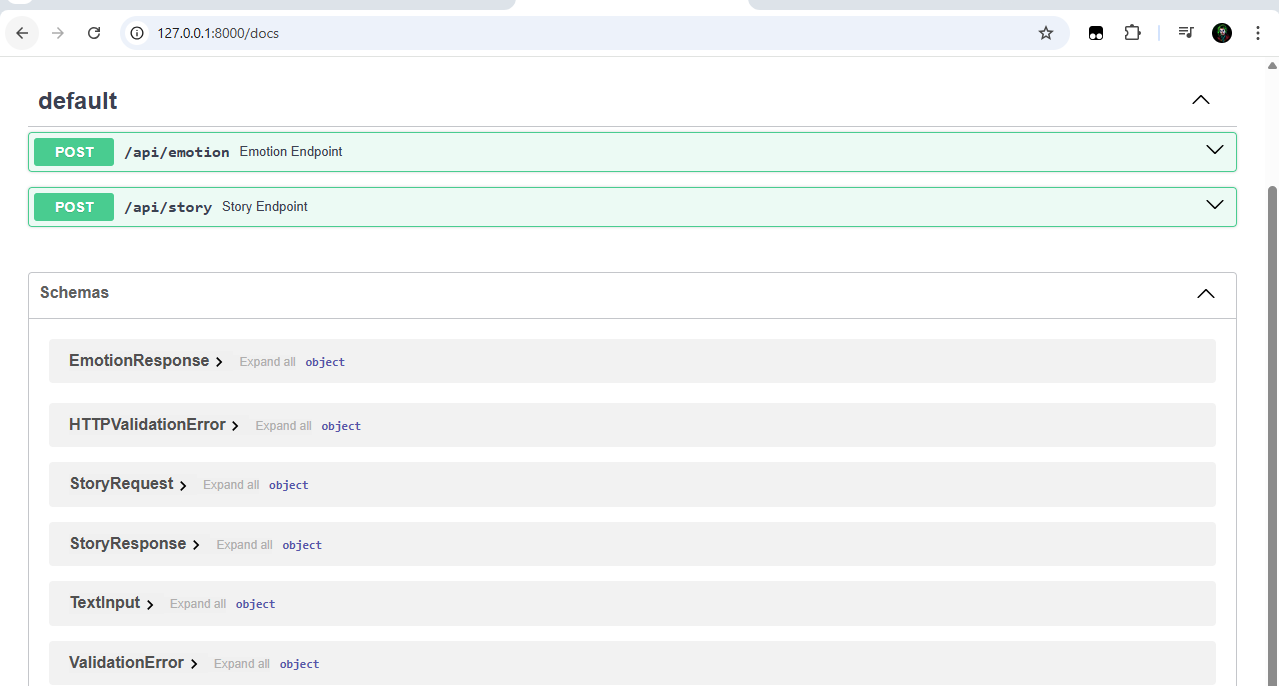
- API routes that connect the front end and the back end.
- A real-time feedback loop that guarantees instantaneous modification of story and setting.
Mathematically, we translate emotions to world parameters using: [\text{WorldParameter} = \alpha \cdot \text{Valence} + \beta \cdot \text{Arousal} + \gamma] where (\alpha), (\beta) and (\gamma) are adjustable parameters that encode the influence of emotions on visual features.
Challenges we ran into
- Emotion detection accuracy: NLP models occasionally misclassified subtle emotional perceptions. We fixed this by adding contextual checks to the valence-arousal mapping.
- Real-time 3D adjustments: We had to tweak Three.js rendering and React state management in order to patch the scene up smoothly, without lags.
- Story coherence: It was challenging to make dynamically generated stories make sense with multiple emotional inputs; we iterated on prompt engineering and context tracking.
- Cross-platform integration: The Python backend and JavaScript frontend integration demanded thoughtful API design and CORS configuration.
Accomplishments that we're proud of
- A full-stack AI system integrating emotion analysis, narrative generation and 3D visualization was successfully implemented.
- Created a real-time adaptive environment for interaction with typed and spoken emotions.
- A new technique for emotional storytelling was introduced that can be used in mental wellbeing, education and the creative arts.
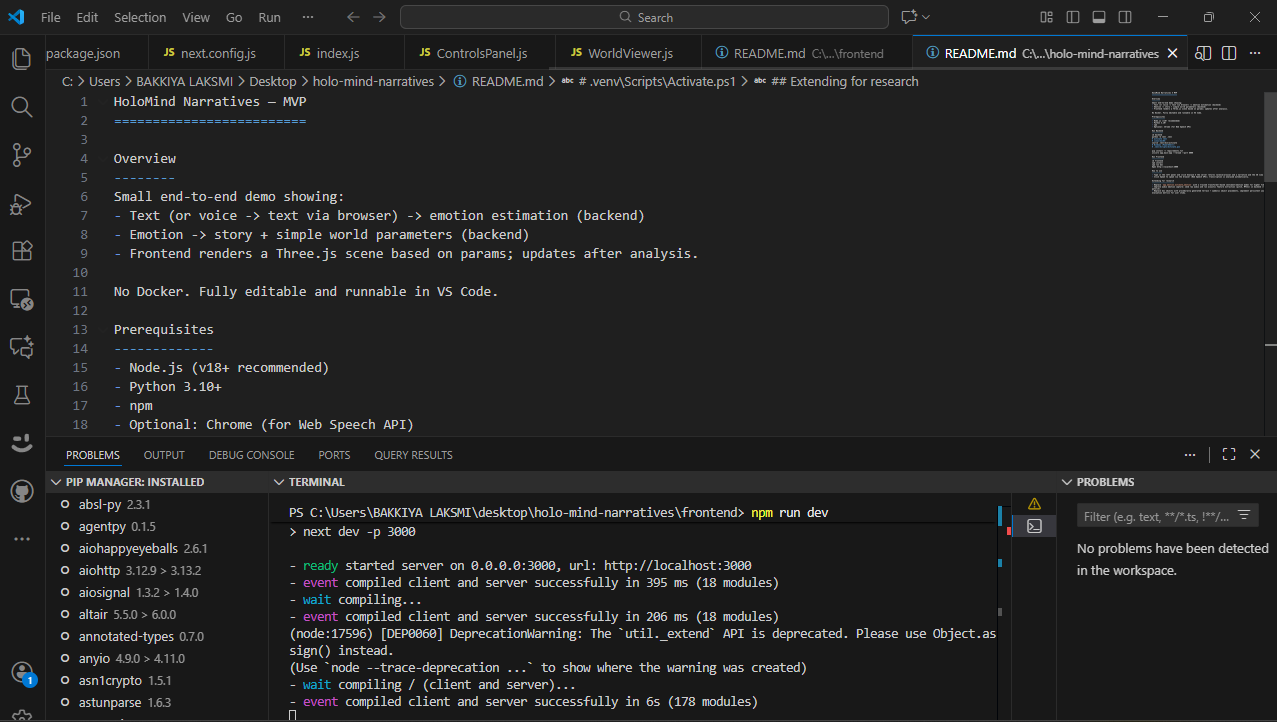
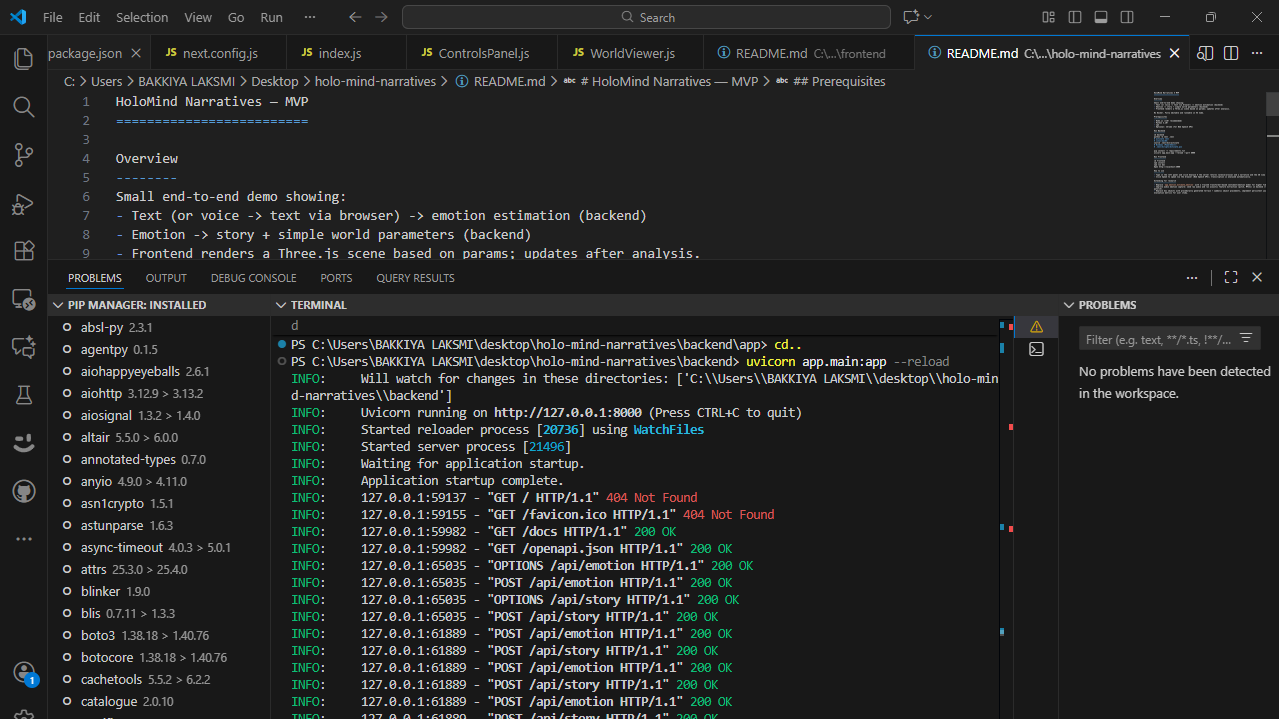
- No Docker/heavy local setup needed — runnable end-to-end in VS Code, with fluid user experience.
What we learned
- Integrating AI-driven NLP with frontend 3D visualization is possible without overly complex infrastructure.
- Emotional computation is nuanced — mapping valence and arousal to visual parameters requires careful tuning.
- Real-time systems benefit from optimized state handling and rendering pipelines.
- Collaboration between backend and frontend teams/tools can be simplified with RESTful APIs.
What's next for HoloMind Narratives
- Emotional Memory Graph: Monitor emotions on a timeline and affect world evolution in the long term.
- User Archetypes: Modify worlds according to common emotional patterns.
- Storytelling Layered: Multi-threaded stories reacting to several emotional vectors.
- Cognitive Wellness Scripts: Add guided reflections, exercises or affirmations depending on your mood.
- Mobile / AR Support: Allow HoloMind Narratives to run on mobile phones and AR devices for even more immersive experiences.
With these additions, HoloMind Narratives is poised to push the boundaries of interactive storytelling, weaving emotion, AI and 3D visualization in a way never before realized.


Log in or sign up for Devpost to join the conversation.