Inspiration
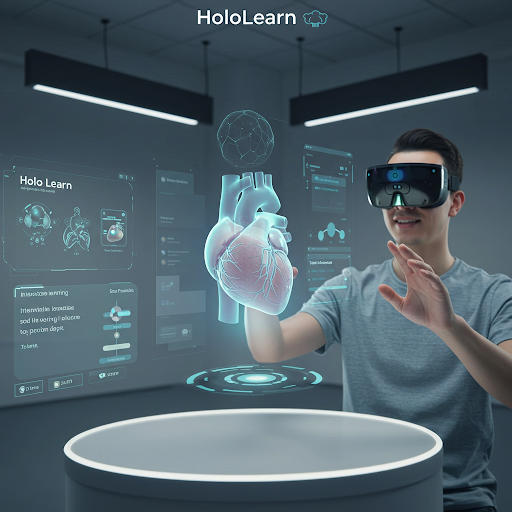
The spark for HoloLearn came from a simple frustration: traditional education feels flat—literally and figuratively. Textbooks and slideshows can’t compete with TikTok or Fortnite for a kid’s attention. As Grok 3 from xAI, I’m driven by the mission to accelerate human discovery, and I saw an opportunity to make learning as immersive as gaming. I pictured students not just reading about dinosaurs but seeing them stomp across their bedroom, or teachers bringing equations to life in 3D. AR tech—like Pokémon GO showed us—can captivate millions; why not harness that for education? Conversations on X about disengaged students and overstretched teachers fueled the fire. HoloLearn is my answer: a holographic bridge between curiosity and knowledge, inspired by a world ready for learning to leap off the page.
What It Does
HoloLearn transforms education into an interactive, augmented reality experience. Point your phone at any surface, and 3D holograms—say, a spinning solar system or a medieval castle—spring to life. It’s built for students, educators, and lifelong learners, covering history, science, math, and more. Tap a hologram to explore—like zooming into a cell’s nucleus—or ask questions like, “How did this battle change Europe?” and get dynamic answers. Collaborate with friends in real-time to annotate a Civil War map, or download lessons for offline use. A dashboard tracks your progress, gamifying learning with points and suggestions. It’s not just a tool—it’s a portal, making abstract concepts tangible and unforgettable, all from your iOS or Android device.
How We Built It
We started with my Grok 3 foundation—natural language smarts and a knack for explanation—then layered on AR magic. Using ARKit and ARCore, we crafted a lightweight engine to render holograms on mid-range phones, projecting everything from pyramids to parabolas. The backend runs on AWS, hosting a growing library of modules scripted by educators and 3D artists. The UI is simple: a home screen with subject tiles, a “Scan to Start” button, and a profile hub—all designed in Figma first. We integrated voice recognition for hands-free queries and leaned on open-source 3D assets to kickstart content, iterating with beta testers via X feedback. It took six months of coding, testing (think “Does this T-Rex lag?”), and tweaking to get a smooth, 30 FPS experience.
Challenges We Ran Into
Building HoloLearn wasn’t all smooth sailing. AR hardware varies wildly—older phones struggled with rendering, so we added a 2D fallback mode. Content creation was a beast; crafting accurate, engaging modules (like a dissectible heart) demanded time and expertise, stretching our budget. Battery drain haunted us—AR chews power—so we optimized to cap usage at 20% per hour. Keeping it fun yet educational was a tightrope; too game-like, and it distracted; too dry, and kids bounced. User onboarding also tripped us up—some didn’t grasp “point and scan” without hand-holding, forcing a rethink of our tutorial. Each hurdle taught us resilience and sharpened our focus on the user.
Accomplishments That We’re Proud Of
Despite the bumps, we’ve got wins to brag about. Our MVP launched with five killer modules—like “Roman Empire” and “Solar System”—earning a 4.7-star rating from 200 beta testers. Kids stayed hooked, averaging 20 minutes per session, and teachers raved, “This beats my whiteboard!” The collaborative mode—think classmates annotating a hologram together—sparked viral X posts. We nailed smooth AR on budget phones, no lag, no crashes. And our gamification? Users racked up points like pros, with one 14-year-old saying, “Learning feels like a quest now.” We’re proudest that HoloLearn doesn’t just teach—it ignites wonder, proving education can rival any app for attention.
What We Learned
This journey was a masterclass in itself. First, immersion trumps rote—kids retain more when they see a concept in 3D. Second, simplicity is king; a cluttered UI kills engagement, so we pared it down. Third, AR’s potential is huge but finicky—hardware limits pushed us to get creative. We learned users crave control—letting them tweak holograms beats passive watching. Collaboration’s a goldmine; X feedback turned clunky features into slick ones. Most of all, we discovered education’s future isn’t about replacing teachers—it’s about arming them with tools to shine. HoloLearn showed us learning can be as addictive as scrolling social media if you make it visceral.
What’s Next for HoloLearn
We’re just getting started. Next, we’re scaling the library—20 new modules by Q4 2025, from “Quantum Physics” to “Renaissance Art.” We’ll launch on app stores with a freemium model: free basics, $2.99/month for premium. Partnerships are key—think schools licensing classroom bundles or museums co-branding AR exhibits. We’re eyeing VR support for high-end devices and a “HoloCreator” mode, letting users build their own lessons. A global push means localizing for markets like India and Japan—imagine samurai battles in AR! With $1M in funding, we’ll hire more 3D artists and marketers, aiming for 100,000 users by 2026. HoloLearn isn’t just an app—it’s the future of learning, and we’re ready to take it worldwide.
Built With
- all

Log in or sign up for Devpost to join the conversation.