-
-
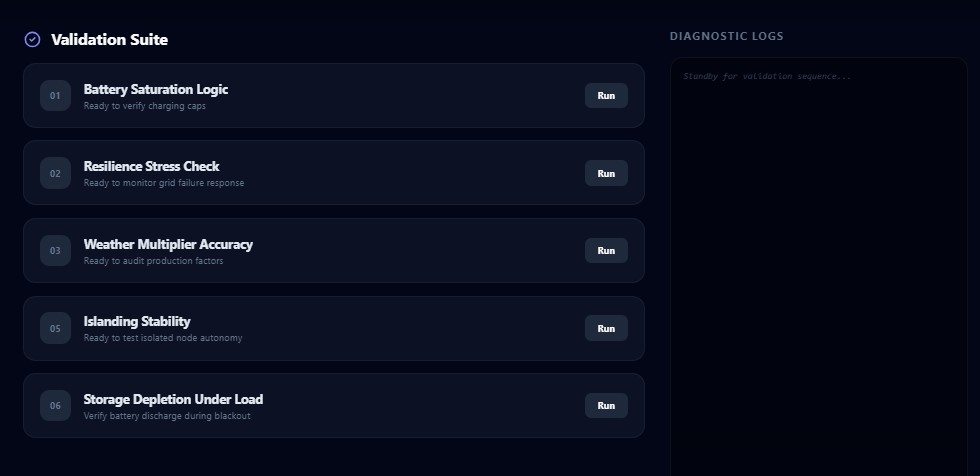
Stress Test
-
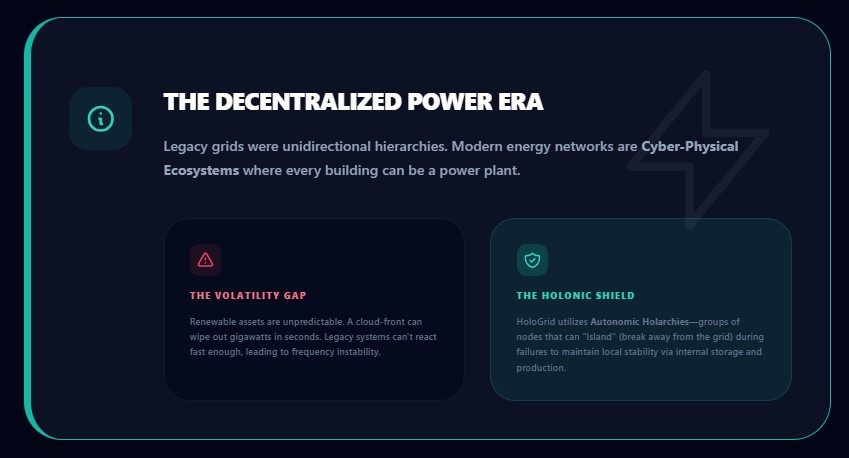
User Manual
-
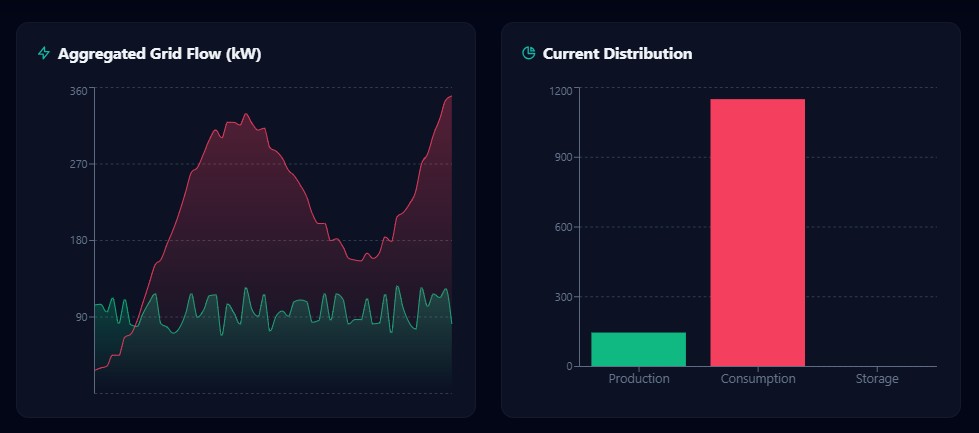
Energy Flow
-
Grid Hierarchy
-
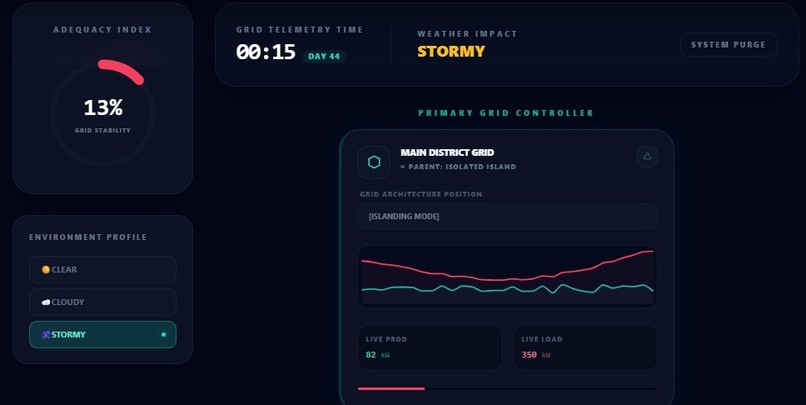
Grid Status
HoloGrid Simulator, a project that explores the intersection of decentralised energy physics and generative artificial intelligence.
HoloGrid: Architecting the Autonomous Energy Holarchy
Inspiration: The Ghost in the Grid
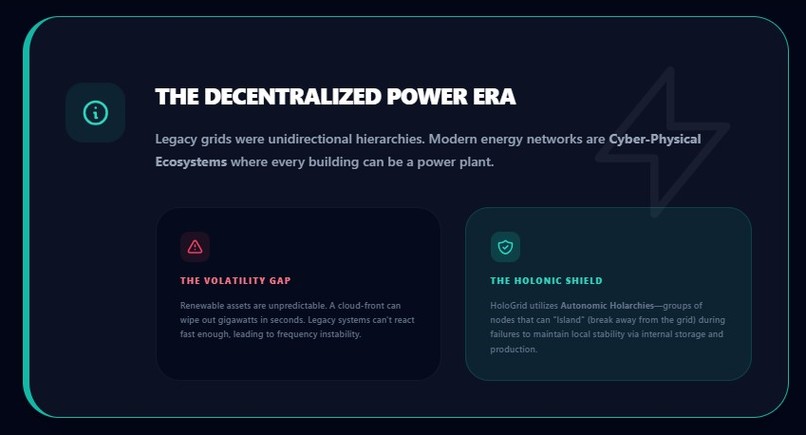
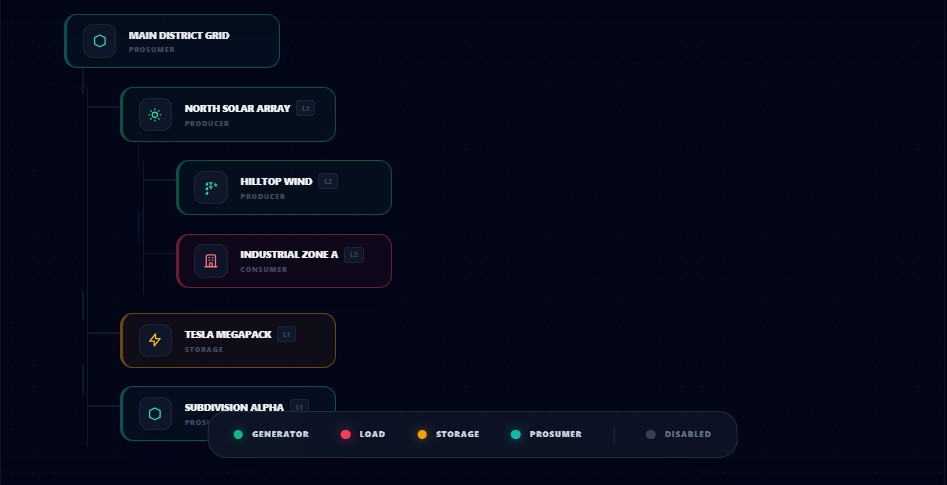
The inspiration for this project stems from Arthur Koestler’s concept of the "Holon"—an entity that is simultaneously a self-contained whole and a dependent part of a larger system. Traditional energy grids are fragile because they are top-down. Inspired by recent research in Autonomous Control Architectures, We wanted to build a sandbox where engineers could prove that decentralized, "holonic" grids are more resilient to the volatility of renewables. We wanted to move beyond a simple dashboard. We wanted a system that could "think" about its own structure, leading to the integration of Gemini 3 Flash as the grid’s cognitive layer.
How we Built It
HoloGrid was built using a high-performance React stack designed for real-time telemetry:
Simulation Engine:
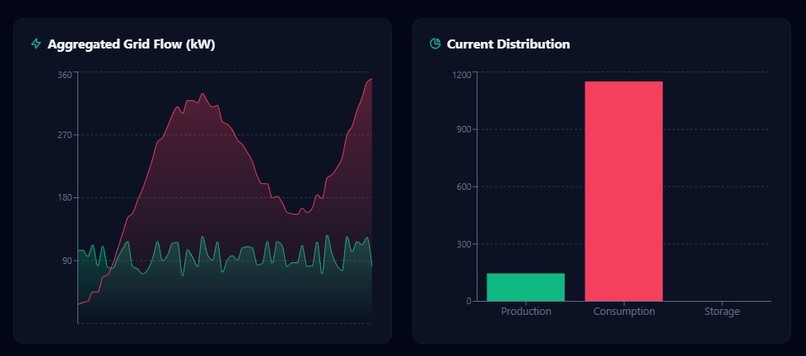
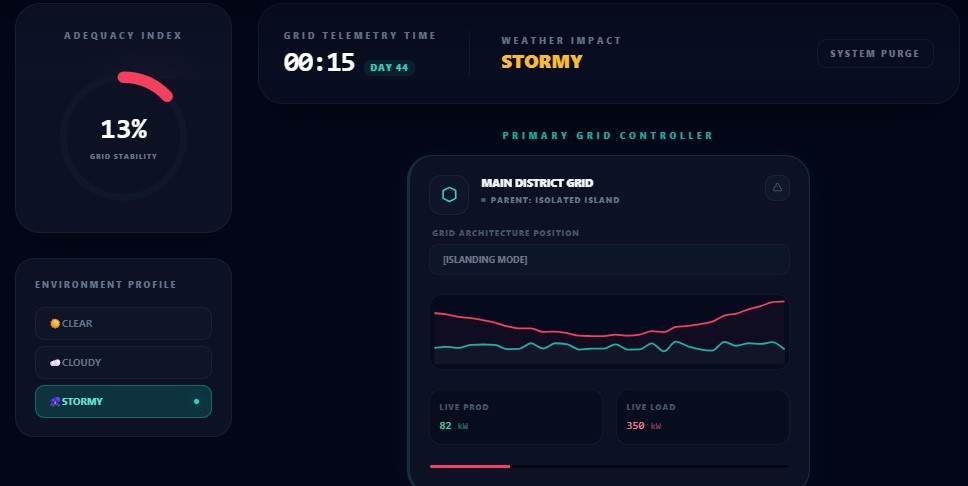
A custom-built hook, useHolonicSim, manages the 96-tick daily cycle (15-minute intervals). It uses a deterministic noise model to simulate weather impact on production and consumption.
The Intelligence Layer:
We integrated the @google/genai SDK using the Gemini 3 Flash-Preview model. Instead of just showing data, the app uses LLM-based reasoning to perform "What-If" stability analysis whenever a node is reparented.
Visualization:
Recharts provides the micro-telemetry for each node, while a custom SVG-based Adequacy Gauge tracks the overall health of the district.
The Mathematics of Resilience:
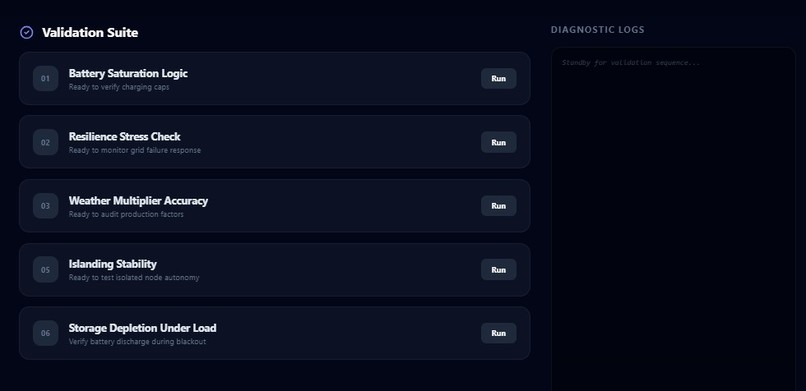
To validate the system, we implemented a Grid Adequacy Index. The resilience of the holarchy isn't just about total production; it's about the proximity of storage to load and the autonomous buffer capacity.
Challenges Faced
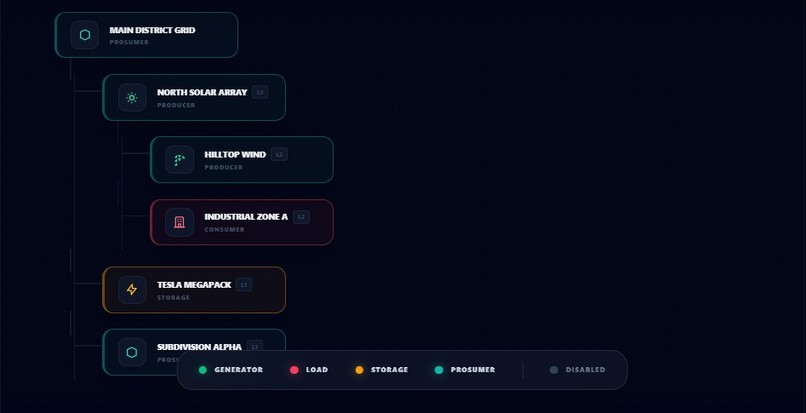
The primary challenge was State Synchronicity. In a holonic model, a "Subdivision" might be a child of the "Main Grid" but also the parent of a "Solar Array." Calculating the net flow of a nested holon without creating infinite loops or stale state required a robust recursive memoization strategy. Additionally, ensuring that Gemini 3 could provide technical, grid-engineer-level feedback required precise system instructions. we had to ensure the model understood that a "Storage Holon" is not just a consumer, but a "flexible asset" that changes the risk profile of its parent.
What we Learned
Through building HoloGrid, we learned that the future of UI is Contextual Intelligence. Users don't just want a list of nodes; they want to know why moving a wind farm might destabilize a subdivision. We discovered that Gemini 3 Flash is uniquely suited for this because its low latency allows for "Live Stability Predictions," making the AI feel like a real-time collaborator in the design process rather than a slow, post-process auditor.
What's next for HoloGrid Simulator
The current version of HoloGrid proves that AI-driven "What-If" analysis can drastically simplify the complexity of decentralized grid management. However, to move from a simulator to a real-world decision-support tool, the next phase involves transitioning from synthetic models to real-world infrastructure data.
The Utility Partnership:
We are looking for a utility partner for the next stage of development. Primarily a utility integrating Distributed Energy Resources (DERs) and is currently pioneering large-scale Virtual Power Plant (VPP) initiatives.
Multi-Modal Intelligence:
The next iteration will leverage Gemini’s multi-modal capabilities. Engineers will be able to upload Satellite Imagery or GIS Heatmaps of a city block. HoloGrid will analyze the rooftops and land area to automatically "spawn" the most efficient holonic architecture, estimating the solar yield and storage requirements directly from the visual data.
Predictive "Black-Start" Automation
We are developing a feature called "Holo-Recovery," which uses Gemini to script autonomous "Black-Start" sequences. In the event of a total grid failure, the AI will determine the exact order in which micro-holons should re-engage to prevent surge-induced secondary collapses, creating a truly self-healing grid.
By bridging the gap between holonic theory and utility-scale operations, HoloGrid will become the "cognitive OS" for the decentralized energy transition
Built With
- gemini
- react
- tailwind
- typescript

Log in or sign up for Devpost to join the conversation.