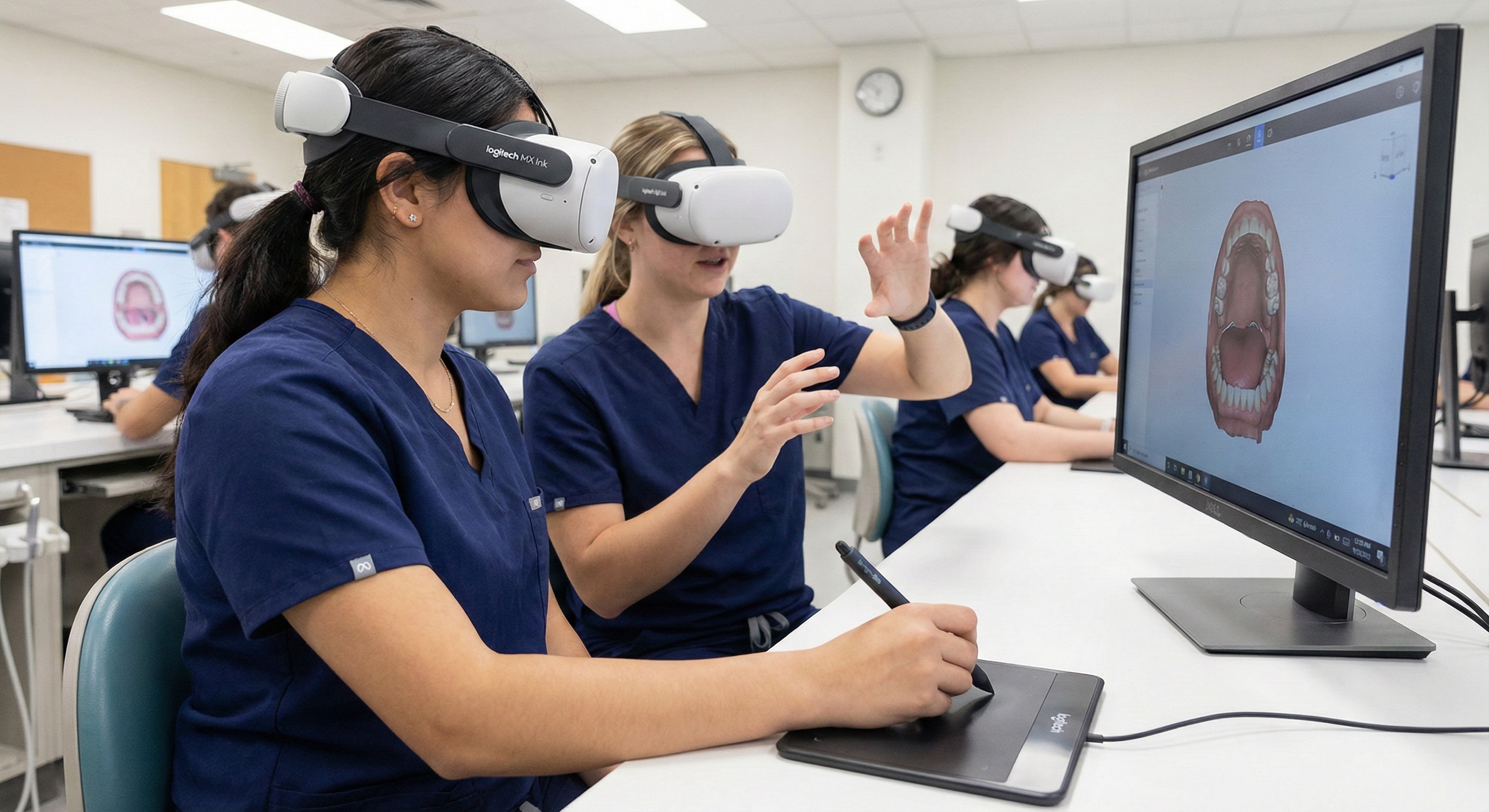
Inspiration: The Ergonomic Gap in Medical Simulation
Dentistry is a profession of microscopic precision, yet the way we train future dentists is painfully outdated. Currently, dental students spend hundreds of hours practicing on physical plastic teeth (typodonts). This traditional method is prohibitively expensive, generates massive plastic waste, and lacks real-time error tracking (e.g., warning a student the millisecond they drill too deep into the sensitive nerve/pulp).
While Virtual Reality (VR) seems like the perfect medium for medical simulation, current VR dental applications share a fatal flaw: Hardware Ergonomics. Standard VR controllers force an unnatural grip. You cannot perform millimeter-precise micro-surgery holding a bulky gaming joystick. It destroys medical ergonomics and builds dangerous, incorrect muscle memory. We realized that to truly digitize high-precision medical education, we needed a hardware revolution. The Logitech MX Ink, with its true pen-like form factor, is the exact paradigm shift needed to solve this educational gap.
What it does: The "Pen Grasp" Revolution
HoloDent is the world’s first Mixed Reality (MR) dental training platform built exclusively around the unique capabilities of the Logitech MX Ink. We transform this mixed-reality stylus into a precision high-speed virtual dental handpiece.
Unlike traditional controllers where hands hover awkwardly in mid-air, HoloDent enforces real-world clinical techniques:
- The "Pen Grasp": Holding the device exactly like a real surgical drill.
- The Finger Rest (Fulcrum): Students can physically rest their pinky or ring finger on a real desk (acting as the virtual patient's jaw) to stabilize their hand—a vital technique impossible with standard controllers.
- Analog Speed Control: We utilize the MX Ink's 1024-level analog tip pressure to control the virtual drilling speed intuitively. Press lightly to gently polish the enamel; press hard to aggressively cut into the dentin.
How we designed the architecture (Tech Stack)
As a concept pitch for the Application Phase, our technical blueprint is designed for high-fidelity execution on Meta Quest headsets:
- Core Engine & SDKs: Unity 2022 LTS paired with the Meta XR Core SDK (for Passthrough & spatial tracking) and the Logitech MX Ink SDK.
- Real-time Voxel Deformation: Instead of cheap surface texture painting, we will utilize Compute Shaders (or voxel libraries like MudBun/Clayxels) to run a real-time Subtractive Mesh Engine. As the MX Ink stylus presses into the virtual 3D holographic tooth, it physically and dynamically carves the mesh away at 90fps.
- Spatial Haptics & Audio: We map the MX Ink’s high-frequency haptics to anatomical material density. Touching hard enamel triggers a sharp, high-frequency buzz; softer dentin feels smoother. Drilling into the pulp triggers a heavy "Game Over" vibration, paired with spatial drilling audio.
- Non-diegetic UI: Crucial data (drill depth, pressure level, bur type) is elegantly displayed holographically directly on the virtual MX Ink barrel, keeping the surgical field of view perfectly clean.
Challenges we are addressing
The biggest UX challenge in Mixed Reality medical simulation is bridging the physical and virtual worlds. Designing a system that perfectly calibrates the physical fulcrum (the actual desk or silicone pad the student rests their hand on) with the virtual hologram of the patient's jaw requires precise spatial anchors. Additionally, mapping the MX Ink's analog pressure curve to accurately mimic the physical cutting resistance of human teeth requires deep research into dental material science to ensure the drilling doesn't feel "floaty."
Accomplishments that we're proud of
We are incredibly proud to bridge the gap between cutting-edge consumer hardware and professional medical education. By proving that the Logitech MX Ink can serve as a highly accurate medical instrument, we are opening up entirely new B2B SaaS use cases for this stylus beyond 3D art and design. HoloDent perfectly answers Logitech's call for "Medical Simulation and Training," with the potential to reduce university material costs by over 90%.
What we learned
Through our research, we learned that 6DoF spatial tracking alone is never enough for surgical simulation—tactile feedback and analog pressure are the two most critical factors. A standard VR controller only offers binary triggers (0 or 1), whereas the MX Ink offers a continuum (0-1024), which perfectly mimics the physical resistance of real human tissue.
What's next for HoloDent (Semi-Finals Roadmap)
If selected for the Top 50 Semi-Finals, our team is ready to execute a strict 4-week MVP development roadmap for the April 1st demo submission:
- Week 1: Integrate the MX Ink SDK, establish 6DoF tracking, and map the analog tip pressure to a basic 3D voxel sphere.
- Week 2: Implement the Voxel subtractive mesh algorithms for real-time 3D tooth deformation.
- Week 3: Integrate high-quality anatomical 3D dental models, particle effects (enamel dust), and spatial audio (drilling sounds based on pressure).
- Week 4: Polish the Mixed Reality Passthrough alignment, refine the non-diegetic UI, and record the final gameplay demo using Meta's MR Utility Kit.

Log in or sign up for Devpost to join the conversation.