-
-
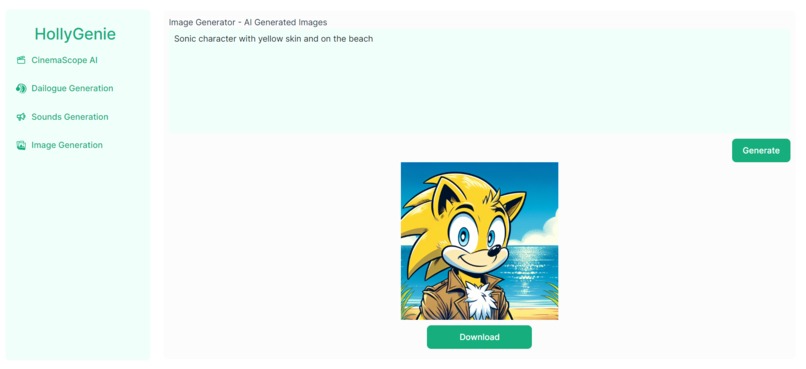
Image Generation
-
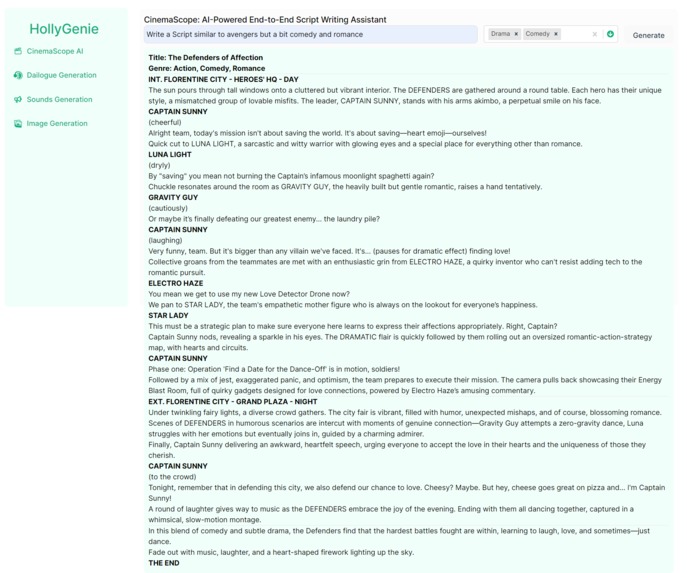
Script Generator

Here's a detailed version for each of the sections for your project, HollyGenie:
Inspiration
The inspiration behind HollyGenie came from the desire to revolutionize content creation and enhance the capabilities of artists, filmmakers, and creators in the entertainment industry. We noticed a gap in accessible tools for generating scripts, dialogues, and sound effects, making the creative process time-consuming and resource-intensive. HollyGenie aims to provide a comprehensive AI-powered platform that empowers users to effortlessly bring their creative visions to life through automated tools for scriptwriting, dialogue generation, audio synthesis, and image creation.
What it does
HollyGenie is an AI-driven platform that offers a suite of tools to streamline and enhance various aspects of content production:
Script Generator: Automatically generates compelling and structured scripts based on given prompts or ideas, making it easier for writers and filmmakers to develop storylines and dialogue.
Dialogue Text-to-Audio Conversion: Transforms written dialogues into realistic voiceovers using AI-powered text-to-speech (TTS) technology, providing natural and expressive voice outputs in different languages and tones.
Sound Creation (Prompt-to-Audio): Allows users to create custom sound effects or background music by inputting descriptive prompts, enabling creators to generate unique audio content for their projects.
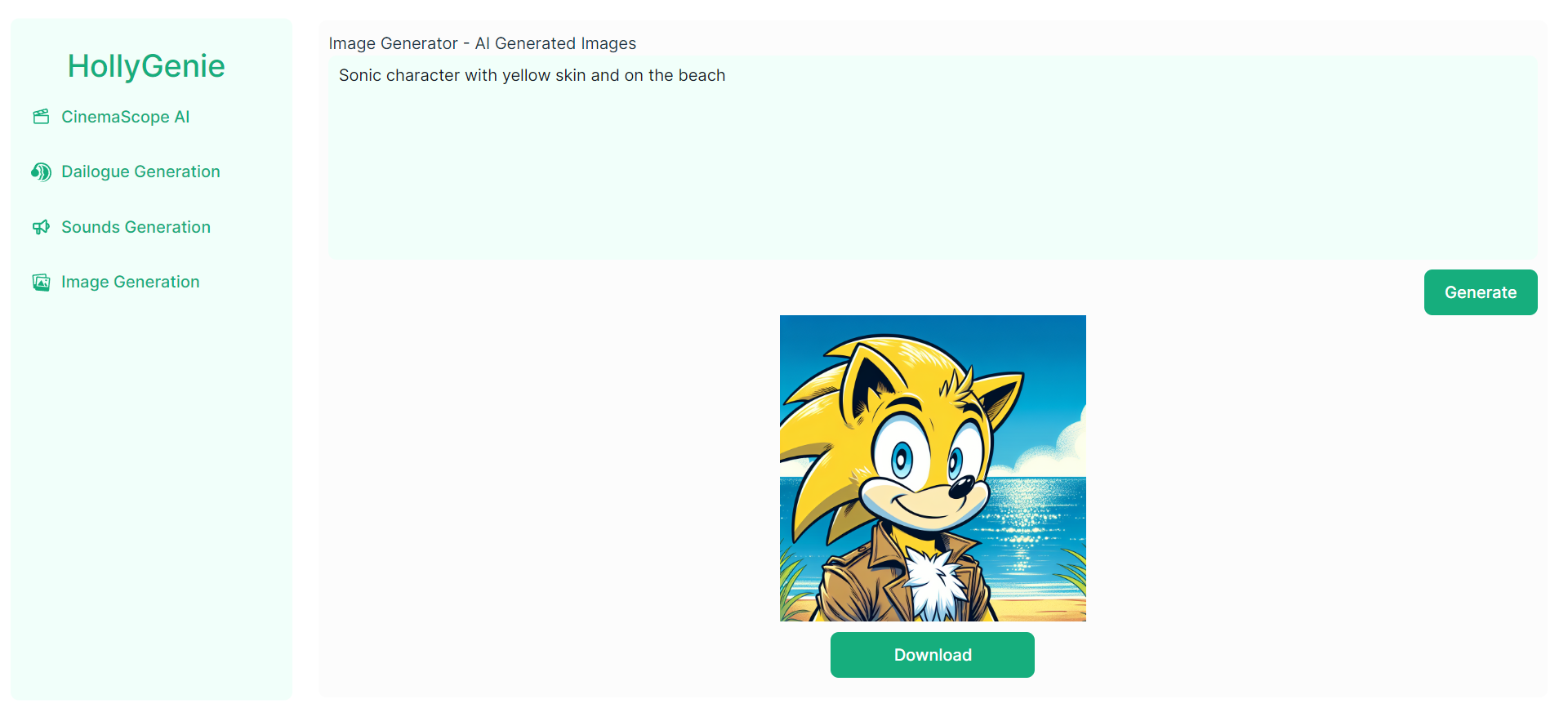
Image Generation: Converts text descriptions into images, helping creators visualize scenes, characters, or settings for films, storyboards, or other artistic works.
How we built it
Backend (Flask): The backend is built using Flask, which handles API requests, integrates with third-party AI services (such as ElevenLabs for TTS and Azure OpenAI), and processes data for the various tools.
Frontend (React with Vite): The frontend is developed using React with Vite, providing a dynamic and interactive user interface for accessing HollyGenie's tools. Vite’s fast build and hot module replacement make the development experience smoother.
API Integrations: We used APIs like ElevenLabs for text-to-speech synthesis and Azure OpenAI for generating creative content. These integrations allow us to leverage powerful AI models for content generation.
Environment Configuration: Securely configured the environment with variables such as FLEAK_API_KEY, ELEVENLABS_API_KEY, AZURE_OPENAI_ENDPOINT, and AZURE_OPENAI_KEY for accessing external services.
Challenges we ran into
API Rate Limits: Some third-party APIs had rate limitations, which made it challenging to test the platform extensively. We had to implement caching mechanisms and optimize requests to handle this issue.
Voice Synthesis Quality: Ensuring natural and expressive text-to-speech output required tuning the TTS settings and experimenting with different voice models to achieve the desired audio quality.
Frontend Integration: Integrating the AI-generated content into a seamless user interface proved challenging due to asynchronous data handling and managing different response formats from the APIs.
Handling Large Files: Managing and processing large audio and image files was resource-intensive, requiring efficient storage solutions and handling techniques to ensure optimal performance.
Accomplishments that we're proud of
Successful Integration of Multiple AI Tools: We managed to bring together several AI-powered tools into a single platform, making content creation much more accessible and efficient.
Realistic and Natural Audio Generation: The text-to-speech conversion outputs sound expressive and natural, bringing life to the generated dialogues, which is crucial for media production.
User-Friendly Interface: Developed a smooth and intuitive user interface that allows even non-technical users to create scripts, dialogues, sounds, and images effortlessly.
What we learned
Optimizing API Usage: Learned how to effectively manage and optimize the use of third-party APIs for generating creative content.
Enhancing Voice Synthesis: Gained insights into making text-to-speech outputs more realistic by experimenting with different voice models and parameter settings.
Cross-Platform Development: Improved skills in full-stack development by working on both the frontend (React Vite) and backend (Flask), along with handling the challenges of integrating multiple services.
Efficient File Management: Learned about techniques for managing large files and optimizing file storage and retrieval to maintain performance.
What's next for HollyGenie
Multi-Language Support: Expand the platform’s capabilities to support more languages and regional dialects for voice synthesis, making HollyGenie accessible to a global audience.
Advanced Script and Dialogue Customization: Add more customization options for script and dialogue generation, allowing users to fine-tune tone, style, and character traits.
AI-Enhanced Video Editing: Integrate video editing capabilities to enable users to create complete multimedia projects within the platform.
Cloud Storage Integration: Provide options for users to store their generated content in cloud storage services like AWS S3 or Google Cloud Storage.
Mobile App Version: Develop a mobile-friendly version of HollyGenie, allowing creators to access the platform's tools on the go.
Marketplace for AI-Generated Assets: Create a marketplace where users can share, sell, or collaborate on AI-generated scripts, sound effects, and other content.

Log in or sign up for Devpost to join the conversation.