What it does
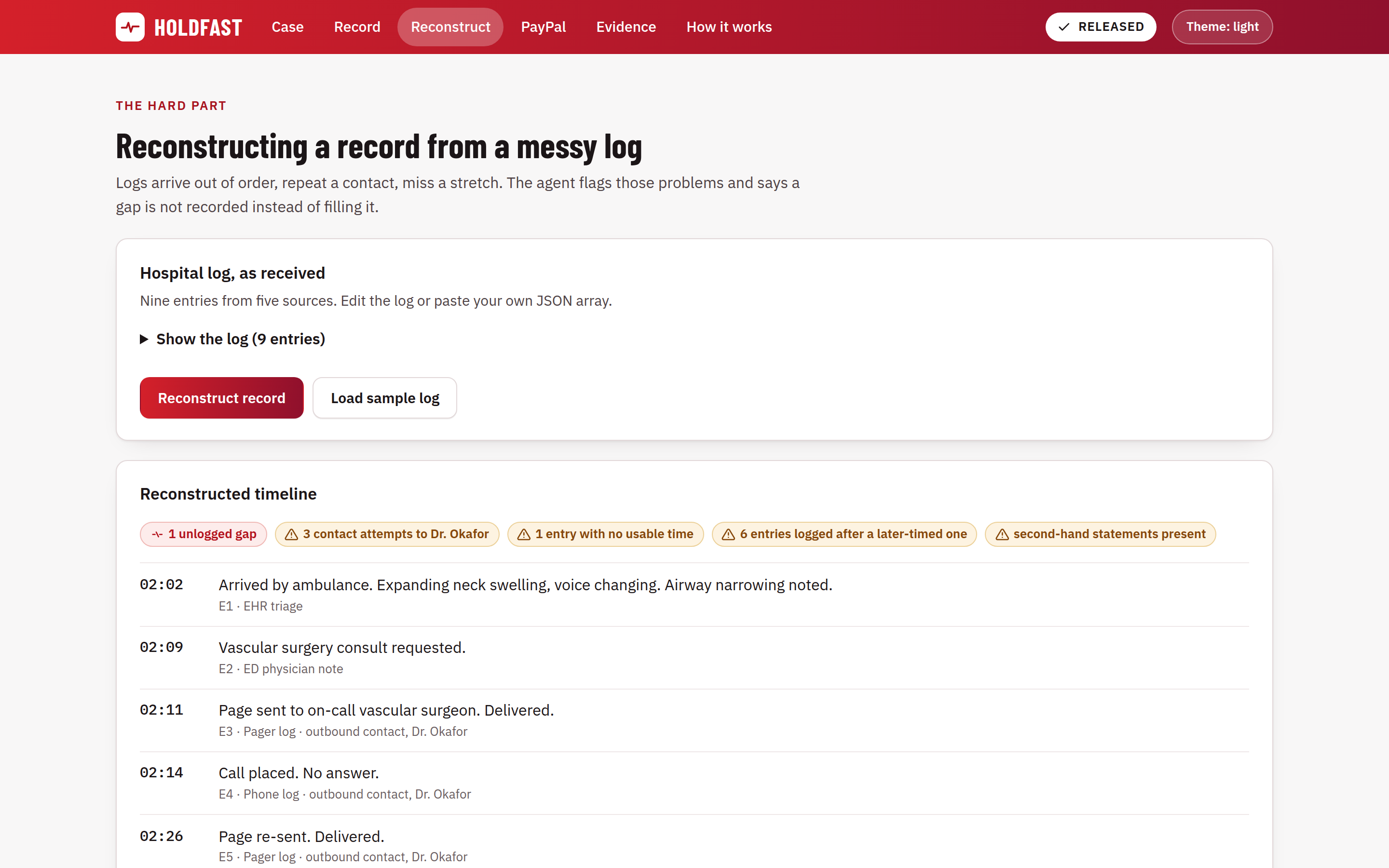
Holdfast puts a payment guarantee in front of an on-call surgeon in about ten seconds, so nobody has to ask the patient how they intend to pay.
It sizes the guarantee from the hospital's own published price file, places a real authorization on a sponsor's PayPal instrument, and then captures only what the procedure note supports. If the operation does not happen, the hold is voided and nothing is charged at all.
Every state change below is a live PayPal call. The app holds 86 real PayPal object IDs.
A patient in Spartanburg, May 2024
Someone arrived at Spartanburg Medical Center with a bleeding carotid hematoma. Their airway was closing. The on-call vascular surgeon would not come in.
The hospital settled with the Office of Inspector General for $100,000.
We pulled every published OIG settlement for emergency-care violations and parsed all one hundred of them. The totals:
| Money across the corpus | $10,621,898.10 |
| Median settlement | $52,414 |
| Largest | $1,295,000 |
| Deaths, 2023–2026 | 12 across 11 settlements |
The median is the figure worth sitting with. Fifty-two thousand dollars is roughly what it costs a hospital when someone dies waiting in its emergency department. The largest in the set is AnMed Health, at $1,295,000 across 36 incidents. Patients were held in the emergency department for between six and thirty-eight days each. The psychiatric unit upstairs had empty beds.
This is not a historical problem. There were ten settlements in 2024 and twelve in 2025.
The law has said so since 1986
42 U.S.C. § 1395dd(h) is a single sentence:
"A participating hospital may not delay provision of an appropriate medical screening examination… in order to inquire about the individual's method of payment or insurance status."
Penalties reach $50,000 per violation, and the statute extends the same exposure to the physician personally.
So the rule is clear and the penalty is real, and it keeps happening. The reason is duller than malice: a specialist woken at two in the morning has no way to know whether this operation will ever be paid for. The law forbids asking the patient. Nobody built the thing that makes asking unnecessary.
How Holdfast answers it
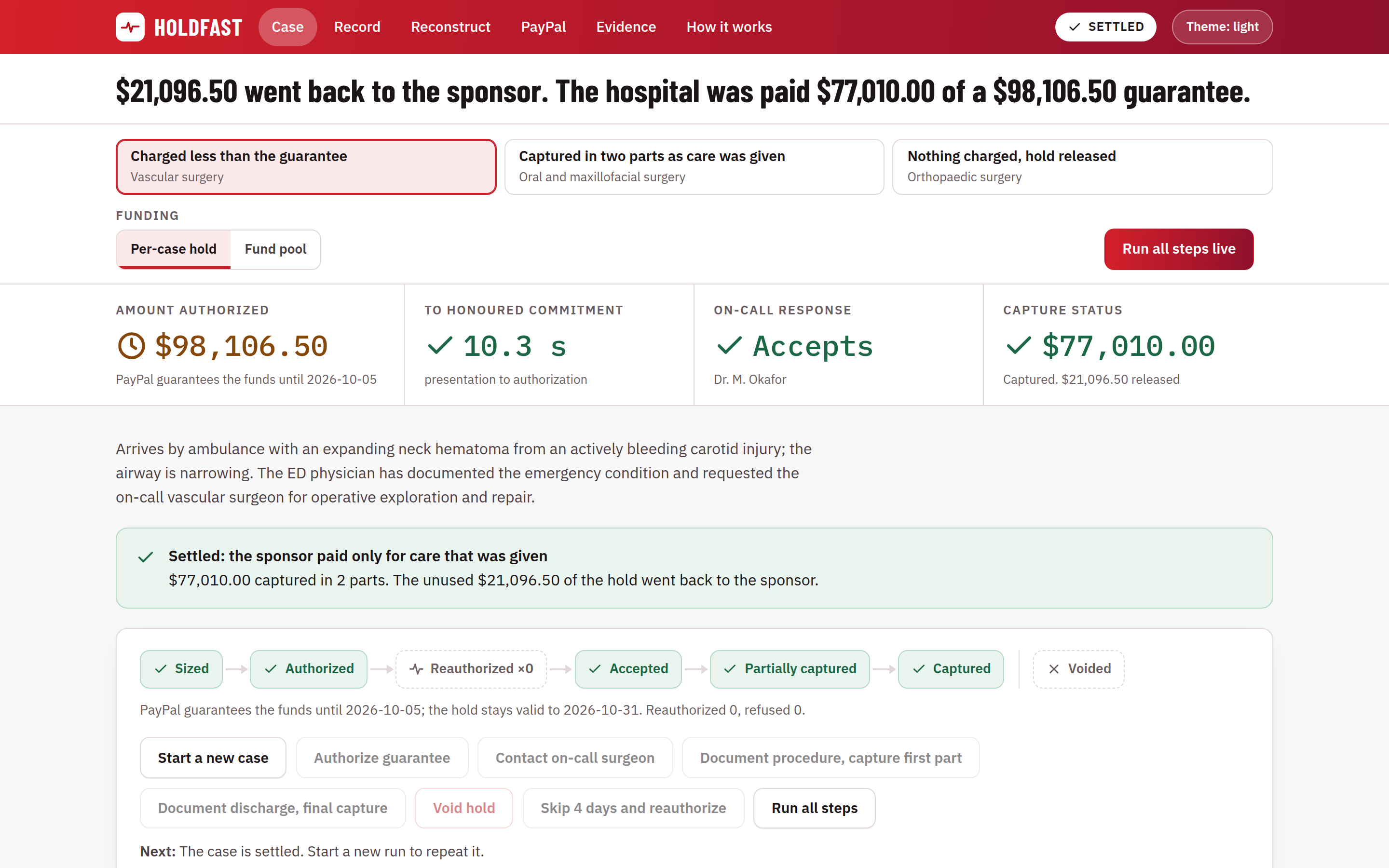
It sizes a guarantee from the hospital's own published price file, places a real authorization on a sponsor's vaulted PayPal instrument, and puts a number in front of the surgeon — before anyone asks the patient anything.
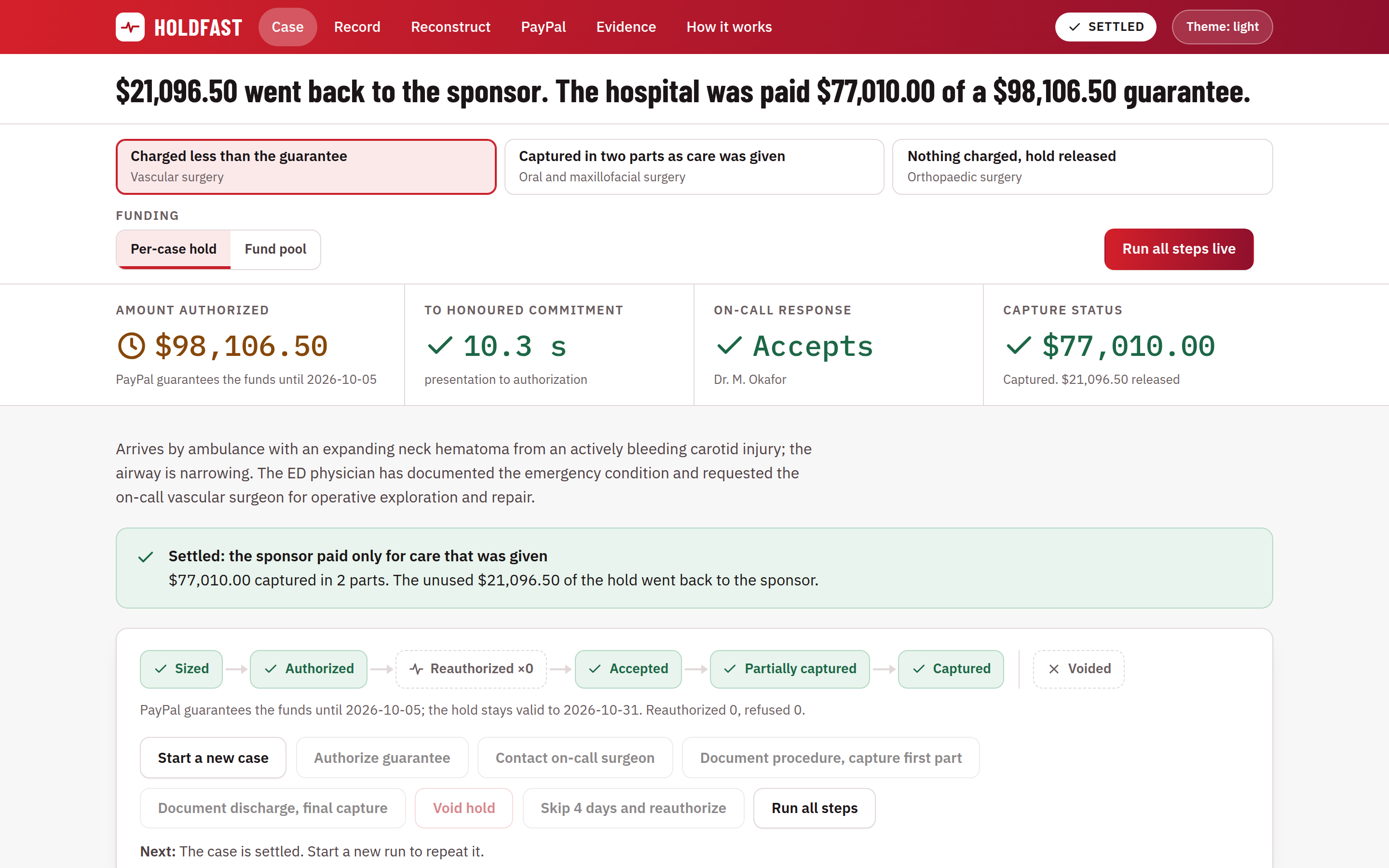
The demo case runs like this:
- Sized — $98,106.50, built from published price lines
- Authorized — held on the sponsor's instrument, honoured to a stated date
- Accepted — the surgeon sees the guarantee and accepts in 10.3 seconds
- Captured in two parts — as the procedure note and discharge come in
- $21,096.50 returned
That last line is the whole product. A guarantee that charges its full held amount is just a prepayment with extra steps. Holdfast captures what the procedure note supports and gives the rest back.
The case that charges nothing
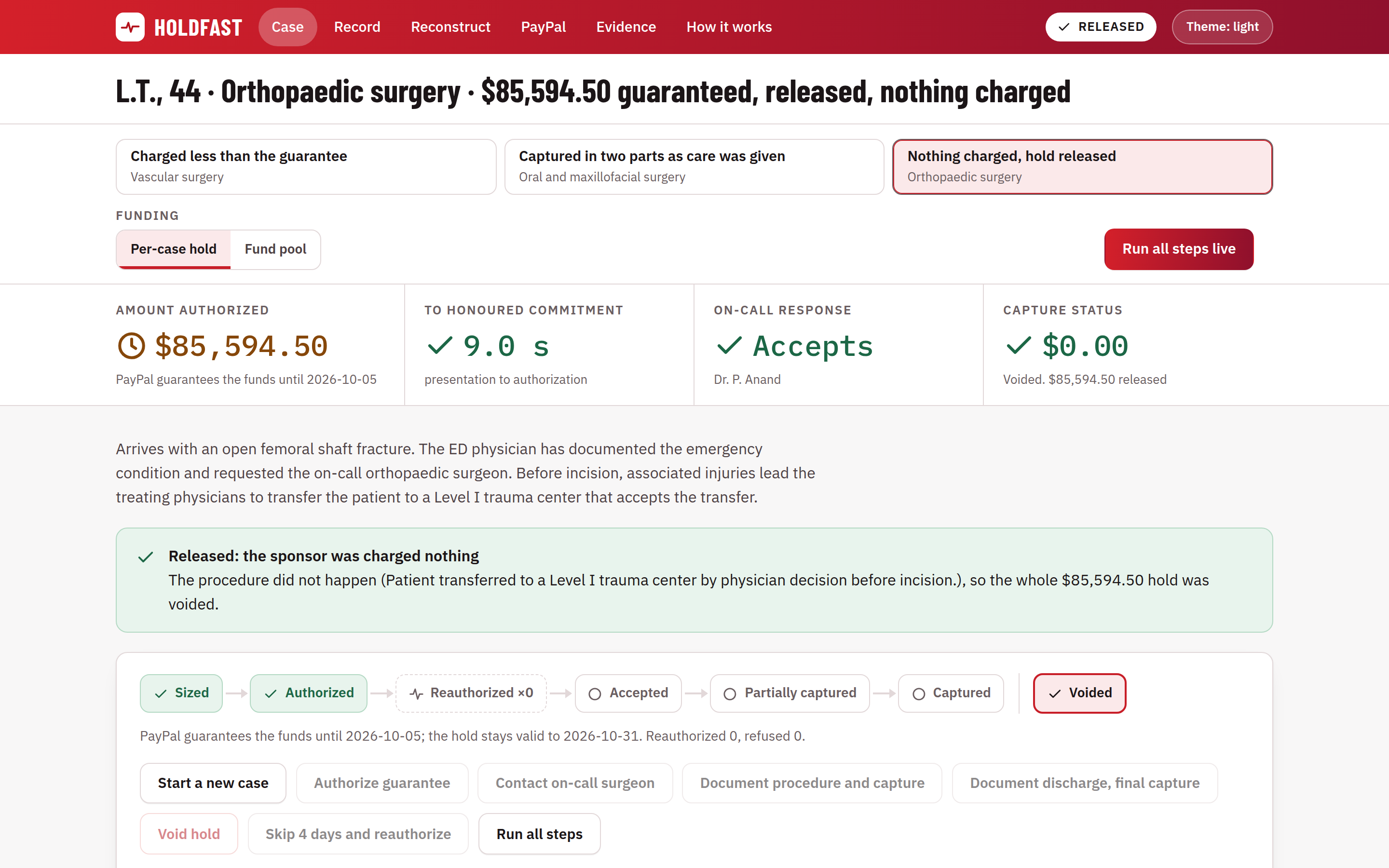
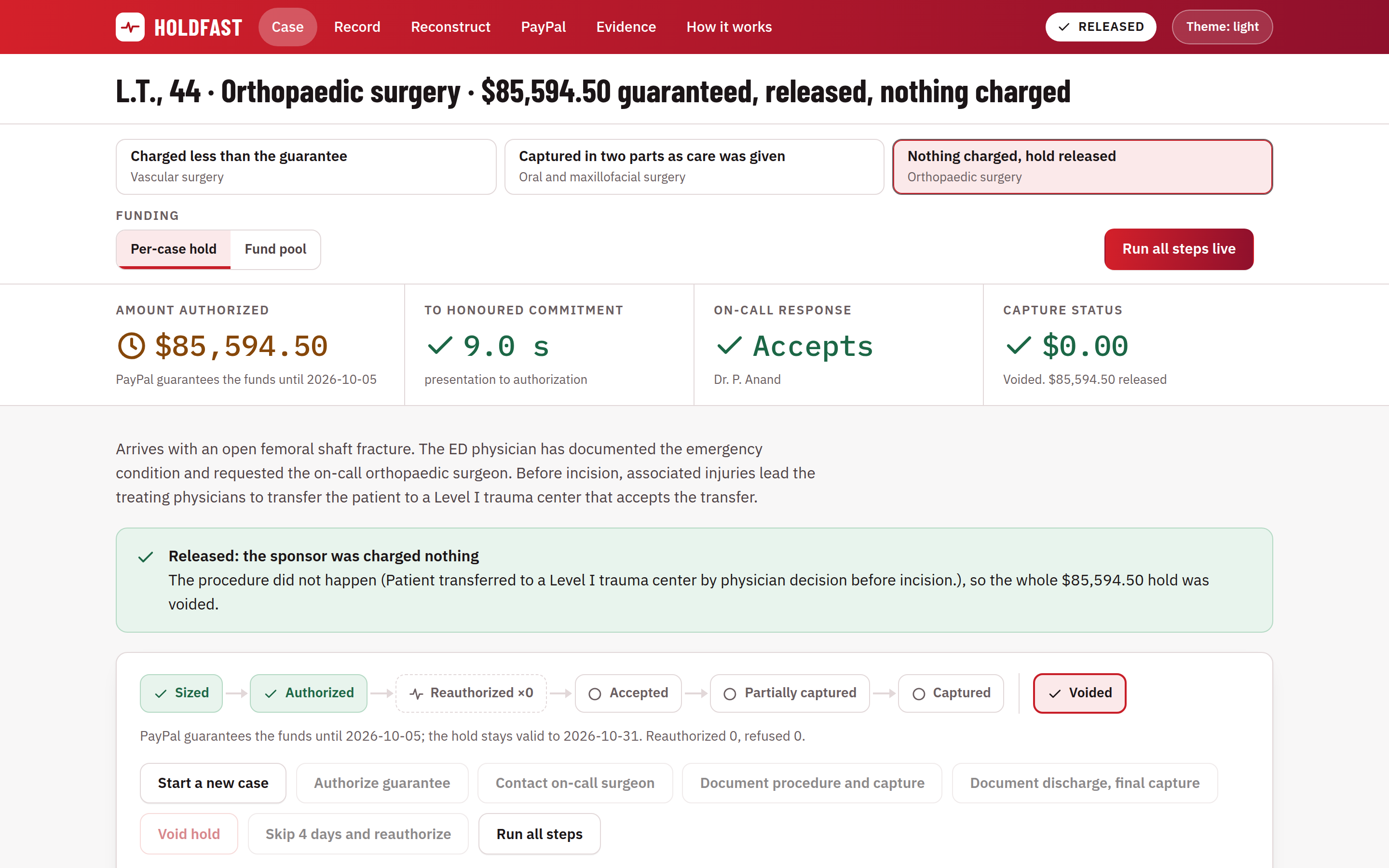
A patient arrives with an open femoral shaft fracture. Before incision, associated injuries send them to a Level I trauma centre. The operation never happens.
Holdfast voids the hold. $85,594.50 released, $0.00 charged.
Under it
| Layer | What runs |
|---|---|
| Agent | Claude Sonnet 4.5 on Amazon Bedrock, sizing against the price file and reading each procedure note |
| PayPal | Orders v2 — authorize, reauthorize, partial capture, capture, void. Vault v3 for the sponsor's instrument. Signed webhooks. |
| Platform | AWS Lambda on a Function URL, DynamoDB, S3 and CloudFront |
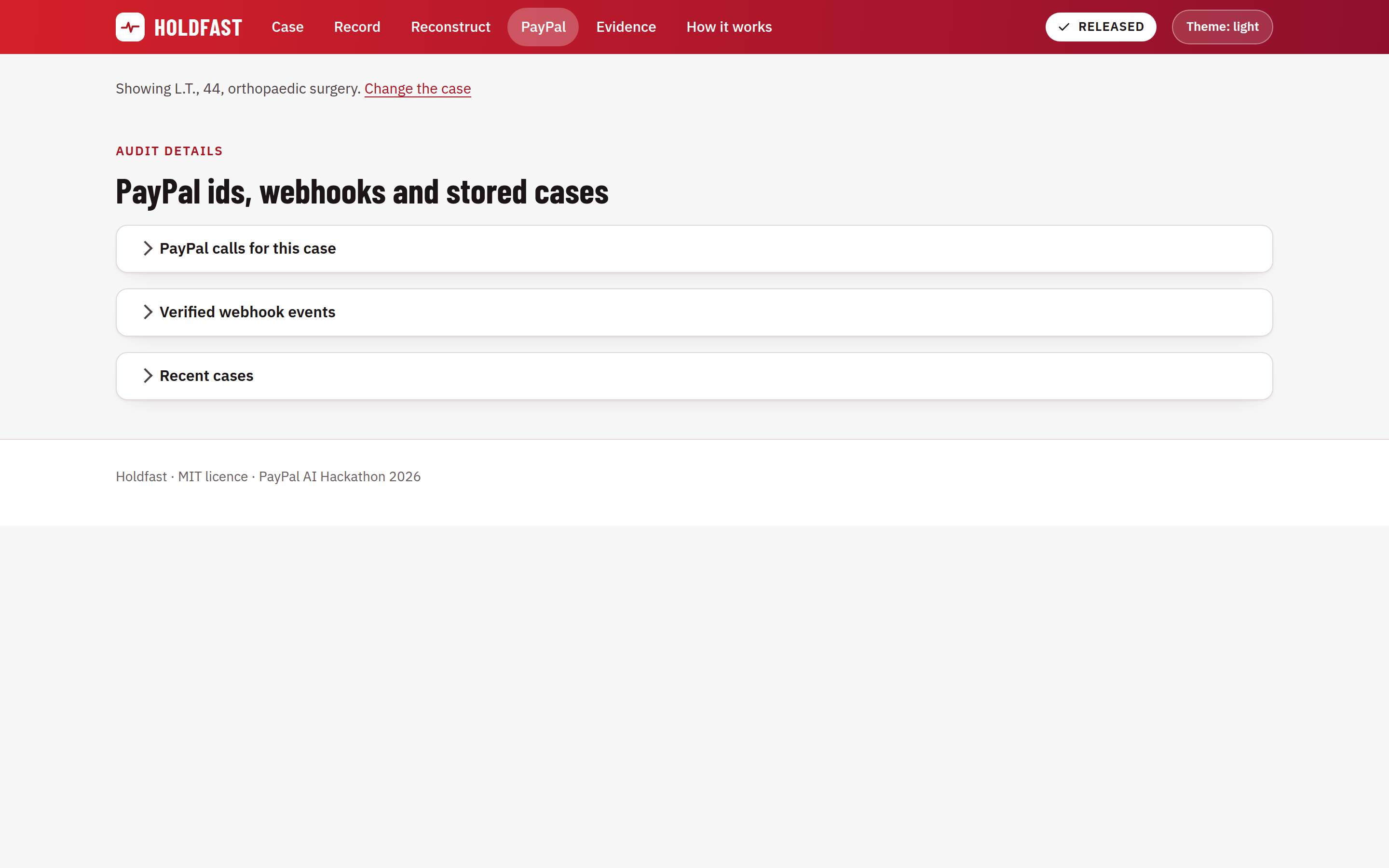
Every state change above is a real PayPal call. The app holds 86 PayPal object IDs. When a hold nears expiry it genuinely reauthorizes; when a patient is transferred it genuinely voids.
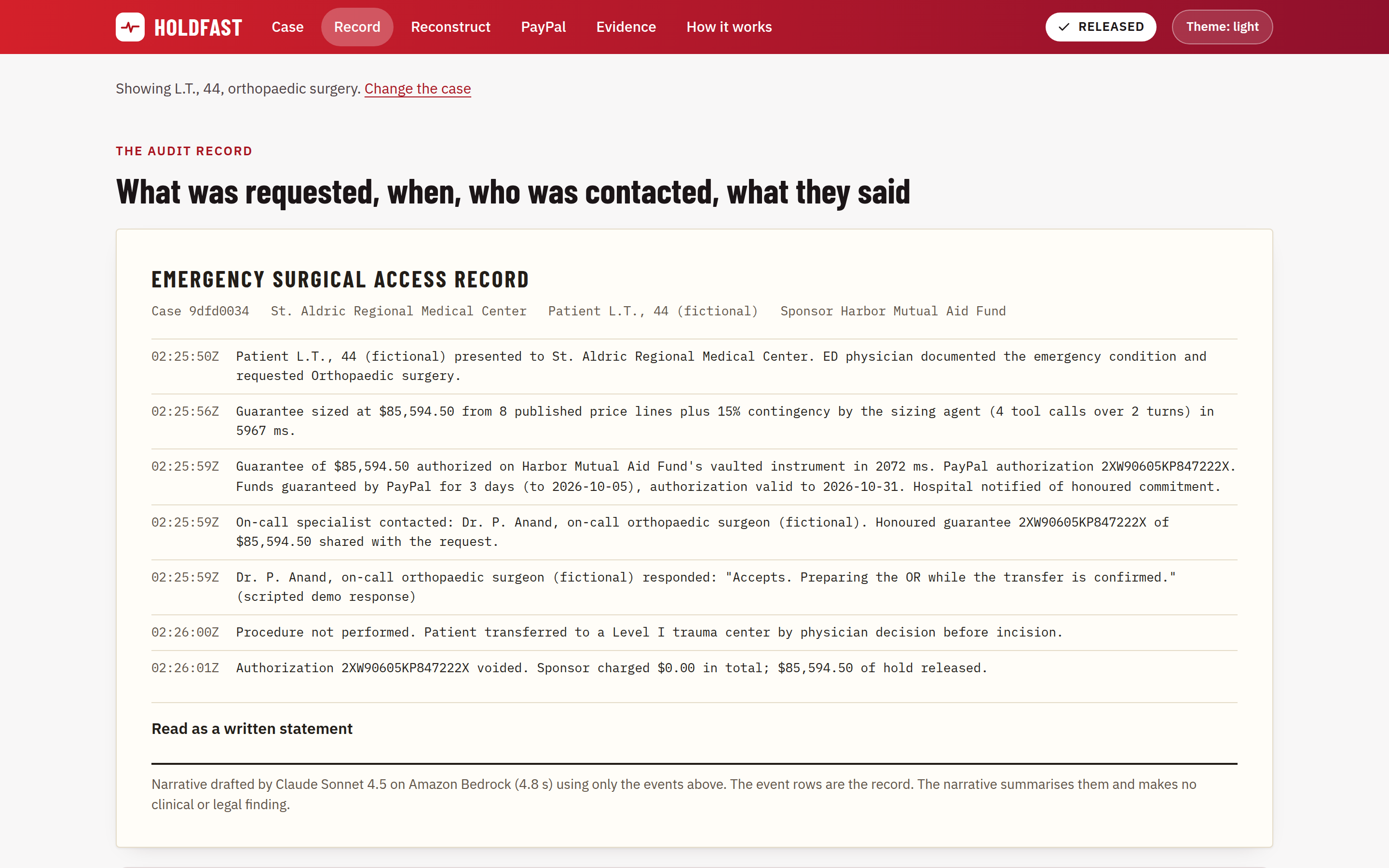
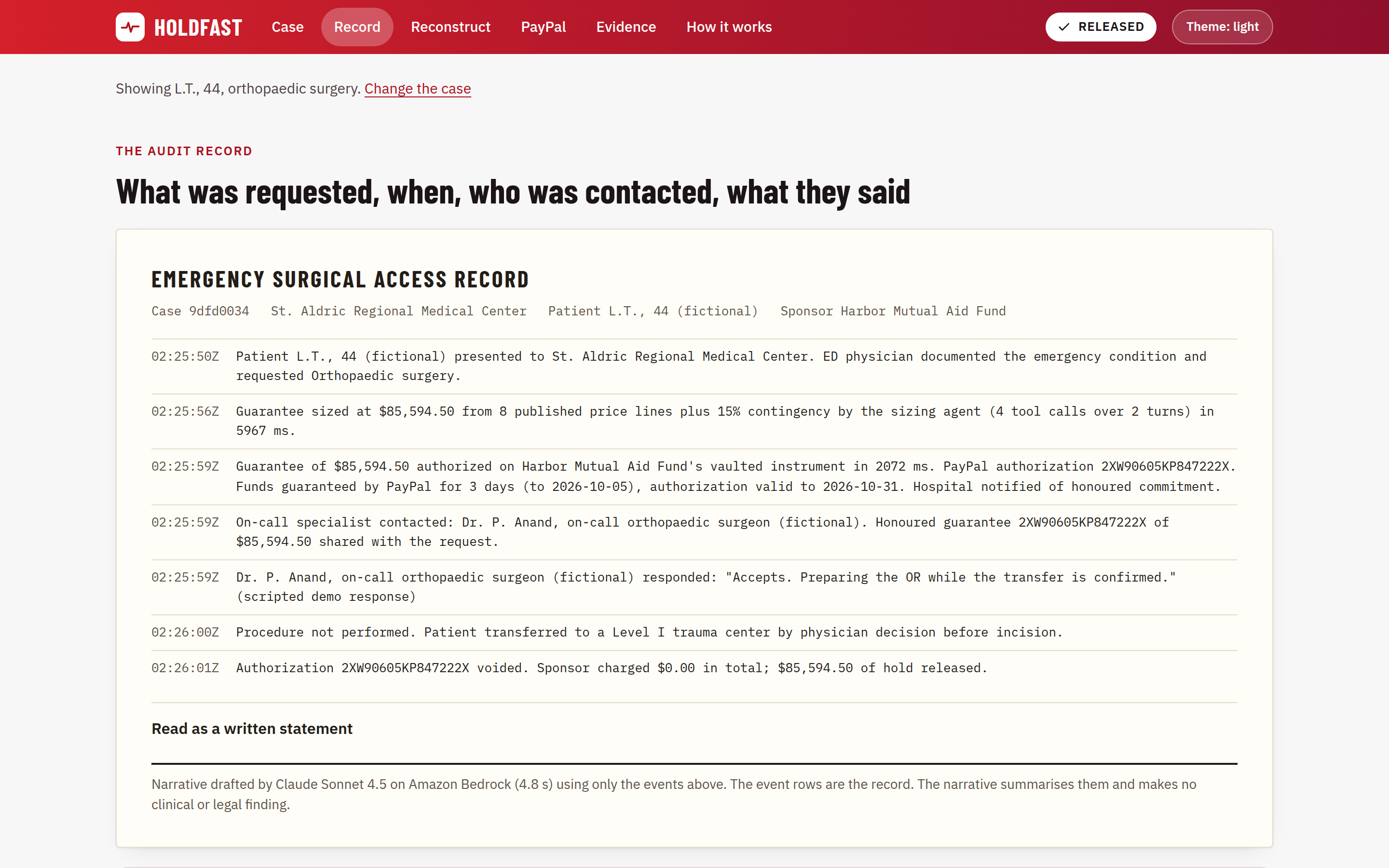
Every step is written down as it happens, so the case can be read back rather than reconstructed from memory.
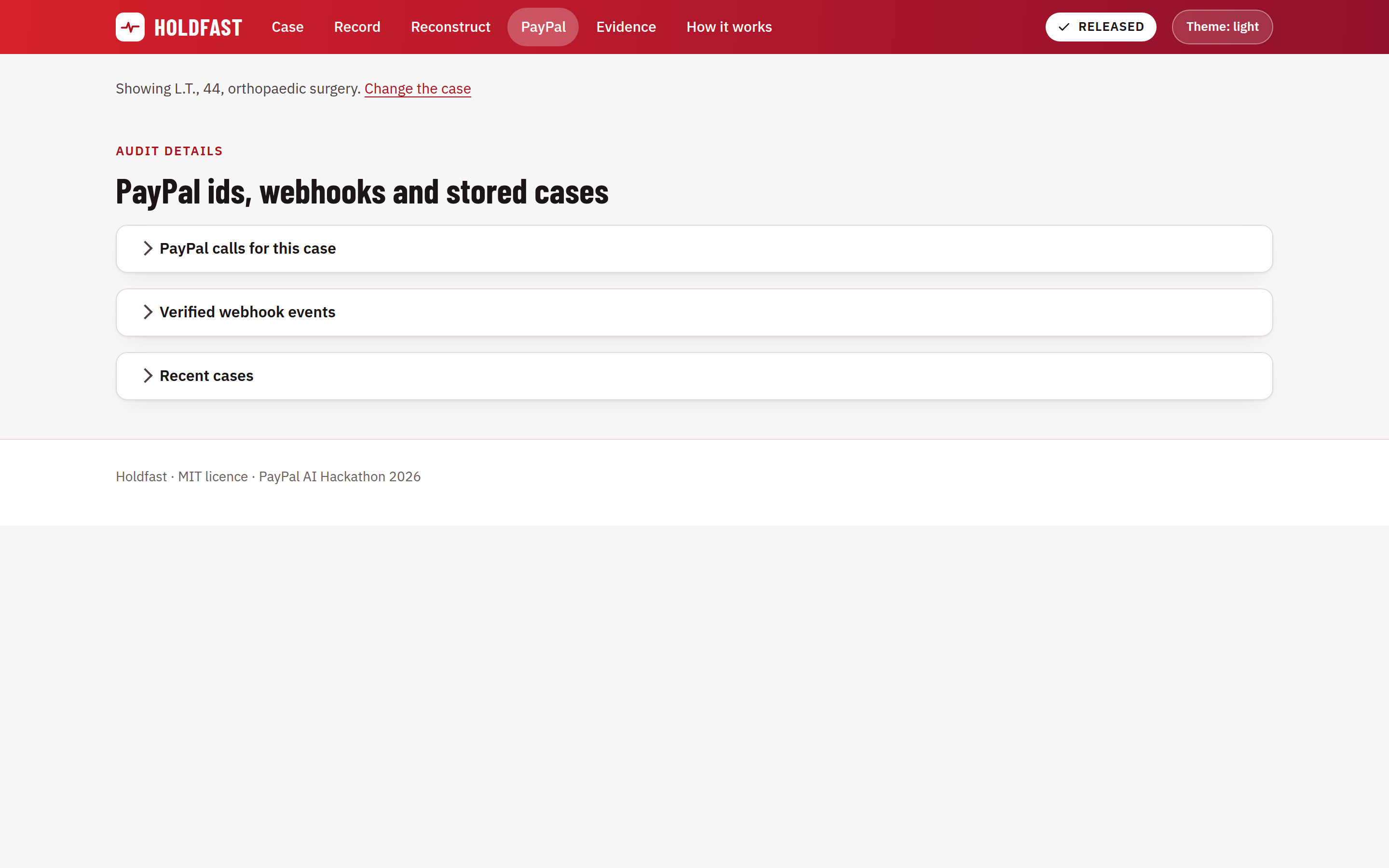
Checking our own books
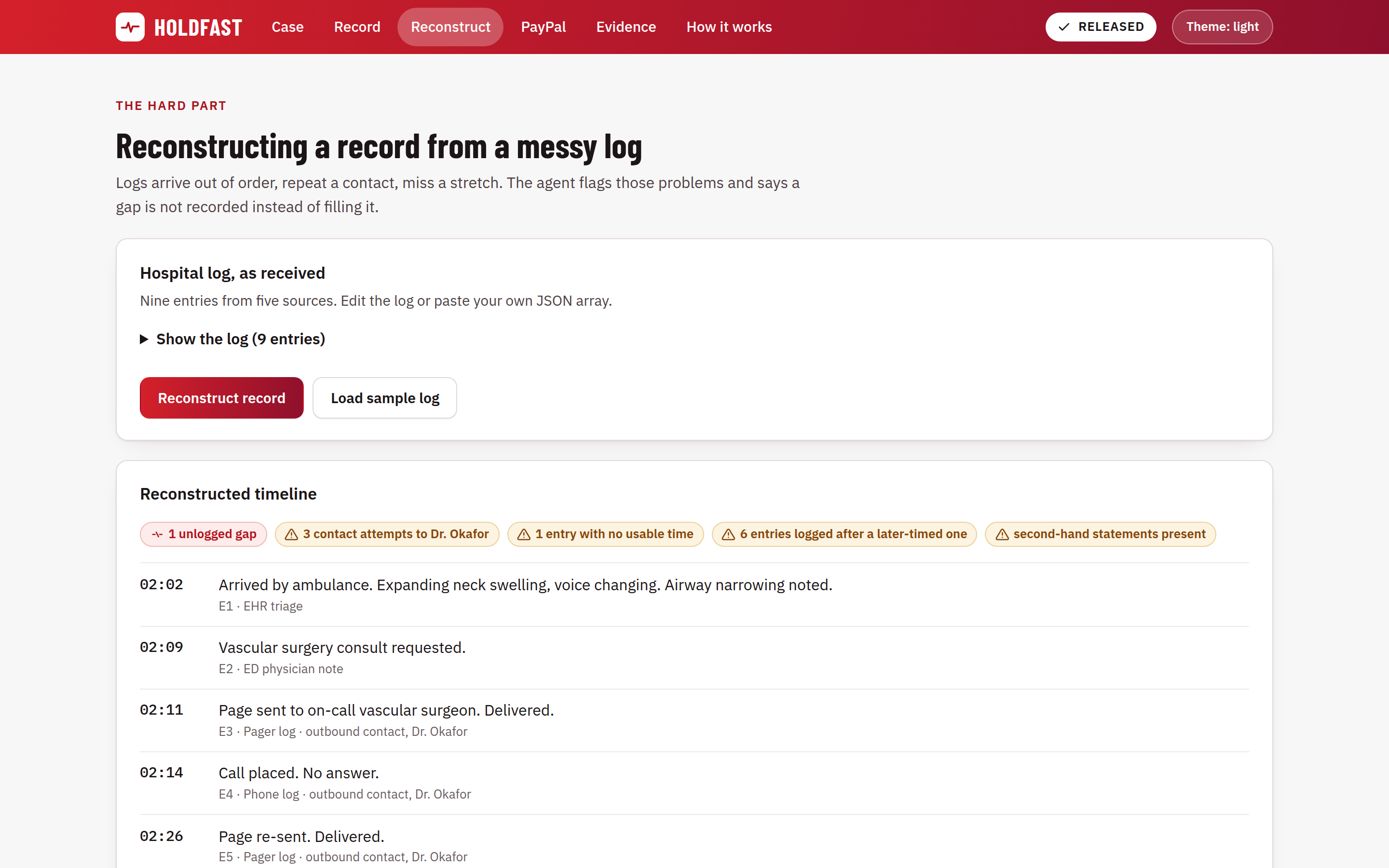
Reconstruct rebuilds the entire case from PayPal's records rather than ours. If our ledger and PayPal's disagree, this is where it shows.
Where PayPal's sandbox stops
Card processing is unavailable on a sandbox account, so the sponsor's instrument is a vaulted PayPal wallet rather than a corporate card. The surgeon's acceptance is scripted, because there is no surgeon. Everything that moves money is real.
Built With
- amazon-web-services
- paypall
- sonnet

Log in or sign up for Devpost to join the conversation.