-
-

Meet Sage, the cactus security guard who holds the fort while you're on vacation.
-
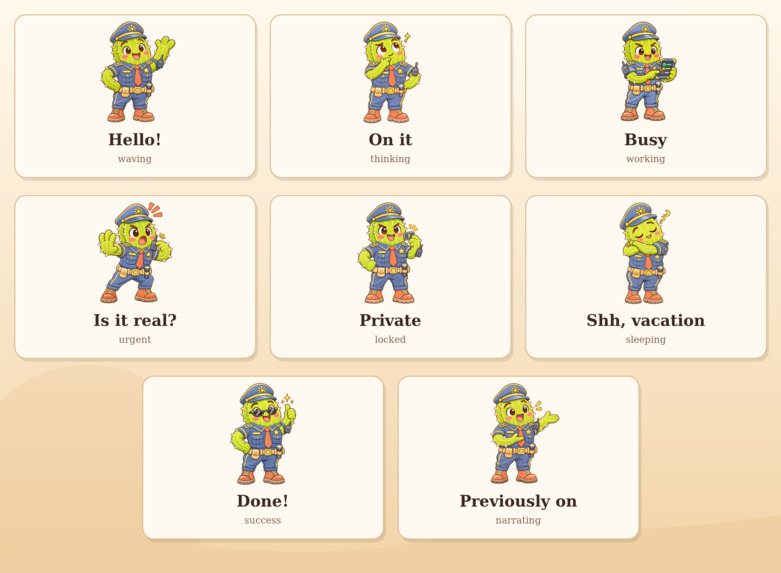
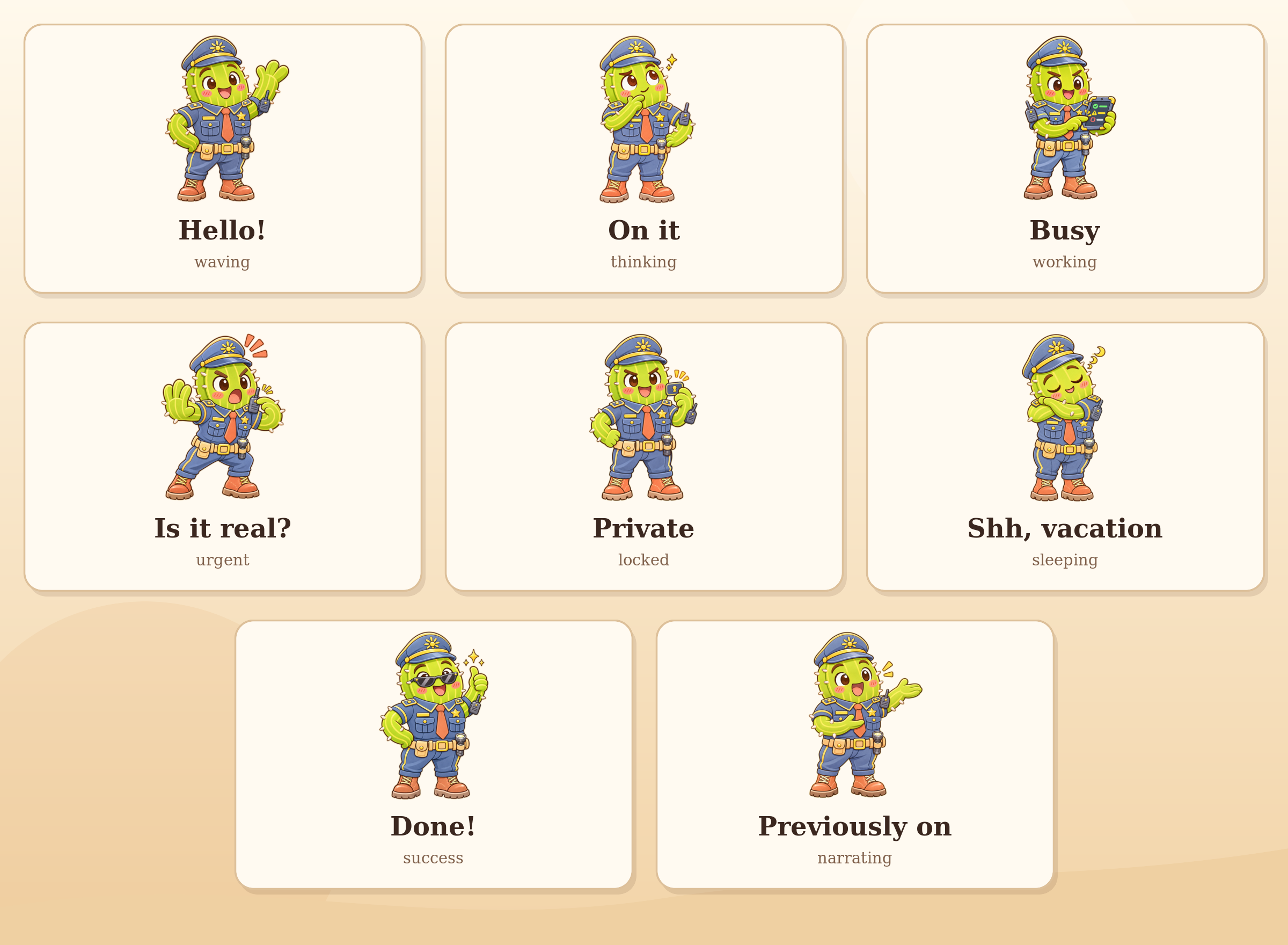
Sage's moods change with the moment: waving, thinking, busy, checking emergencies, guarding secrets, resting, celebrating, and narrating.

Inspiration
Almost everyone I know checks work messages on vacation. Not because everything is urgent, but because anything might be. A coworker needs a file only you know about, a deadline lands while you're away, and one message in capital letters saying URGENT is enough to ruin a day at the beach.
Out of office replies don't help. They tell people you're gone, but they don't answer the question, and they can't tell a real emergency from an empty printer. So people either stay on call during their time off, or their team gets stuck without them.
I wanted to build the coworker everyone wishes they had: someone who answers your team for you, protects your time off, and only taps you on the shoulder when the building is actually on fire. That became Sage, a cactus security guard who holds the fort while you're away.
What it does
Before Alice leaves, she gives Sage her notes, her return date, her backup (Jen), and how many times Sage is allowed to interrupt her. While she's away:
- Quick Answers: Sage answers coworkers only from Alice's shareable notes, live pages and things it has learned, and shows the source for every answer. If it doesn't know, it says so instead of guessing.
- Smart triage: every message is sorted. It is answered, answered and logged for Alice, saved on her desk, locked, or sent to the Vacation Shield.
- Vacation Shield: anyone who claims an emergency gets interviewed: what breaks, by when, and who else can fix it. Only a real emergency reaches Alice's phone, and it spends one of her shield passes.
- Break glass: with no passes left, only a true 9 or 10 out of 10 emergency still gets through.
- Smart Reschedule: requests due while she's away move to a fair slot after she returns, with a one click calendar invite.
- Locked notes: private notes never leave the fort. They are never sent to the model or to memory.
- Live pages: Sage reads the team board live with TinyFish, so answers are never stale.
- Voice: coworkers can talk to Sage with their mic, and Sage answers out loud in a natural Amazon Polly voice.
- Thank You Stars: whoever covers for Alice earns a star on a shared team board.
- Catch Me Up: when Alice returns, one live page shows everything that happened, plus a short "Previously on" recap of her week.
- Learning loop: when Alice answers a question on her desk once, Sage remembers it and answers it on its own next time.
What can wait, and what reaches Alice
| Can wait | Reaches Alice |
|---|---|
| The printer is out of toner, and Jen at the front desk can swap it. Declined, and the phone stays quiet. | The texting tool is down for 3,000 students the night before orientation, and only Alice has the admin login. 10 out of 10, and her phone buzzes. |
| A purchase order number for new banners. Saved on her desk. | With zero passes left, only a true 9 or 10 still breaks the glass. |
| The huddle moved to room 118. Answered and logged for later. | |
| "What did her review say?" Locked, never shared. |
How I built it
The core idea is AI suggests, plain code decides. Gemini understands messages, writes replies and scores urgency. Every decision that protects a person is plain code with tests.
The Vacation Shield is a good example. Gemini interviews the coworker and returns an urgency score \( u \) from 0 to 10, plus two checks: is there real harm before Alice is back (\( h \)), and can the backup fix it (\( b \)). With \( p \) shield passes left, the code decides:
$$ \text{bar} = \begin{cases} 8 & \text{if } p > 0 \ 9 & \text{if } p = 0 \text{ (break glass)} \end{cases} $$
$$ \text{notify Alice} \iff u \ge \text{bar} \;\land\; h \;\land\; \lnot b $$
The model can be persuaded by a dramatic message. The rule can't.
Smart Reschedule works the same way. A request due while Alice is away moves to the first weekday \( d' \) after her return day \( r \) that still has room:
$$ d' = \min {\, t > r \;:\; t \text{ is a weekday},\; \text{deadlines}(t) < 2 \,} $$
So she never comes back to a pile of work due on her first day.
The stack:
- Website: Next.js 15 and React 19 in TypeScript, hosted on AWS Amplify, with the domain on Amazon Route 53.
- Agent: Node 22 and Express, deployed on Maritime, always on and locked behind a shared secret.
- Understanding and writing: Gemini, with a fallback chain of models.
- Voice: Amazon Polly (the generative Tiffany voice), streamed to the browser.
- Data: MongoDB Atlas.
- Memory: supermemory.
- Live pages: TinyFish.
- Phone alerts: ntfy.
I also wrote a 14 question accuracy eval and 11 rules tests. The final build scores 14 of 14 on the eval and passes 11 of 11 tests.
How Hold the Fort fits each track
Every sponsor tool here does a real job in the product. Take any one out and a feature stops working.
🌵 Best Mascot: Sage
Sage isn't a logo in the corner. Sage is the product's voice and face. Every reply comes from Sage, in first person, with a personality: a cactus security guard who is a little dramatic but always on your side. Sage has nine moods (waving, thinking, working, urgent, locked, sleeping, success, narrating, on duty), and the mood changes with what Sage is doing. Sage looks "urgent" during a Shield interview, "locked" when guarding a private note, and "sleeping" when there's nothing to bother Alice about. Sage narrates the demo video, the "Previously on" recap, and the little demo for every feature. With Amazon Polly, Sage even has a real voice.
💼 JFF Ventures: Future of Work
Burnout often comes from never being fully off. Hold the Fort makes real rest possible without leaving your team stuck:
- Coworkers stay unblocked. They get real answers with sources, any time, instead of an out of office reply.
- Time off is protected by rules, not willpower. Alice picks how many interruptions she allows, and the code enforces it.
- Fair workload when she returns. Deadlines move to after she's back, never on her first day, and never more than 2 on one day.
- Covering is recognized. Coworkers who step in earn Thank You Stars on a shared team board, so the extra work is visible.
- Coming back is easy. One welcome back page and a one minute recap replace hours of catching up.
This works for any role where one person holds knowledge others need: aides, coordinators, small teams, and frontline staff.
⚓ Maritime
Maritime hosts Sage itself, the agent that does all the work. It runs always on, so coworkers can reach Sage at any hour, and Alice's phone buzzes within seconds of a real emergency. It's deployed from the repo's Dockerfile with the Maritime CLI. Every key lives in Maritime secrets, never in the code. The agent is locked down: only the website can reach it, through a shared secret. Alice's routes need her owner passcode, and chat, interviews and voice are rate limited per visitor.
✨ Gemini
Gemini is Sage's brain. It sorts every message (answered, logged, desk, locked or urgent), writes answers from Alice's notes with sources, runs the Vacation Shield interview, scores urgency from 0 to 10, and writes the welcome back note and "Previously on" recap. A fallback chain of models keeps Sage answering if one model is busy. Gemini never makes the final call: it suggests, and plain code decides.
🍃 MongoDB Atlas
Atlas is the fort's memory of the week: owners, notes, questions, Shield interviews, interruptions and passes spent, moved deadlines, Thank You Stars, and the team board. The welcome back page and its live counts are built straight from Atlas, so what Alice sees is exactly what happened.
🧠 supermemory
supermemory holds Alice's shareable notes and everything Sage learns. When Alice answers a question on her desk once, Sage saves it to supermemory and answers it on its own next time, marked "Learned". Private notes are never sent there.
🐟 TinyFish
TinyFish lets Sage read live web pages at question time, like the public team board. When a coworker asks for a status, Sage checks the live page instead of a stale note, and warns when a saved note and the live page disagree.
☁️ AWS: Amplify, Route 53 and Polly
- Amplify hosts the Next.js website with server side rendering.
- Route 53 serves the domain, holdthefort.club.
- Amazon Polly gives Sage her voice: the generative Tiffany voice, streamed so Sage starts talking in under a second. Coworkers can talk to Sage with their mic, and Sage talks back.
📲 ntfy
When the Shield lets an emergency through, ntfy makes Alice's phone buzz with exactly who needs her and why. A weak emergency never makes a sound.
🎨 Design
The site has day and night themes, a story film of Alice's week, a little demo for every feature, and a QR code so anyone can try Sage from their phone. Every reply has a "How I did it" trace, so coworkers can see where an answer came from.
🔒 Security
Private notes never reach the model or memory. Coworkers only reach the routes they need. Alice's view is behind a passcode. Rate limits stop abuse. Most importantly, no AI output can interrupt a vacation, share a secret, or set a date without passing a rule in code.
Challenges I ran into
- Getting the AI to stop overreacting. Early on, Sage treated almost anything as urgent and leaked a little too much. I narrowed the urgency and privacy keyword rules, moved every final decision into code, and built the eval so I could see every regression instead of guessing.
- Numbers that sound right but aren't. Sage's welcome back note is written by Gemini, and once it confidently invented a count. Now a rule checks every number in the note against the real data. If anything doesn't match, a plain version is used instead.
- Voice. My first voice setup read its own style instructions out loud, was slow, and hit a free tier limit of a few clips a day. I switched to Amazon Polly with streamed audio, then had to work around Safari blocking autoplay by unlocking audio on the first tap.
- Deploying. My first Amplify deploy came up as a static site and every page returned 404. I had to switch the platform to server side rendering for Next.js. On Maritime, I learned that new secrets only apply after a restart.
- Security as a solo builder. Opening a personal agent to the public meant locking it down properly: a shared secret between the site and the agent, owner only routes, filtered notes for coworkers, and rate limits.
Accomplishments that I'm proud of
- A complete, deployed product at holdthefort.club that anyone can try from their phone.
- A trust model that judges can read: the AI never gets the final say on privacy, interruptions or dates.
- 14 of 14 on the accuracy eval and 11 of 11 rules tests passing.
- Sage herself, with nine moods, day and night themes, a real voice, and a little demo video for every feature.
What I learned
- Put the AI where it's strong and keep it out of where it's risky. Gemini is great at understanding messy messages and writing warm replies. It shouldn't decide who gets to interrupt someone's vacation.
- An eval changes everything. Once I had 14 real test questions, every prompt change became a measured choice instead of a feeling.
- Speed is part of the experience. Streaming the voice made Sage feel alive. Waiting four seconds made it feel broken.
- Shipping solo means owning everything, from DNS records to rate limits to the mascot's facial expressions.
What's next for Hold the Fort
- Connecting to Slack, Teams and email, so Sage answers wherever coworkers already ask.
- Calendar sync, so Smart Reschedule books real time on Alice's calendar.
- Team mode, where everyone has a fort and backups cover for each other automatically.
Try it
- Live site: holdthefort.club. Click Try it live, then Continue as coworker.
- Ask Sage as a coworker: holdthefort.club/ask/alice
- Code: github.com/manaswichowdary/hold-the-fort
Built With
- amazon-polly
- amazon-route-53
- aws-amplify
- css
- docker
- express.js
- gemini
- maritime
- mongodb-atlas
- next.js
- node.js
- ntfy
- react
- supermemory
- tinyfish
- typescript
- web-speech-api
