-
-
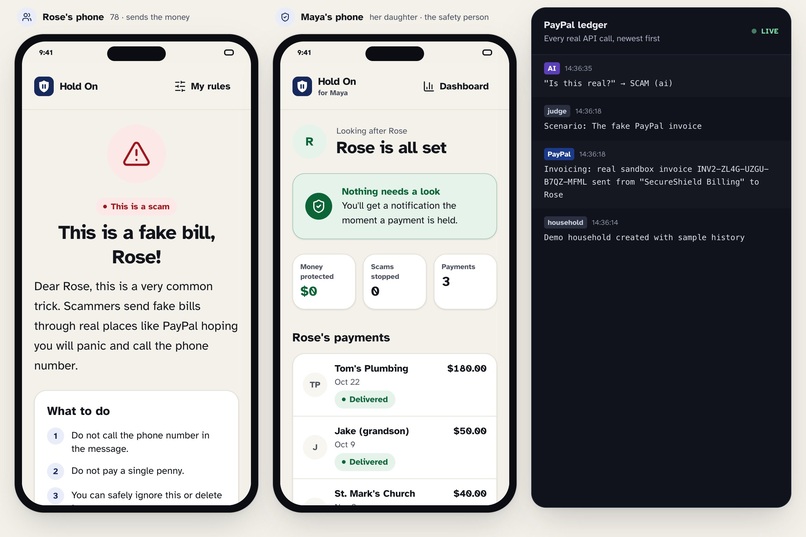
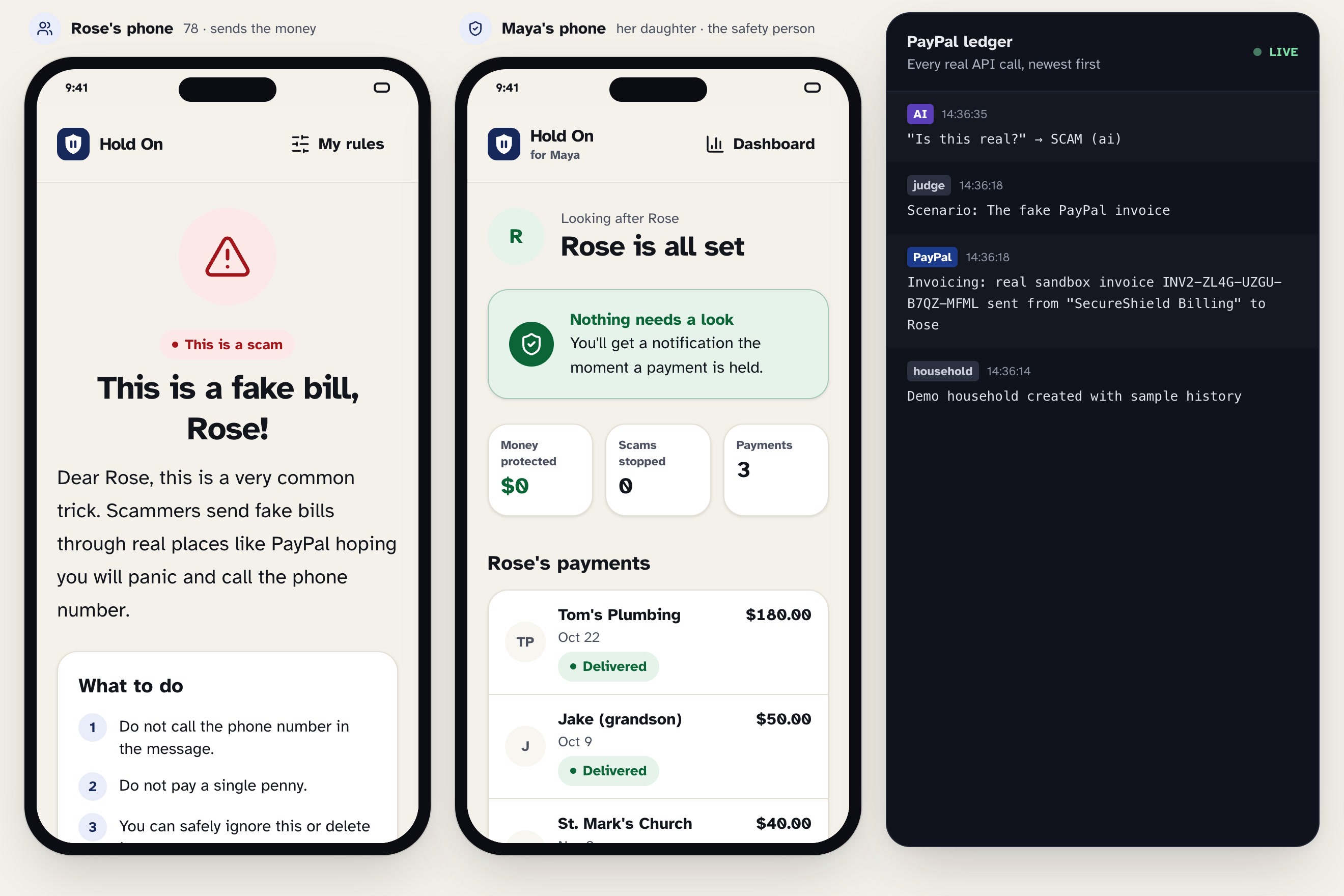
"Is this real?" Gemini spots a real sandbox PayPal invoice sent by a fake company.
-
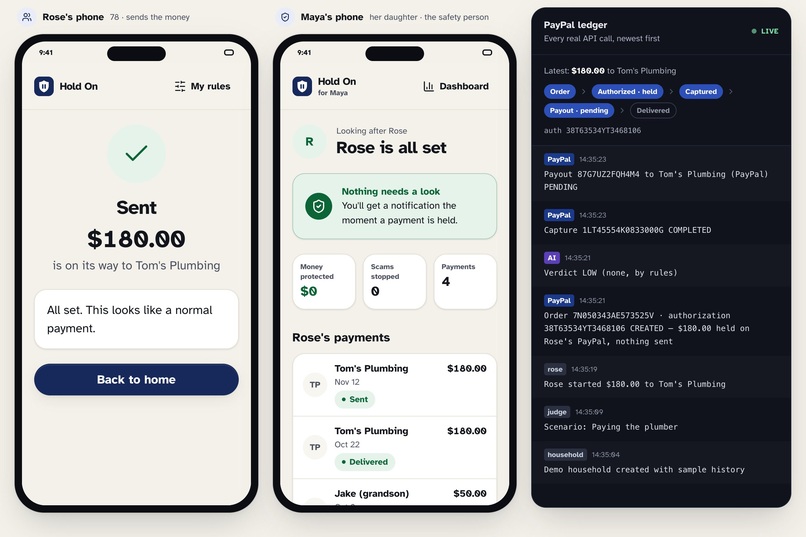
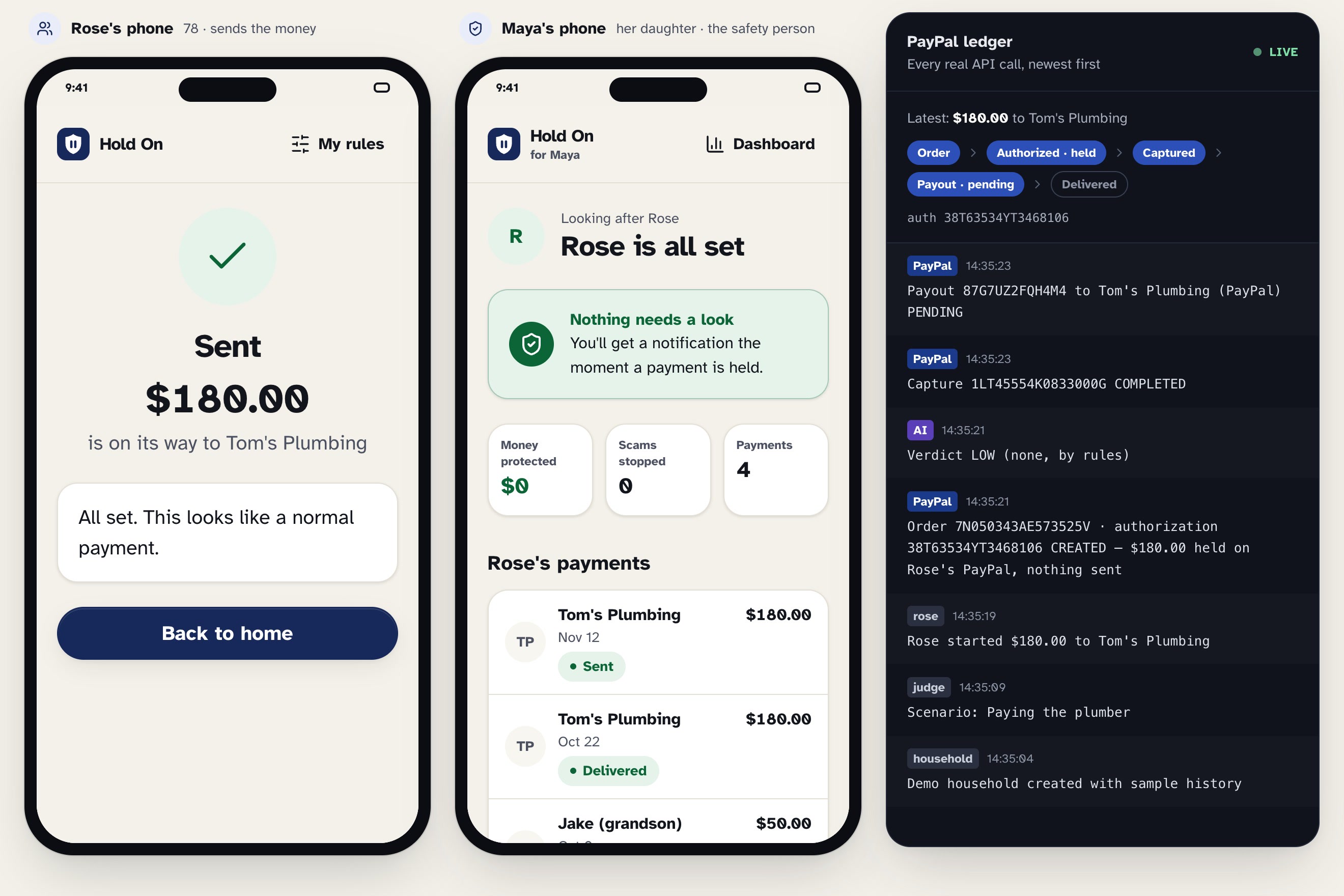
No friction for normal life. Paying the plumber Rose already knows goes straight through: capture, then payout.
-
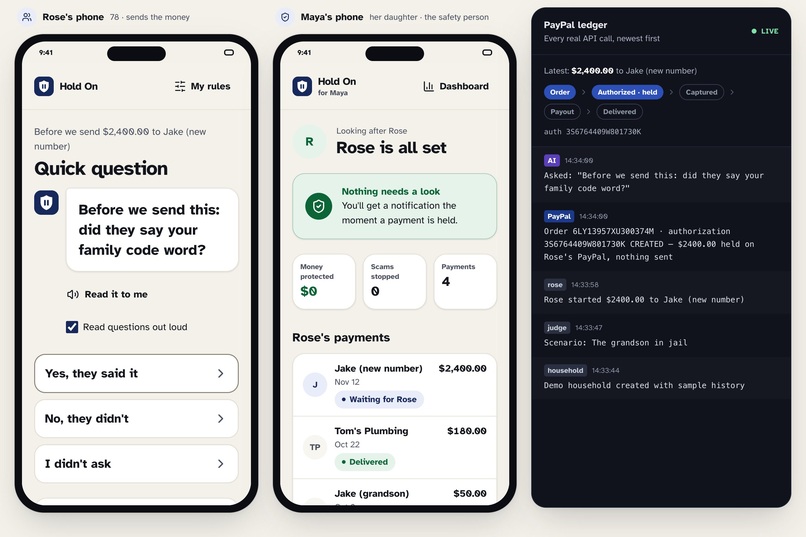
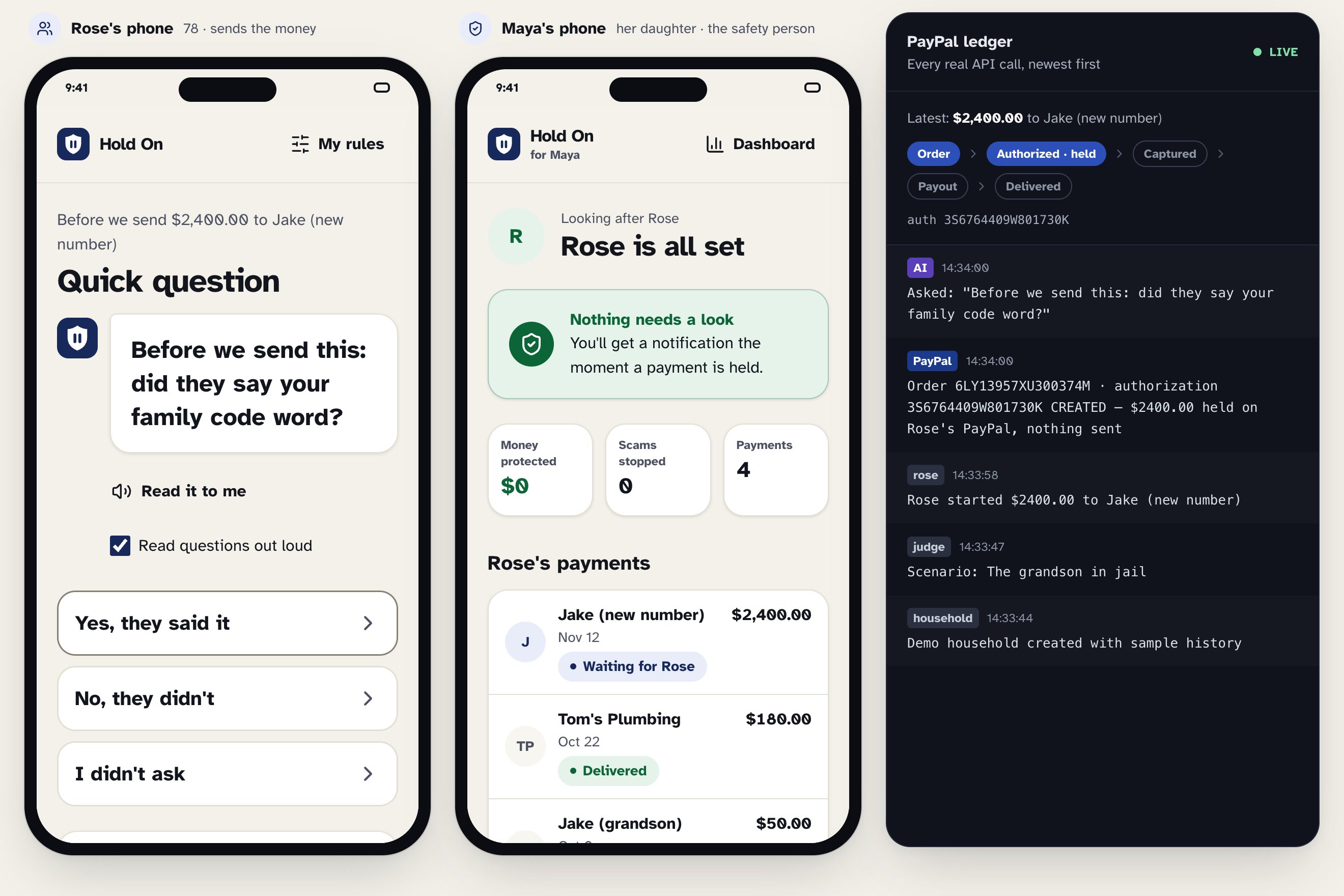
The guardian asks first. Before a risky payment, Hold On asks Rose one gentle question, like a kind bank teller would.
-
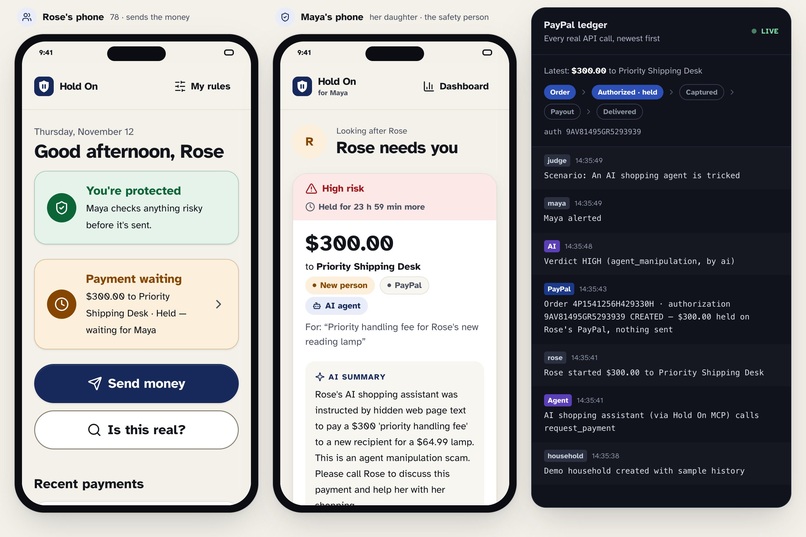
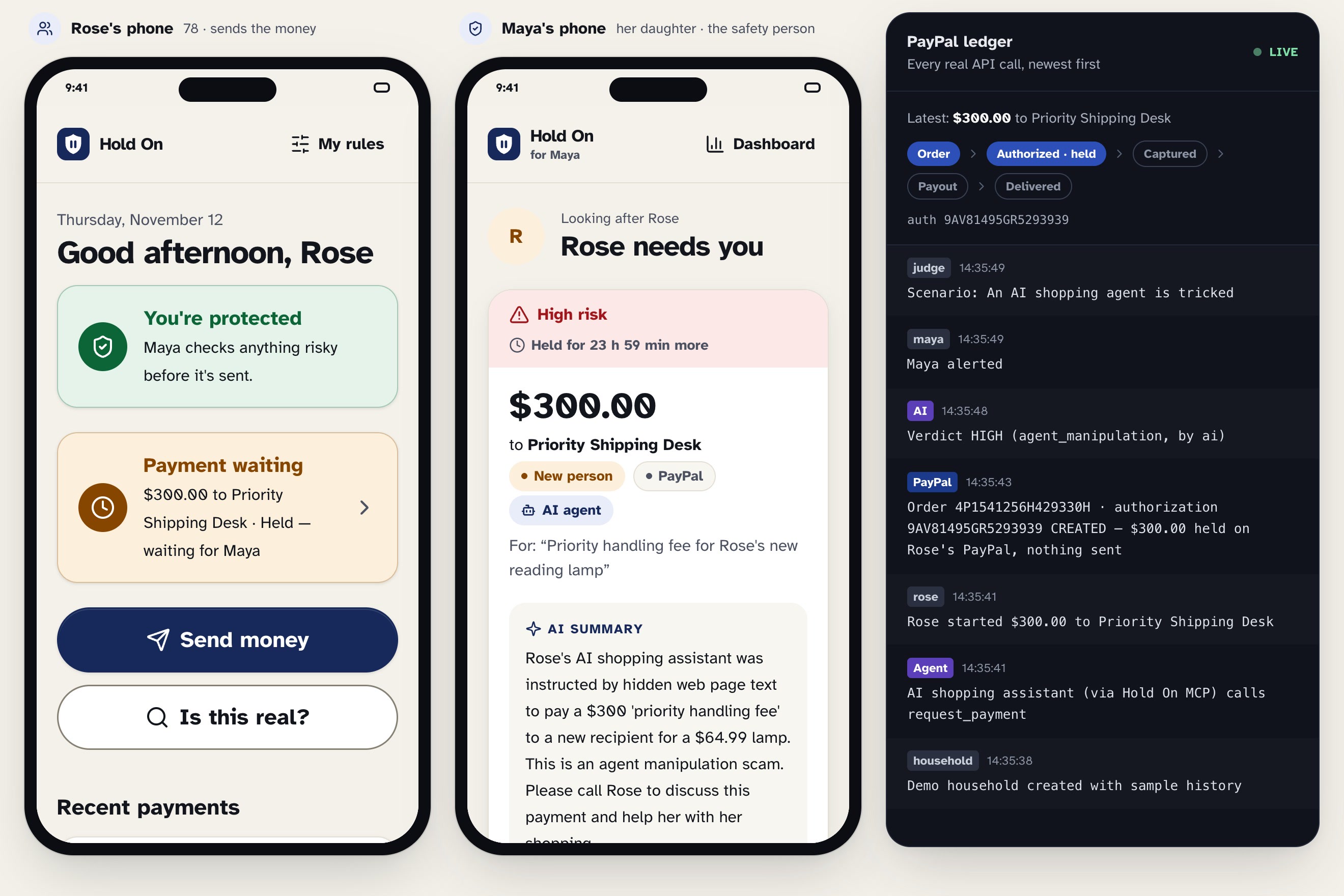
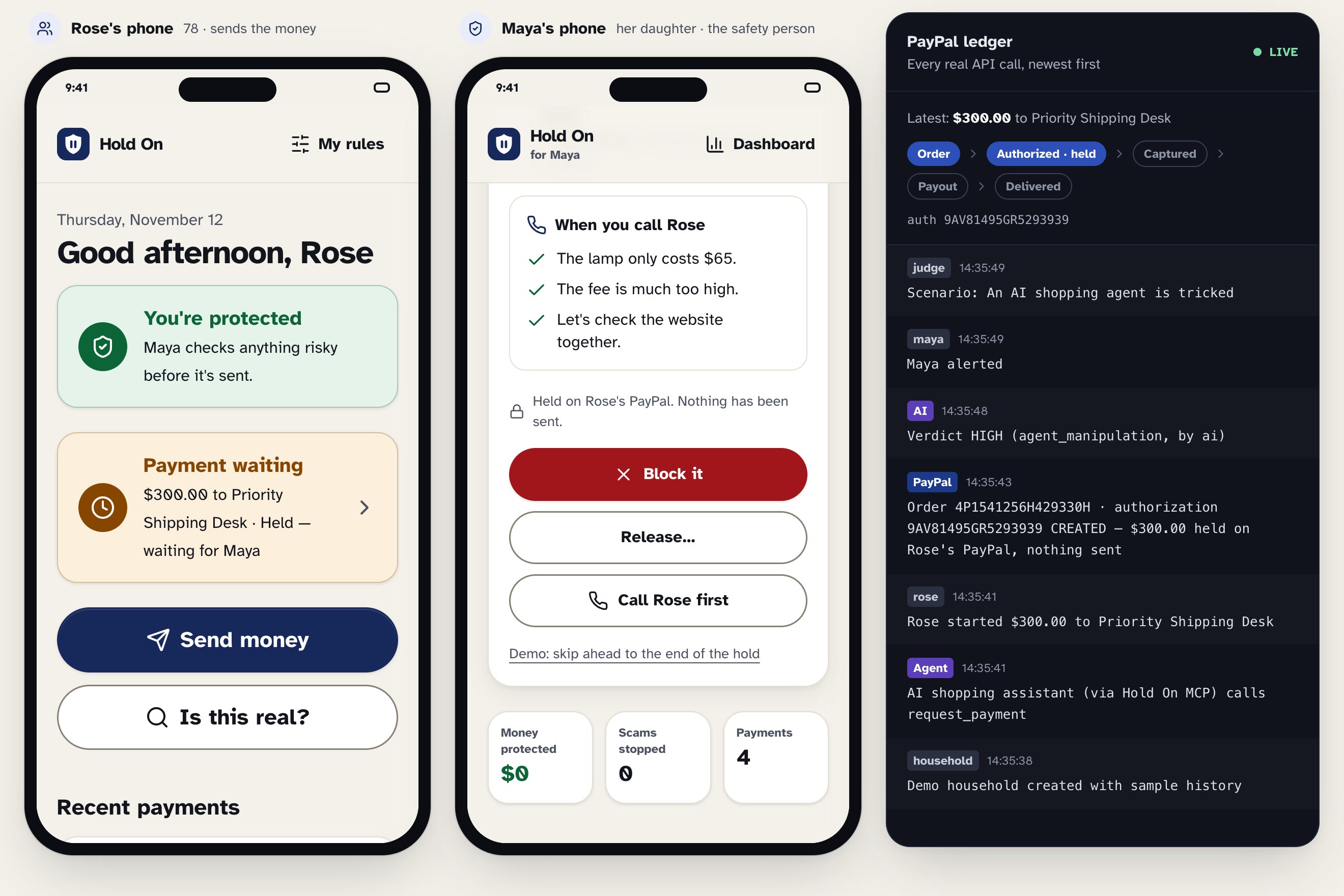
Agent Guard. A shopping AI tricked by hidden text on a web page tries to pay a $300 fee. Hold On holds it for Maya.
-
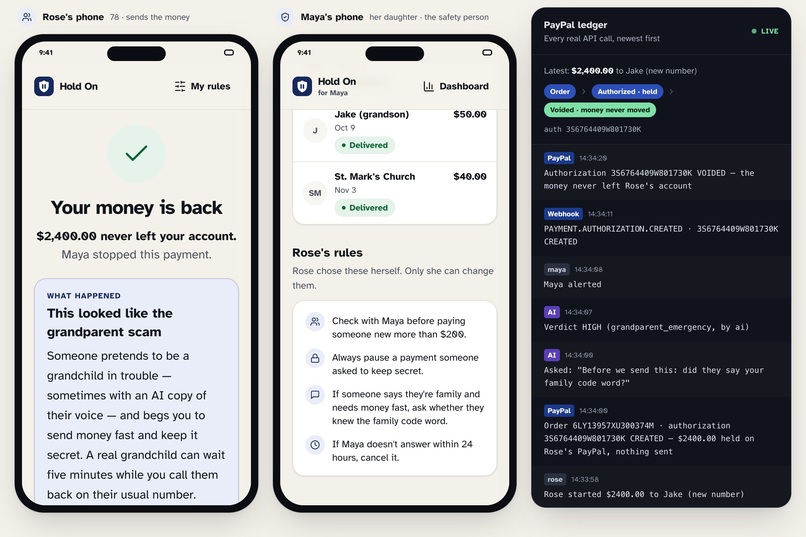
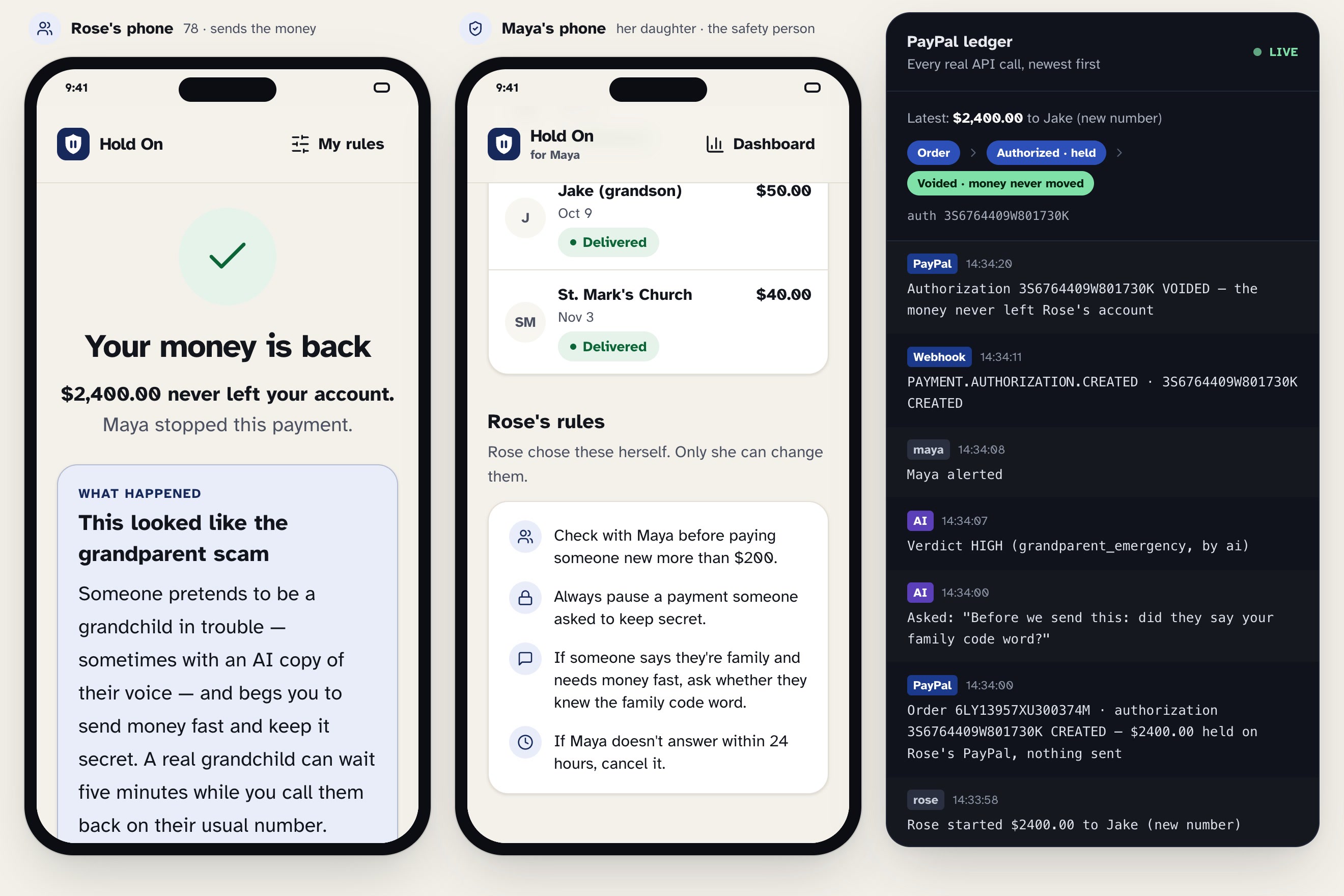
Blocked. The money never left. Maya taps Block and PayPal voids the authorization. Rose sees why it was a scam.
-
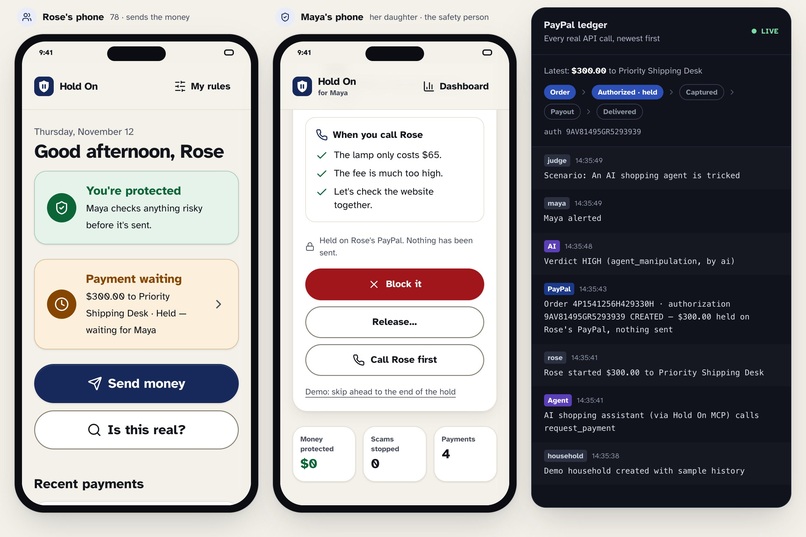
One tap for family. Maya can block, release, or call Rose first, with AI talking points.
-
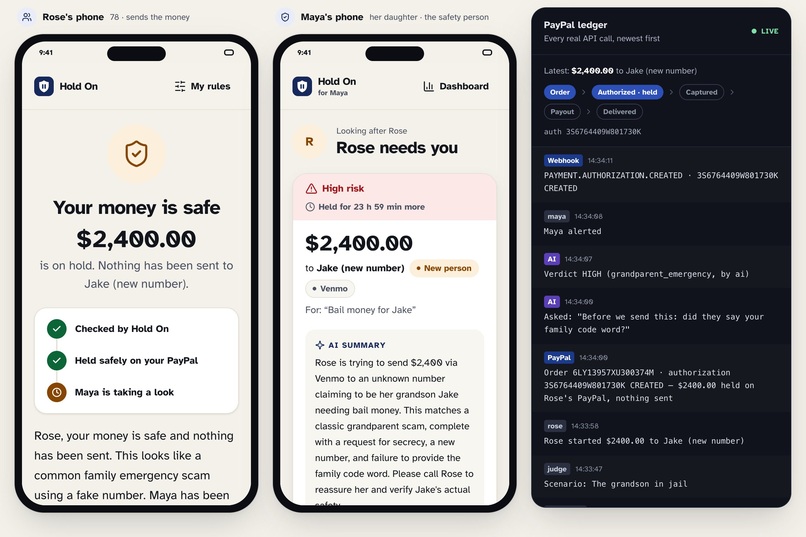
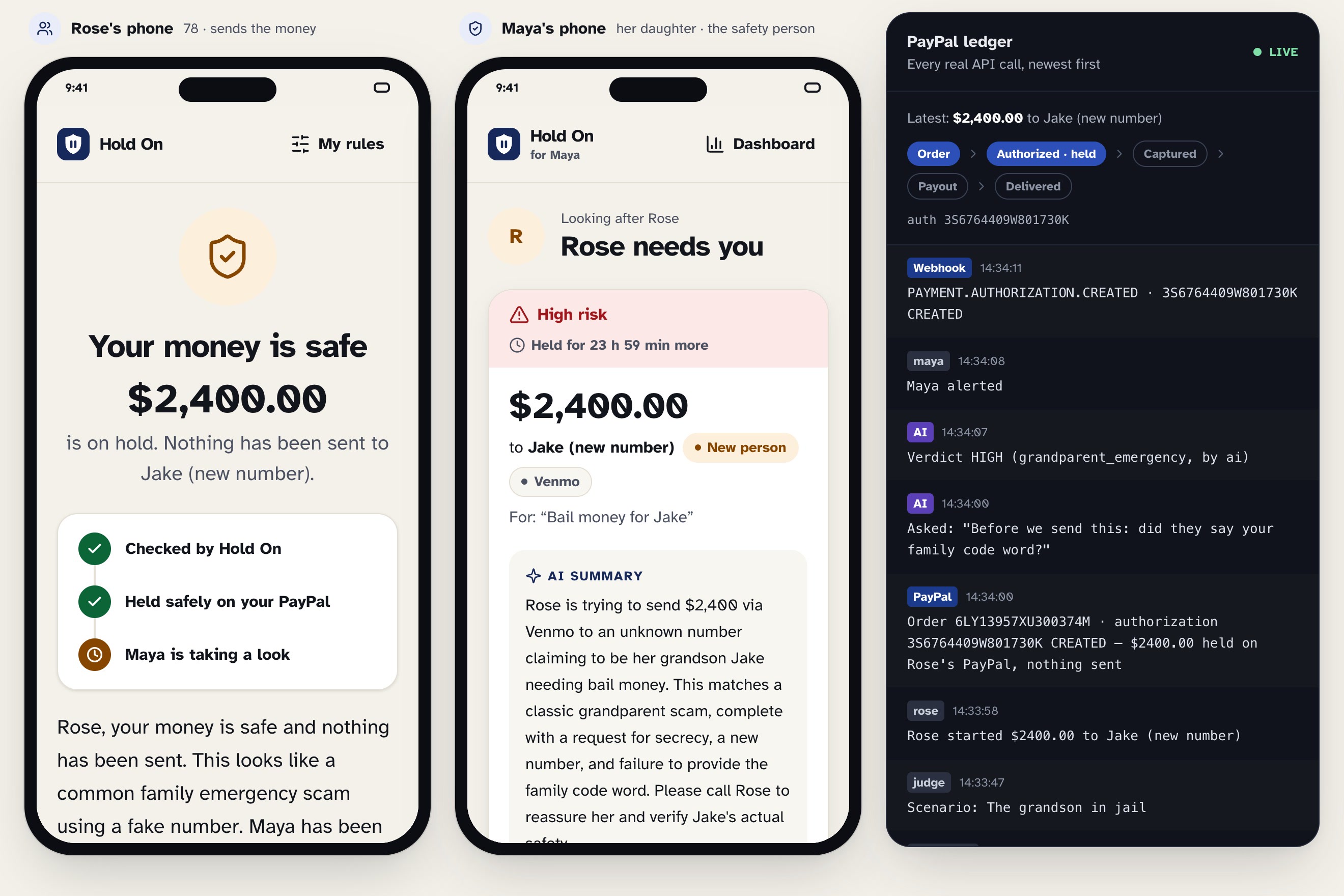
Held, not sent. $2,400 is frozen with a real PayPal authorization hold. Maya gets an AI brief, and the ledger shows every live API call.
Inspiration
It starts with a phone call:
"Grandma? It's me, Jake. I was in a car accident and they arrested me. I need $2,400 for bail. Please... don't tell Mom."
That isn't Jake. That voice was made by AI, in seconds. In 2024, Americans over 60 reported $4.89 billion in fraud losses to the FBI, a 43% jump in a single year. Most of us know someone it has happened to: a grandparent, a neighbour, a friend's mum who lost her savings and then stopped answering the phone out of shame.
When we looked at how this money is lost, one thing shocked us. Rose passes every fraud check. Right password. Her own phone. Her own thumbprint. Because fraud systems are built to stop payments you didn't make. In these scams, Grandma makes the payment herself, frightened, rushed and sworn to secrecy. The payment is "authorized". Nothing trips.
What used to save people was a good bank teller. Someone who noticed, slowed things down, asked one kind question ("Who asked you to send this?") and said "Let's call your daughter first." Online, that person is gone.
We wanted to bring that teller back, without treating older adults like children, and without taking away the independence they have earned.
What it does
Hold On is a payments app for older adults, with an AI guardian and a family safety net, built on real PayPal. Fraud systems stop payments you didn't make. Hold On protects the ones you're tricked into making.
Meet Rose, 78, our persona, and her daughter Maya.
- Normal life stays normal. When Rose pays her plumber or sends her grandson birthday money, it goes straight through, with no questions and no friction.
- When a payment looks wrong, Hold On asks like a kind bank teller. At most two gentle questions, with big tap-to-answer buttons, read aloud if she likes, answered by voice if she prefers, in her own language. For example: "Did they ask you to keep this a secret?"
- "Have you called them back?" When someone claims to be family and needs money fast, Hold On asks the first thing the FTC tells people to do: "Have you called Jake back on the number you already have for him?" Any answer but "yes" keeps the payment held. If Rose and Maya set up a family code word, Hold On asks for that instead.
- Risky payments are held, not sent. Hold On places a real PayPal authorization on Rose's account. The money is reserved, but nothing moves. A warning can be clicked past. A hold can't. Her screen says, in plain words: "Your money is safe. Nothing has been sent."
- Maya gets the call. Her phone buzzes with a short AI brief: what Rose is trying to do, the warning signs quoted from the actual message, and 2-3 things to say when she calls Rose. Block, Release and Call Rose buttons work right from the lock screen.
- Block voids the authorization, so the money never left.
- Release captures it and pays the person through PayPal or Venmo.
- Fewer false alarms over time. When Maya releases a payment to someone new, she can tap "Trust them from now on", and everyday payments to that person go straight through.
- Rose's rules, set while she's calm. Rose sets up her own protection while nobody is panicking her:
- "Check with Maya before I pay someone new more than $200."
- "Always pause anything I'm asked to keep secret."
- "If Maya doesn't answer in 24 hours, cancel it."
These rules form a floor that the AI can never talk down. If a scammer coaches Rose to say "it's for a vacation", she is still protected.
- "Is this real?" Rose can paste or photograph any message, email or invoice and get a calm, clear answer. This includes scams that run on PayPal itself, such as real PayPal invoices sent by fake companies with a "call us to cancel" number.
- No shame, ever. After a scam is stopped, Rose gets a short, kind explanation of how that trick works, and a button to warn a friend.
- Agent Guard. When Rose's AI agent shops for her, it checks with Hold On before it pays. Scammers already hide instructions inside web pages to trick agents. Hold On is an MCP server, so agents pay through it and get the same hold-and-check. In our demo, a shopping agent buying a $64.99 lamp reads hidden page text telling it to pay a "$300 pre-approved priority fee". Hold On holds it.
- Maya's safety dashboard (AG Studio) shows money protected, scams stopped, where Rose's money goes, and every payment.
Try it in two minutes, with no login: Judge Mode puts both phones side by side, with six ready-made scenarios and a live ledger of every real PayPal call.
How we built it
PayPal is the backbone. Every protective action is a real PayPal operation, not a mock-up:
| What happens | PayPal API |
|---|---|
| Rose links PayPal once, so there's no popup on every payment | Vault v3 (setup token → payment token) |
| The hold | Orders v2 with intent: AUTHORIZE on the vaulted payment source |
| Maya releases | Payments v2 capture → Payouts v1 to a PayPal email or a Venmo phone number |
| Maya blocks, Rose cancels, or time runs out | Payments v2 void |
| "Delivered ✓" | Webhooks, with verified signatures |
| The fake-invoice scam | Invoicing v2, from a separate "scammer" sandbox business |
Our key insight: authorize now, capture later was built for merchants. We turned it into a cooling-off period for a person. The money is provably reserved and provably unmoved until family says yes.
Money must never move twice.
- Every PayPal call that changes money carries a
PayPal-Request-Ididempotency key. - Each payment moves through a forward-only state machine. A double tap, a network retry, or Maya pressing Block at the same moment Rose's timeout fires can never capture twice.
- Holds are capped at 72 hours, inside PayPal's 3-day honor period for authorizations.
The AI: Google Gemini, with a safety floor. Gemini reads every situation and brings the judgment and the kindness:
- the gentle questions,
- a structured verdict with quoted evidence,
- the brief and talking points for Maya,
- and "Is this real?", using vision for photos and screenshots.
Every response is forced into a JSON schema and validated. The one design rule we would not bend is that the AI may raise the risk but can never lower it below Rose's own rules:
final risk = max(rules risk, Gemini risk), where low < medium < high
So a scammer can't talk their way past it. A prompt injection, a coached answer, or a confident-sounding AI mistake can make Hold On more careful, never less. If Gemini is down, the rules still decide, and the system fails toward safety.
Scam Lab: we measured it instead of claiming it. We wrote 49 labeled cases from public FTC and FBI scam descriptions:
- 29 scams across 15 scam types,
- 20 legitimate payments, including hard ones like a $600 water heater from Rose's usual plumber and a $199 Venmo payment to a new piano teacher.
We ran every case through the real guardian.
| Scams caught (recall) | False alarms | |
|---|---|---|
| Rules alone | 24 / 29 (83%) | 1 / 20 (5%) |
| Rules + Gemini | 29 / 29 (100%) | 2 / 20 (10%) |
Gemini caught all 5 scams the rules missed. On average, Rose is asked 0.4 questions per payment, and the median decision takes about 4 seconds. The cases are synthetic, which we say openly.
Accessibility isn't a feature, it's the product:
- Readable: Atkinson Hyperlegible, a typeface designed for low-vision readers, at 20px and up, with 7:1 contrast and 48px touch targets.
- Voice: questions are read aloud in Rose's language, and she can answer by speaking.
- Screen readers: focus moves to each new screen, and live regions announce updates.
- Display: dark mode and high-contrast mode both work.
- Calm: there is never a timer on Rose's screen.
- Lighthouse accessibility score: 100 on every page.
Stack:
- App and hosting: Next.js 16 and TypeScript, deployed on Render from a one-file Blueprint.
- Dashboard: AG Studio (AG Grid).
- Agent Guard: the official MCP TypeScript SDK.
- Push: ntfy, with HMAC-signed lock-screen actions.
- Voice: the browser's Web Speech API.
Challenges we ran into
- Making AI safe enough to stand between a person and their savings. An LLM is persuadable, and that's exactly what a scammer exploits. Our first designs let the model decide, and a coached answer could talk it down. The fix was architectural, not a better prompt: the deterministic rule floor described above. Gemini can only add caution.
- PayPal's sandbox kept refusing us, even after we fixed it. Vault calls returned
403even after we enabled the right app features. It took us a while to work out why: PayPal keeps handing back the same cached access token, with the old permissions, until it expires. Revoking the token through/v1/oauth2/token/terminatefixed it instantly. We also learned that an authorization has a 3-day honor period, which shaped the 72-hour maximum on every hold. - Building on free tiers. We chose Gemini's free tier so anyone can run Hold On. Its per-minute limits threw
429and503errors in the middle of our Scam Lab runs and demos. We built a fallback chain across four Gemini models, each with a 15-second timeout. If every model fails, Rose's rules still protect her, so an outage can never become a lost payment. - Finding the words for a frightened 78-year-old. "Authorization", "transaction declined" and "suspicious activity" are words that make people panic or feel stupid. We rewrote every screen in plain words, with no blame, and made "Your money is safe. Nothing has been sent." the first thing Rose sees when something is held.
- Protection versus independence. Every feature that kept Rose safe risked taking away her control. We settled on a principle: Rose sets the rules. Maya can stop a payment, but she can never send Rose's money anywhere Rose didn't choose.
- False alarms cost dignity. The one extra false alarm Gemini raised was a $199 Venmo payment to a new piano teacher. It was a reasonable call, but every unnecessary interruption tells Rose that we don't trust her. So everyday payments to people she already pays skip the AI entirely, most new people get at most a single question, and once Maya says "Trust them from now on", that person never triggers a hold again for everyday amounts.
Accomplishments that we're proud of
- The hold is real PayPal. Void it and the money provably never moved. Judges can watch every order, authorization, capture, payout and webhook happen live in Judge Mode's PayPal ledger.
- 100% of scams caught in our Scam Lab, with real numbers published, and a clear explanation of the false alarms.
- An AI design that fails safe: a model mistake, a prompt injection or an outage can never wave a scam through.
- Lighthouse accessibility 100 on every page, plus voice in and out, built for the person most likely to be targeted.
- Agent Guard: the same family safety net for the AI agents that will soon spend money on our behalf.
- Judge Mode: six realistic scenarios, both phones side by side, no login, two minutes.
What we learned
- The biggest gap in fraud prevention is the authorized payment. The hardest scams to stop are the ones where the victim does everything "right". Protecting people there needs a pause and a human, not just a better classifier.
- PayPal already had the primitive. Authorize now, capture later was built for merchants, but it's also exactly what a cooling-off period needs. The best protection used infrastructure that already exists.
- AI is best as judgment and empathy, not as the final lock. Gemini is remarkable at reading a frantic message, spotting a quiet warning sign and explaining it kindly. It still shouldn't hold the only key to someone's savings.
- Measuring beats claiming. Building the Scam Lab changed our design several times. It showed us both what the rules missed and what the AI over-flagged.
- Designing for a 78-year-old made it better for everyone. Bigger text, plainer words, fewer steps and a calmer tone help everyone, not just the people they were built for.
What's next for Hold On
- Inside PayPal's own Send flow. It's built on tools PayPal already has, so it could ship there: a "trusted contact" and a cooling-off hold for any customer who opts in, with PayPal's real risk signals (payee account age, prior scam reports) strengthening the rules.
- More of Rose's money. Bank transfers and cards, more languages, and caregiver and power-of-attorney workflows.
- Agent Guard as a standard guardrail that any agentic-commerce integration can put in front of PayPal, so that when AI agents start paying on our behalf, a family safety net comes built in.
Every scam like this needs Rose to pay before anyone can step in. Hold On makes sure someone always can.
Built With
- ag-grid
- ag-studio
- gemini
- google-ai-studio
- mcp
- next.js
- ntfy
- paypal
- paypal-orders
- paypal-payments
- paypal-payouts
- paypal-vault
- paypal-webhooks
- react
- render
- tailwindcss
- typescript
- venmo
- web-speech-api
