Inspiration
As Hokies, we make financial decisions every day: grab food on campus, buy something we need, or put money toward a savings goal. But those decisions happen across separate places—bank balances, dining funds, campus charges, and our own mental budgets.
We wanted one place that answers more than “What did I spend?” We wanted to ask, “What can I do next, and how will that affect my goals?” That became Hokie Wallet: a student-built financial planning companion centered on the everyday realities of Virginia Tech students.
Our team is sudo win—a nod to the command line and the spirit of building together.
What it does
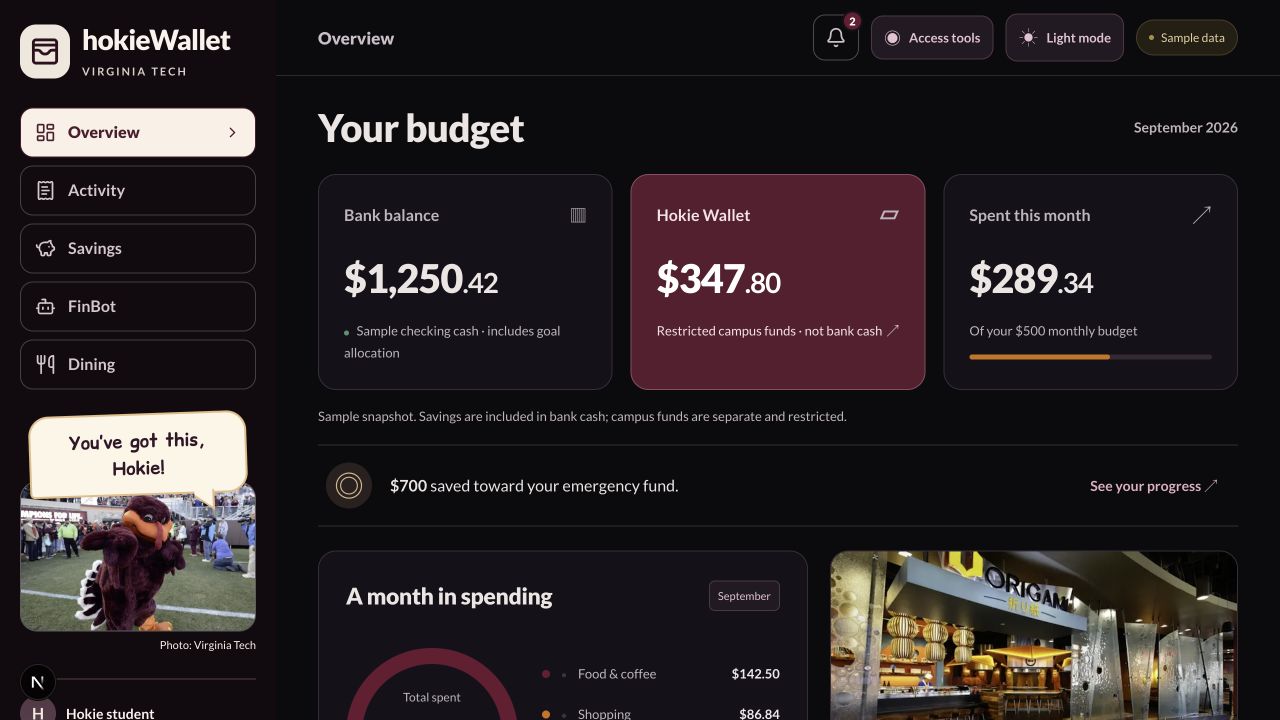
Hokie Wallet brings account balances, campus funds, recent activity, and savings goals into a clear dashboard. It keeps restricted campus money separate from spendable bank cash, so a dining balance never becomes an imaginary source of rent money.
Its strongest feature is looking ahead. Students can preview a hypothetical purchase or contribution and see its effect on their cash buffer and projected savings dates before confirming a plan change. The backend considers dated income, bills, existing goal allocations, and weekly spending allowances.
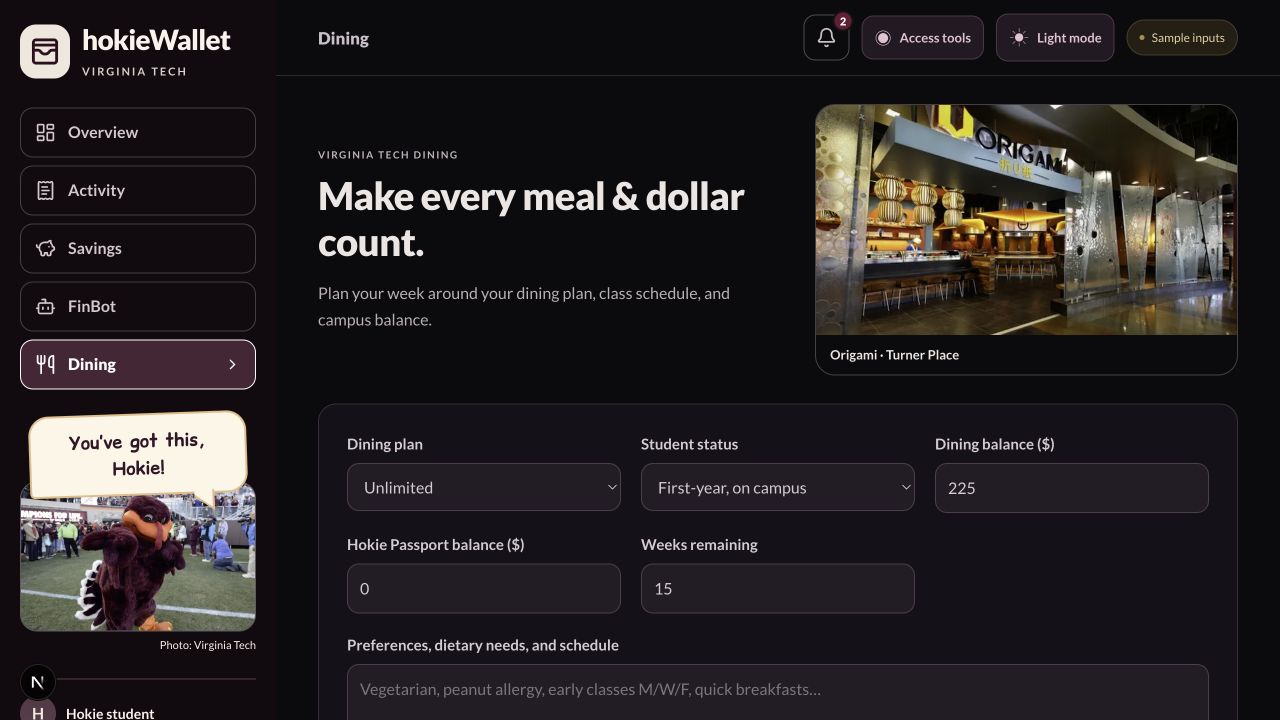
FinBot and the dining-planner interface extend that experience through conversational guidance and campus meal planning. Adjustable text size, selectable color palettes, light and dark themes, reduced motion, interface-language choices, and read-aloud controls help more students use the experience comfortably.
Our current prototype includes a labeled interactive demo, a working calculation engine, verified Nessie sandbox data retrieval, and verified ANS planner discovery. Hosted authentication and live AI flows are still undergoing final integration testing.
How we built it
Carlos and Neha built the frontend with Next.js, React, and TypeScript. Bilguun and Grant built a Fastify and TypeScript backend, with Supabase authentication and persistence support.
Capital One’s Nessie API supplies sandbox banking data; campus balances and charges are entered manually. Hokie Wallet is an independent student project, with no official connection to Virginia Tech financial accounts.
We implemented a Coach-to-Planner agent architecture: the Coach interprets a request, the Planner calculates its financial impact, and the Coach explains the result. GoDaddy ANS supports planner discovery, with a signed communication path implemented in code. Financial arithmetic stays in deterministic backend code rather than being invented by a language model.
We used existing open-source frameworks and AI-assisted development tools, including ChatGPT and Codex, to build and iterate on the prototype.
Challenges we ran into
Working across separate frontend and backend branches taught us how much shared contracts matter. We also had to distinguish restricted funds from available cash, prevent savings allocations from being counted twice, and handle incomplete financial information honestly.
Connecting authentication, provider services, and a polished interface was our biggest integration challenge. We kept demo data clearly labeled so unfinished connections could never masquerade as live results.
Accomplishments that we’re proud of
We turned a problem we experience as students into an accessible, cohesive prototype. We retrieved real Nessie sandbox data and built purchase comparisons that explain consequences in terms students understand: protecting a cash buffer or changing a goal’s completion date.
We also implemented explicit save confirmation, version checks, and duplicate-save protections, backed by automated frontend and backend tests.
What we learned
A useful financial tool needs clear boundaries and trustworthy calculations as much as an attractive interface. We learned to separate AI explanations from financial calculations, design around missing information, and collaborate through shared API contracts.
What’s next for Hokie Wallet
Finish hosted end-to-end verification, activate the live FinBot and dining experiences, and test with fellow Hokies. Their feedback will guide better campus planning, clearer explanations, and a smoother first-time setup.
Prototype screenshots
Built With
- next.js
- react
- supabase
- typescript

Log in or sign up for Devpost to join the conversation.