Inspiration
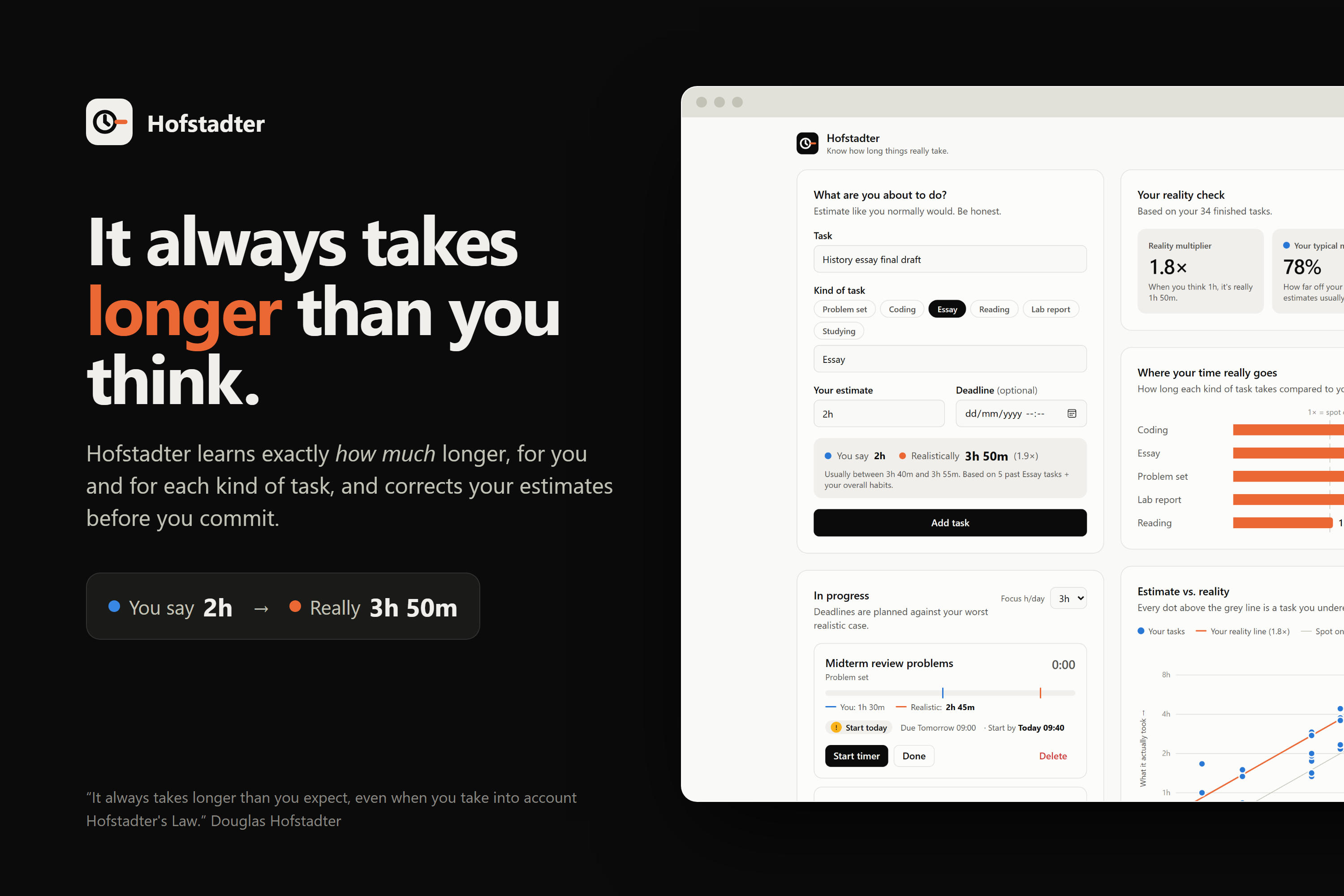
"It always takes longer than you expect, even when you take into account Hofstadter's Law." Douglas Hofstadter, Gödel, Escher, Bach
Every student knows the feeling. "This essay will take two hours" becomes an all-nighter. Psychologists call it the planning fallacy: we underestimate our own tasks even when we know we've underestimated before.
Most productivity apps respond by asking you to plan harder. But the bias isn't in your planning, it's in the estimate itself. When we looked at our own habits, we noticed something useful: we're wrong in a consistent way. Our essays always took about twice as long and our readings almost exactly as long as we thought. A consistent error can be measured, and a measured error can be corrected.
What it does
Hofstadter is a reality check for your time estimates.
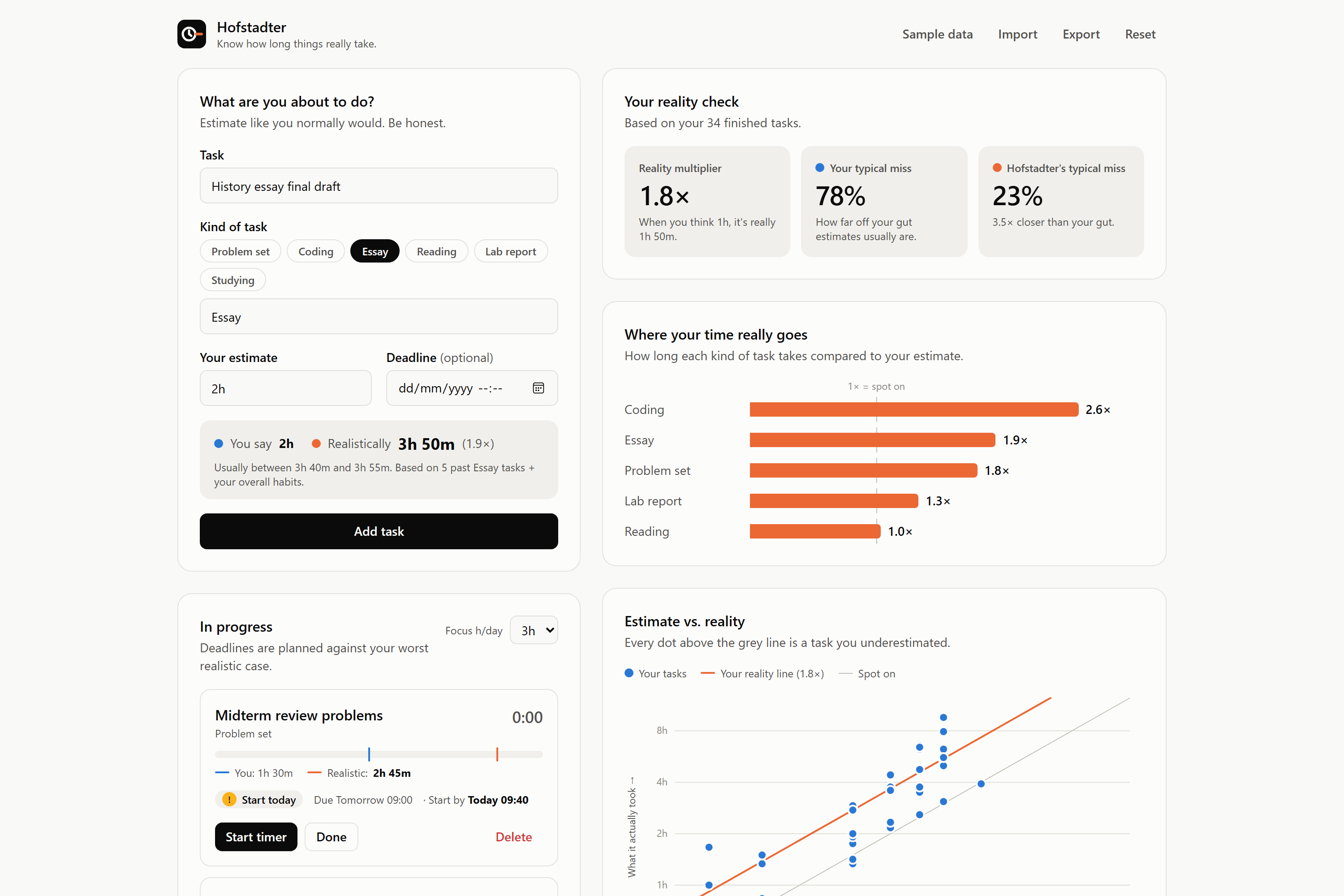
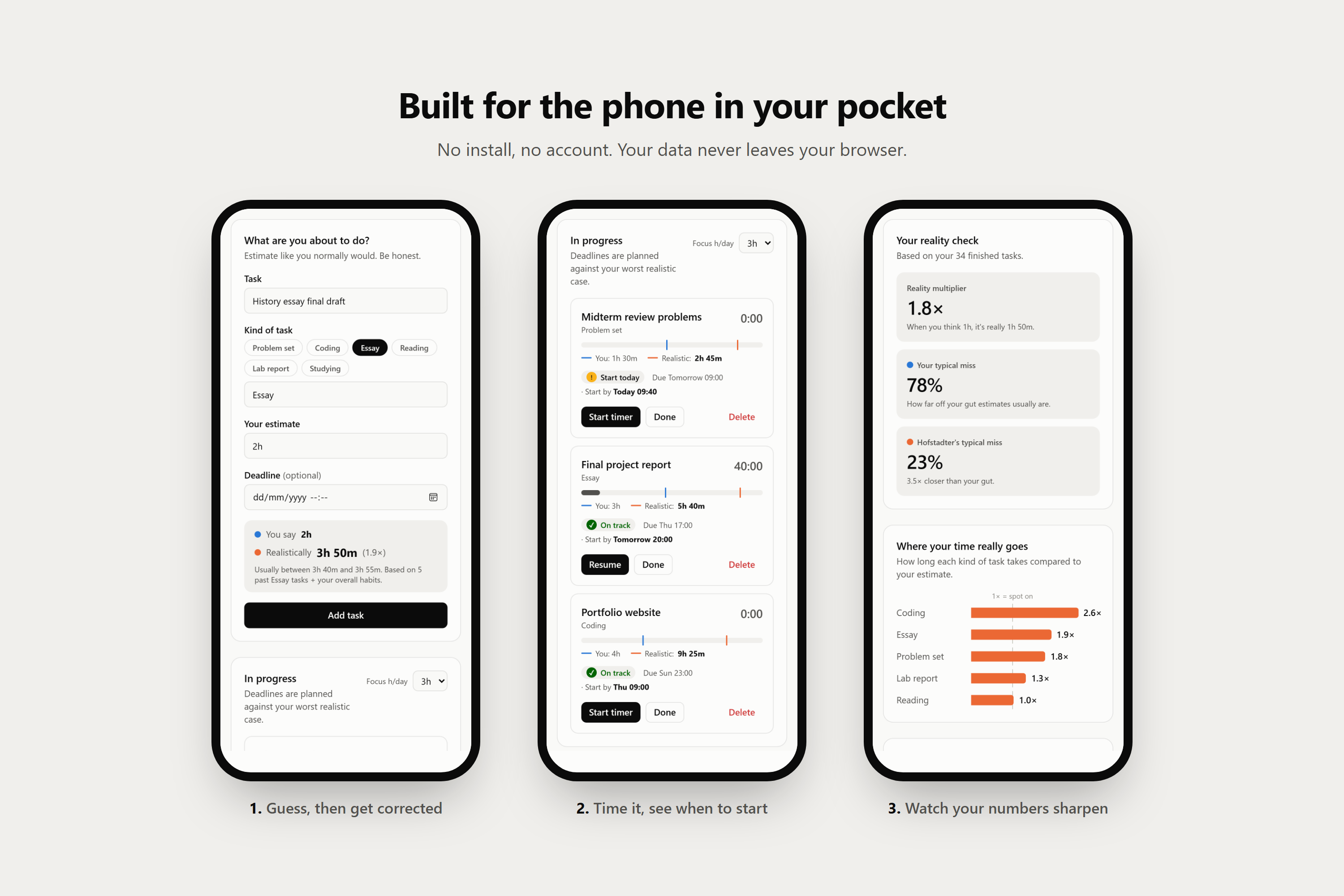
- Guess. Add a task, pick what kind it is (essay, coding, reading…) and type your gut estimate:
2h,45m,1h30. - Get corrected, live. Before you even save it, Hofstadter answers from your own history: "You say 2h → realistically 3h 50m (usually 3h 40m–3h 55m), based on 5 past essays."
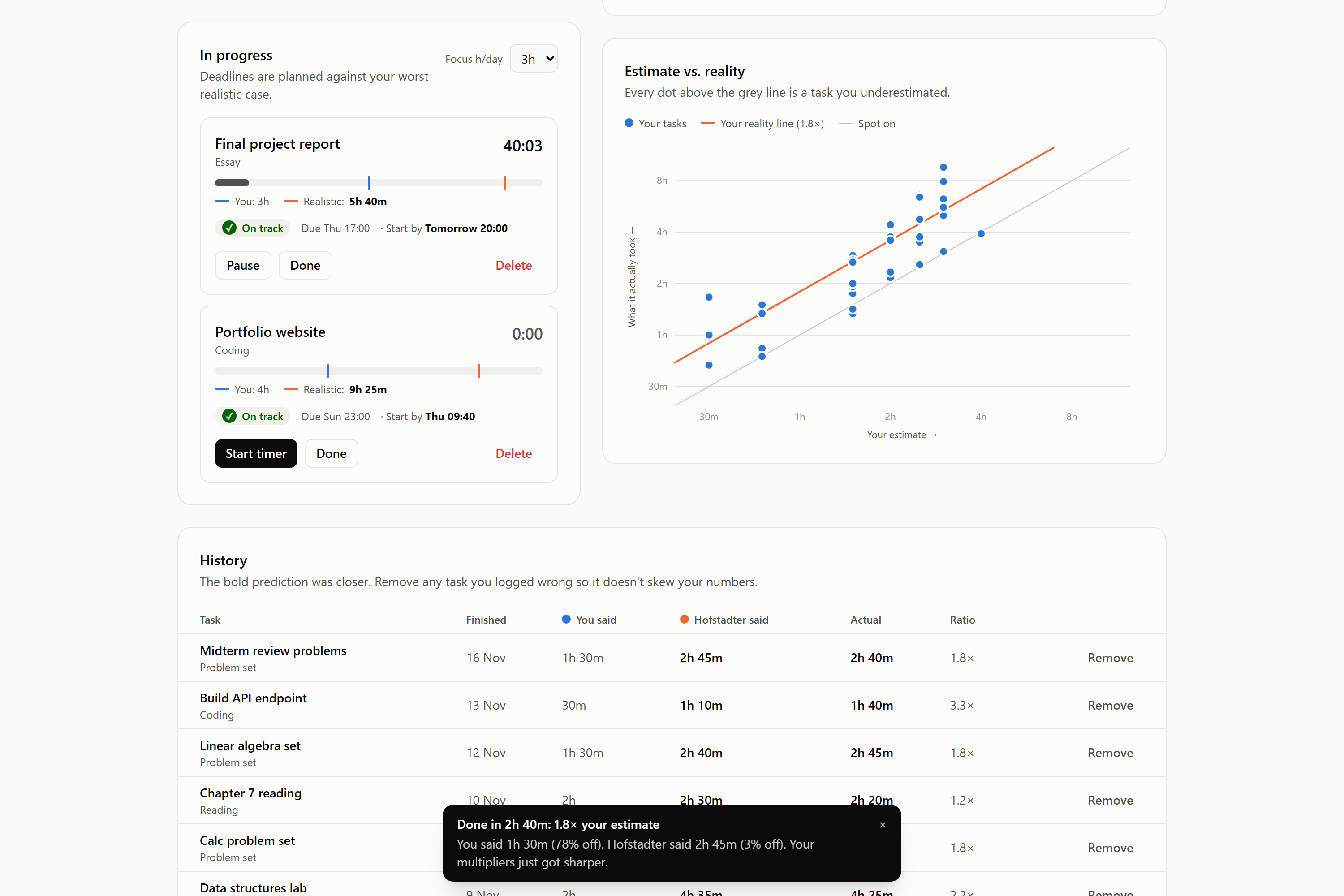
- Time it. Start a timer, or type the real time when you're done.
- It learns. Every finished task sharpens your personal reality multiplier for that kind of work.
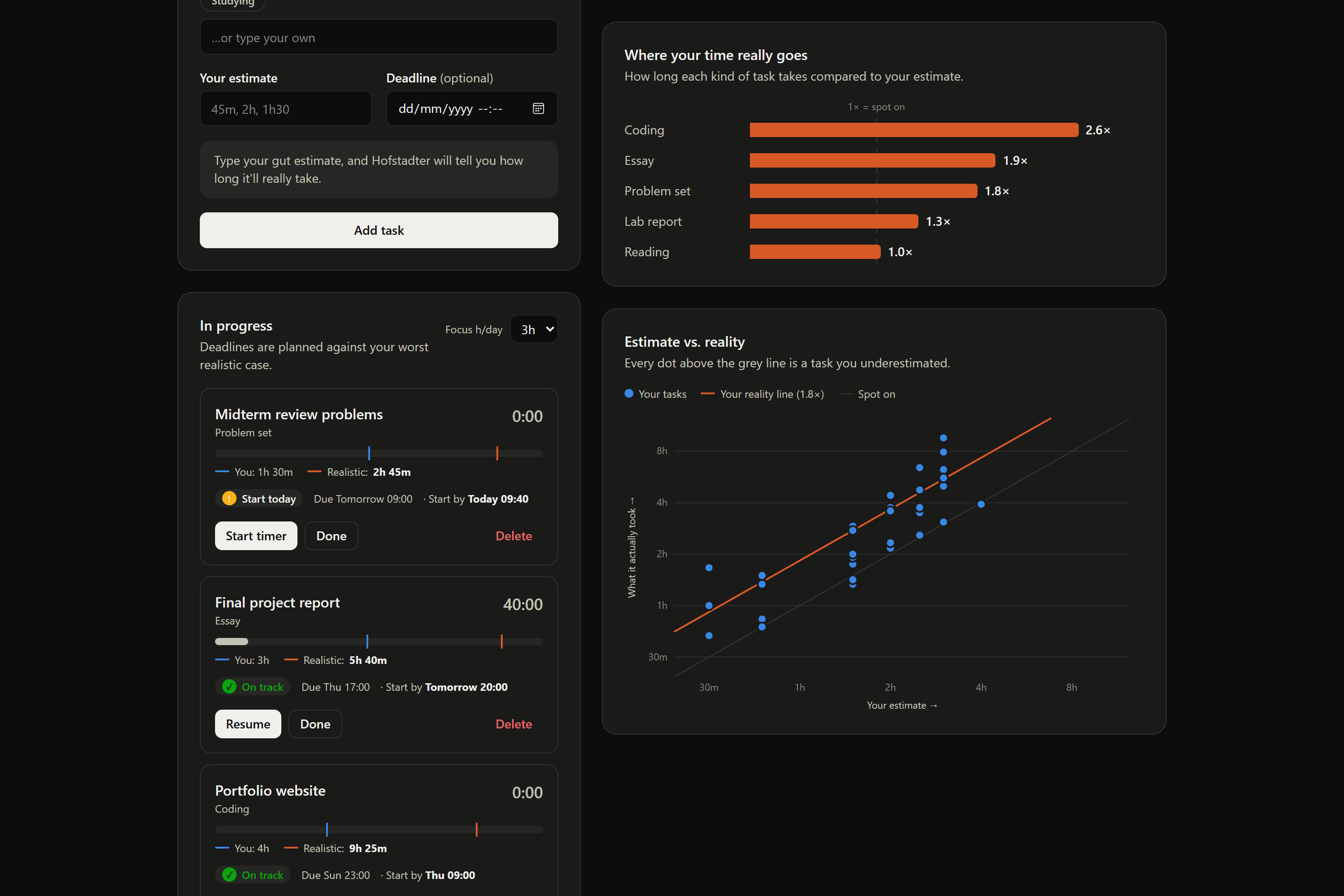
- Plan deadlines honestly. Add a due date and Hofstadter works backwards from your worst realistic case and how many focus hours you have per day, then tells you when you really need to start. If you can no longer make it at a sustainable pace, the task is flagged at risk.
It proves itself. When a task is created, Hofstadter freezes its prediction. When the task is done, both your guess and Hofstadter's are scored against reality. In our sample data, gut estimates were typically 78% off and Hofstadter's were 23% off, about 3.5× closer.
No account, no install, no API keys. Your data never leaves your browser.
How we built it
- React 19 + Vite + Tailwind CSS 4 for a fast, responsive UI with light and dark themes.
- TypeScript domain core (
src/lib): the model, task state transitions, duration parsing and storage validation are framework-free and covered by 46 unit tests (Vitest). - A deliberately simple, explainable model. Each finished task gives
ratio = actual / estimate. We work in log space, because "twice as long" and "half as long" are equally wrong. Your multiplier is the median of recent ratios per category, blended toward your overall habits when a category has little data. The likely range is the 20th–80th percentile. - Hand-built SVG charts, no chart library: a log-scale estimate-vs-reality scatter plot with your personal reality line, and per-category bars. The colour palette is checked for colour-blind safety, and status colours always come with an icon and a label.
- Local-first storage with validated JSON import/export, deployed as a static site on Vercel.
Challenges we ran into
- Tiny data. A new user has zero to five data points. Averages swing wildly on that little data. Medians plus shrinkage toward your overall behaviour give sensible predictions from your first finished task, without overreacting to one disaster.
- Not fooling ourselves. It's easy to make a model look accurate by scoring it on data it has already seen. We freeze every prediction at creation time, and the sample data is generated the same way, so each prediction only sees earlier history.
- Advice a human can follow. Our first deadline planner suggested starting a task "by 23:40". It was mathematically correct and useless in practice. Start times now land in waking hours and only ever move earlier.
- Timers that survive real life. Timers store a start timestamp instead of a ticking counter, so closing the tab or losing battery doesn't lose time.
Accomplishments that we're proud of
- The moment you type an estimate and watch it get corrected before you commit. That's the whole idea in one interaction.
- Every number on screen can be explained in one sentence. No black box.
- It works on any phone, in light and dark mode, with keyboard navigation and screen-reader labels on the charts.
- A codebase another student could pick up tomorrow: small, tested, documented, with only React and React DOM as runtime dependencies.
What we learned
- The planning fallacy is remarkably stable per person and per task type, which is why a simple model works.
- Robust statistics (medians, log ratios, shrinkage) beat fancy models when you have ten data points.
- Good UX copy matters as much as good maths: "1.9×" means little, but "when you think 1h, it's really 1h 55m" lands.
What's next for Hofstadter
- Optional account sync so your multipliers follow you across devices
- Calendar export of "start by" times
- Spotting when you underestimate most: late nights, Mondays, the week before exams
- Splitting big tasks into steps, focused on the categories where your estimates are worst
Built With
- css3
- html5
- javascript
- react
- svg
- tailwindcss
- typescript
- vercel
- vite
- vitest
