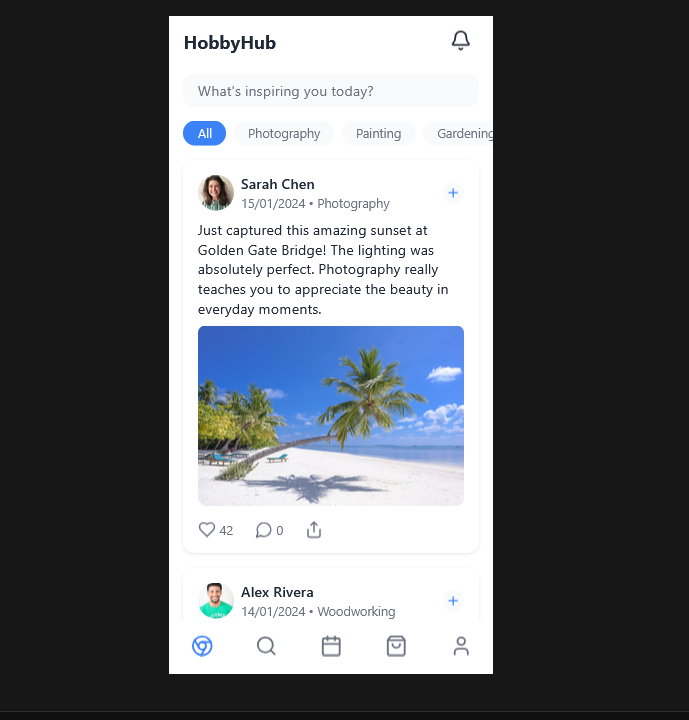
It's exciting to talk about HobbyHub, a project I'm particularly enthusiastic about!
The Story Behind HobbyHub
What Inspired Me
The inspiration for HobbyHub sprung from a simple observation: in our increasingly digital world, genuine, local connections often get lost. While there are countless online communities, many are too broad to foster the kind of immediate, in-person interaction that truly enriches a hobby. I envisioned a goble platform that could bridge this gap.
I saw people in the world with incredible passions – from intricate traditional crafts to modern tech hobbies – often working in isolation, or struggling to find others who shared their specific interests nearby. The idea was to create a globle digital "town square" where these enthusiasts could easily discover each other, share their work, learn new skills, and even organize local meetups or workshops.
What I Learned
Building HobbyHub, even conceptually, was a fantastic learning experience across several dimensions:
The Power of globle Focus: Initially, I considered a niche, local platform, but quickly realized the immense value in starting globle . This allows for more meaningful connections and a stronger sense of community.

User Experience is Paramount: For an app like HobbyHub, the interface needs to be incredibly intuitive and visually appealing. Users are often engaging with their passions, so the app should feel like an extension of that joy, not a barrier. This reinforced the importance of clean design, smooth navigation, and a "content-first" approach where user creations shine.

Balancing Simplicity and Richness: The challenge was to offer enough features to be genuinely useful (like event discovery and marketplace) without overwhelming the user or making the app feel cluttered. It's about finding that sweet spot where functionality meets ease of use.

Community Moderation is Key: While not explicitly built out, the foresight into how communities need to be managed (e.g., preventing spam, ensuring respectful interactions) became clear. A good app for connecting people also needs good community guidelines and potential moderation tools.
How I Built (Conceptualized) My Project
My approach to "building" HobbyHub involved a structured conceptualization, much like an architect designs a building before construction begins:
Define the Core Problem: Lack of globle, accessible platforms for hobbyists to connect.

Identify the Target Audience: Hobbyists in the world , ranging from beginners to experts.

Brainstorm Core Features: What absolute necessities would make this app valuable? This led to the ideas of personalized feeds, discovery, messaging, and groups.

Visualize the User Journey: I walked through how a user would sign up, find a friend, join a group, or post an event. This helped identify key screens and interactions.

Prioritize "Stunning" Elements: This wasn't just about functionality, but about the feel of the app. High-quality visuals, smooth animations, and an intuitive flow were integrated into every feature idea.

Consider Technology Stack: I mentally mapped out suitable technologies (e.g., React Native/Flutter for cross-platform, Firebase/AWS for backend) that would enable this vision efficiently. but since this challange is from bolt  i used bolt.new platform to build it (vibe coaded)

Strategize for Growth: ensuring the architecture could support scaling.
This iterative process of ideation, refinement, and user-centric thinking allowed the comprehensive prompt to be formulated, encapsulating all the necessary components for development.
Challenges I Faced (and Anticipated)
Even in the conceptual phase, certain challenges became apparent:
Achieving Initial User Adoption (The "Cold Start" Problem): Getting enough hobbyists onto the platform from word wide . to make it genuinely valuable from day one is tough. Without enough users, the network effect won't kick in. This led to the emphasis on strong local marketing and community outreach in the prompt.

Maintaining Content Quality and Relevance: Ensuring the feeds remain interesting and free from spam or irrelevant content will require robust algorithms and potentially user-driven reporting mechanisms.

Monetization Strategy (Long-term): While not a primary focus for the initial build, considering how the app could sustain itself financially without compromising the user experience is a challenge. Ideas might include premium features for event organizers or a small commission on marketplace transactions, but these need careful consideration.

Scalability: While initially focused on globle , designing the app to smoothly scale to other regions or even nationally without a complete overhaul requires careful architectural planning from the start.

Balancing Privacy and Discovery: Users want to be found by like-minded people but also need control over their personal information. Striking the right balance here is crucial for trust and adoption.
Built With
- bolt.new

Log in or sign up for Devpost to join the conversation.