-
-
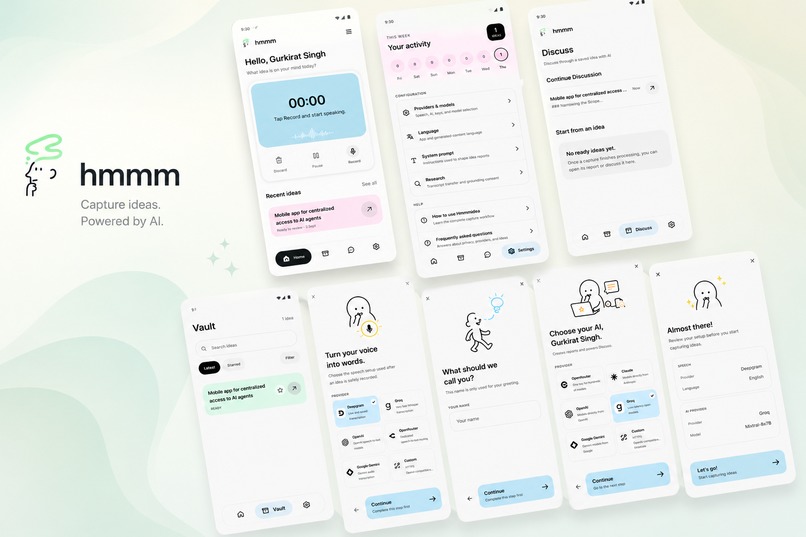
Thumbnail
-
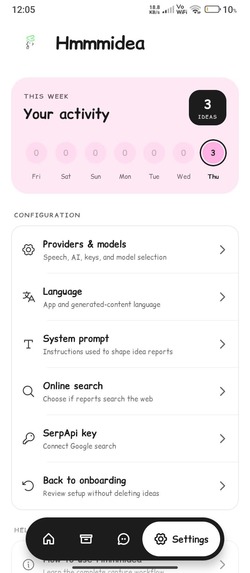
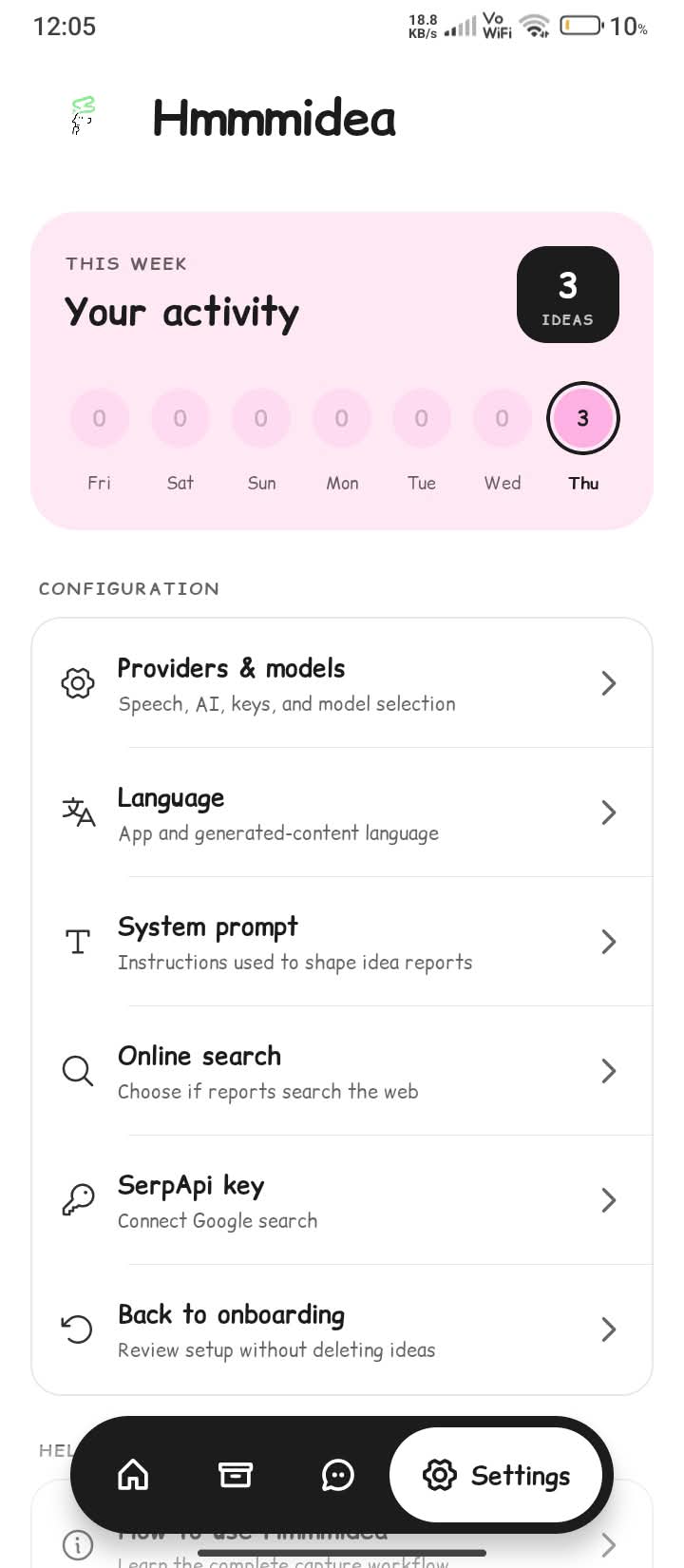
setting screen
-
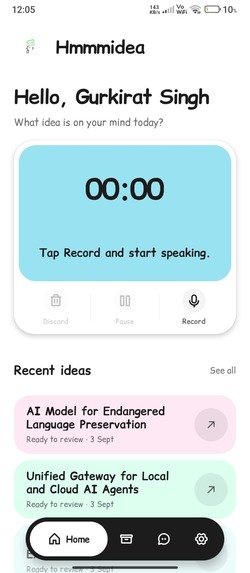
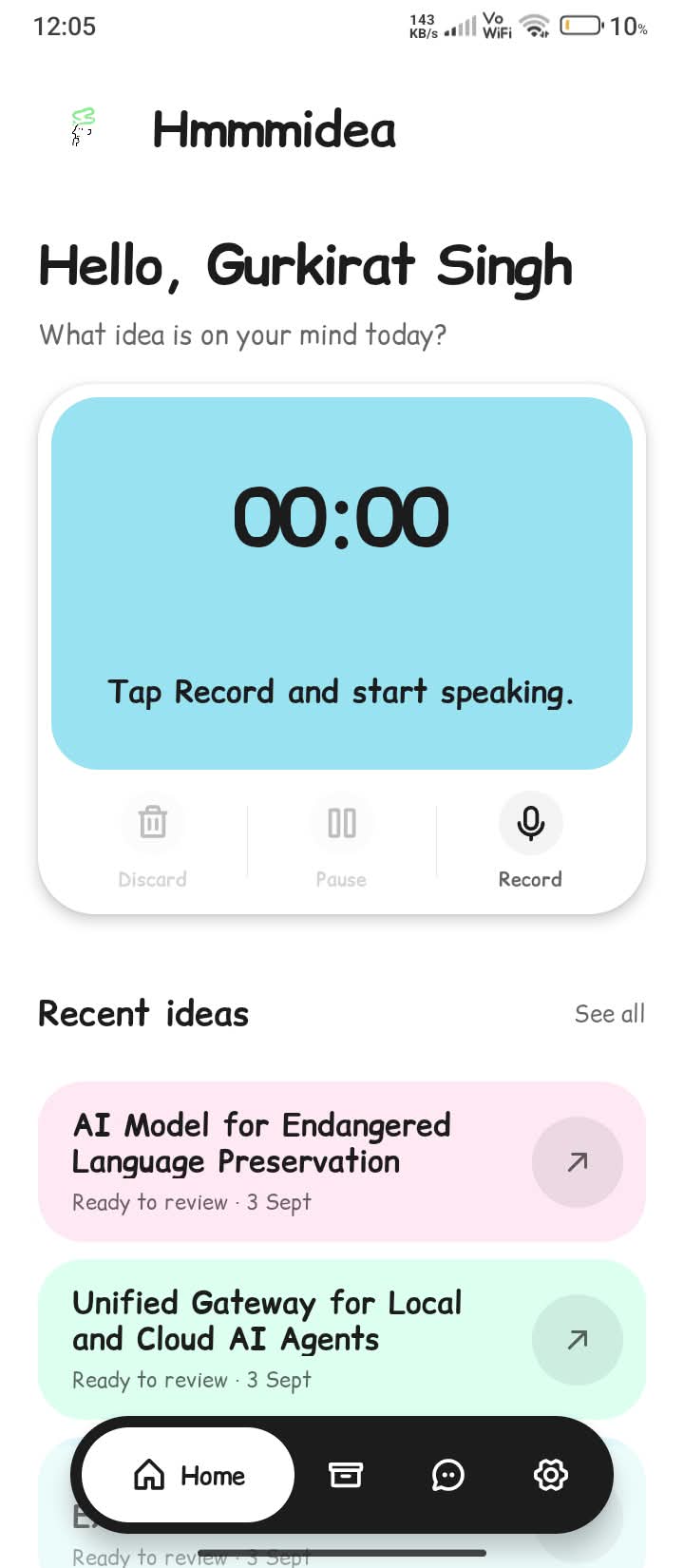
home screen
-
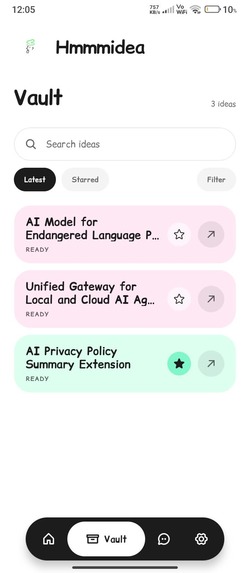
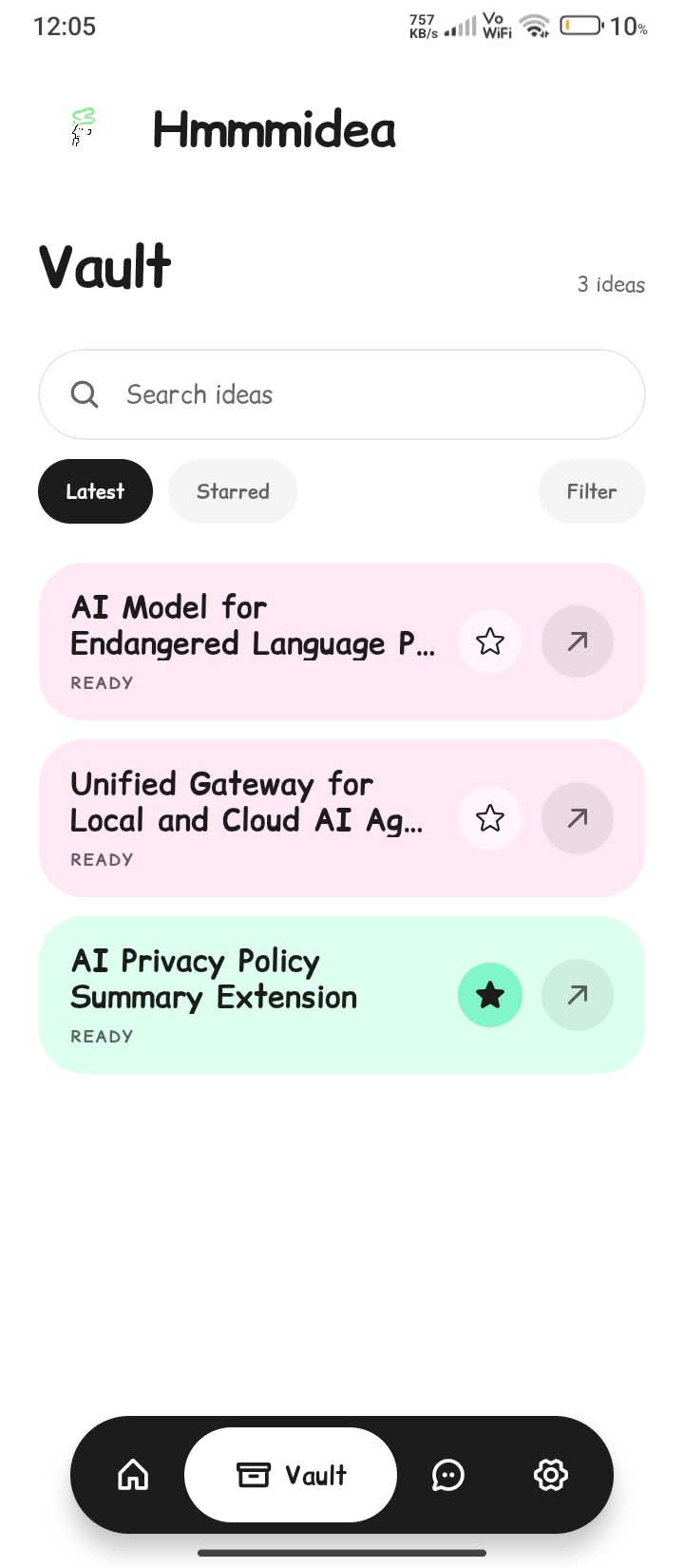
vault screen
-
logo
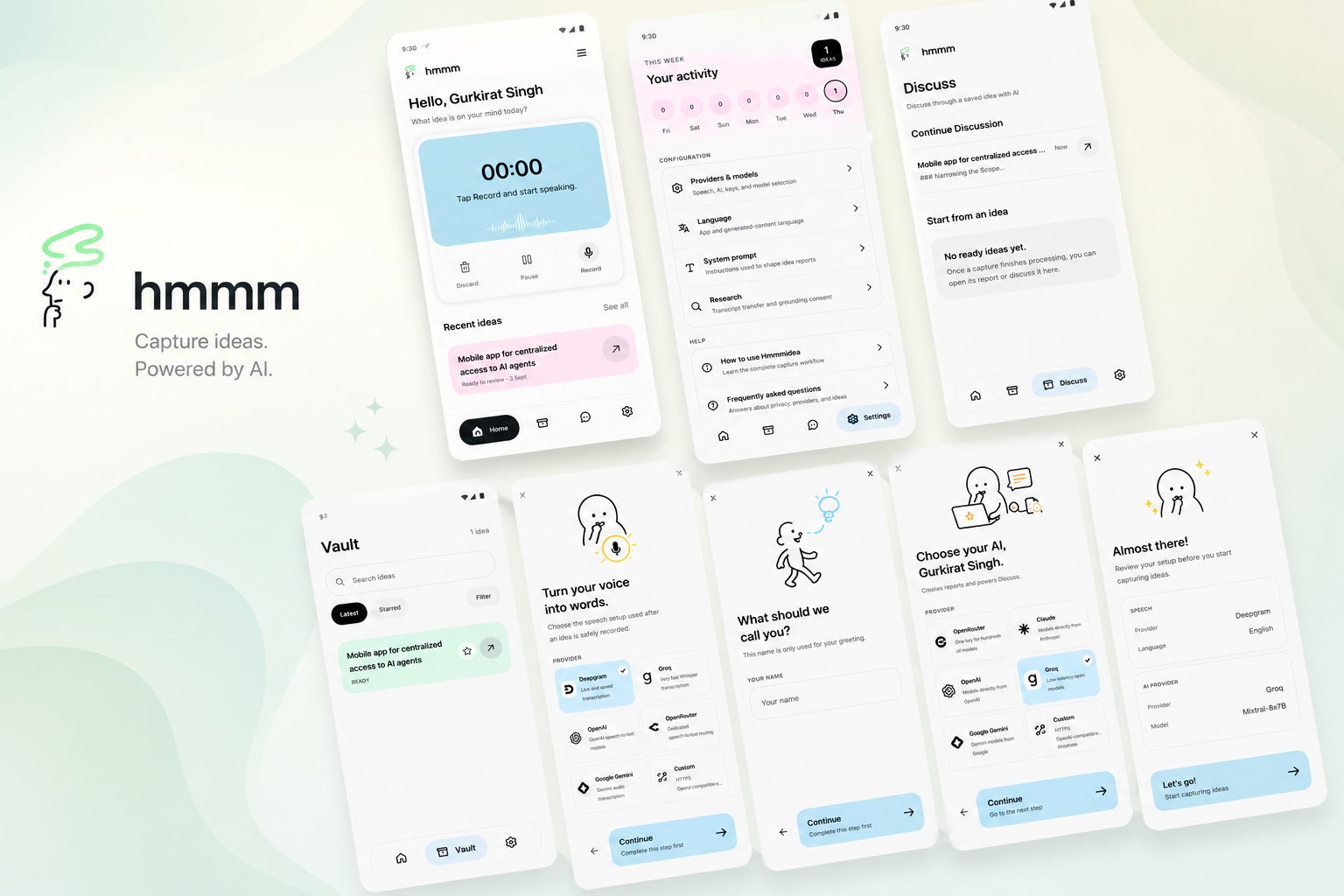
Inspiration
Hmmmidea
Hmmmidea is a local-first, voice-first idea vault built around one simple problem:
Good ideas usually appear when you do not have time to organize them.
Instead of asking you to create a title, choose a category, add tags, write a description, and organize everything before saving an idea, Hmmmidea does the opposite.
You just speak. The idea gets saved first. Everything else happens afterward.
Inspiration
I often get ideas while walking, working on something else, travelling, or doing something completely unrelated.
The problem was never coming up with ideas.
The problem was capturing them.
Opening a notes app and manually writing everything down creates enough friction that I would either write a useless one-line note or simply tell myself:
"I'll remember this later."
Most of the time, I wouldn't.
I wanted something that felt closer to talking to myself than filling out a form.
That became Hmmmidea.
The core philosophy is:
Capture first. Organize later.
The moment an idea appears should require as little interaction as possible.
What it does
The shortest Hmmmidea workflow is intentionally simple:
- Open the app.
- Tap record.
- Speak naturally.
- See a live transcript when the selected speech-to-text provider supports it.
- Pause, resume, or finish the recording.
- Leave the app.
- Come back later to a structured and searchable idea.
Once the thought is safely captured, Hmmmidea can organize the raw input into useful information such as:
- A clean title
- A summary
- The core problem or pain point
- Potential advantages
- Potential weaknesses
- Relevant competitors or similar products
- Additional context discovered through search
The goal is not to let AI decide whether an idea is good or bad.
Instead, Hmmmidea gathers and structures the information required for you to make that decision.
The original thought always remains the important part.
Local-first by design
I wanted Hmmmidea to feel like a personal idea vault rather than another cloud service that owns your thoughts.
The application is designed around a local-first architecture, keeping the user's ideas and application state on the device wherever possible.
It also follows a bring-your-own-key approach, allowing users to choose the AI and speech providers they want to use instead of locking the application to one expensive backend.
This makes the project more flexible, more private, and easier to experiment with.
Search instead of folders
Ideas are messy.
They don't always belong inside perfectly organized folders and categories.
So instead of forcing users to maintain an elaborate organization system, Hmmmidea focuses on making captured ideas easy to retrieve later.
Users can search through their idea vault and return to thoughts that may have been captured weeks or months earlier.
The goal is for the archive to become more useful as it grows rather than harder to manage.
How I built it
Hmmmidea is built as a mobile application with a workflow centered around audio capture, transcription, local persistence, AI processing, and search.
The application separates the process into two stages:
1. Capture
The capture experience is intentionally lightweight.
Recording and preserving the idea has priority over everything else.
The user can speak naturally without worrying about formatting or organization.
2. Processing
After the capture is saved, the application can perform the more expensive work separately:
- Speech-to-text processing
- Cleaning the transcript
- Extracting useful information
- Researching additional context
- Structuring the idea
- Preparing it for future search
Separating these two stages was important because AI processing should never make the user wait before their thought is safely stored.
Challenges I faced
Designing for almost zero friction
The biggest challenge was deciding what not to put on the capture screen.
It is very easy to keep adding features: titles, categories, tags, prompts, templates, and configuration.
But every additional decision creates friction.
I had to repeatedly simplify the experience until recording an idea felt almost instantaneous.
Handling multiple AI providers
Hmmmidea is designed so users are not tied to one speech-to-text or language model provider.
Different providers support different capabilities, especially around live transcription, model names, API formats, and response structures.
Designing the application around those differences while keeping the user experience simple was one of the more interesting technical problems.
Separating capture from AI processing
A captured thought should never disappear because an AI request fails.
That meant treating the original recording/transcript as the source of truth and treating AI-generated structure as something that can be produced or regenerated afterward.
This significantly influenced the architecture of the application.
Designing AI that assists instead of decides
Another challenge was determining what role AI should actually play.
I did not want Hmmmidea to produce a meaningless score like:
"Your startup idea is 87% validated."
An LLM cannot know that.
Instead, I designed the AI layer to behave more like a research assistant: organize the thought, identify possible problems, find relevant competitors, surface information, and leave the final judgment to the person who had the idea.
What I learned
Building Hmmmidea taught me that adding AI to an application is often the easy part.
The harder problem is deciding where AI should disappear from the experience.
I learned a lot about:
- Mobile application architecture
- Speech-to-text workflows
- Working with multiple AI providers
- Local-first application design
- Background processing
- Designing around unreliable external APIs
- Structuring LLM output
- Search and information retrieval
- Building interfaces around real user behavior instead of feature lists
The project also changed how I think about AI products.
Sometimes the best AI interface isn't another chatbot.
Sometimes it is simply a button that lets you speak, close the app, and continue with your day.
What's next
There is still a lot I want to explore with Hmmmidea.
Future improvements could include better semantic search, relationships between similar ideas, richer research, improved offline functionality, and more provider integrations.
But the core principle will stay the same:
Your idea deserves somewhere to exist before it deserves to be evaluated.
Hmmmidea is meant to make that first step effortless.
Built With
- bun
- expo.io
- tailwind
- typescript

Log in or sign up for Devpost to join the conversation.