
Inspiration
Every IT admin answers the same question a dozen times a day: "Should this person get this access?" It sounds simple, but answering it properly means jumping between HR, the identity provider, the SIEM, the ticketing system, and a pile of policy docs. Most real breaches don't come from clever attackers — they come from access that shouldn't exist: a contractor with no MFA, an admin account nobody de-provisioned, a "temporary" grant that never expired.
I wanted to collapse that entire workflow into a single question you ask in Slack — and to find out how far the Model Context Protocol (MCP) could go for real multi-system orchestration.
What it does
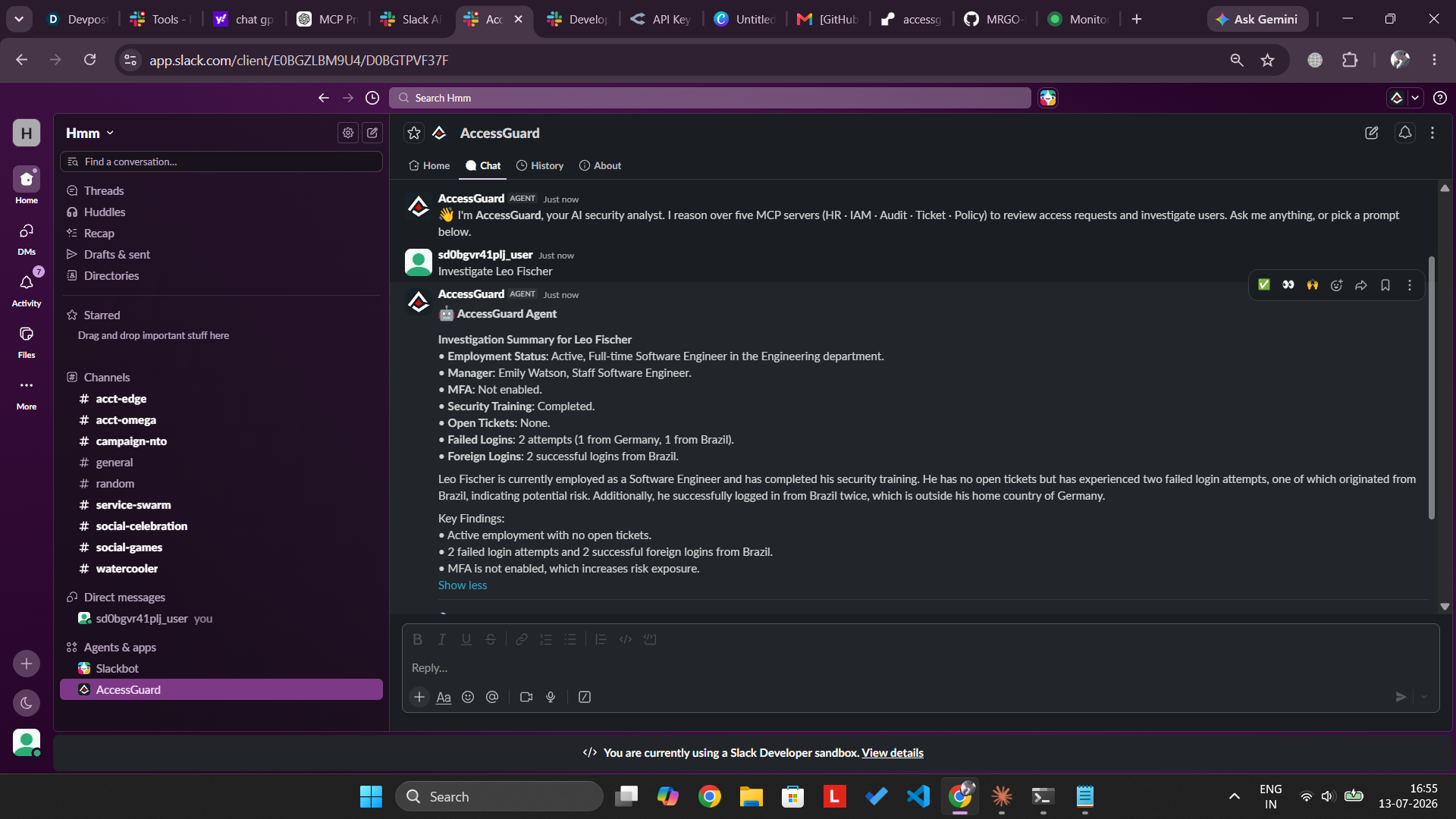
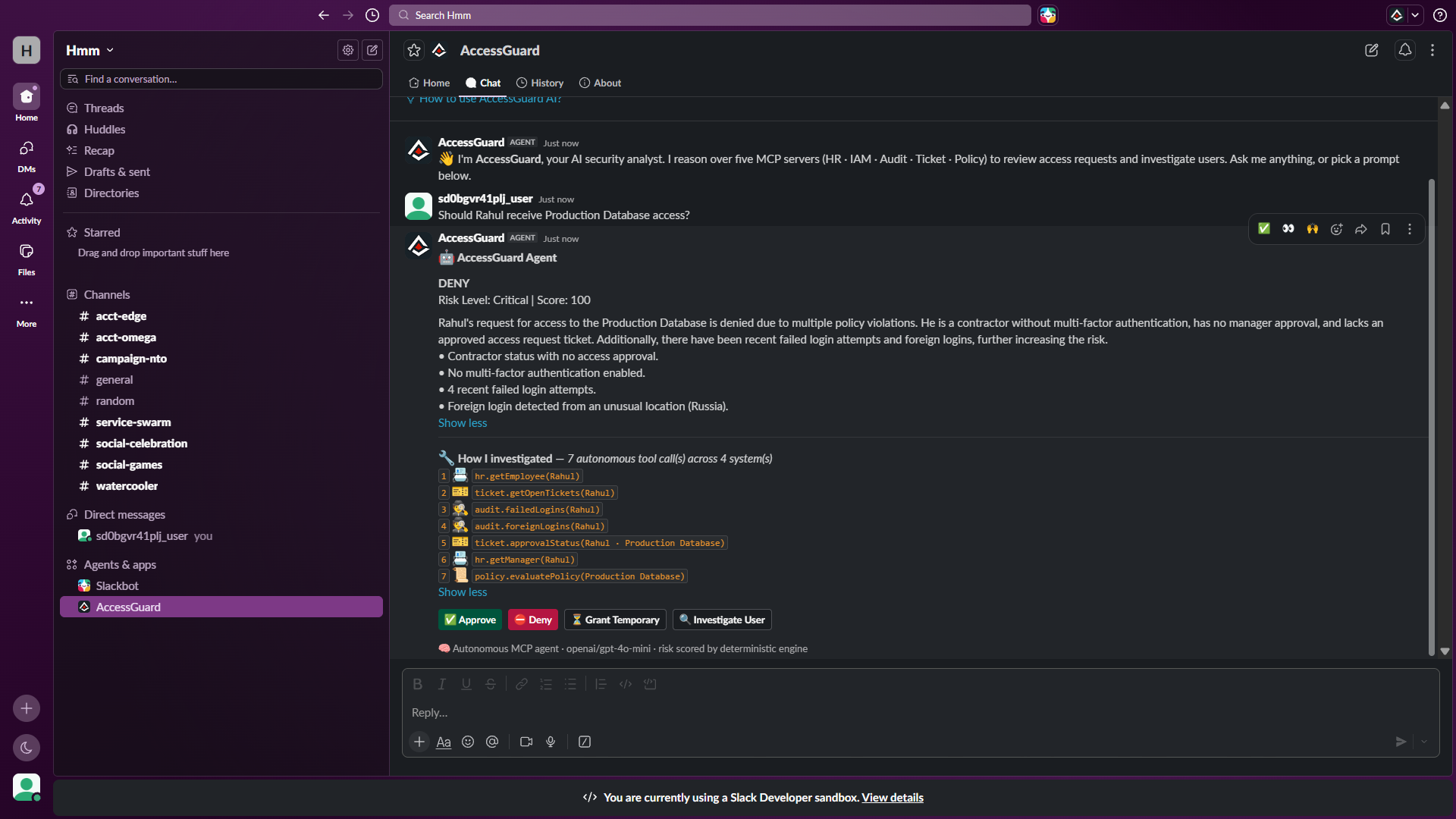
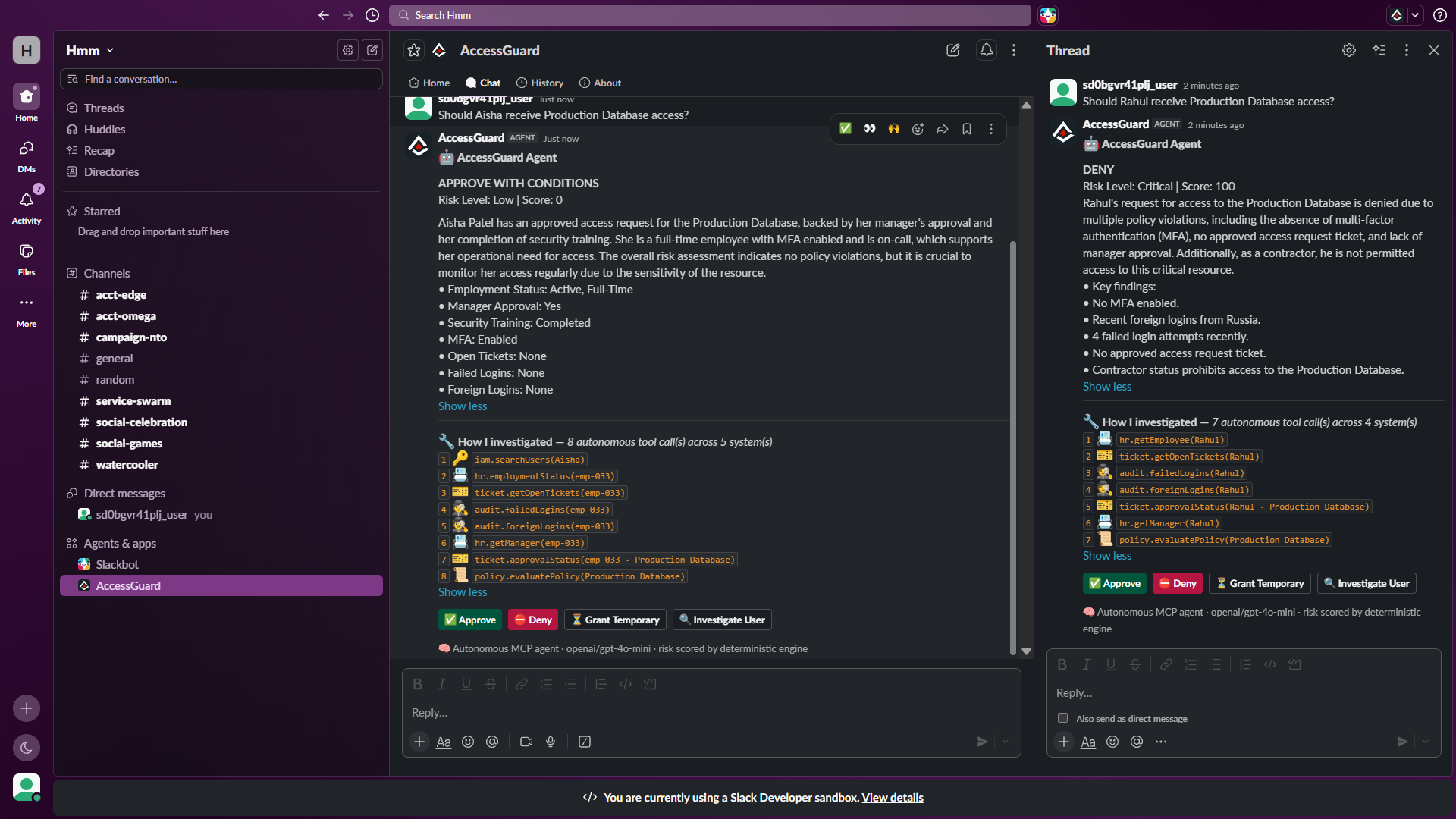
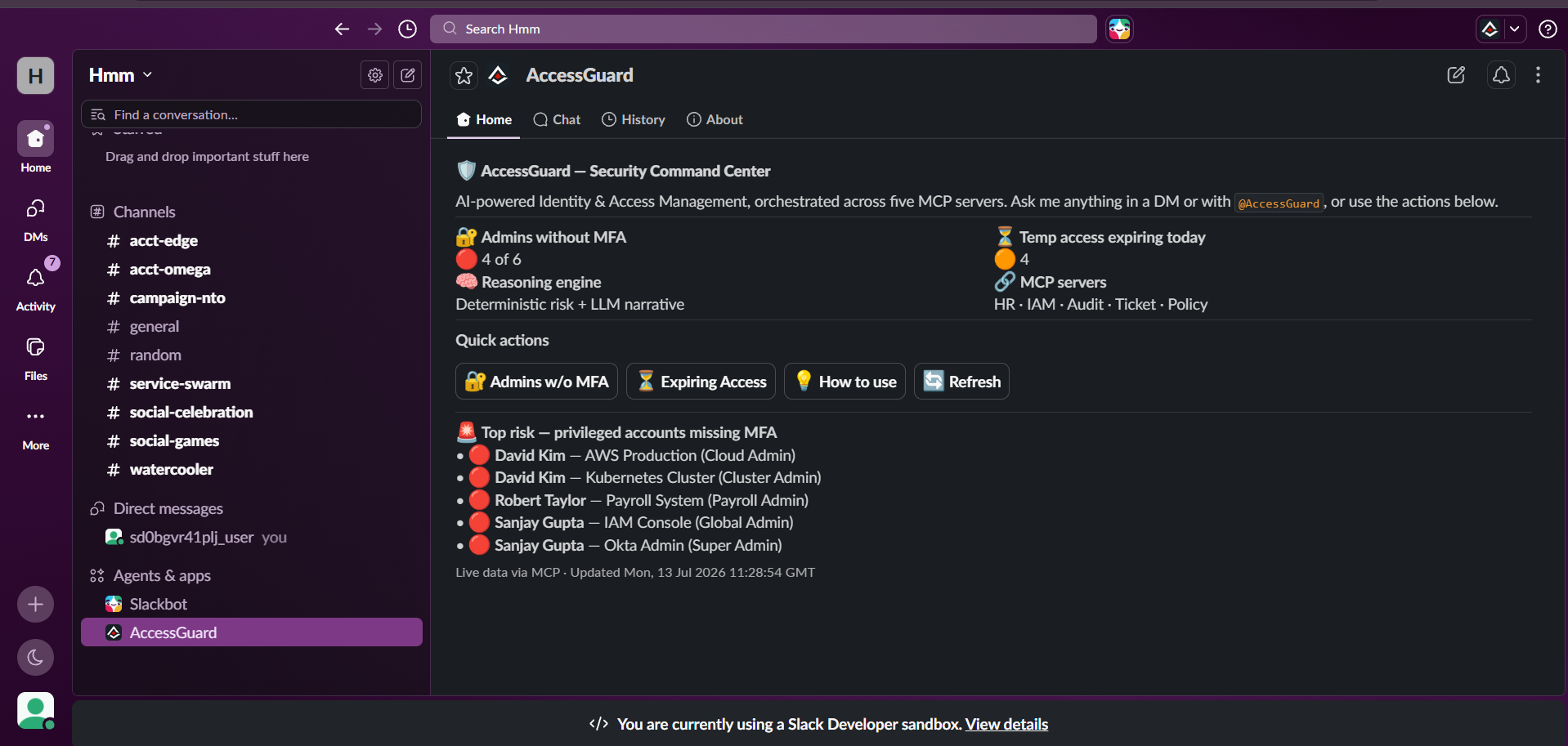
AccessGuard is an autonomous AI security analyst that lives in Slack. Ask it "Should Rahul receive Production Database access?" and it decides — on its own — which systems to query, gathers the facts across five MCP servers (HR, IAM, Audit, Ticket, Policy), computes an explainable risk score, and replies with a recommendation, reasoning, confidence, and one-click Approve / Deny / Grant Temporary / Investigate buttons. It also runs investigations, finds admins without MFA, and lists temporary access expiring today — via @mentions, slash commands, an Assistant panel, and a Home-tab dashboard.
How I built it
- TypeScript monorepo (npm workspaces): a Slack Bolt app (Socket Mode) plus five independent MCP servers built on the official MCP SDK.
- The agent is a pure MCP client — it never touches the database. Every fact comes from an MCP tool call.
- An autonomous tool-calling loop: the LLM (via OpenRouter) is given all ~40 MCP tools and decides which to call and in what order. The reply shows the real tool-call trace.
- A deterministic risk engine does the scoring, exposed as a tool the agent must call:
$$\text{score} = \min!\Big(100,\ \max\big(0,\ \textstyle\sum_i w_i\big)\Big)$$
where each $w_i$ is a fixed weight (no MFA +30, foreign login +25, contractor +20, manager approval −20, …). The LLM writes the narrative and picks tools, but it can never invent the number — so a Critical risk can't be talked into an "approve."
- SQLite via Node's built-in
node:sqlite(zero native dependencies), seeded with a believable ~30-person org.
Challenges I ran into
- Keeping the AI honest. Making the agent genuinely autonomous without letting it hallucinate a risk score was the core design tension. The fix — treating the deterministic engine as a mandatory tool and overriding any score the model returns — is the thing I'm most proud of.
- OpenRouter only implements the Chat Completions API, not the newer Responses API, so I had to rewire the reasoning layer to work with both providers.
- Tooling friction: pnpm was blocked by machine permissions (fell back to npm workspaces), and native SQLite builds are painful on Windows — Node's experimental
node:sqlite(behind a flag) saved me. - Slack's newer surfaces (Assistant container + Home tab) needed manifest changes, new scopes, and a reinstall to light up.
- Deployment was the real slog. Fly.io and Railway now require a credit card. I landed on Render's free tier, which meant adding a tiny HTTP health server (Socket Mode opens no port), plus an uptime pinger to stop the free instance from sleeping — and it's memory-tight running six Node processes at once.
What I learned
- MCP is a genuinely clean way to model federated enterprise systems — swapping a mock for a real backend is just a new server behind the same tool contract.
- The most trustworthy AI decision is one where the AI doesn't actually make the decision. It gathers evidence and explains; a deterministic engine owns the verdict.
- Slack's agent surfaces (Assistant, Home tab, Block Kit) are more capable than I expected.
Honest limitations & what's next
- The five MCP servers currently share one seeded SQLite dataset — they demonstrate the orchestration pattern, not five separate production backends. The natural next step is backing each with a real system (Okta, Workday, Splunk, ServiceNow, and an OPA-style policy engine) behind the identical tool interface.
- Data is mocked (~30 employees) for a reliable demo.
- Because it uses Socket Mode on a free host, it needs to stay running; a production deploy would be properly hosted and scaled.
- Next up: conversational in-thread follow-ups ("why?", "now check his manager"), access-recertification campaigns, and anomaly detection on the audit stream.
Built With
- ai-agent
- block-kit
- docker
- llm
- mcp
- model-context-protocol
- node.js
- npm-workspaces
- openai
- openrouter
- render
- slack
- slack-bolt
- socket-mode
- sqlite
- typescript
- zod

Log in or sign up for Devpost to join the conversation.