Inspiration
As college students, we kept noticing around campus: students were throwing away perfectly usable furniture, textbooks, and dorm essentials, while other students were buying those exact same items new. At the end of every semester, hundreds of useful items are thrown away or sold through scattered group chats/marketplace. Although existing platforms help people buy and sell, they aren't designed for student life. It's often difficult to verify whether a seller is actually a student, find items nearby, arrange a safe meetup, or simply keep track of listings spread across multiple apps and websites. Therefore, the idea for Hive was born. We wanted to create one trusted place where students could easily discover secondhand items within their own university, nearby campuses, or even universities across the country. Instead of searching through multiple platforms, students could find everything in one space. We also wanted to make selling just as easy as buying, so we built an AI-powered listing assistant that helps students generate a title, description, category, condition, and estimated price from a single photo, making it faster and easier to list secondhand items. Our goal was simple: make student-to-student buying and selling easier, safer, and faster. We chose the name Hive to reflect our vision for the app, like a beehive, where every member contributes to support the community. We wanted to build a marketplace where every student can give used items a second life by helping someone else find what they need. Hive is more than just a marketplace; it is a shared community built on trust, collaboration, and sustainability.
What it does
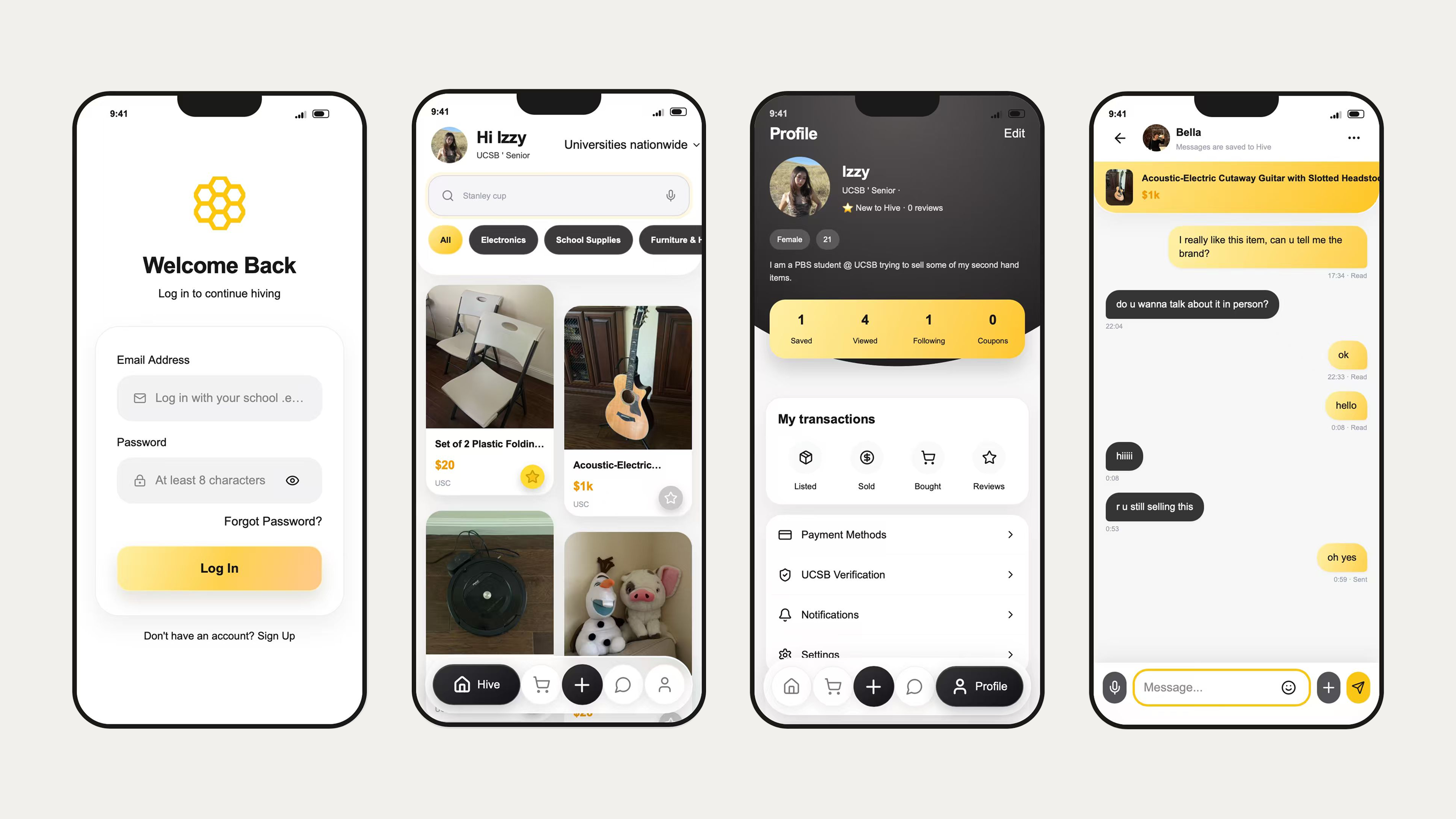
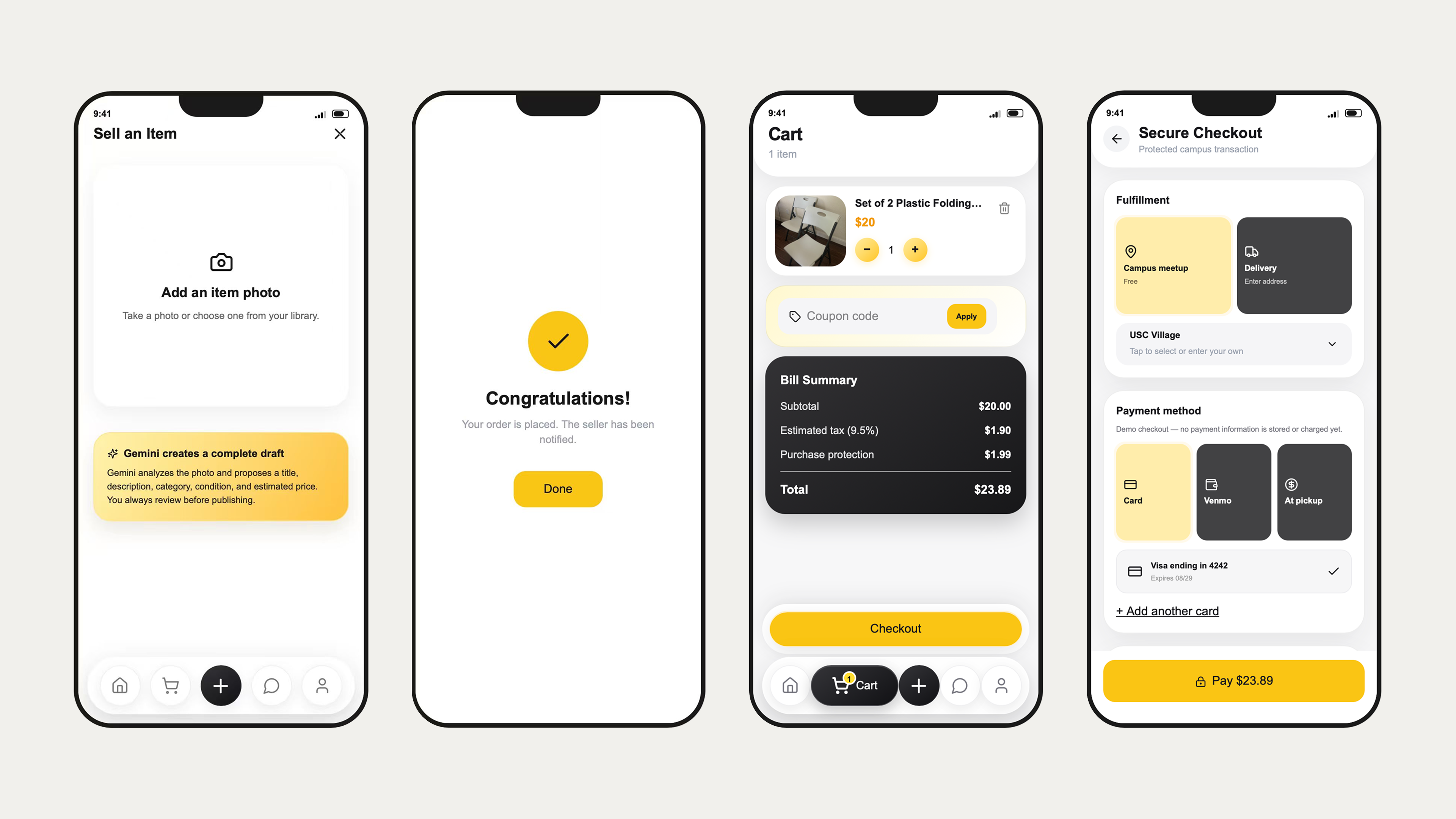
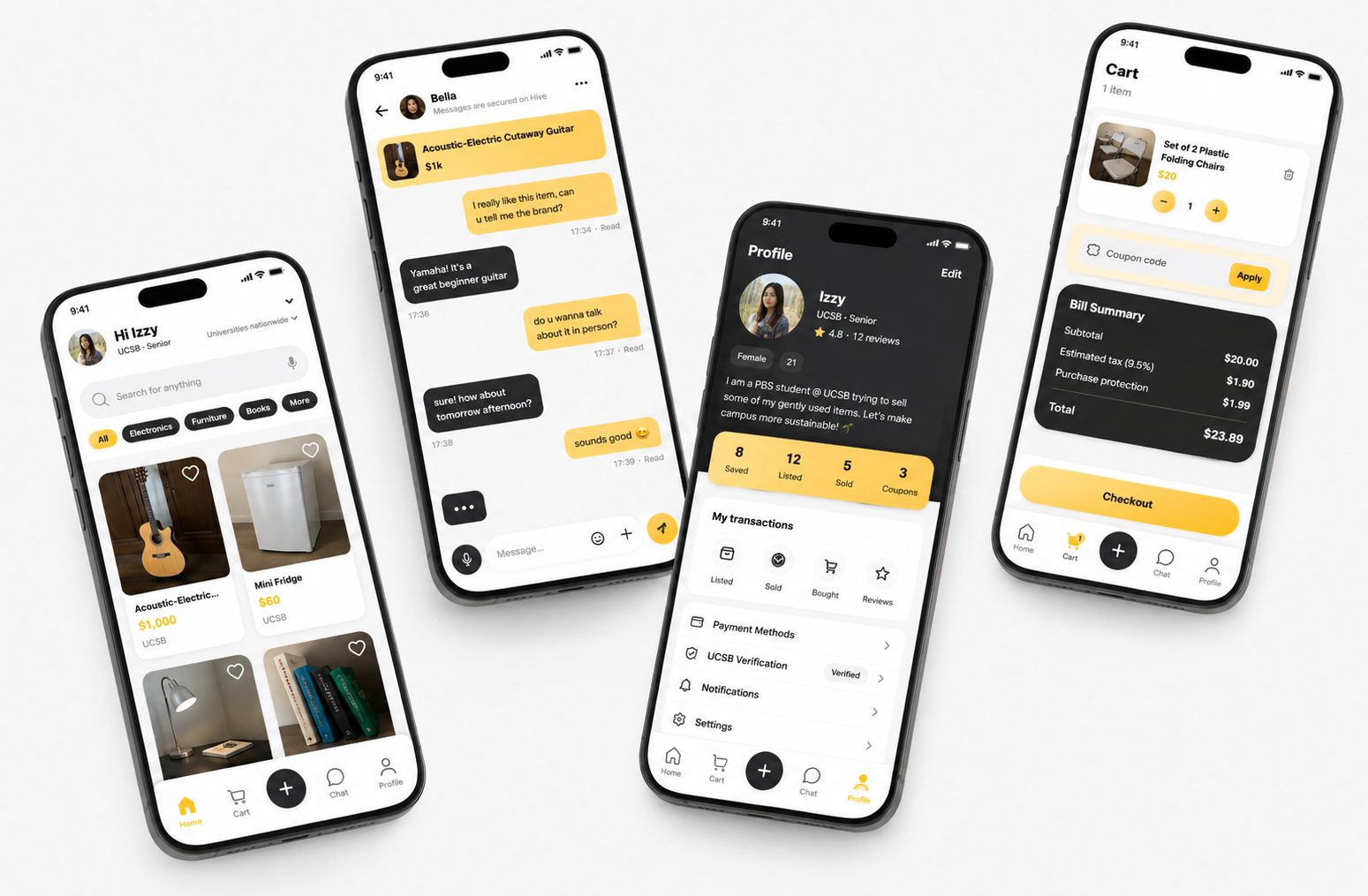
Hive is an AI-assisted, student-focused marketplace where verified student users can buy and sell secondhand items within their own university community, nearby campuses, or universities across the country. By verifying every user with a university email, Hive creates a safer and more trusted environment designed specifically for students. In Hive, items are organized into everyday categories such as electronics, school supplies, furniture & home, clothing, books, and other, making it simple to find exactly what they need. Users can search for items, save favorites, view seller profiles and reviews. They can also message sellers directly from a listing and complete purchases through an integrated checkout process. Each chat is linked to the item being sold, making communication more organized and reducing confusion between buyers and sellers. To make selling faster and easier, users can simply upload or take a photo of an item, and Hive's AI-powered listing assistant will automatically generate a suggested title, description, category, condition, and estimated price. Then sellers can review and edit the listing before publishing. This feature helps busy college students create high-quality listings fast instead of starting from scratch. Hive also includes transaction history, saved items, seller reviews, listing management, campus-based discovery, and safety guidance for student meetups. We aim to integrate everything students need for secondhand buying and selling into one trusted platform.
How we built it
Hive was built collaboratively, with our team developing the frontend, backend, product design, and user experience in parallel before bringing everything together into one application. Once we had settled on the idea for Hive—its purpose, core features, name, and the vision behind it—we brought ChatGPT 5.6 and Codex into our working process. Since none of us had prior coding experience, they became useful tools that helped us turn our ideas into a working product while teaching us how the development process works along the way. ChatGPT 5.6 helped us brainstorm features, improve user flows, challenge our ideas from different perspectives, and create supporting documents such as our Privacy Policy, Terms of Service, and user consent materials. Because Codex is powered by ChatGPT 5.6, we were able to carry those ideas directly into development. We built Hive as a responsive, mobile-first web application using React, TypeScript, Vite, HTML, and CSS, while using Codex to help implement features, connect navigation between screens, debug issues, and keep data consistent across listings, profiles, chat, checkout, and our AI-powered listing assistant. Rather than generating everything at once, we built the app feature by feature, testing, refining, and improving each part before moving on to the next. Although ChatGPT 5.6 and Codex greatly accelerated our development process, every product decision, design choice, and final implementation was made, tested, and refined by our team.
Challenges we ran into
One of our biggest challenges started off being deciding what not to build. We originally envisioned Hive as a complete student ecosystem, but quickly realized that trying to build everything at once would weaken the experience. Instead, we focused on one core feature: the student marketplace. Keeping the application consistent as it grew was another challenge. Hive includes onboarding, marketplace browsing, search, product details, profiles, reviews, chat, checkout, listing creation, and account settings. Even small changes could affect multiple screens, so we spent a great deal of time testing and refining how everything worked together. Building a real backend was also a significant learning experience. Rather than relying on static mock data, we implemented persistent data storage, user accounts, listings, and university email verification so the app behaved like a real marketplace. Learning how authentication, databases, and backend data flow work together was one of the most challenging but valuable lessons of the project. Finally, we spent hours refining the user experience. From choosing the interface and color palette to adjusting spacing, navigation, typography, and other small design details, we learned that creating a user-friendly app is the result of continuous iteration rather than a single design decision.
Accomplishments that we're proud of
We are proud that Hive feels like a complete running product rather than a collection of disconnected screens. A user can move through the full experience: create an account, search for an item, inspect the seller, start a conversation, and check out. A seller can also create a listing, review the AI-assisted draft, publish it, and manage it from their profile. We are also proud of how much the project evolved through iteration. The final interface is much more user-friendly and well-rounded than our first version while we still stayed true to the original vision and personality of Hive. The project also led to our personal growth that we are proud of. None of us had prior experience with coding or AI-assisted coding before starting this project. With the help of ChatGPT 5.6 and Codex, we learned how modern applications are designed, built, debugged, and refined, turning our ideas into working code and fully functional features. As college students ourselves, a problem we genuinely cared about has become a real, working product that we're incredibly proud of. We hope Hive can one day help solve real issues students face every semester by making campus secondhand marketplaces safer, simpler, more efficient, and more connected.
What we learned
We learned that a marketplace depends heavily on trust and clarity. Showing the university, seller history, reviews, item context, and safety information can make a transaction feel much safer and more comfortable for users. We also learned how to collaborate efficiently with Codex and ChatGPT 5.6. We learned that giving them clear, focused instructions consistently produced better results than broad prompts, while reviewing every output and refining it repetitively led us to a much stronger solution. Working with ChatGPT 5.6 showed us AI's value as a collaborative partner, where it helps us brainstorm, explore new perspectives, generated supporting documentation, and worked with Codex to transform ideas into functioning features. Furthermore, we gained a much deeper understanding of what it actually takes to build a real application. We learned how frontend and backend systems work together, how to structure and manage data so features work consistently, and how ideas that look simple require many interconnected parts before they become reliable, working functions. We also discovered how to create a user-friendly experience, from navigation flow, visual color and consistency to reducing friction at every step of the user journey.
What's next for Hive
Our next step is to test Hive with students from multiple universities and learn what makes students feel safe buying from someone they have not met before. We would also like to improve university verification, strengthen fraud detection, add smarter, personalized search, and connect AI pricing suggestions to real marketplace trends and data. As for the transaction feature, we want to expand pickup locations, payment methods, and dispute reporting. In the long term, we hope Hive can expand more features to solve student problems, such as housing, carpools, and finding/posting side hustles. We also want Hive to become the main app college and graduate students think of when selling or searching for secondhand items. We aim to keep useful items within student communities rather than ending up in landfills—and to make it easier and more sustainable for students to find what they need without always buying new.
Built With
- ai
- api
- codex
- css
- css3
- gemini
- github
- gpt-5.6
- html
- javascript
- localstorage
- lucide
- mobile-first
- node.js
- render
- responsive
- student-marketplace
- typescript
- vision
- vite


Log in or sign up for Devpost to join the conversation.