Inspiration
Most AI agents today are really just one model trying to play every role at once. But when people solve difficult problems, they don't rely on a single expert—they build teams. Different people bring different skills, challenge each other's assumptions, and work toward a better solution.
That idea inspired HIVE. Instead of creating one "super agent," we wanted to build an operating system for AI agents that can assemble a temporary team of specialists for each task. These agents can debate important decisions, manage limited resources, learn from outcomes, and disappear once their job is finished.
The Agent Society track at the Qwen Cloud Hackathon was the perfect opportunity to bring that vision to life.
What it does
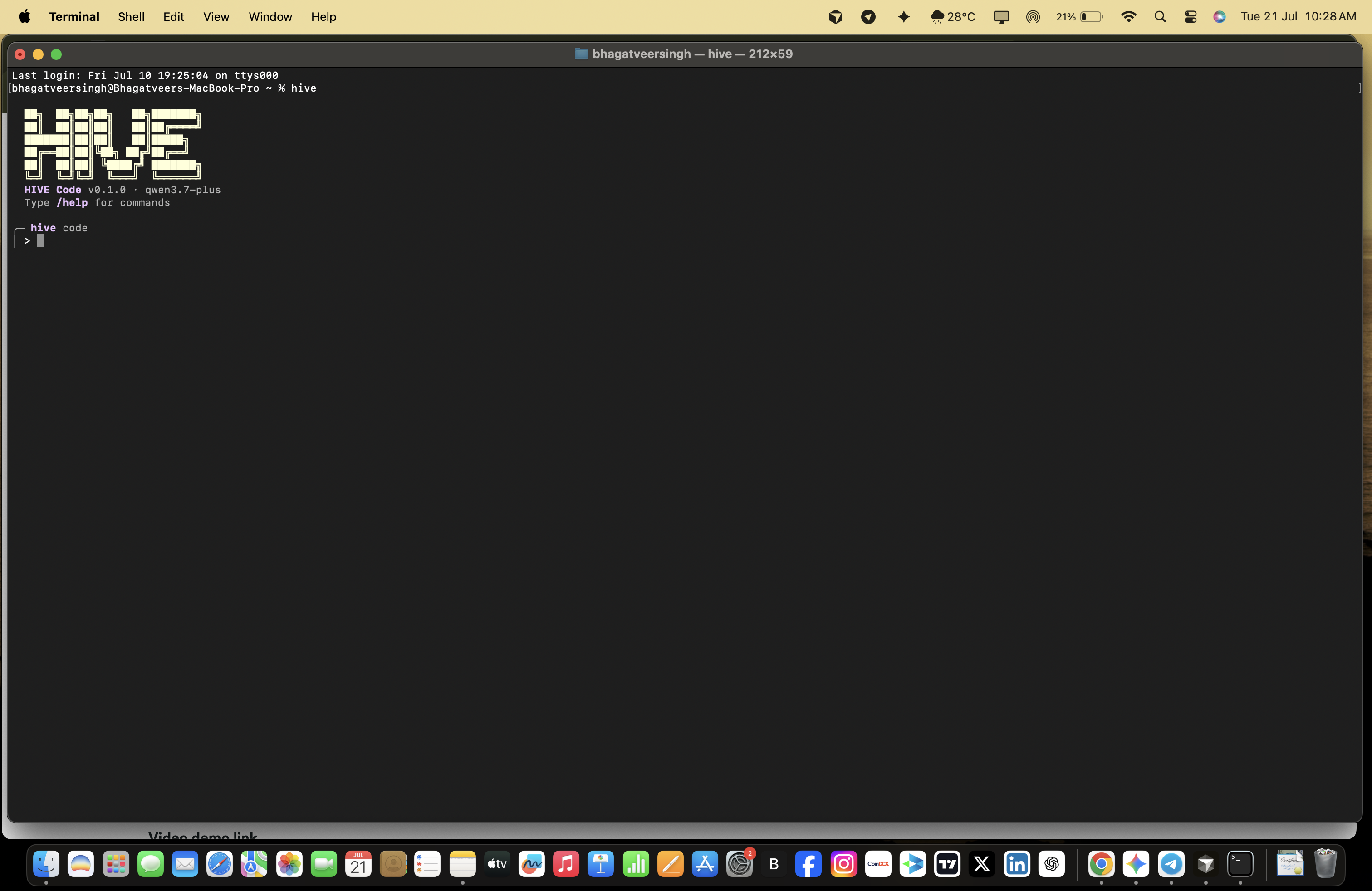
HIVE is a command-line-first operating system for collaborative AI agents.
Rather than relying on a single assistant, it dynamically creates specialized agents that work together under a central coordinator.
Key features include:
- A HiveCore (Queen) agent that plans work and manages resources.
- Agent Forge, which creates specialist agents only when they're needed.
- A Cleanup Crew that removes idle agents to keep the system efficient.
- Specialized workers such as researchers, architects, security reviewers, and reporters communicating through a shared message bus.
- A structured four-round debate system where agents challenge proposals before risky actions are approved.
- Confidence scores, reputation tracking, and credit-based budgeting so every decision has measurable cost and reliability.
All reasoning is powered by Qwen models through DashScope, and the system can be deployed on Alibaba Cloud ECS with a public health endpoint for verification.
How we built it
Our backend is written in Python, with an asynchronous agent runtime that allows multiple agents to operate simultaneously.
For language intelligence, we integrated Qwen through the DashScope OpenAI-compatible API, making it easy to coordinate multiple model-driven agents.
We use SQLite to persist sessions, conversations, agent state, and audit logs, while an optional Ink/React terminal UI communicates with the backend using JSON streams.
Deployment is handled through Docker Compose, with a lightweight deployment server that runs on Alibaba Cloud ECS and exposes a health endpoint for monitoring.
At a high level, the flow looks like this:
User (CLI / TUI)
        │
        ▼
   HIVE Core (Alibaba ECS)
        │
 ┌──────┴───────────┐
 │                  │
SQLite        Worker Agents
 │                  │
 └──────┬───────────┘
        ▼
 Debate + Resource Economy
        │
        ▼
 Qwen Cloud (DashScope)
Challenges we ran into
Building multiple agents is much harder than running multiple API calls.
One of our biggest challenges was coordinating communication without agents getting stuck in loops or repeating the same work. We also needed a scheduling system that could create specialists on demand while keeping resource usage under control.
Designing a debate framework that produced better decisions instead of longer conversations took several iterations. We also spent time balancing response quality against API cost by introducing a credit economy and reputation system.
Finally, deploying everything as a portable, cloud-ready service while keeping the CLI experience smooth required careful engineering.
Accomplishments that we're proud of
We're proud that HIVE feels like more than just another chatbot.
Instead of relying on prompt engineering alone, we built an actual multi-agent operating system with dynamic agent creation, structured collaboration, resource management, and decision validation.
We're also happy with how cleanly the architecture integrates with Qwen Cloud while remaining easy to deploy on Alibaba Cloud ECS. The modular design makes it straightforward to add new agent types, tools, and workflows in the future.
What we learned
This project taught us that collaboration between AI agents is valuable only when there is structure.
Simply adding more agents doesn't improve results. What matters is giving them clear roles, controlled communication, incentives, and a way to resolve disagreements efficiently.
We also learned that practical systems need to balance intelligence with cost, latency, and maintainability—not just maximize model capability.
What's next for HIVE
We're planning to expand HIVE beyond the command line into a complete agent platform.
Future work includes:
- Long-term memory shared across agent societies.
- Persistent reputation and learning across tasks.
- Visual monitoring and orchestration dashboards.
- Support for distributed workers across multiple machines.
- Additional debate strategies and autonomous planning.
- Integrations with external tools, APIs, and enterprise workflows.
Our long-term vision is for HIVE to become an operating system where specialized AI societies can form, collaborate, solve complex problems, and dissolve—all automatically.
Built With
- alibaba
- cloud
- dashscope
- docker
- ecs
- ink
- mcp
- openai
- playwright
- python
- qwen
- react
- rich
- sdk
- sqlite
- typescript

Log in or sign up for Devpost to join the conversation.