-
-
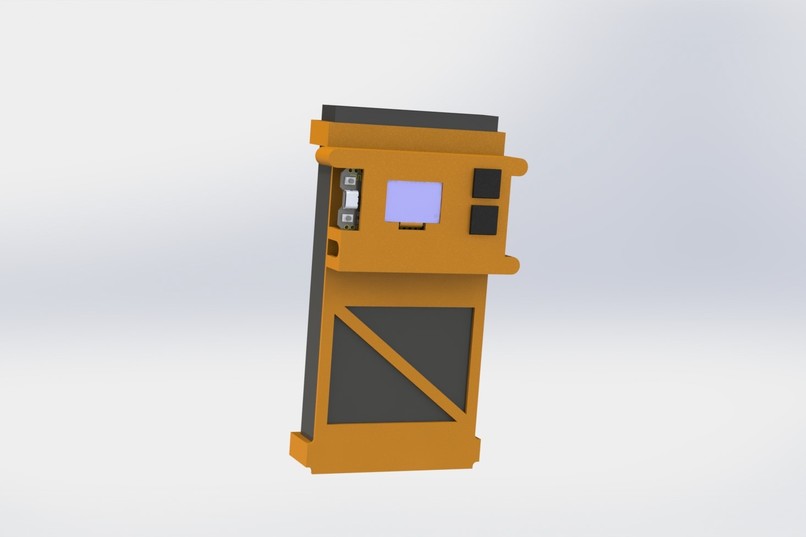
Final Render of 3D Printed Enclosure
-
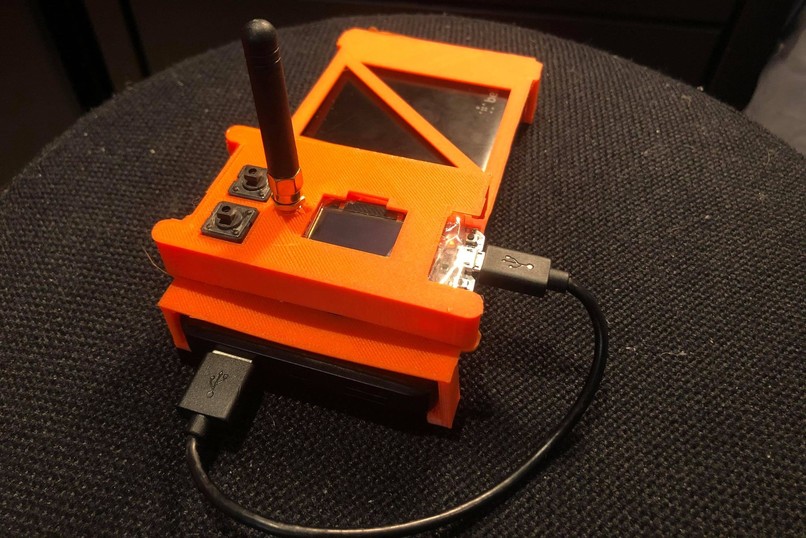
Assembled Device
Inspiration
We were interested in the idea of disaster relief, and the consequences of communications infrastructure failing, which would leave people stranded in a time that they desperately need information and aid. When we considered the possible solutions to a crisis such as this one, we were inspired by the way bees spread information throughout the colony, exchanging information from bee to bee. We decided that creating a network of nodes that exchanged information periodically in this way would be an effective method of creating a temporary infrastructure for communication.
What it does
The device is a transceiver and display for important messages written by EMS or local authorities during a natural disaster. It doesn’t rely on any external communications infrastructure such as WiFi routers, cell towers, or satellites. Each device hosts its own local network. When another device comes into range, they exchange all messages that they are missing. Those two devices, with the updated message ledger, can then continue to spread to other devices that come into range. With this system, disaster relief messages such as “Boil water until further notice” can spread quickly among the population without the need for external infrastructure.
How we built it
We decided that the best choice for wireless communication would be to use LoRa radio modules. These modules already have many open-source software libraries for implementation and can easily be wired to any Arduino-compatible microcontroller. For the controller, we used the Heltec LoRa 32. This is a development board with a LoRa module, an ESP32 controller, and an attached LCD screen. The screen is used to display the messages to the user, with two externally wired buttons on the side in order to select the next or previous message.
The device is powered by a USB battery pack. This was selected because it can be charged with cables that most users would have at home already, as well it is easily replaceable if it is damaged. The enclosure is a 2 piece 3D printed shell, held together with screws so it can be taken apart and repaired if needed. It was printed on an Ender 3 printer in PLA material. A bright orange colour was chosen for the filament so it could be easily spotted if dropped in water.
Challenges we ran into
Initially, we planned on receiving new hardware that included a larger LCD screen and a GPS. We discovered our hardware was not arriving at the last minute, so our design and code needed to be revised quickly to use the parts that we did have. Due to the time crunch, there were features that we could not implement, and our two devices could not be built using the same hardware. Since the hardware was changed, we had to also redesign our enclosure to accommodate the different sized PCBs.
Accomplishments that we're proud of
Despite the hiccups with our hardware supply, we are proud of what we were able to build and how well it works. It was difficult to build something when we couldn't all be in the same room to work, but we still managed to put our individual pieces together. We all learned something new with this project, and we are especially glad we designed a project with a humanitarian goal.
What we learned
One of the most important things we’ve all learned from this project is the importance of being flexible in our project planning. We would not have run into as many challenges if we were willing to make changes early on. For example, we could have had a more thorough backup plan in case our hardware order did not arrive on time.
As well, all of our team members have learned new technical skills over the course of the last few weeks. It was really a chance for us to leave our comfort zone of what we really work on. It also gave us a chance to explore a wide range of technologies that we want to learn more about in the future. For example, one member did research about protocol buffers, a language-neutral method of packaging communication messages.
What's next for HIVE: The Decentralized Disaster Communication Network
A big feature that we want to implement for HIVE is a GPS feature that would enable the device to transmit a distress signal, allowing aid to be sent to their location. Also, we want to be able to connect the device to a phone, which creates the opportunity to design a user interface that has much more functionality than the 2 buttons combined with the LCD screen.
Built With
- arduino
- lora
- solidworks


Log in or sign up for Devpost to join the conversation.