-
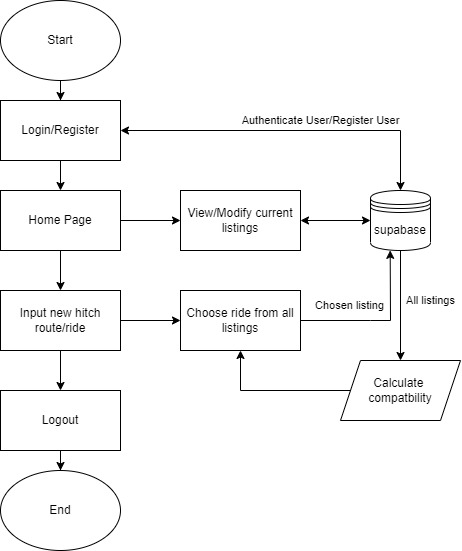
User flowchart

Inspiration
With increased population densities in smart cities around the world, human and vehicular traffic is bound to increase. This leads to increased levels of greenhouse gases and traffic congestion, which has further impacts on human health and sustainability. This is because it has a direct link to poor air quality and decreased quality of life due to noise pollution. This inspired our group to come up with a solution to increase the productivity of vehicular transportation, while reducing waste such as pollution from solo driving or private hire cars.
What it does
Our website, Hitch, connects drivers and commuters who travel to similar locations on a regular or one-time basis together.
How we built it
Using laptop (Michael)
We took inspiration from popular private-hire apps such as Grab, Gojek, and Comfortdelgro. Through this, we realised that having a map interface is important as it allows users to pin-point their location and visually represent their paths. Furthermore, we had to match the databases of both drivers and hitchers to find the best-fit routes that would not make either party feel like they are making a compromise. However, to enjoy the benefits of Hitch, it is assumed that the hitchers are the ones who have to match with the schedule of the drivers as they are depending on the good will of the drivers.
Challenges we ran into
Since this was the first time for all of us in the group working on front end programming, we had to learn about the frameworks of Javascript such as Next.js which we used while building our web app. In addition, debugging was not an easy feat since we were not familiar with the software used.
Accomplishments that we're proud of
Our group produced an interactive and detailed website within a day with little background in react. Despite a slow start as we were having difficulties brainstorming to come up with a solution due to the broad scope of possibilities, our group managed to come up and finish the solution timely as we narrowed down the problem and target audience. Furthermore in Singapore’s context, where one of the main solutions to reducing private vehicles is by raising its prices, more can be done to ensure that the reduction is long-term.
What we learned
In the creation of our web app, it required us to be proficient in both front-end and back-end web development. However, our group did not have much experience as full-stacked developers and were required to self-learn and research while concurrently building our web app, which was a time-consuming yet fruitful process. In building our web app from scratch, we were able to start new and be receptive towards improvements in the way we designed and programmed it.
What's next for Hitch
There is a need to find a balance in the pricing of each hitch ride. It has to be high enough to incentivise drivers to pick up hitchers, while remaining significantly cheaper than other competing ride-share apps so that users would choose to use Hitch.
A future improvement that Hitch can explore is more precise locations that group people within a walkable 1.5km radius together. This will increase the number of hitchers per car and simultaneously target the issues of traffic congestion and increased air and noise pollution.
Furthermore, we could introduce rating systems to both drivers and hitchers to ensure accountability and responsibility to avoid unpleasant rides.
Built With
- chakra
- css
- html5
- javascript
- next.js
- react
- supabase


Log in or sign up for Devpost to join the conversation.