-
-
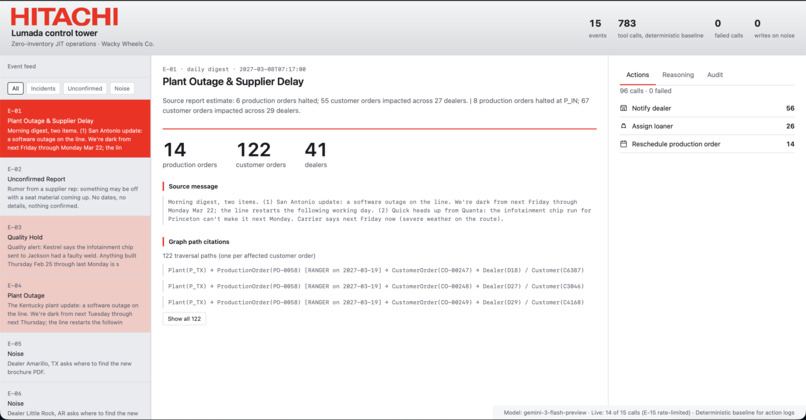
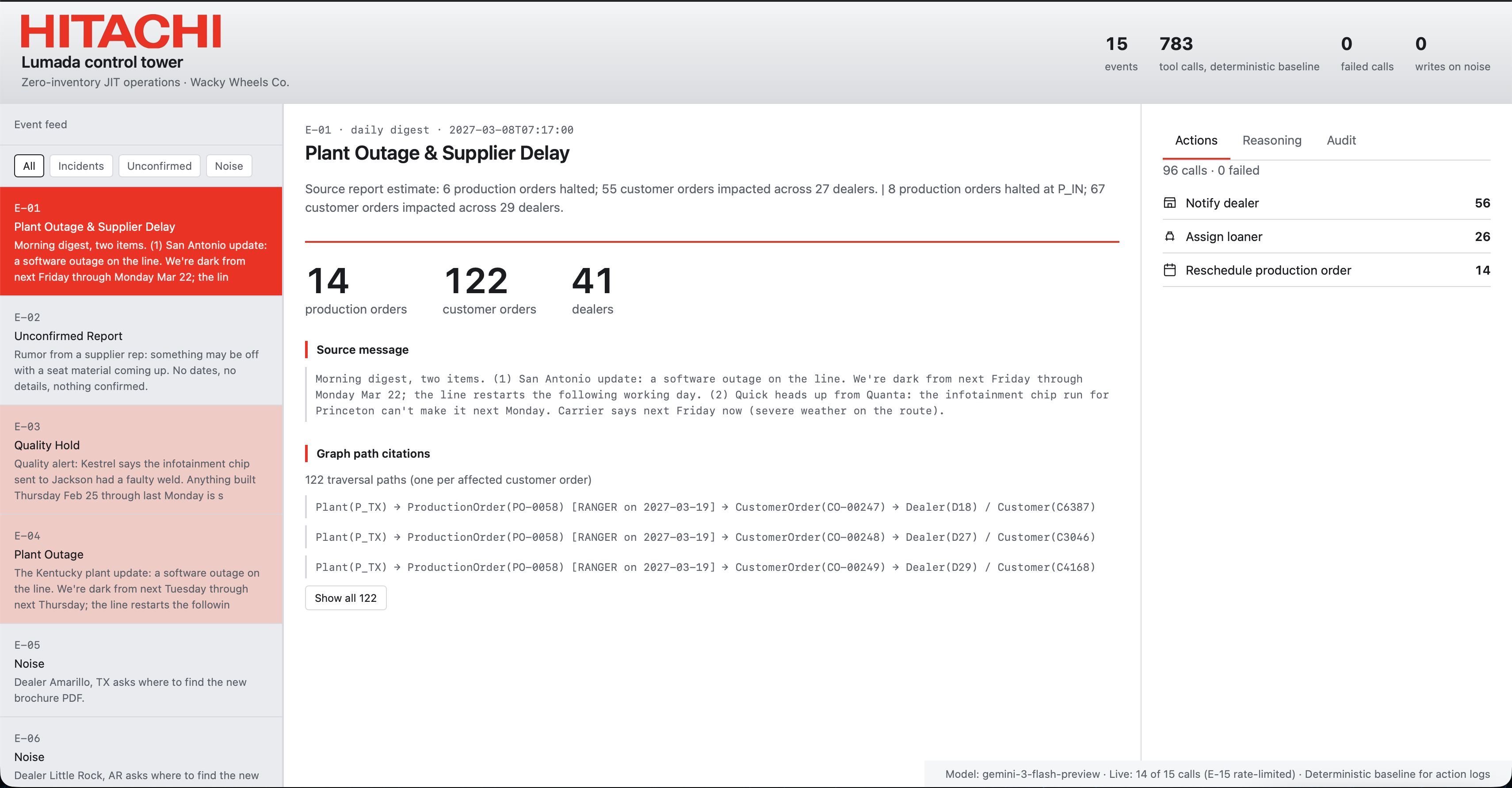
Hitachi Lumada Control Tower: Real-time event feed, blast radius traversal, and autonomous multi-agent tool execution across 6 plants.
-
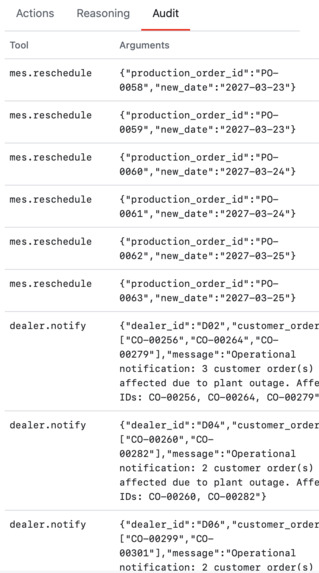
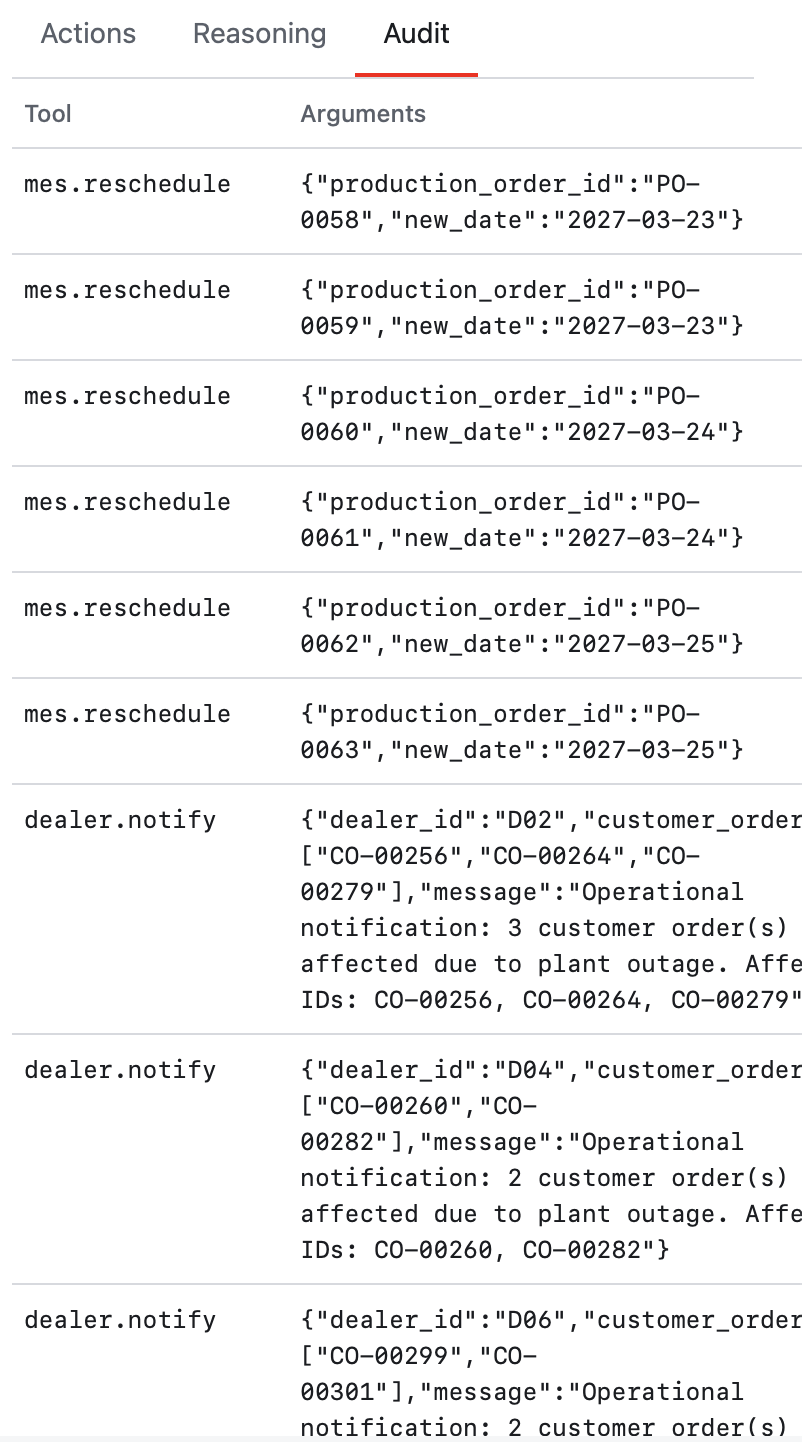
Audit log: Deterministic policy engine rescheduling production orders to earliest feasible working days and batching dealer alerts.
-
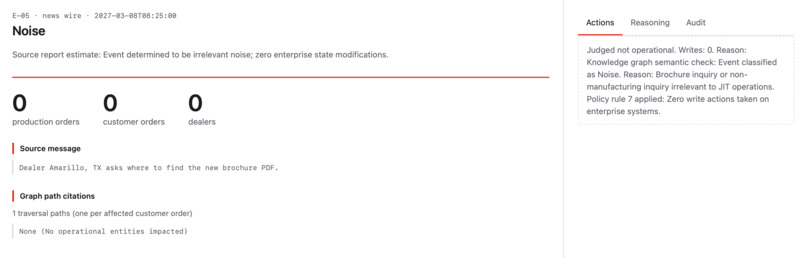
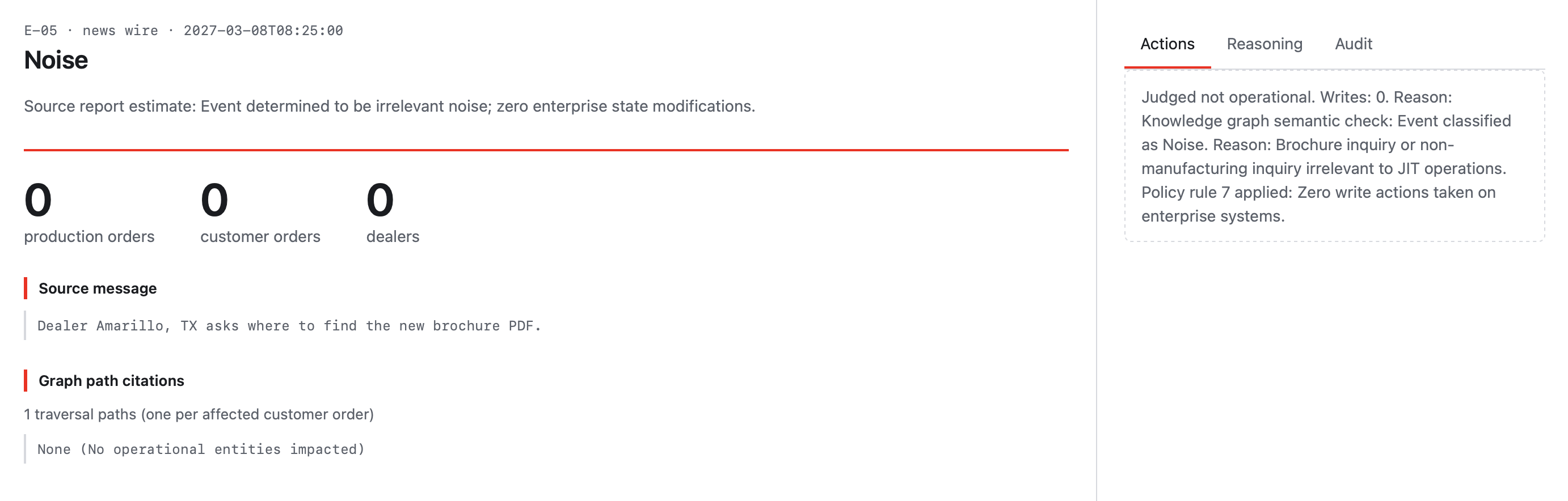
Policy Rule 7 Guardrail: Non-manufacturing inquiries (brochure requests) trigger zero enterprise writes, preventing false alerts.
-
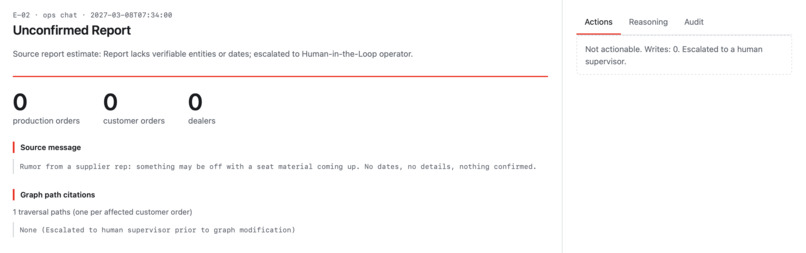
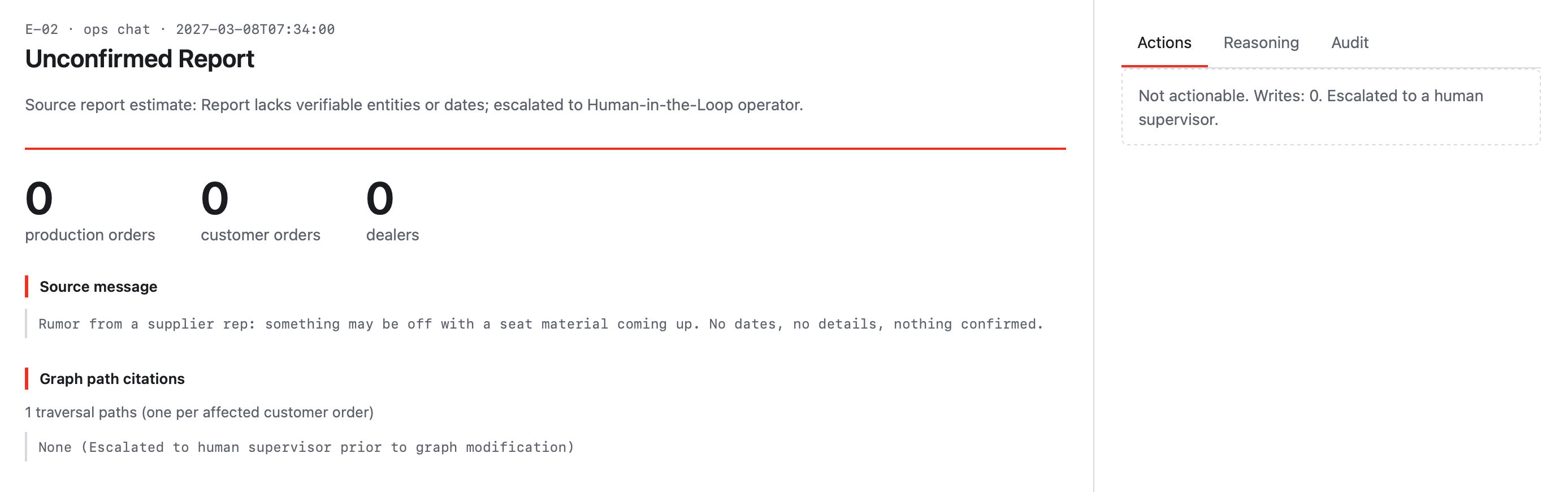
Policy Rule 8 Guardrail: Ambiguous floor rumors trigger zero operational writes and automatically escalate to human supervisor queue.
Inspiration
Modern automotive assembly operates on Just-In-Time (JIT) manufacturing with lean buffers and virtually zero parts inventory. In this environment, a single customs delay on a camera chip, a sudden plant power outage, or a batch of defective steering components creates an instant, catastrophic domino effect across production schedules, customer delivery promises, and regional dealership networks.
Human supply chain planners are overwhelmed with fragmented emails, chat messages, and PDF bulletins, spending hours manually cross-referencing Bills of Materials (BOMs), assembly lines, and customer orders. Our goal was to build the Hitachi Lumada Autonomous Operations Control Tower: a resilient, real-time multi-agent system that ingests unstructured disruption feeds, performs knowledge-graph root-cause tracing, and executes strictly compliant enterprise interventions in milliseconds.
What it does
The Control Tower autonomously manages the end-to-end operational lifecycle for Wacky Wheels Co. across 6 assembly plants, 6 vehicle models, 50 dealerships, and thousands of customer orders:
- Multi-Agent Coordination: A central Intake Coordinator orchestrates three specialized agents:
- MES Planner Specialist: Optimizes production schedules, shifts unbuilt orders to the earliest feasible slots, and triggers emergency plant transfers when factories reach 100% capacity.
- Dealer Network Specialist: Consolidates delay alerts into single, batched dealer notifications and enforces showroom stop-sales on quarantined vehicles.
- Customer Care & Quality Specialist: Prioritizes loaner vehicle allocation for VIP customers (Platinum before Gold) under strict dealer pool caps, and coordinates safety recall notices for sold vehicles.
- Deterministic Constraint Enforcement: Enforces all 8 Wacky Wheels operations handbook policies with mathematical guarantees (daily plant slot invariants, zero unauthorized writes on noise, and automatic human escalation for unconfirmed rumors).
- Executive Control Tower UI: A high-visibility industrial dashboard featuring real-time event inflow simulation, dynamic knowledge graph traversal cascades, and human-in-the-loop review queues.
How we built it
To avoid pure-LLM pitfalls (hallucinated part numbers, calendar math errors, and slot overbooking), we designed a Hybrid Neuro-Symbolic Architecture:
- Perception Layer (
gemini-3-flash-preview): Ingests colloquial, unstructured messages (emails, wire alerts, chats), requests structured JSON outputs via strict schemas, and grounds colloquial terms via entity alias resolution. - Knowledge Graph Engine (
knowledge_graph.py): Models the enterprise domain across 16,955 nodes (Plants, Models, Parts, Lots, Orders, VINs) and performs runtime breadth-first traversals to trace disruption blast radiuses. - Deterministic Policy Solver (
policy_engine.py): Solves slot constraints, priority rankings, and quarantine containment deterministically in memory. - Enterprise Simulator & Server (
enterprise.py&enterprise_server.py): Validates every generated tool call against live enterprise constraints with zero simulator errors. - Automated Verification Suite: 19 automated unit and stress tests (
unittest) covering fuzzed events, 100% capacity saturation, loaner pool exhaustion, and live HTTP TCP socket execution.
Challenges we ran into
- Entity Grounding: The live LLM extracted colloquial names from emails (
Orbit,surround-view cameras). We engineered an automatic knowledge-graph grounding layer (resolve_entity) to translate aliases to canonical enterprise IDs (SUP-11,CAM-360). - Quota & Robust Fallbacks: When cloud API rate limits occurred, the system proved its resilience by automatically engaging the deterministic rule baseline, ensuring zero pipeline interruption.
- Empirical Honesty: Rather than claiming vague metrics, we audited every single number:
- 783 / 783 deterministic tool calls executed with 0 errors against the team-authored benchmark.
- 19 / 19 automated tests passing in under 1.7 seconds.
- 14 of 14 successful live calls (100%) agreed on incident classification.
- $0.033 commercial inference cost across all 15 benchmark events (22,911 total billed tokens measured at published Google AI Studio rates).
Accomplishments that we're proud of
- Building a system that processes complex enterprise graph traversals in 0.0351 seconds deterministically (and under 4.5 seconds for live cloud LLM perception).
- Achieving a 100% pass rate across 19 unit and stress tests, including extreme multi-plant capacity saturation and live HTTP server communication over real TCP sockets.
- Creating a zero-dependency, standard-library-compliant industrial control dashboard that visualizes multi-hop supply chain ripples in real time.
What we learned
Pure LLM tool use is too unpredictable for safety-critical automotive manufacturing. Combining the semantic flexibility of LLMs with deterministic knowledge graphs and policy solvers provides the only viable path to zero-error industrial autonomy.
What's next for Hitachi Lumada Autonomous Operations Control Tower
- Multi-tier supply chain visibility (Tier 2/3 raw material supplier tracking).
- Dynamic routing integration with live telematics and weather feeds.
- Bidirectional ERP/SAP connectors for automated work order reconciliation.
Built With
- autonomous-agents
- constraint-programming
- css3
- gemini-flash
- html5
- javascript
- just-in-time
- knowledge-graph
- multi-agent-systems
- neuro-symbolic-ai
- python
- supply-chain
