-
-
Application of Project
-
Landing Page
-
Demo
Inspiration
Growing up, reading was a huge part of life. But books could only go so far. No matter how good the writing was, there was always a wall between the reader and the person on the page. It was easy to wish you could just hop on a call with the person you read about, for instance like MLK Jr., and ask what it actually felt like to live their lives, instead of reading about it secondhand.
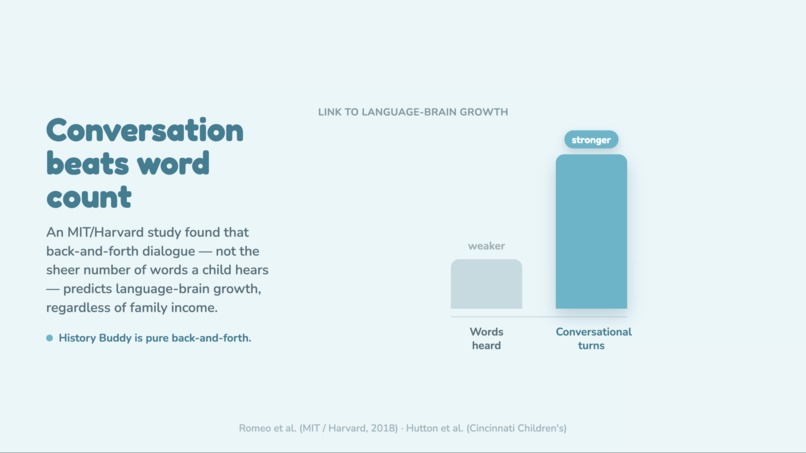
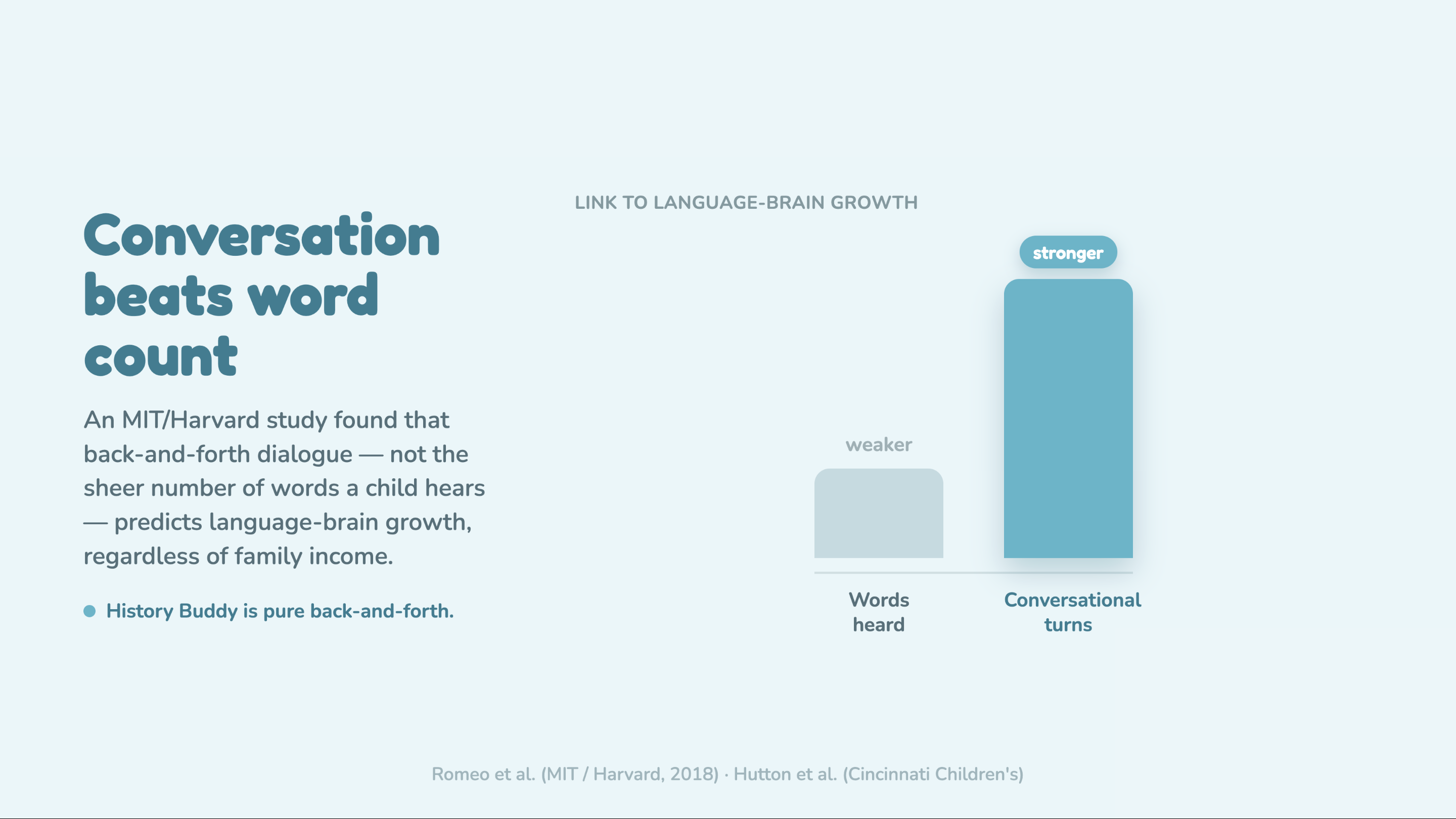
That instinct lines up with the research. A 2018 MIT/Harvard study (Romeo et al.) found that conversational turns, not the raw number of words a child hears, predict language-brain growth, and that holds true regardless of family income (Romeo et al., MIT/Harvard 2018; Hutton et al., Cincinnati Children's). Reading alone is one-directional. History Buddy is built to be the opposite: pure back-and-forth.
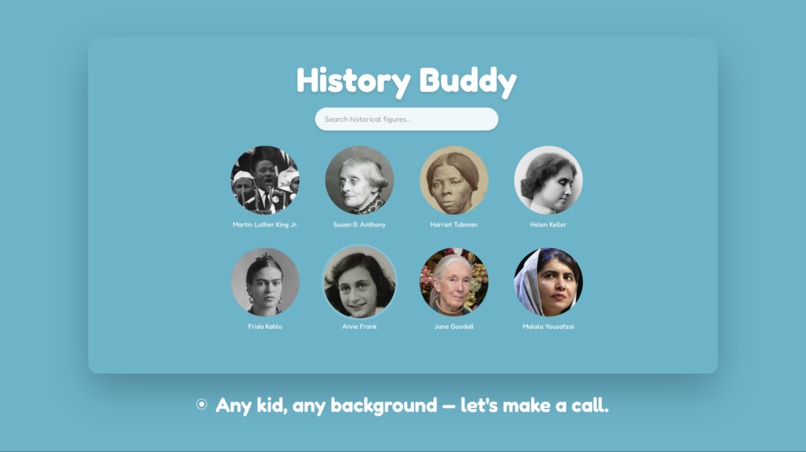
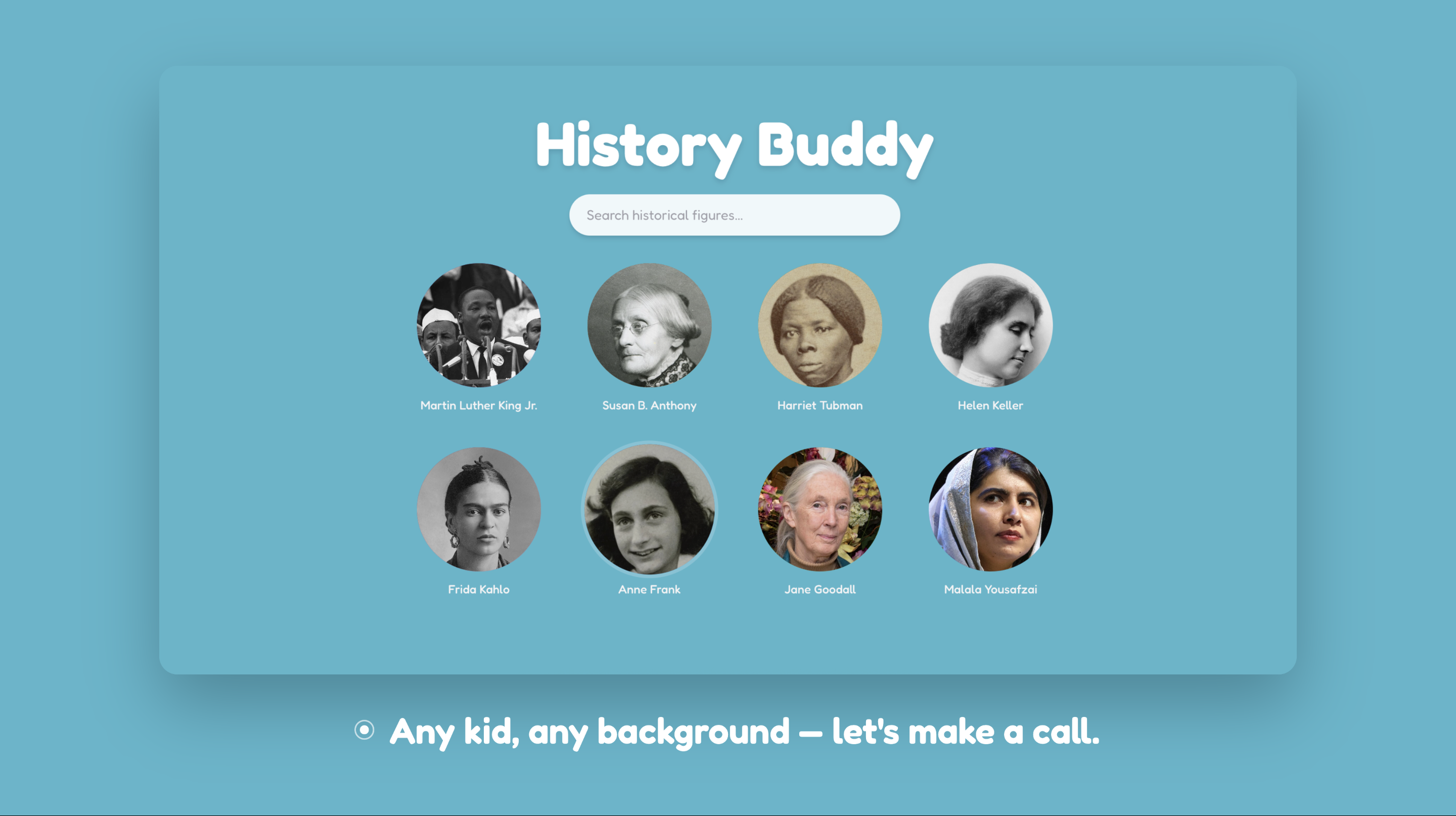
I built History Buddy, a platform that turns a static biography into a live conversation, letting elementary school students "video call" the historical figures they're learning about.
What it does
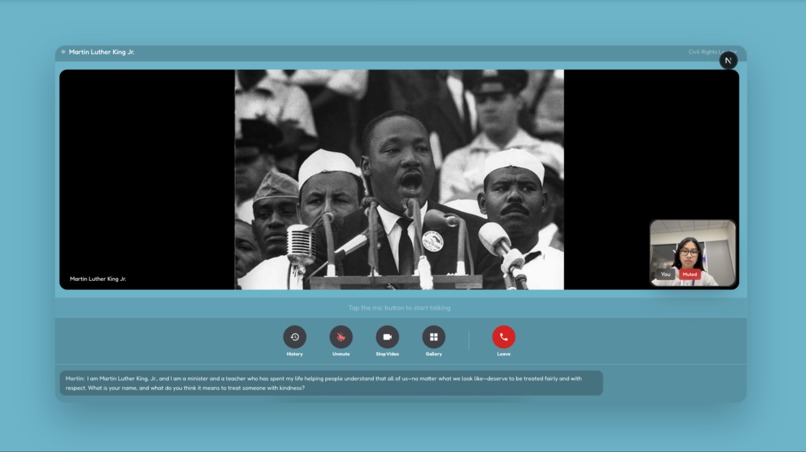
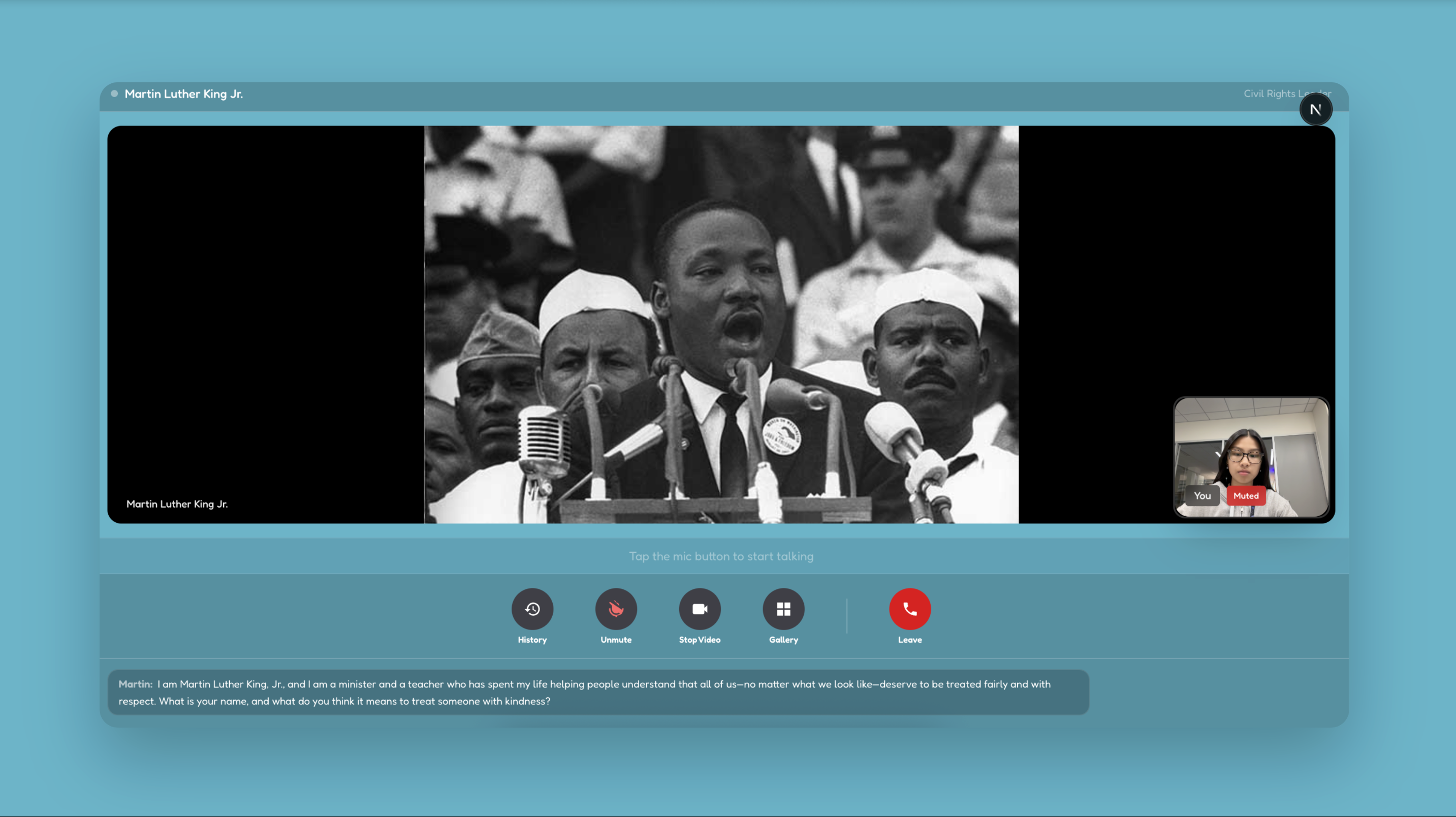
History Buddy gives elementary school students a video-call-like interface to talk directly with historical figures. A student picks a name from their history lesson, calls them, asks questions, and gets answers grounded in that person's real, documented life. A chapter they'd otherwise skim becomes a conversation they'll actually remember.
History Buddy is build for children at every income level, but it's especially powerful for kids who don't have it easy. For students with strong reading and writing instruction already, History Buddy is a supplement, a fun way to go deeper on what they're learning. For students in under-resourced schools, it's something bigger. Built into the school day, it facilitates discussions that may not be facilitated otherwise. And because it's a conversation, not a chapter, it can do something a textbook can't: spark enough curiosity that a kid goes and picks up the real biography afterward because they actually want to know more.
How we built it
I build History Buddy with Claude Code as my main tool. I also used Browserbase to scrape publicly available data to create a database for each historical figure. I used Deepgram to set up speech to text and text to speech. And, I used ElevenLabs for both customizable AI voices and a wider variety of AI voice options.
Challenges we ran into
A big challenge I ran into was complications with STT. I wanted the figures to start talking right when the user selected it. But, I ran into the issue of having to wait 20+ seconds before it would speak. Sometimes, if I clicked the button more than once, it wouldn't load for the same 20+ seconds, but then play the STT over itself. By employing methods like changing Claude generation models from Sonnet to Haiku, I was able to drastically shorten delays in verbal and visual cues, which made conversation seem much more seamless!
Accomplishments that we're proud of
I am proud that the app works! The app successfully converses with the user in a way that is understandable for a younger child, and is also safeguarded to be authentic to the historical beliefs of the figure, whether MLK Jr. or Jane Goodall.
What we learned
I learned how to use many tools regarding TTS and STT with Deepgram and ElevenLabs, which was a bit of a challenge given bottlenecks and some frustrating bugs, but it proved to be a very rewarding experience to learn how to use these kinds of technology. Also, using Browserbase to automate scraping data was really a unique experience and definitely showed me the possibilities of AI in my daily life. On top of all that, this was my first hackathon and I must say that I've learned that hackathons are a rewarding experience that I will continue to pursue further after this event!
What's next for History Buddy
History Buddy's next steps are to connect with underprivileged school districts to bring this technology to them. Also, I'd love to come in contact with my previous schools to see whether implementation might be possible after ensuring more robust structure, and seeing kids interact with the models would be fascinating!
Built With
- anthropic-claude-api
- deepgram
- elevenlabs
- eslint
- mediapipe
- next.js
- node.js
- postcss
- react
- tailwind-css
- typescript
- vercel

Log in or sign up for Devpost to join the conversation.