
The problem: Where did the money actually go?
For small transport operators, completing a trip does not always mean completing its financial settlement.
A customer may claim they paid. A driver may confirm collecting the cash. Fuel expenses and advances may be recorded separately. Receipts can be missing, records can conflict, and the owner is left trying to figure out what actually happened.
Traditional spreadsheets can record amounts, but they do not investigate the evidence behind those amounts. Generic AI chatbots can explain figures, but trusting a language model to calculate financial balances or assume that a payment reached the owner is risky.
We wanted to build something different.
Our solution: HisabGuard
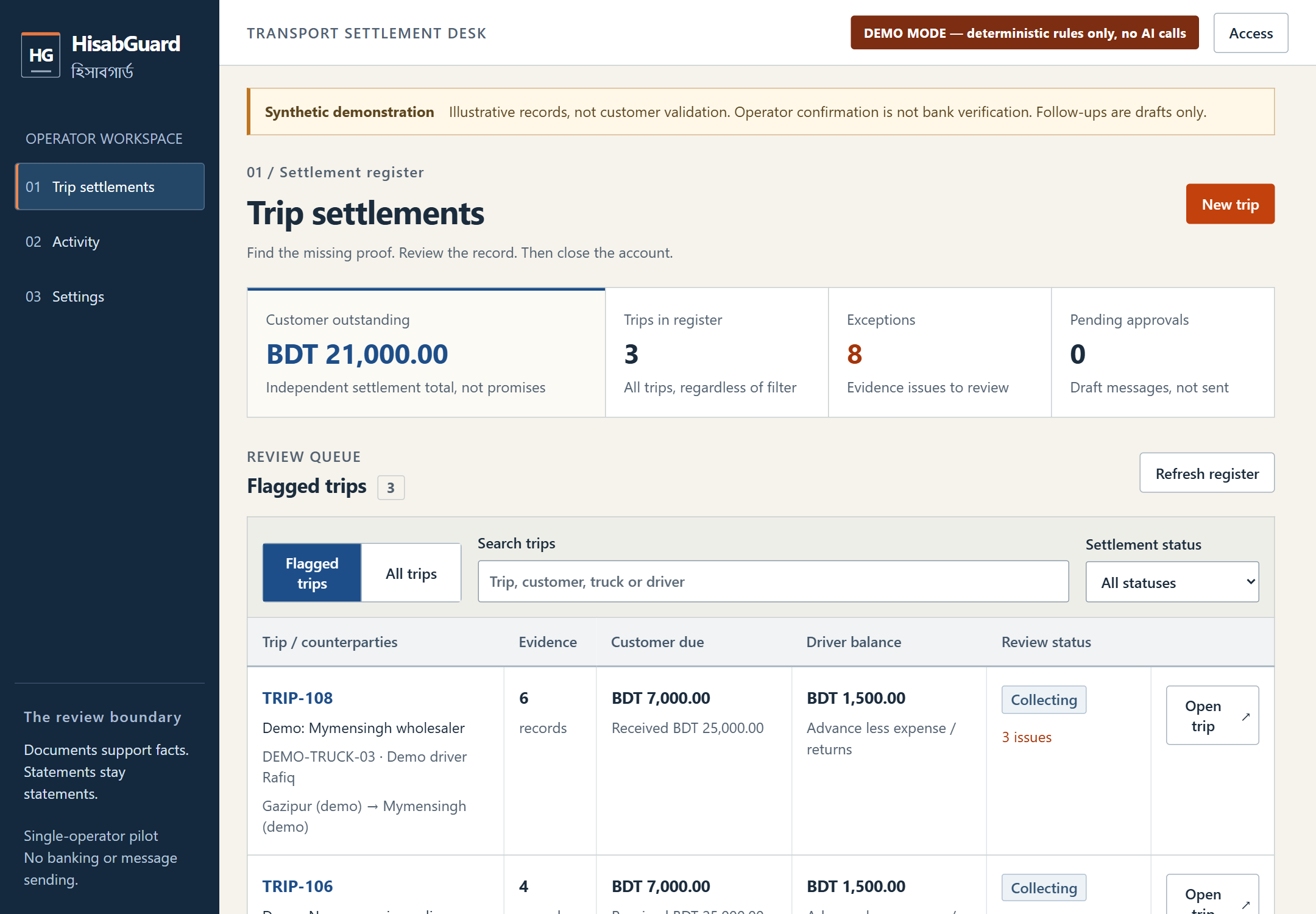
HisabGuard is an evidence-first AI investigation agent designed to help small transport operators investigate trip settlements, reconcile driver cash and expenses, and identify unresolved financial discrepancies.
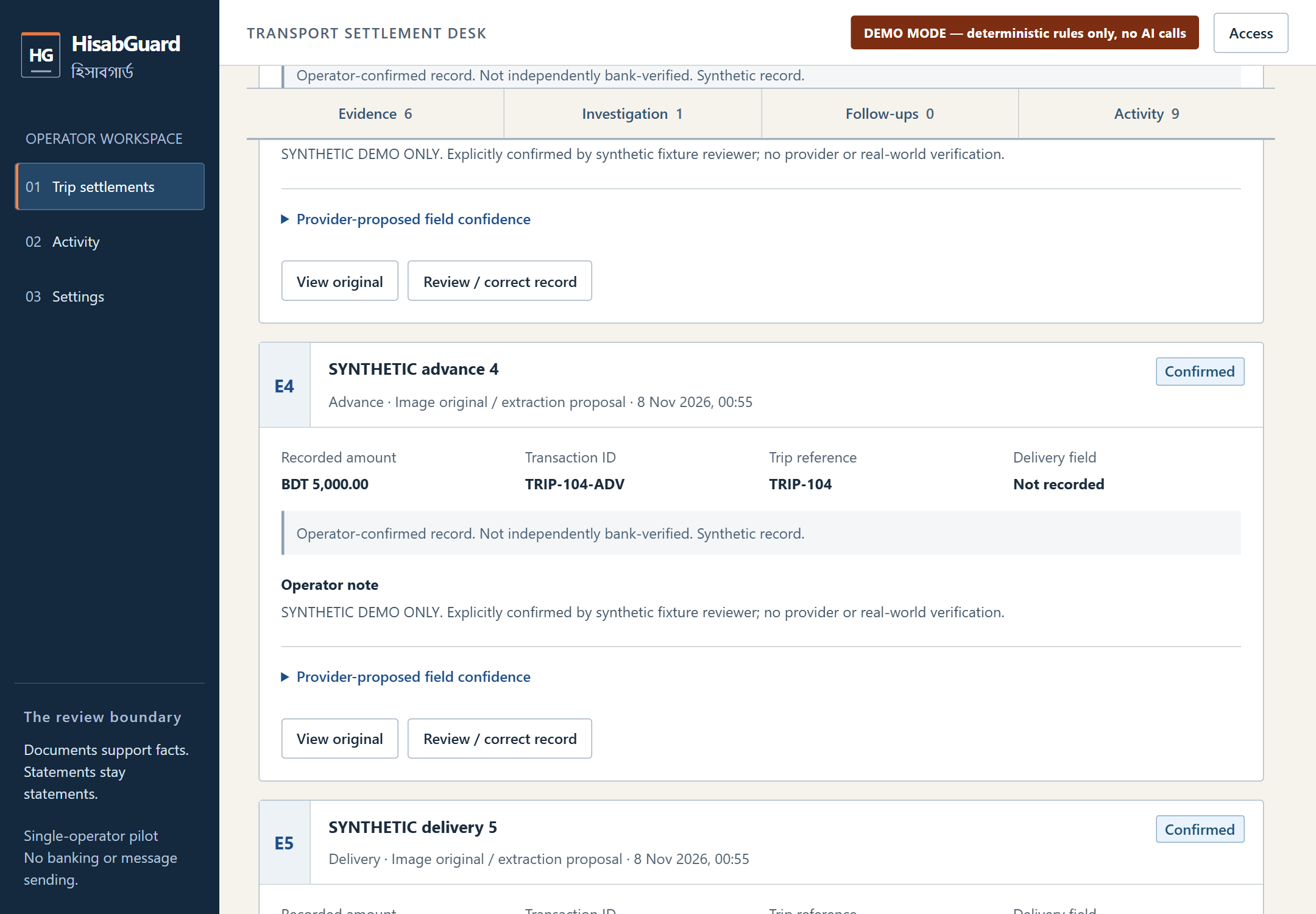
It brings together invoices, payment records, driver statements, advances, fuel expenses and other supporting documents into a structured investigation.
Instead of simply generating an answer, HisabGuard:
- Organizes evidence and identifies inconsistencies.
- Calculates settlement balances using an independent deterministic engine.
- Uses a bounded investigation workflow to examine discrepancies.
- Requests missing information instead of inventing explanations.
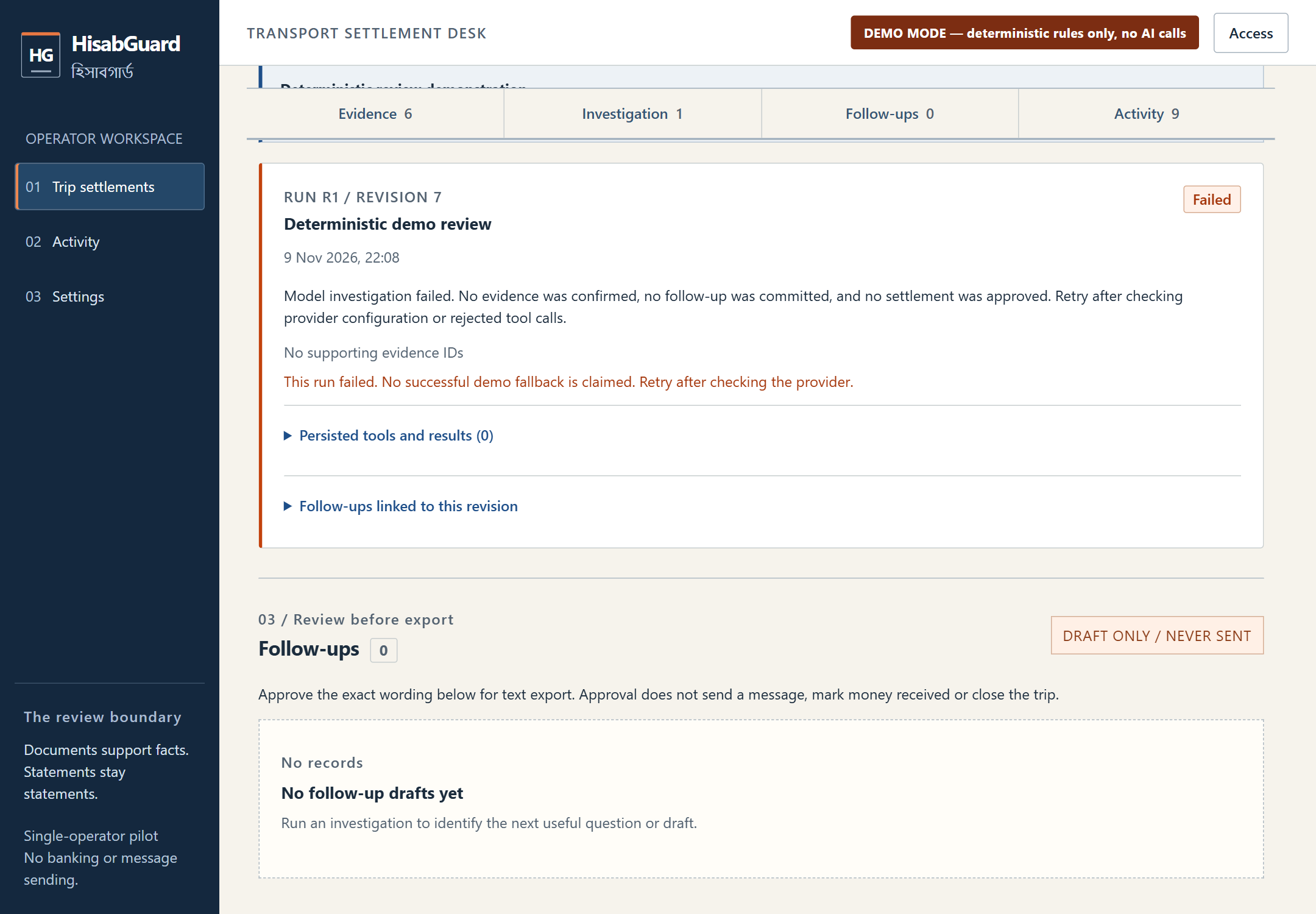
- Prepares follow-up drafts with references to supporting evidence.
- Requires human approval before an action is finalized.
- Maintains an audit trail and prevents unresolved cases from being incorrectly marked as closed.
The key insight: Collected does not mean settled
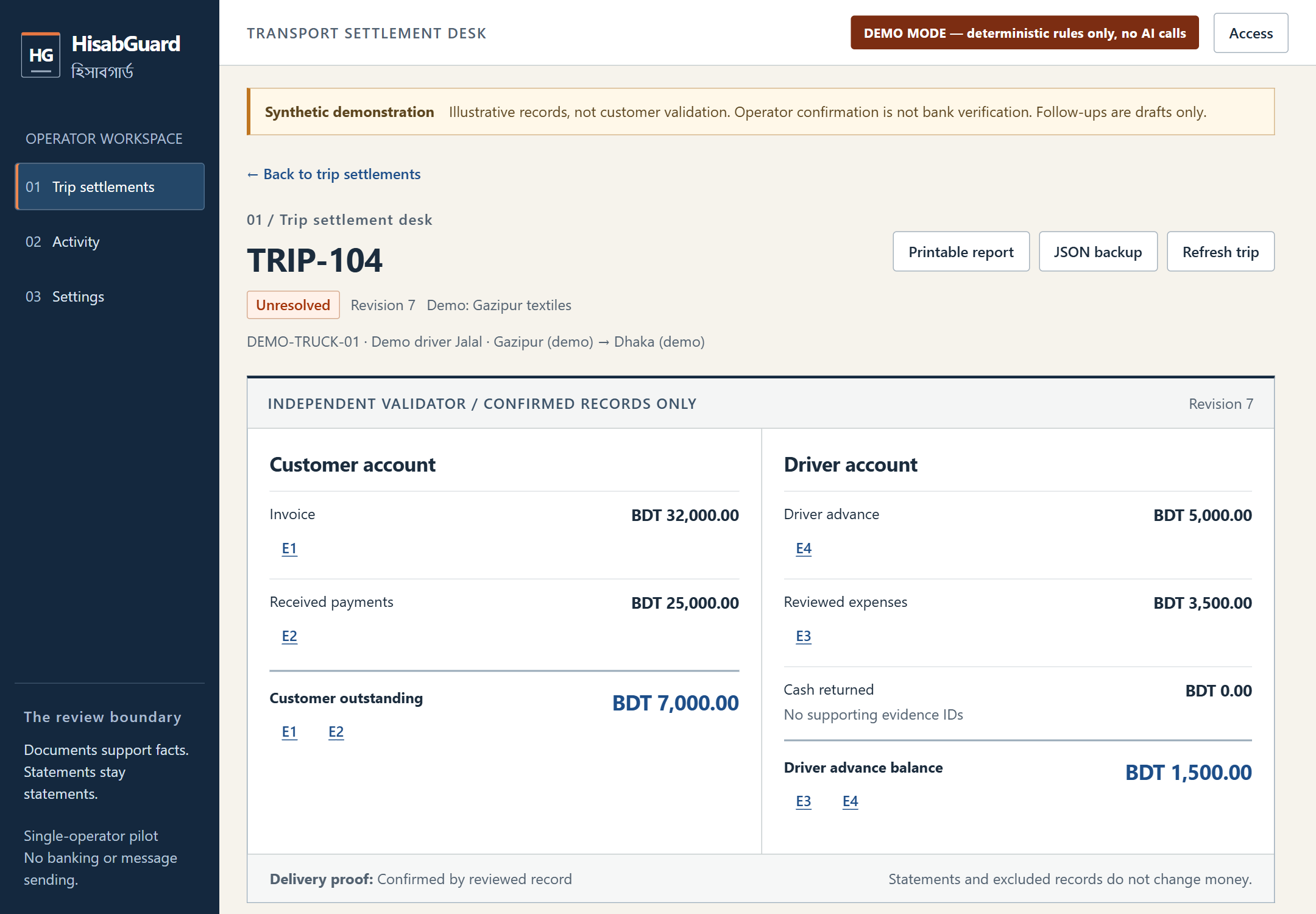
Consider a trip with:
- Invoice: BDT 32,000
- Recorded payment: BDT 25,000
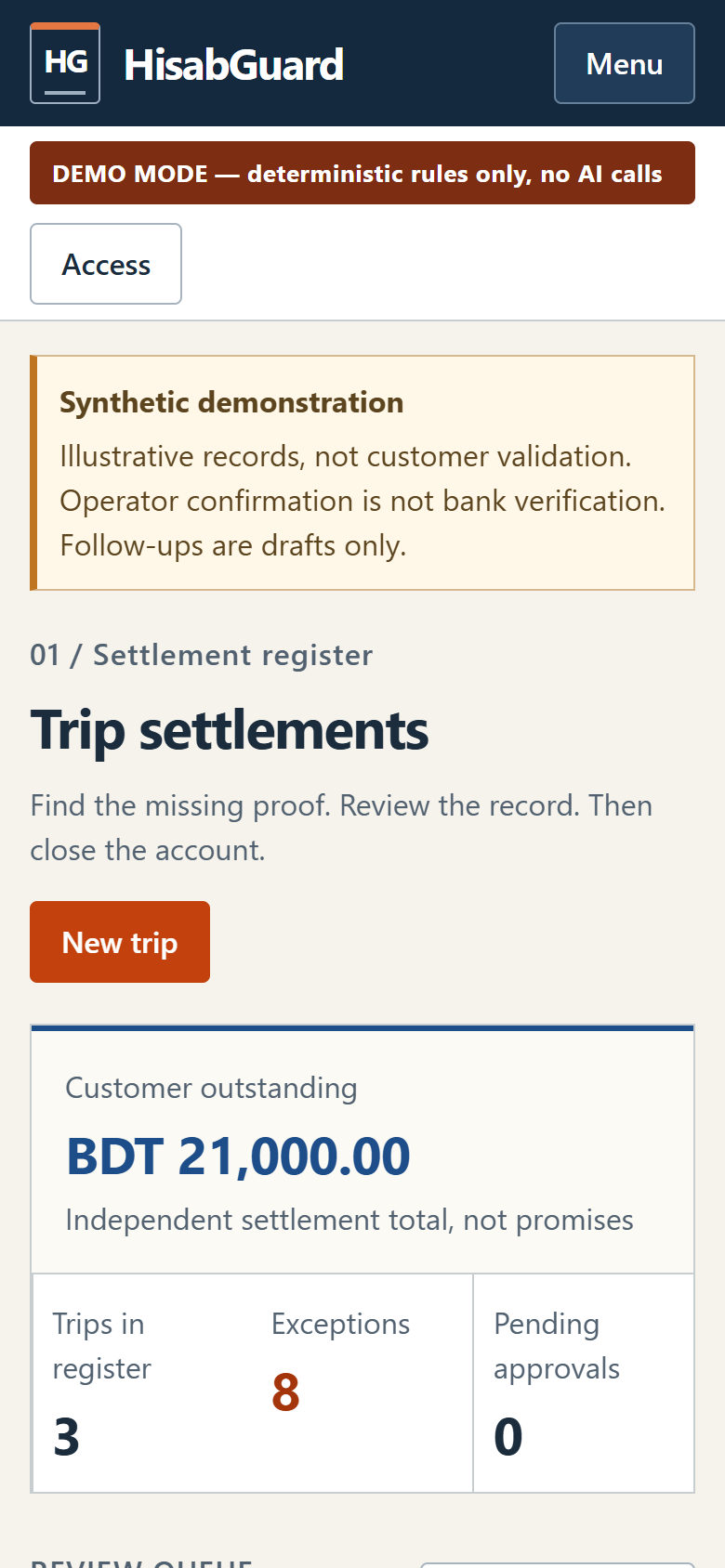
- Customer outstanding: BDT 7,000
- Driver advance: BDT 5,000
- Fuel expense: BDT 3,500
The customer says the remaining BDT 7,000 was handed to the driver. The driver confirms having the cash, but there is no evidence that it was handed over to the owner.
A conventional system might mistakenly treat the customer's statement as proof of payment.
HisabGuard keeps these events separate.
The customer's recorded outstanding balance remains BDT 7,000 until the required payment evidence is established. The driver's possession of the cash is investigated separately from the owner's receipt of it.
This distinction is central to the product: a claim is not evidence, and cash collected is not automatically cash settled.
How we built it
We built HisabGuard around a separation of responsibilities between AI reasoning and financial calculations.
1. Evidence intake
The system accepts structured trip records and supporting evidence. Evidence is validated and stored as a draft for review. Failed extraction or incomplete information is not silently converted into confirmed financial data.
2. Deterministic settlement engine
Financial calculations are handled independently of the language model, using integer-paisa BDT arithmetic. This keeps financial totals predictable and avoids relying on generated text for monetary calculations.
3. Bounded investigation agent
The agent uses a restricted set of tools to inspect records, identify discrepancies and request missing evidence. Its investigation is bounded rather than allowed to run indefinitely.
4. Evidence-backed proposals
Financial claims in proposed explanations and follow-ups must reference supporting evidence. Unsupported claims are rejected rather than presented as established facts.
5. Human approval and auditability
Follow-up drafts require human approval. Approval produces a downloadable draft; it does not automatically send a message. The system also maintains an audit trail and applies closure checks so unresolved discrepancies cannot simply disappear.
Challenges we faced
One of the biggest challenges was deciding what the AI should and should not control.
A language model can produce a convincing explanation even when the underlying evidence is incomplete. We therefore separated financial calculations from AI reasoning and introduced validation around evidence references and proposed actions.
Another challenge was handling conflicting statements. A customer saying that money was paid and a driver saying that money was received are not necessarily proof that the owner received it. Modeling these as separate events was essential.
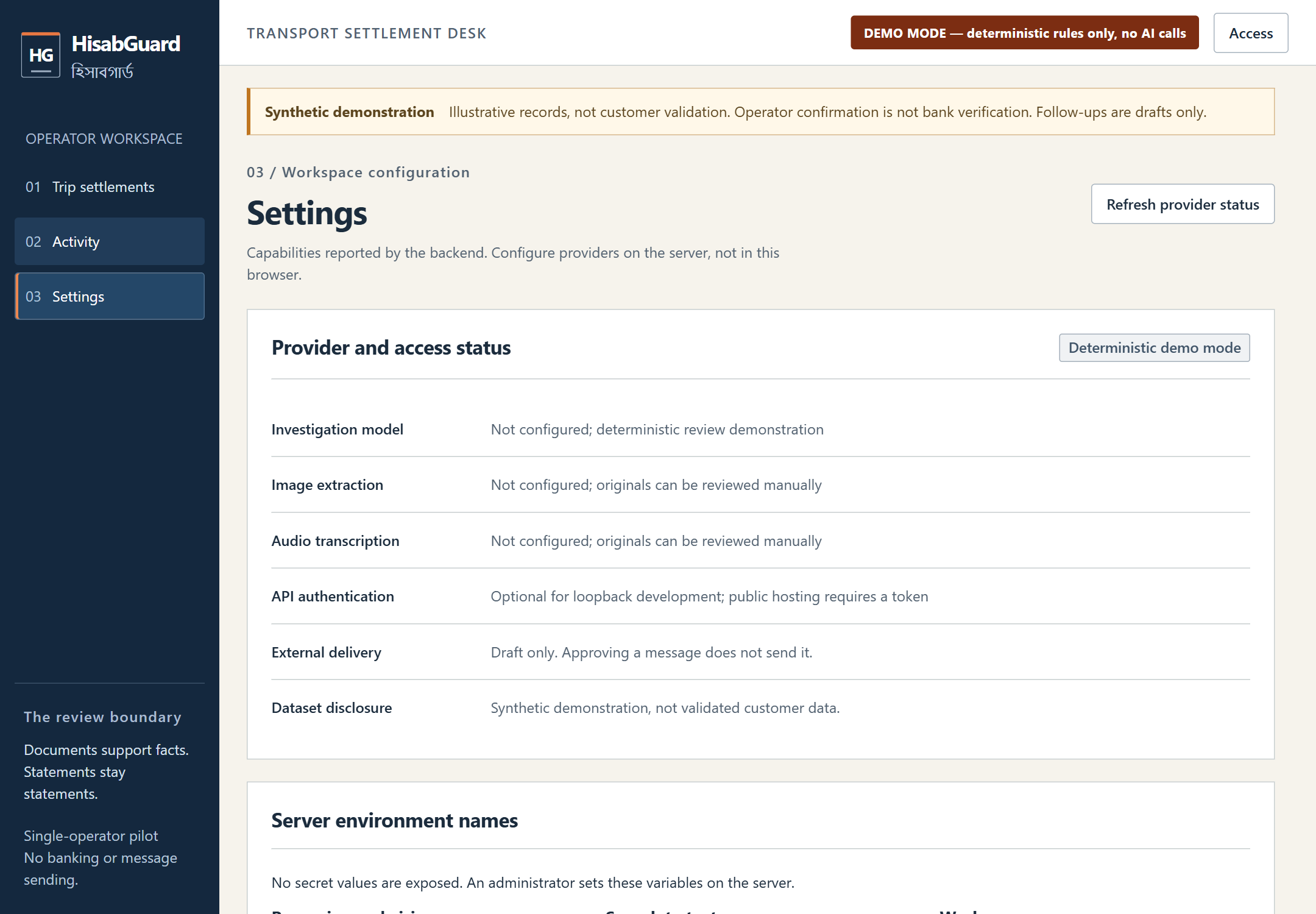
We also had to work within limited access to external AI providers. Rate limits and payment-related provider errors made it important for the demonstration to remain usable without depending on a live model call. The default demo therefore uses a deterministic rule-based reviewer rather than pretending every interaction is powered by a live autonomous model.
What we learned
We learned that useful agentic systems are not just about giving an AI more tools or making it more autonomous.
They are about giving it the right boundaries.
Financial reasoning needs deterministic controls. Evidence needs traceability. Missing information needs to remain missing until verified. And consequential actions need human approval.
HisabGuard is currently a working prototype demonstrated with synthetic records. It does not independently verify bank or bKash transactions, move money, or automatically send WhatsApp messages or emails. Real-world operator validation and broader document-extraction testing remain important next steps.
Our goal is simple:
Help transport operators move from disputed financial records to evidence-backed answers, without relying on guesswork.
