-
-
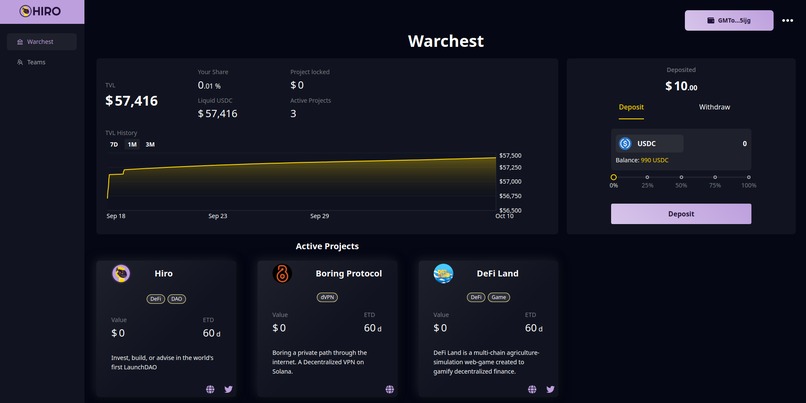
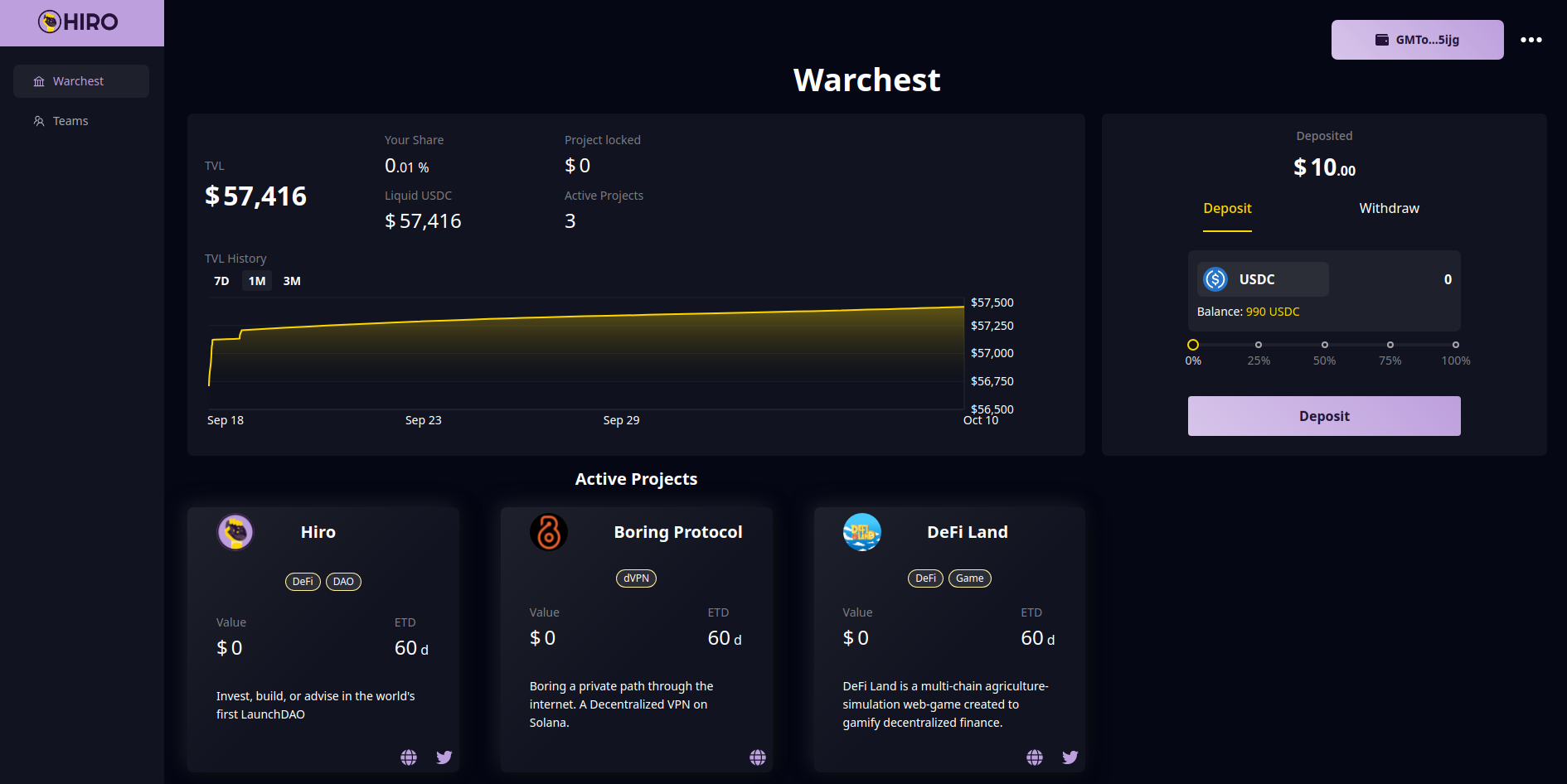
HIRO War Chest frontend
Inspiration
Current launchpads and DAO factories are not truly decentralized. While funding can be contributed by anyone, decisions around project selection, vesting, funding amounts, and more are made by centralized parties whose intentions may not align with those of the DAO. We set out to change that and decentralize all aspects of DeFi VC.
What it does
Retail investors seek the same diversification benefits and accessibility as professional investors. HIRO delivers fluid venture funding as a new passive asset class that promises Accessibility, Transparency, and Equity through a DeFi-native product. We separate the funding from the decision-making, creating a platform for both passive and active investors.
HIRO leverages a DAO to filter and/or feed investments and to reward active manager contributions with financial token options. This DAO gives the platform streamlined decision-making as strong managers compound their rewards into greater voting power over projects and over the protocol’s future.
How we built it
War chest
- Completely passive participation in new projects requires a different kind of pool token than those that we generally use in blockchains. Returns are not linear or unpredictable. Therefore, we had to exclude newcomers to our War Chest from participating in returns generated on projects that were funded at an earlier point in time. Otherwise, promising projects in the HIRO portfolio would draw in heavily diluting inflows of capital and not so promising projects would see a mass exodus of investors.
- We built and tested a model that tracks returns for individual investors in the War Chest based on snapshots at their points of entry.
Reputation
- Instead of limiting ourselves with the traditional token-based governance model, we wanted to replicate what a traditional VC firm is based on: merit and reputation. Our meritocratic model had to somehow track decision-making and reward value-generating voting and punish value-destroying voting among managers in HIRO.
- We knew that this would mean there would be a cost tied to voting. Additionally, we wanted to prevent bandwagon voting (reaping the same rewards for a vote despite having more information than previous voters). For Ignition, we devised an endogenous, self-determining prediction market model
- Reputation can be traded in for vested financial options on the underlying project that was being decided. This incentivizes risk-taking by the managers while also aligning incentives over the long-term.
Challenges we ran into
War Chest
- We knew that we could set the War Chest up as an equity model, but we wanted to prevent investor losses to previous speculation. True to liquidity pools, value should increase (even if slowly) as the capital is utilized effectively by portfolio projects.
Reputation
- We had a hard time trying to figure out ways to prevent voters from gaming the system by voting quickly to lock in an early vote, regardless of how they felt the vote would swing.
- A self-determining prediction market means vote prices will start action like options, resulting in theta-induced upward pricing pressure. To combat this, we allow votes to be redeemed against the protocol at the current market price. This allows managers to lock in their Reputation profits, creating downward pricing pressure and ensuring an efficient market.
Accomplishments that we're proud of
We are devising a completely novel way of doing on-chain governance, with a focus on keeping voting efficient and rewards fair.
What we learned
Unit testing is boring.
What's next for Hiro LaunchDAO
We will be attending Lisbon Blockchain Week and Solana Breakpoint to further develop our model.
Built With
- dapp-scaffold
- digitalocean
- netlify
- rust
- solana
- typescript


Log in or sign up for Devpost to join the conversation.