-
-
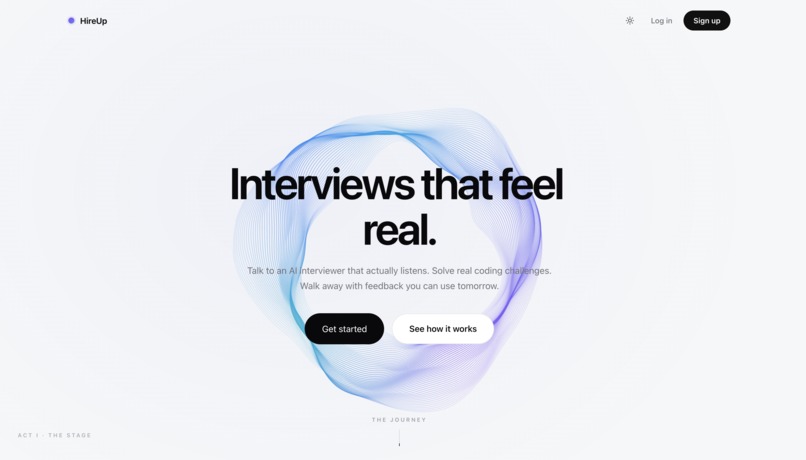
Homepage
-
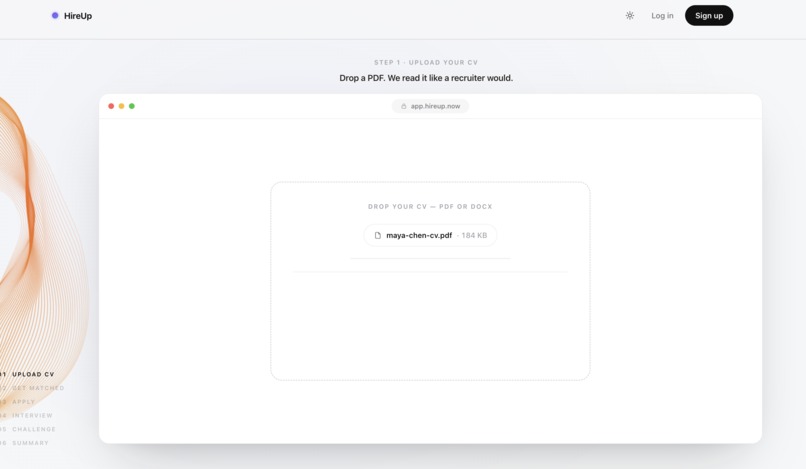
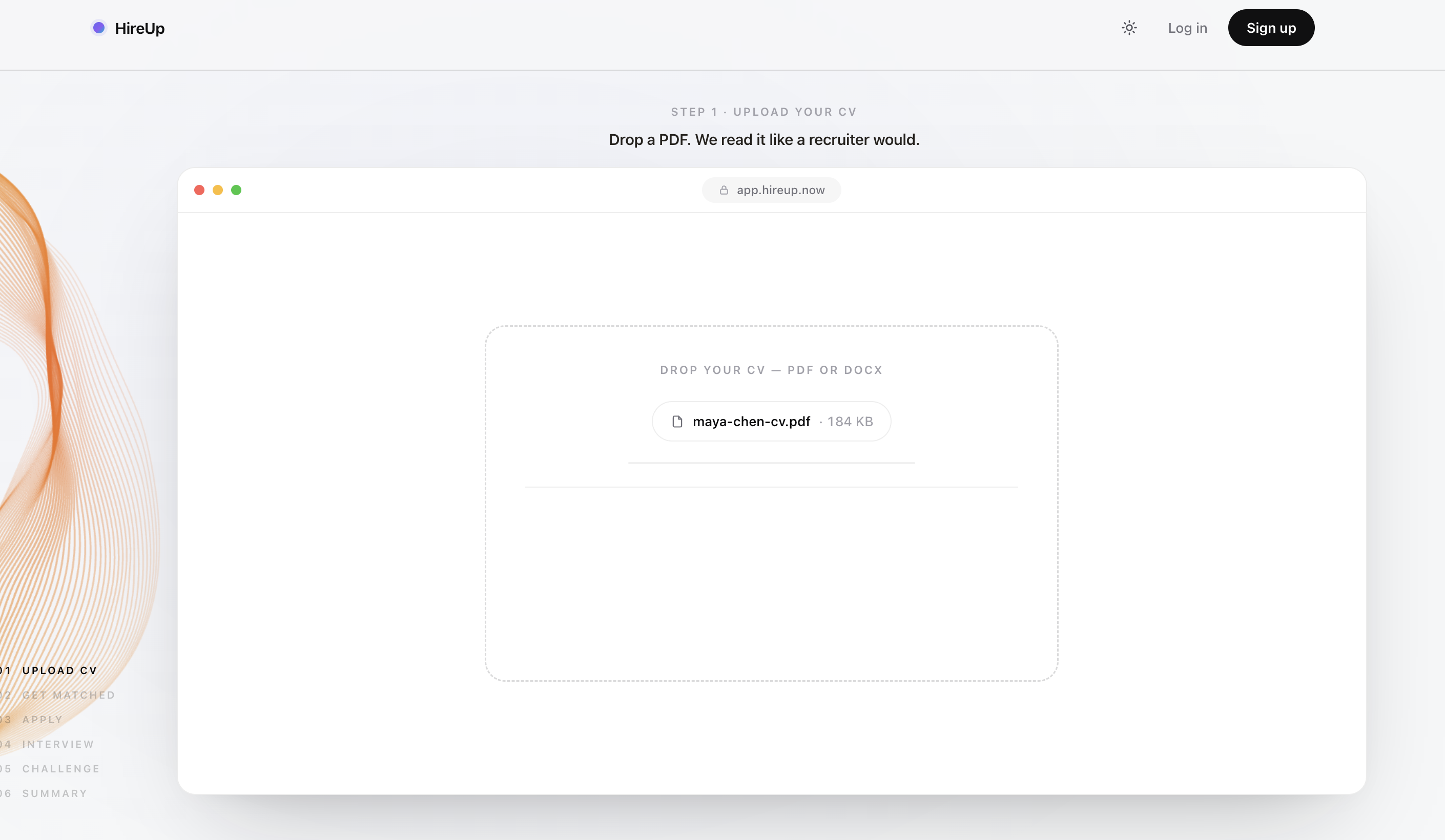
Upload CV
-
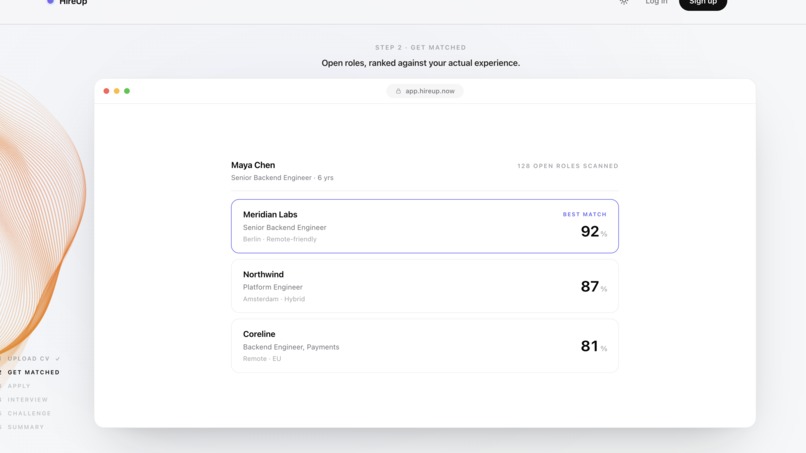
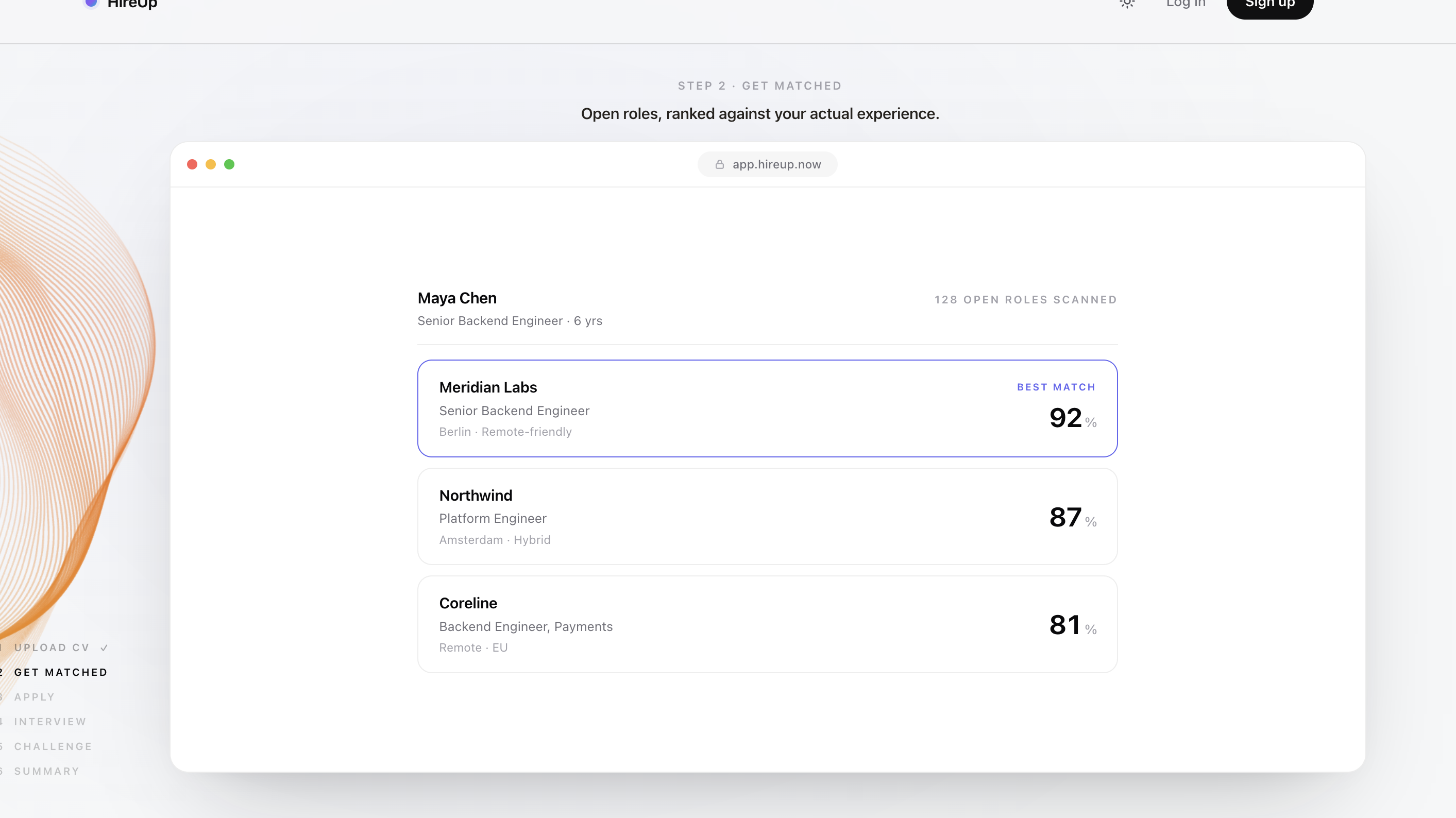
Matching Recommendation
-
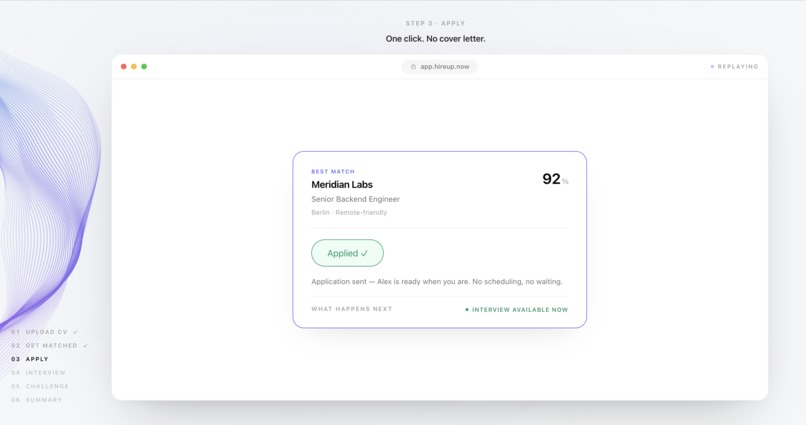
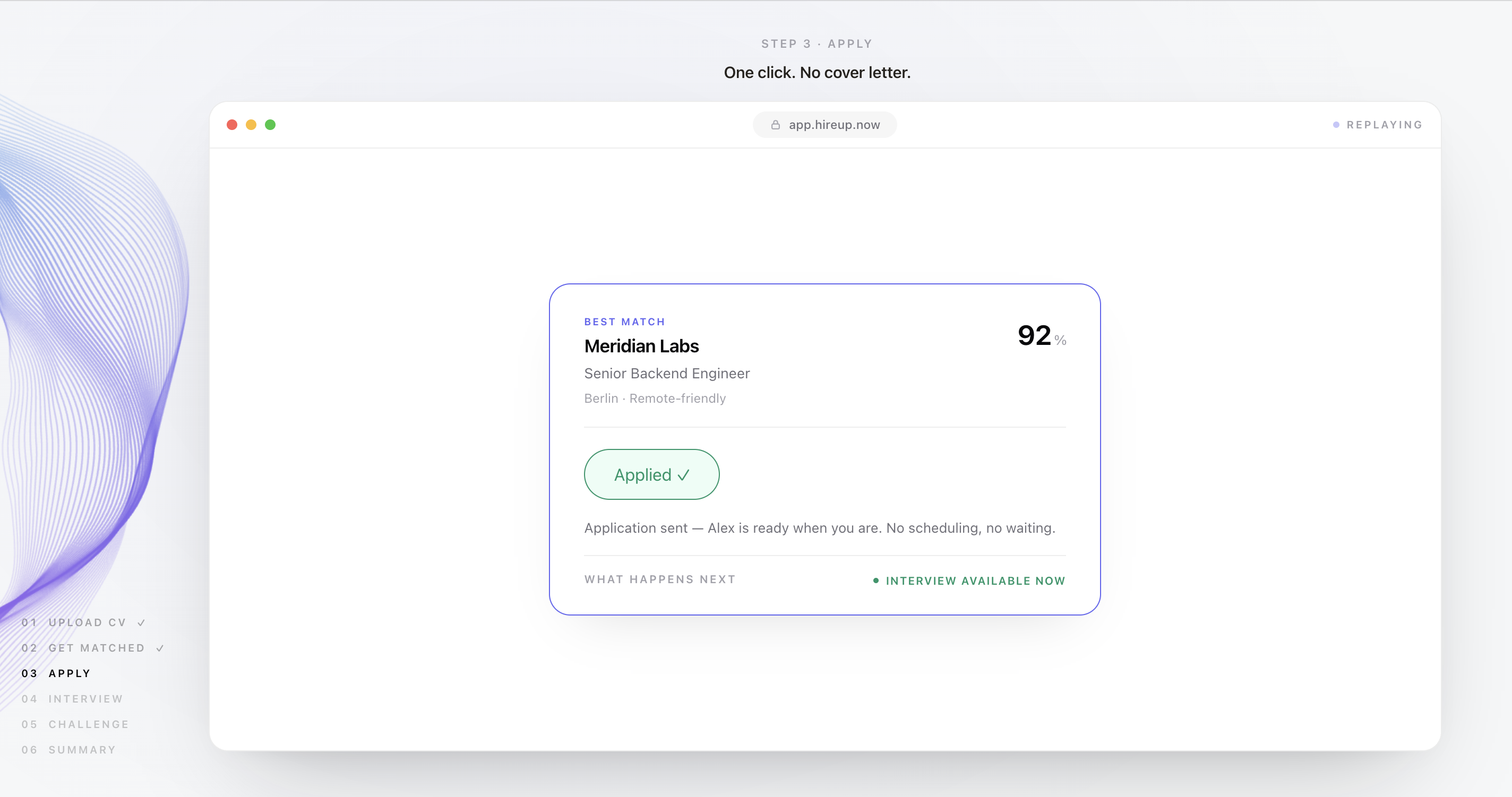
Apply
-
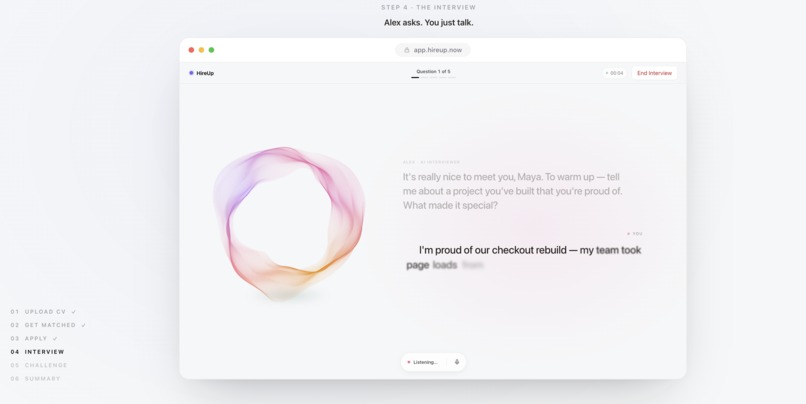
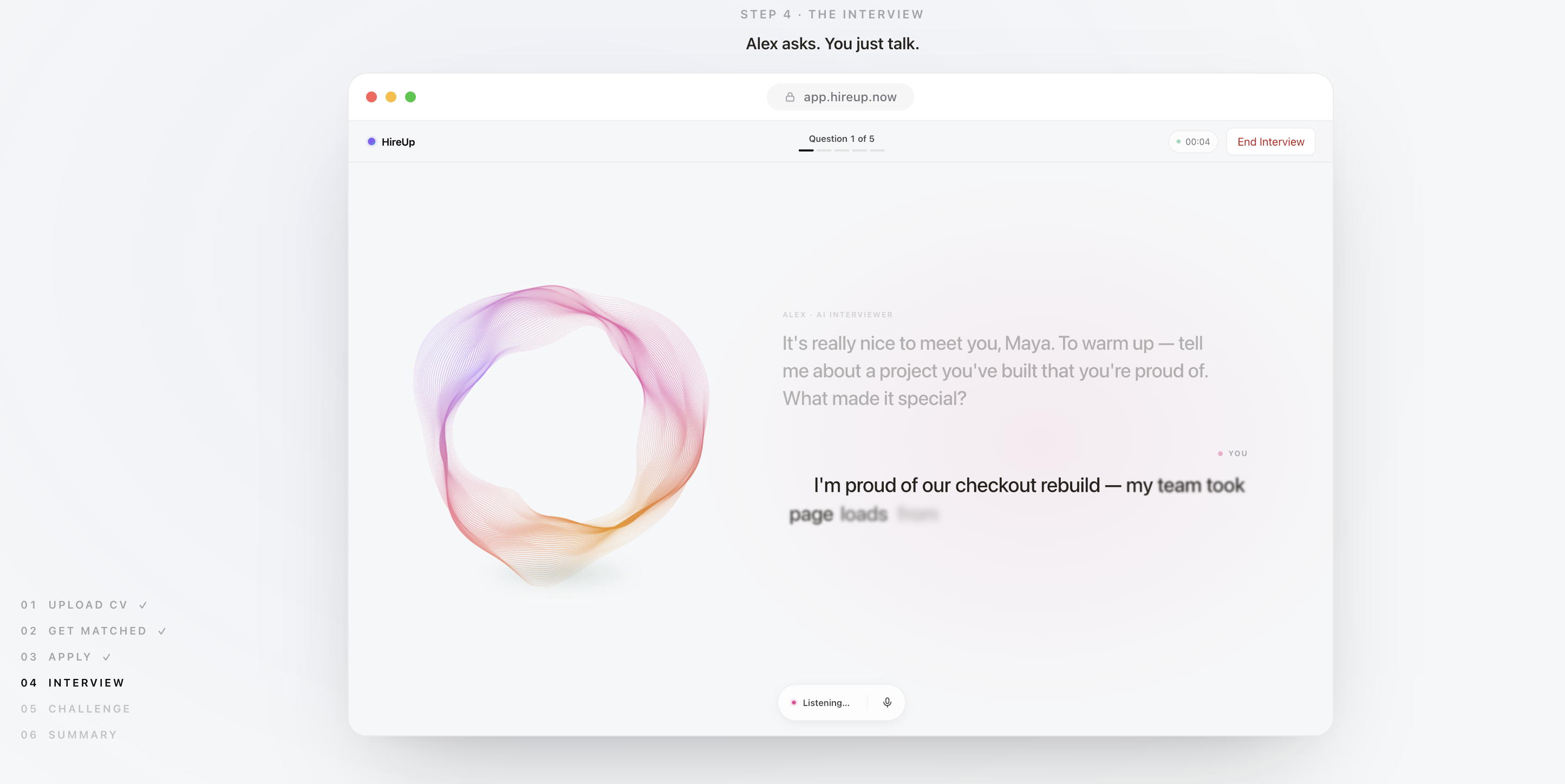
Interview
-
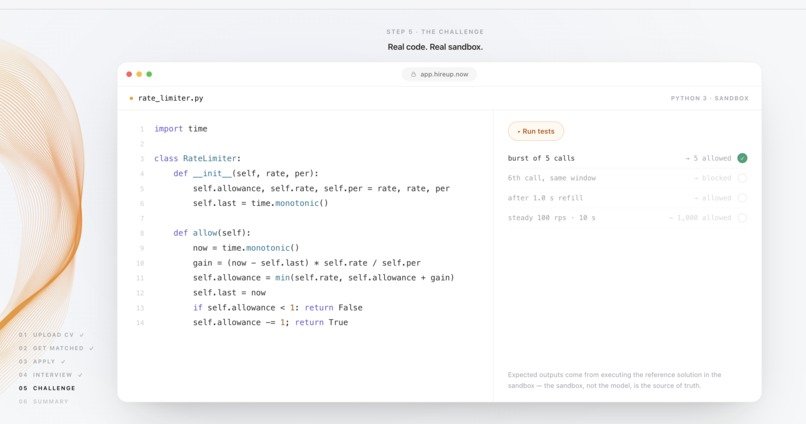
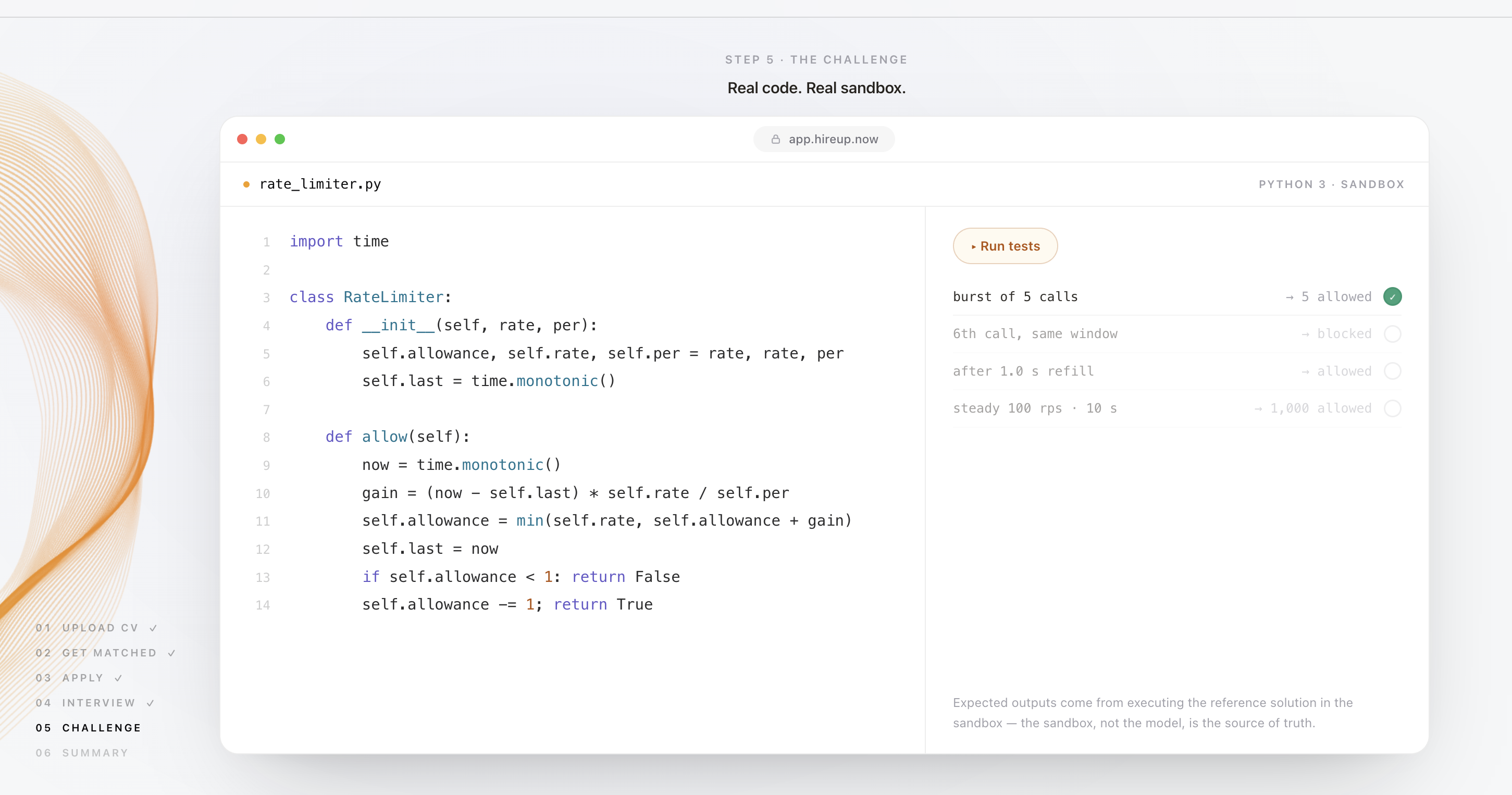
Challenge
-
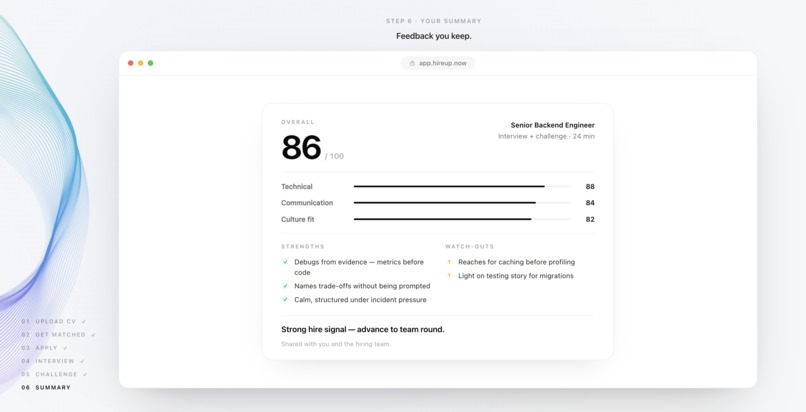
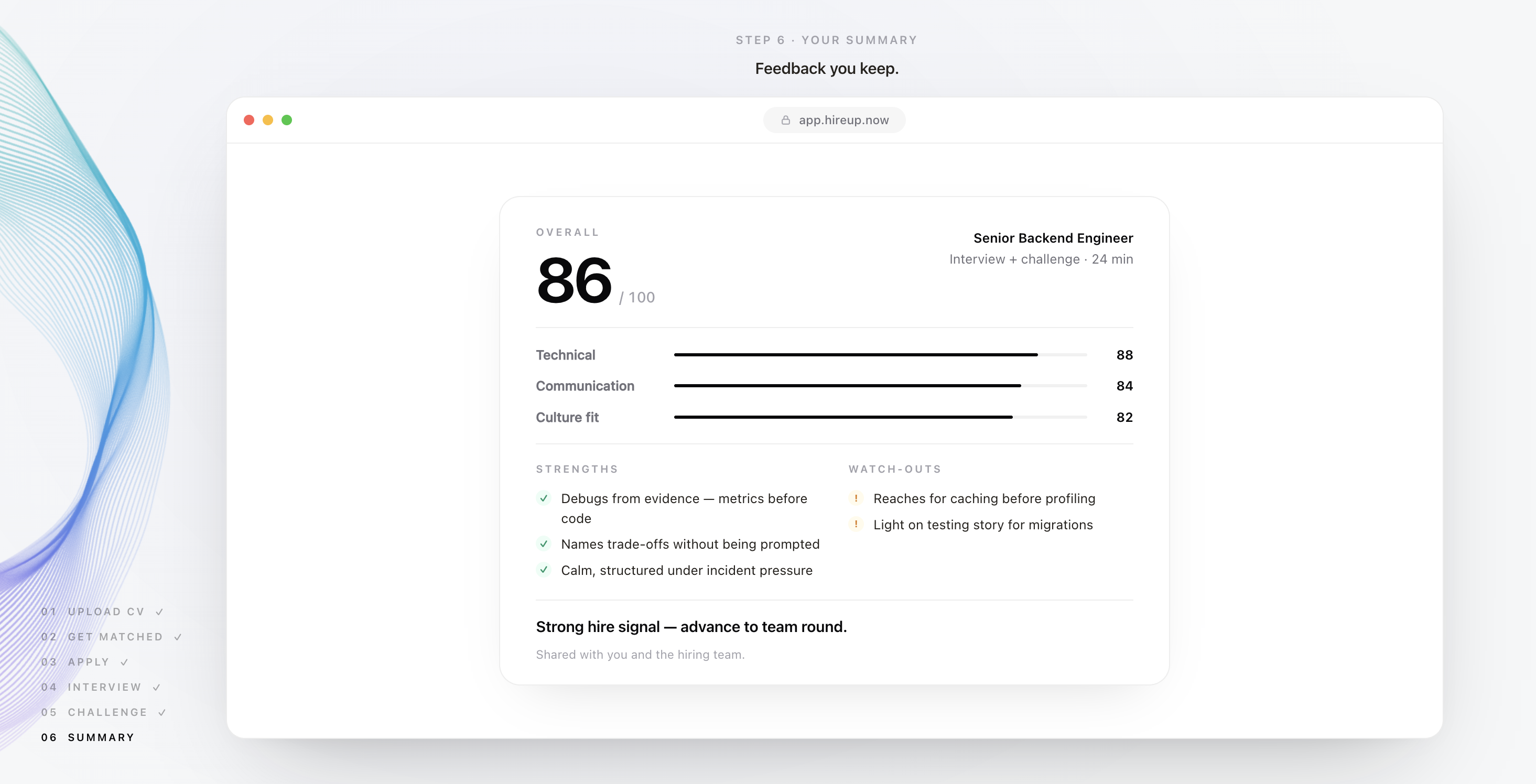
Feedback
Hireup — Devpost Project Story
Our Tagline
From résumé to live AI interview in under three clicks.
Inspiration
The idea for Hireup didn't begin with AI. It began with the frustration of what we face in the current HR system.
In order to make a differnce we got into HR tech. We were given an opportunity to work with recruiters, and we watched talented candidates disappear into systems that seemed designed to overlook them. Hiring had become a process of keyword searches, spreadsheets, outdated databases, and endless manual filtering. Everyone involved was working hard, yet the outcome rarely reflected the quality of the people looking for jobs.
The more time we spent inside the industry, the clearer the problem became. Recruiters are ultimately paid by employers, not candidates, and this drives their business interest and incentive. Job boards often contain listings that remain online long after positions have been filled, esentially becoming a data blackhole. Applicant tracking systems reject qualified people simply because their résumé isn't formatted the "right" way or an ATS friendly format. Instead of understanding someone's experience, software reduces careers to matching keywords.
In Japan, where we are building Hireup, these problems are amplified by a cautious hiring culture that often values conventional career paths over potential, whats worse is they use more legacy systems that rest of the world, exacerbating the problem. Good candidates wait months for opportunities while companies struggle to fill critical roles.
We realized the problem wasn't a shortage of talent. It was a hiring process that had stopped seeing people. When processes are ignored and people become nothing more than data points it is the begning of a destrutive system.
Hireup was built around a simple idea: the hiring experience should serve candidates just as much as employers. The system must be built with all participants in mind. It must have rules that upholds the integrity of the system.
What it does (Our Solution)
Hireup is an AI-native recruitment platform designed to shorten the distance between finding a job and speaking with a hiring manager.
The process is very simple, a candidate uploads a résumé, and the AI parces the context, understands their experience, identifies relevant opportunities, then recommends appropriate jobs to apply. The application takes only a singular click, and then begins the voice interview custom tailored to both the role and the individual.
The experience includes:
- Deep résumé understanding that captures context instead of relying on simple keyword matching.
- AI-powered voice interviews that adapt naturally to each candidate's background and responses.
- Immediate, constructive feedback instead of leaving applicants waiting for weeks without updates.
- Community-driven candidate profiles that provide hiring managers with richer signals while creating greater transparency throughout the hiring process.
Rather than replacing recruiters, Hireup removes repetitive work so people can focus on evaluating potential instead of paperwork.
How we built it
Hireup was built by a team of two during OpenAI Build Week.
The platform combines large language models, semantic search, retrieval-augmented generation (RAG), and real-time voice AI into a single hiring workflow. A résumé is parsed and embedded, matched against verified job opportunities, and used to personalize a live interview conducted through conversational AI. Every interview concludes with structured feedback generated in real time.
To make retrieval reliable, we created our own testing and evaluation framework, manually labeling examples and measuring whether the system was retrieving information that was genuinely useful rather than merely plausible.
Used tech stack: JS, TS, nextjs, react, vercel, 5.6 sol, supabase, tailwind, rag
Challenges we ran into
The most difficult challenge wasn't building the AI, it was teaching ourselves how to measure whether it was actually working.
Retrieval-augmented generation is deceptively difficult. A response can sound convincing while being grounded in the wrong information. The problem became even more complicated because retrieval had to change depending on who was interviewing. A recent graduate and a senior engineer should never receive the same context or the same interview simply because they're applying for similar jobs.
We rebuilt our evaluation pipeline multiple times before reaching results we trusted.
The interface presented a different challenge. Early versions technically worked, but they felt confusing and disconnected. We redesigned large portions of the experience again and again until the technology became almost invisible and the product felt intuitive to use.
Those iterations ultimately mattered as much as the underlying AI.
Accomplishments we're proud of
- Building a complete hiring journey; from résumé upload to AI interview and personalized feedback that works as a single experience.
- Creating a system that understands candidates beyond traditional ATS keyword filtering.
- Developing a candidate-aware retrieval and evaluation framework instead of relying solely on existing benchmarks.
- Shipping the project with a two-person team while integrating multiple AI systems into a seamless workflow.
What we learned
Building AI for hiring quickly reminded us that people don't fit neatly into structured data.
Every résumé tells a different story. Every interview requires different context. Every candidate deserves feedback that reflects their individual experience rather than a generic template.
We also learned that successful AI products are built less by writing clever prompts and more by creating reliable ways to evaluate quality. Better measurement consistently produced better models.
Finally, we learned the value of building as a small team. Progress came from challenging each other's assumptions, dividing ownership, and continually refining ideas until they felt simple.
What's next
Our next goal is to expand Hireup across Japan and the broader Asia-Pacific region while continuing to improve the intelligence behind every interview.
We're growing our peer-review network, refining candidate matching, and making our voice interviewer increasingly capable of delivering consistent, high-quality interviews regardless of language, industry, or level of experience.
Might sound a bit ironic but our long-term vision is straightforward, we would like to make the process a little more human for everyone involved. To achieve this we would like to: make hiring faster, eliminate the noise, and certainly make the evaluation fairer.
🎥 The accompanying demo video walks through the complete experience, from résumé upload to AI interview and personalized feedback, as well as the experince of a hiring manager on the platform.
Built With
- chatgpt
- javascript
- nextjs
- rag
- react
- supabase
- typescript
- vector
- vercel


Log in or sign up for Devpost to join the conversation.