-
-
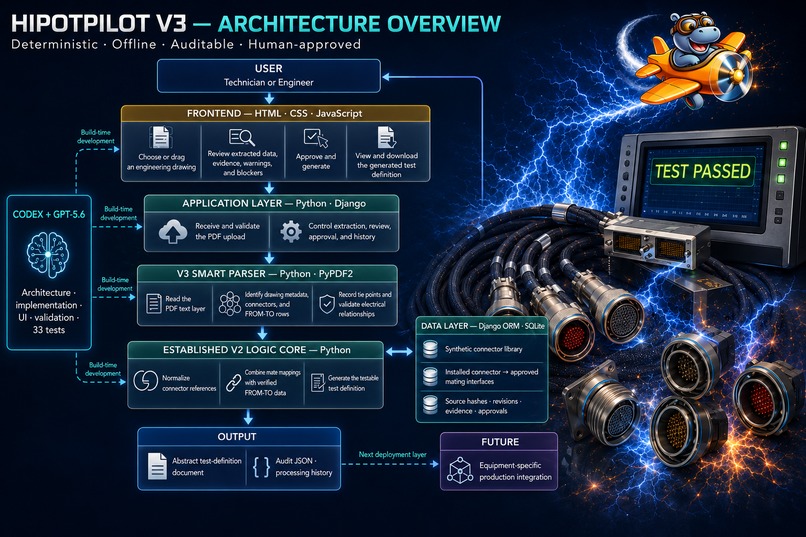
Architecture
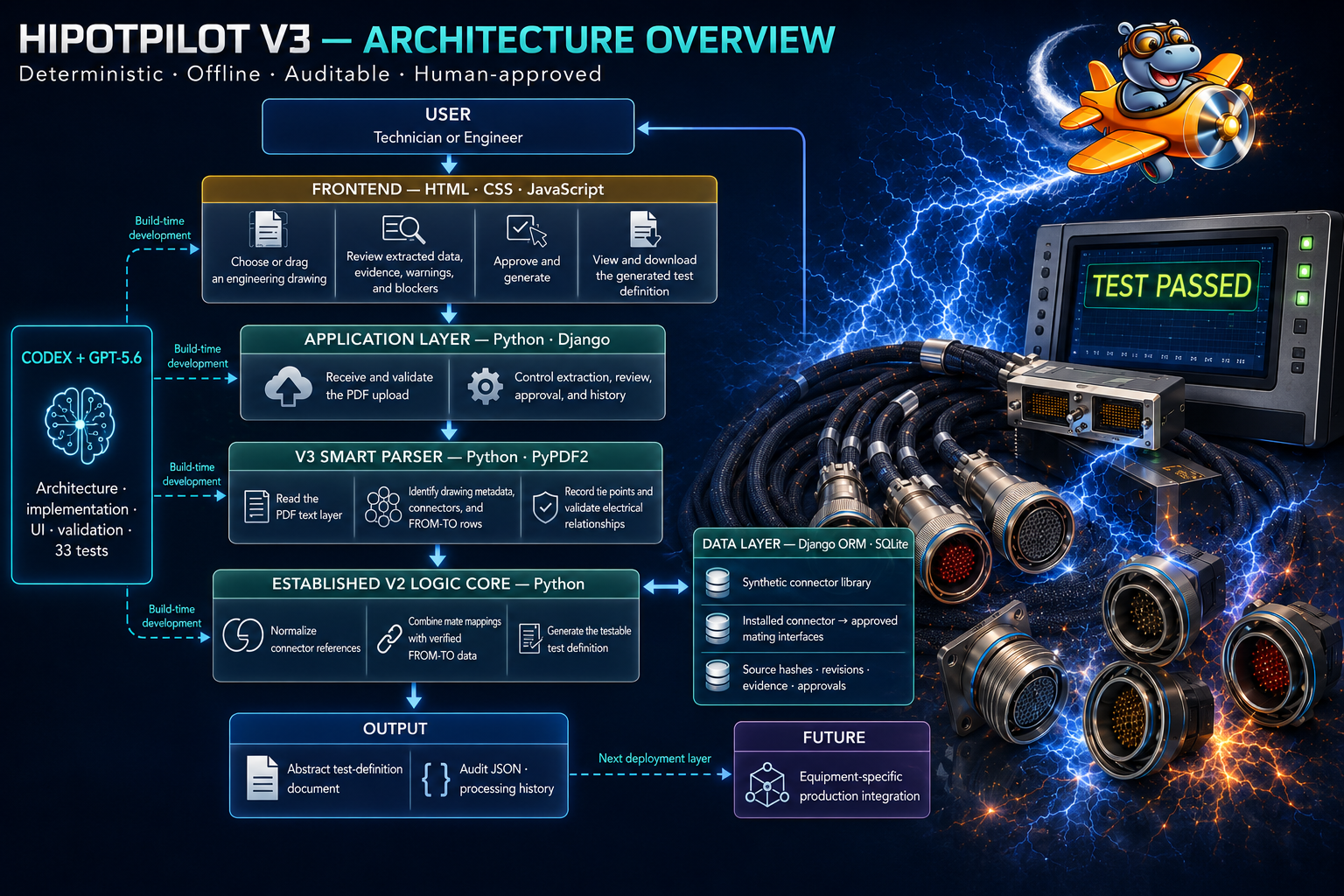
Inspiration
I previously worked as a wire-harness tester during my career as an avionics technician. As I developed stronger systems-thinking skills, I began recognizing how individual processes affect the performance of an entire operation—and how manual steps can become major bottlenecks at scale.
HipotPilot was inspired by one of those bottlenecks: the time required to translate engineering drawings into executable electrical test programs.
What it does
HipotPilot converts complex wire-harness drawings into deterministic, auditable test definitions. It reduces hours of manual connector, pin, and FROM-TO transcription to minutes across current harnesses, future builds, variants, and revisions—while preserving traceability, validation, and human approval.
How we built it
I originally built HipotPilot V1 before modern AI-assisted development tools were available. It used a form-based workflow that required users to enter connector and wiring information manually.
V2 expanded the original concept into a more complete application and established the deterministic validation and script-generation logic.
For V3, I retained that proven logic while replacing manual intake with a deterministic PDF adapter. The Smart Parser reads supported synthetic drawings, identifies connector assignments and semantic FROM-TO tables, preserves exact endpoints and source locations, and validates the extracted information before presenting it for human review. Approved data then passes into the established V2 logic core to produce the traceable test-definition preview.
I built V3 during OpenAI Build Week using Codex with GPT-5.6. Codex helped characterize the existing V2 architecture, identify the connector-identity boundaries, implement the deterministic parser and validation gates, develop the review interface, and create thirty-three regression and workflow tests. My avionics, harness-testing, and quality-assurance experience guided the requirements, safety boundaries, architecture, and acceptance testing. No generative AI service runs inside HipotPilot at runtime.
Challenges we ran into
One of the largest challenges was making deterministic document intake flexible enough to support variations in synthetic drawing layouts without allowing the system to guess. The Smart Parser recognizes equivalent semantic headers, repeated table blocks, and reordered optional columns, while strict validation reconciles connector references, endpoints, and declared connection totals. Another challenge was integrating V3 with the existing V2 logic without creating a second connector database or competing output engine. The extracted connector and FROM-TO data had to be normalized into the exact structures expected by the established Django application. This allowed V3 to automate input preparation while preserving V2’s connector resolution and test-definition generation behavior.
Accomplishments that we're proud of
I completed a working end-to-end version of a project I had been thinking about for years.
HipotPilot V3 successfully processed increasingly complex synthetic harness packages, culminating in a stress test containing 12 connectors, four harness bundles, and 100 synthetic FROM-TO records. It then integrated the extracted data with the existing deterministic logic to generate the final test script.
A system like this could have saved many hours of skilled labor during my own time working in aerospace harness testing.
What we learned
- JavaScript provided a much more flexible intake and review experience than the form-based connector workflow used in V1.
- Determinism is essential in quality-assurance systems. HipotPilot cannot simply trust AI-generated connections, because a hallucinated or incorrect connection could produce a false test result or damage hardware. Codex with GPT-5.6 accelerated development of the extraction workflow, but the finished runtime parser is deterministic and offline. Strict validation and human approval control every generated result.
- A Django application can work effectively with modern front-end tooling when the JSON contracts between the interface, application logic, and database are clearly defined.
- Synthetic engineering drawings paired with authoritative FROM-TO sheets provide a powerful way to test extraction accuracy without exposing proprietary customer data
What's next for HiPot Pilot
The next step is validating HipotPilot with wire-harness manufacturers and aerospace R&D teams.
Production deployment would include integration with internal quality-assurance workflows, support for customer-specific drawing conventions, and equipment-specific script formats and test-system requirements.


Log in or sign up for Devpost to join the conversation.