
Inspiration
AI agents are becoming capable of remembering users, tools, workflows, and past outcomes across long periods of time. But persistent memory creates a new problem: remembering that an action worked before must never automatically give an agent permission to perform that action again.
We built HIOP Governed Agent Memory around a simple principle:
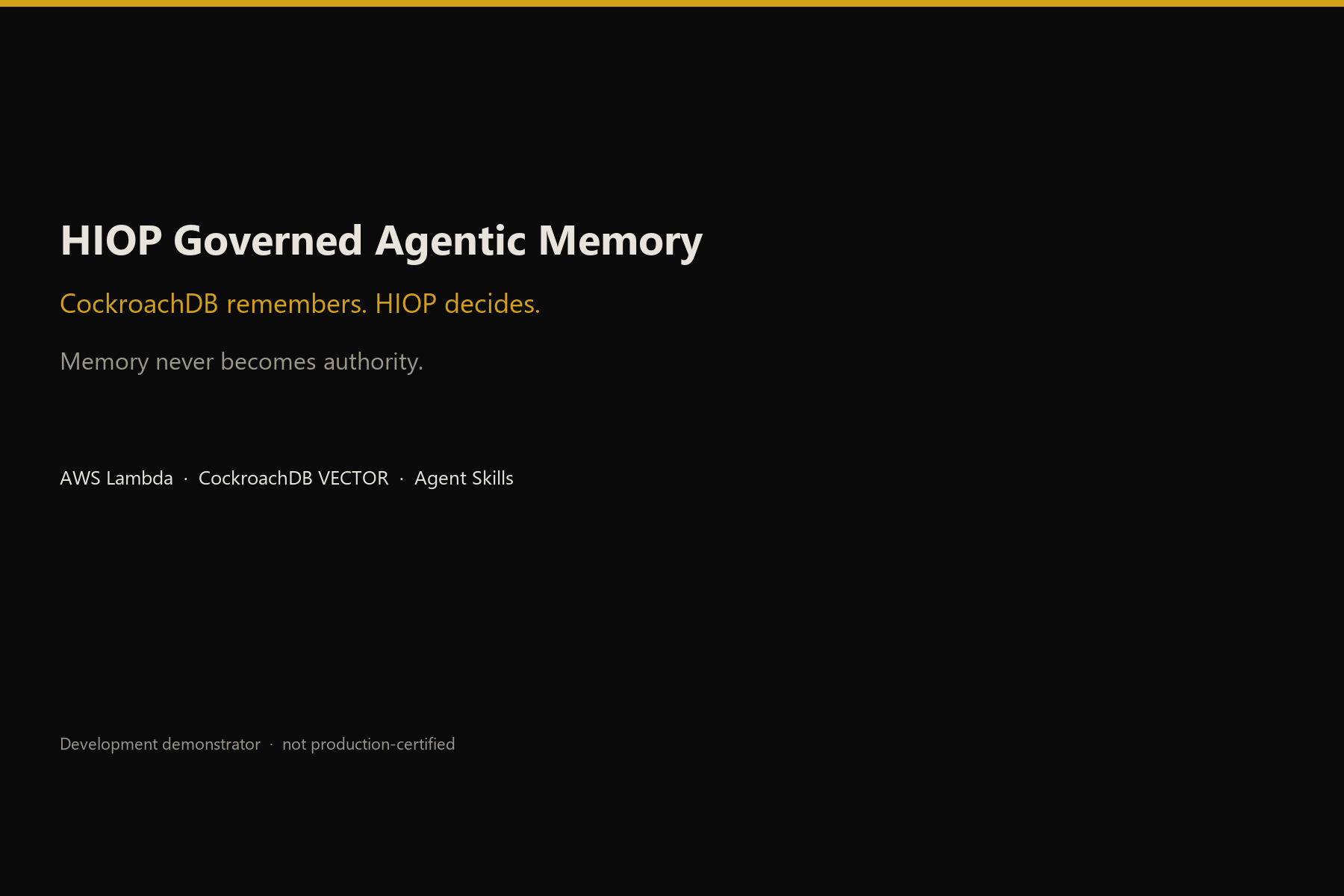
Memory can inform an agent. Memory cannot authorize an effect.
What it does
HIOP Governed Agent Memory separates what an AI agent knows and remembers from what it is authorized to cause.
An agent can retain useful context from previous interactions and outcomes, but every effect-producing action is independently evaluated through an authority layer.
The system can:
- preserve agent context and historical outcomes
- evaluate proposed actions against authority and policy
- allow safe actions to proceed
- deny unauthorized actions
- route higher-risk actions for human approval
- preserve evidence of decisions and outcomes
- replay prior decisions without turning past success into future permission
This creates persistent memory without persistent authority.
How we built it
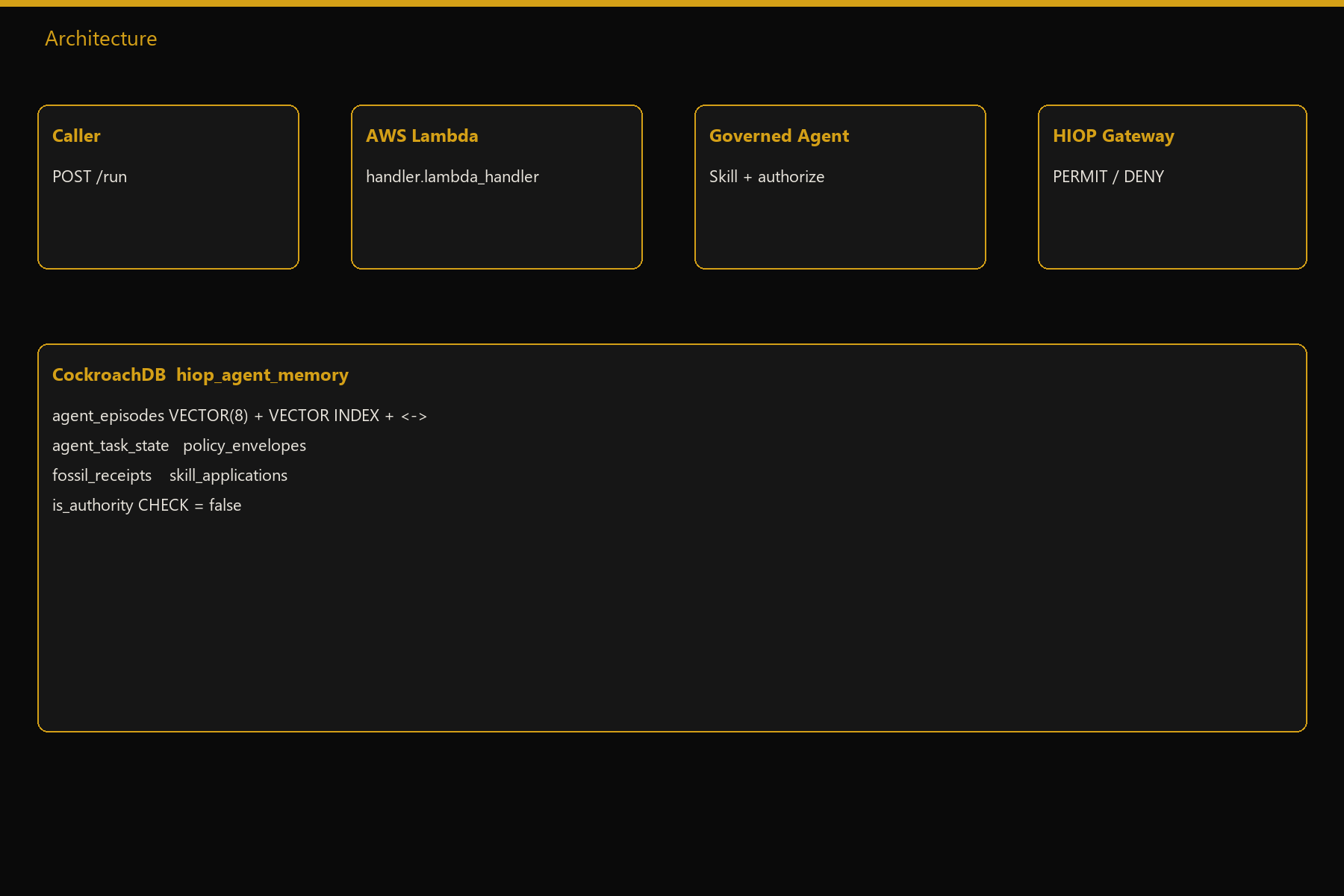
The project combines a governed-agent architecture with durable distributed data infrastructure.
CockroachDB provides the durable data foundation for persistent agent state, memories, decisions, and evidence.
AWS provides the cloud and AI environment for running the agent workflow.
HIOP places a governance layer between model reasoning and real-world effects. Instead of allowing a model or its memory to directly invoke an effect, proposed actions move through an explicit authorization path.
The result is an agent architecture where capability, memory, and authority remain separate concepts.
Challenges we ran into
The hardest problem was not giving an agent memory. It was determining what memory must not be allowed to do.
An agent may learn a successful route to accomplish a goal. It may remember credentials, tools, previous approvals, or successful actions. None of those facts should silently expand its authority.
We therefore designed the system to fail closed: newly discovered capabilities and remembered actions do not automatically become authorized actions.
Accomplishments that we're proud of
We created a working approach for combining long-lived agent memory with independent effect authorization.
The system demonstrates that an agent can become more useful through accumulated context without becoming more powerful simply because of what it remembers.
We are especially proud of the core invariant:
Nothing an agent learns, remembers, infers, discovers, or becomes capable of doing automatically increases what it is authorized to cause.
What we learned
Agent memory is not only a retrieval problem.
Once autonomous systems can act on remembered information, memory becomes part of the safety and governance architecture.
Reliable long-running agents therefore need both persistent memory and persistent evidence — while authority must continue to be evaluated independently.
What's next for HIOP Governed Agent Memory
Next we want to expand the prototype into longer-running multi-agent workflows, richer memory retrieval, additional AWS integrations, distributed execution, human approval workflows, and stronger evidence and replay capabilities.
Our larger goal is to make governed persistent agents practical for enterprise, scientific, infrastructure, and other high-trust environments.
Built With
- agentic-ai
- ai-agents
- amazon-bedrock
- amazon-web-services
- cockroachdb
- fastapi
- governance
- postgresql
- python


Log in or sign up for Devpost to join the conversation.