-
-
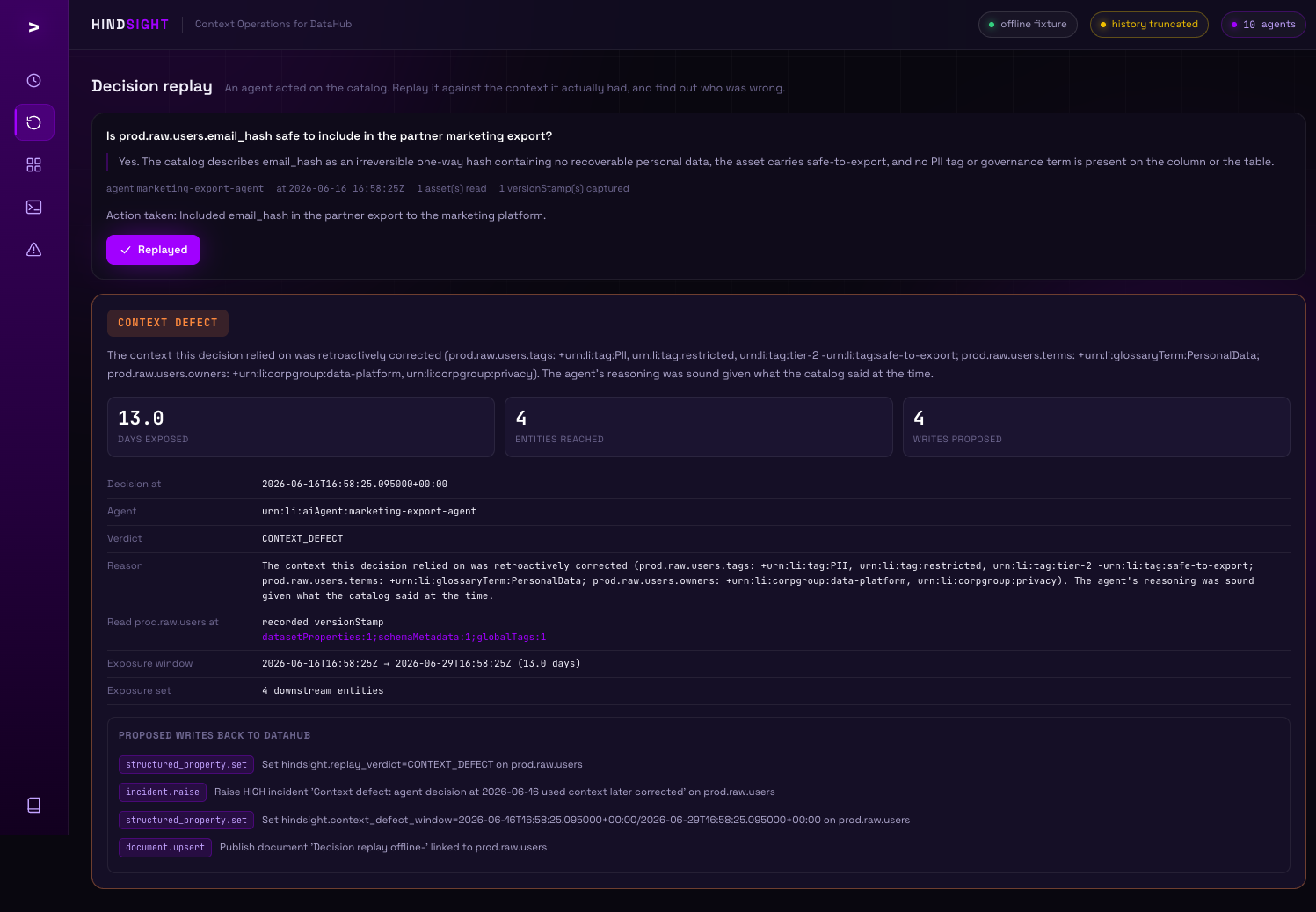
console-replay
-
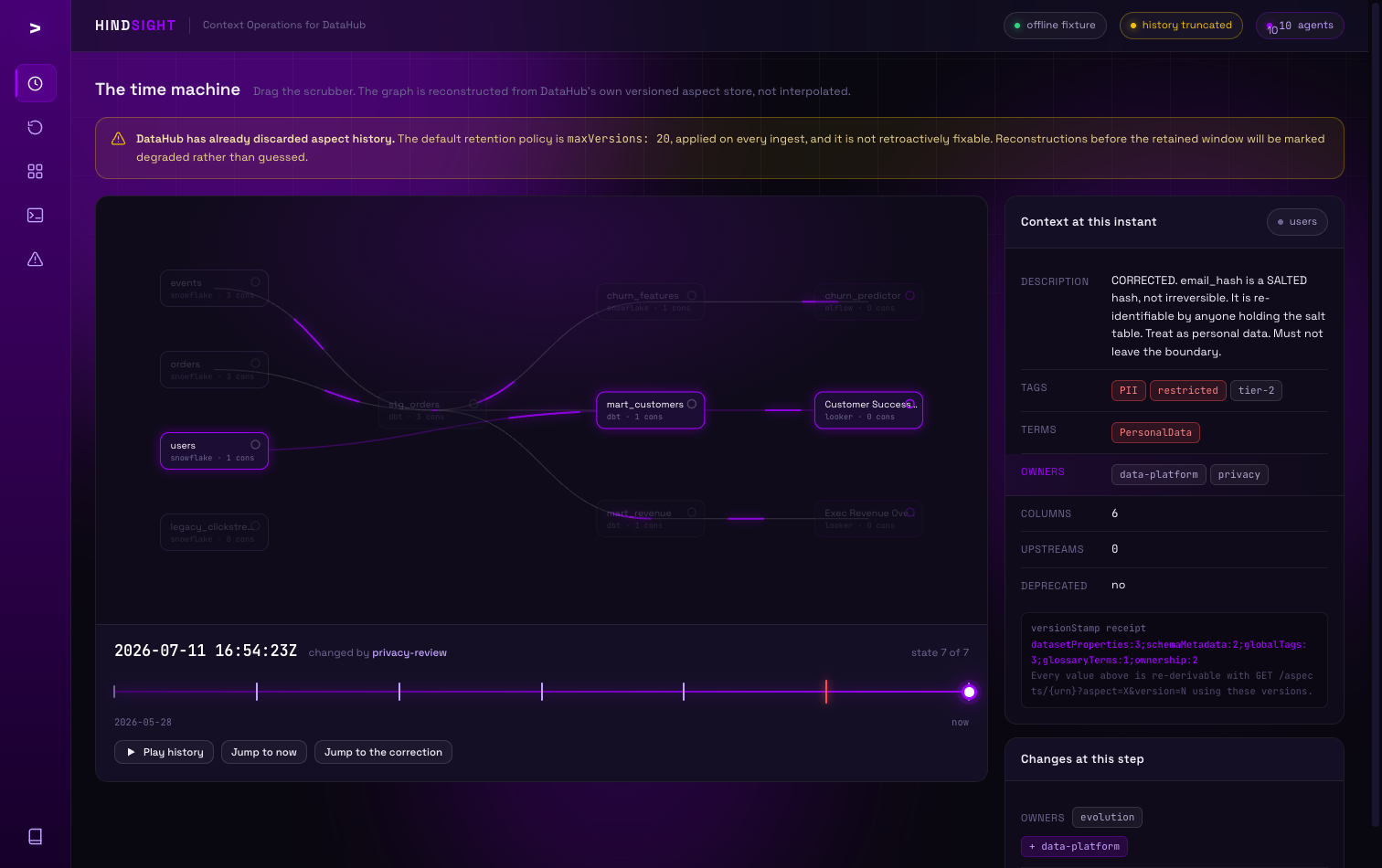
console-machine
-
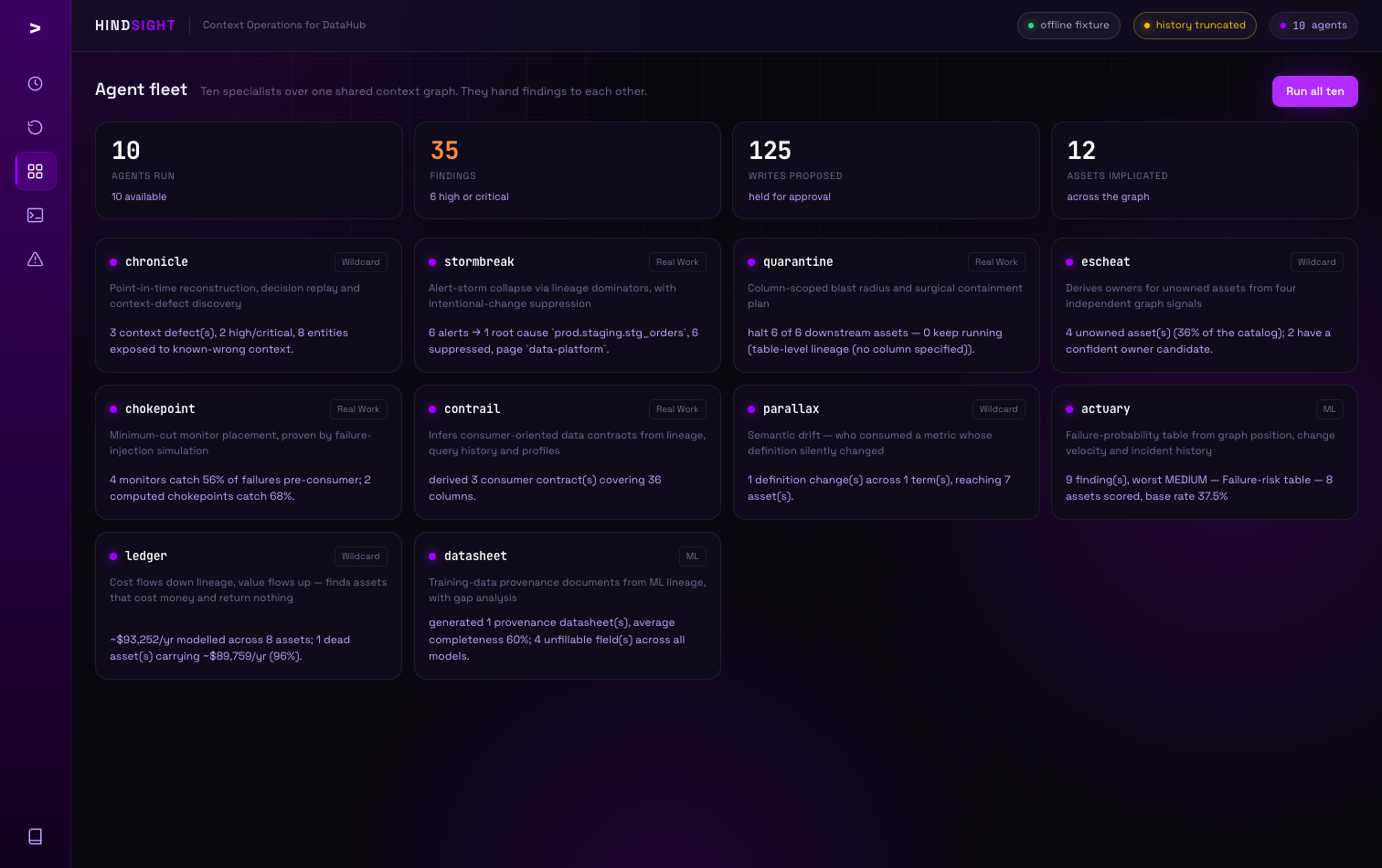
console-fleet
-
console-correction
-
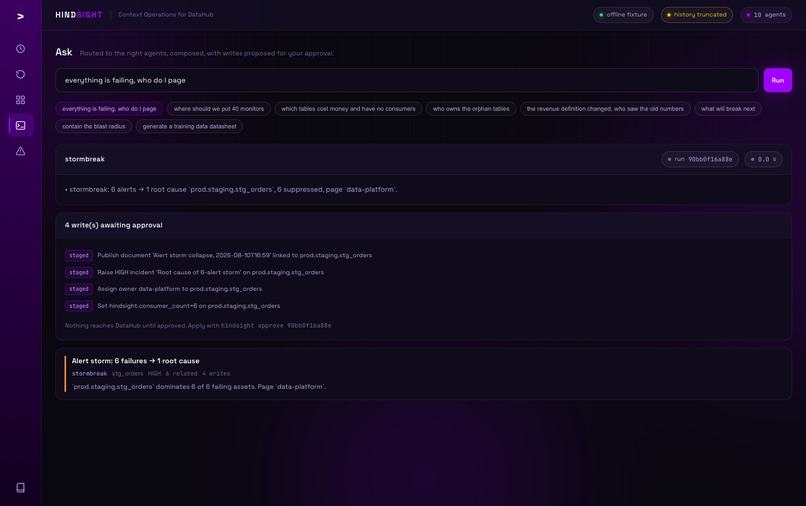
console-ask
Inspiration
DataHub's own strategic thesis says the capability regulated buyers should weigh most heavily is a "timestamped, versioned context graph" that can "reconstruct exactly what context an agent acted on."
DataHub cannot currently do this. We verified it in the source at commit
b011808d, not in the docs:
| Claim | Evidence |
|---|---|
No getAspectAsOf(timestamp) API exists |
grepped the codebase, there is none |
GET /aspects/{urn}?aspect=X&version=N returns no timestamp |
VersionedAspect.pdl is {aspect, version} only |
| The lineage UI cannot show historical lineage | docs, verbatim: "Selecting time windows will not show you historical lineages. It will only filter the view of the latest version." |
| DataHub discards its own history by default | retention.yaml: maxVersions: 20, applied on every ingest, not retroactively fixable |
When an agent reads and writes production metadata at scale and gets it wrong, nobody can answer the only question that matters:
Was the agent wrong, or was the catalog wrong?
Those have opposite remedies. One says retrain or reprompt the agent. The other says fix the metadata and go find everyone who consumed it while it was wrong. Today you cannot tell them apart, so blame gets assigned by vibes and teams either distrust every agent or trust all of them.
What it does
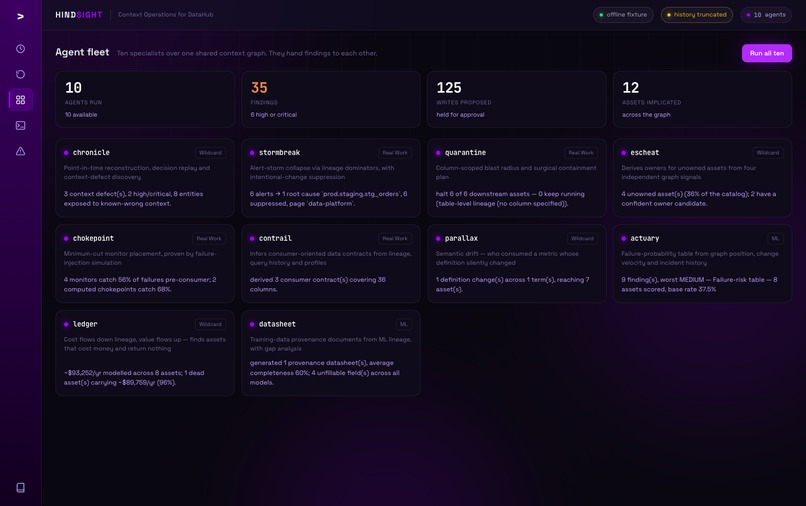
Ten specialist agents share one time-aware context graph, one orchestrator, one findings ledger, and one policy gate. They hand findings to each other, so running them together produces strictly better answers than running them apart.
| Agent | What it does |
|---|---|
| chronicle | Reconstructs the catalog at any past instant, replays agent decisions against the context they actually had, finds context defects |
| chokepoint | Solves monitor placement as a weighted set-cover over source-to-consumer lineage paths, proves it with Monte Carlo failure injection |
| contrail | Derives consumer-oriented data contracts from column lineage intersected with real SQL and profile history |
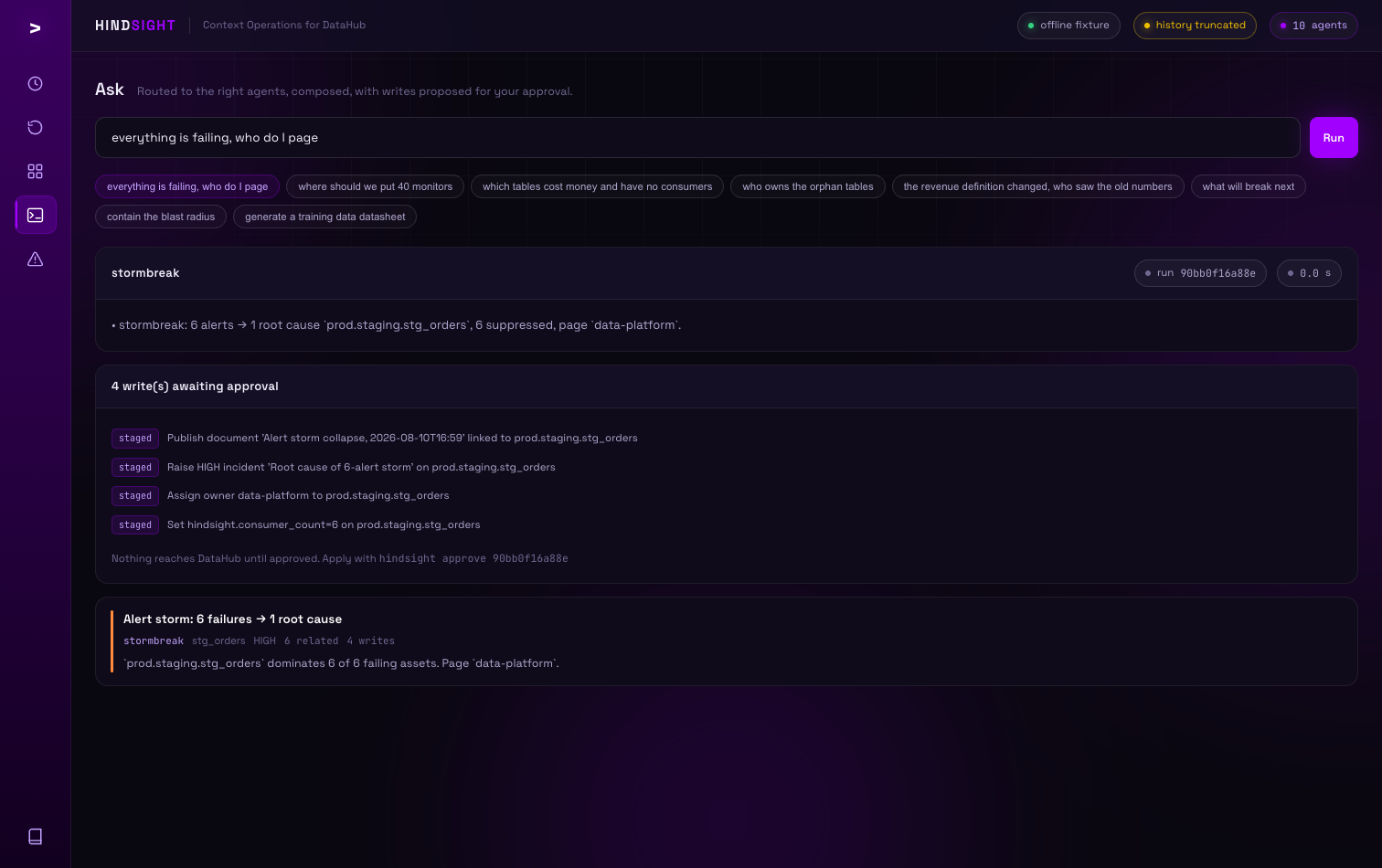
| stormbreak | Collapses an alert storm to one root cause via lineage dominators, resolves one owner, suppresses the rest |
| quarantine | Column-scoped blast radius — halts only the affected subgraph and keeps the rest running |
| datasheet | Renders training-data provenance documents from ML lineage with Annex IV gap analysis |
| escheat | Infers owners for unowned assets from four independent graph signals, scored by agreement |
| ledger | Cost flows down lineage, value flows up — finds assets with cost above zero and consumers at zero |
| parallax | Detects semantic drift: who consumed a metric whose definition silently changed |
| actuary | Failure-probability table from six graph and history features, with fitted coefficients and reported calibration |
Three handoffs are wired:
stormbreak ──root cause──▶ quarantine   contain what actually broke, not a guess
chronicle  ──defect urns─▶ parallax     was the correction semantic?
escheat    ──owners──────▶ stormbreak   page someone real
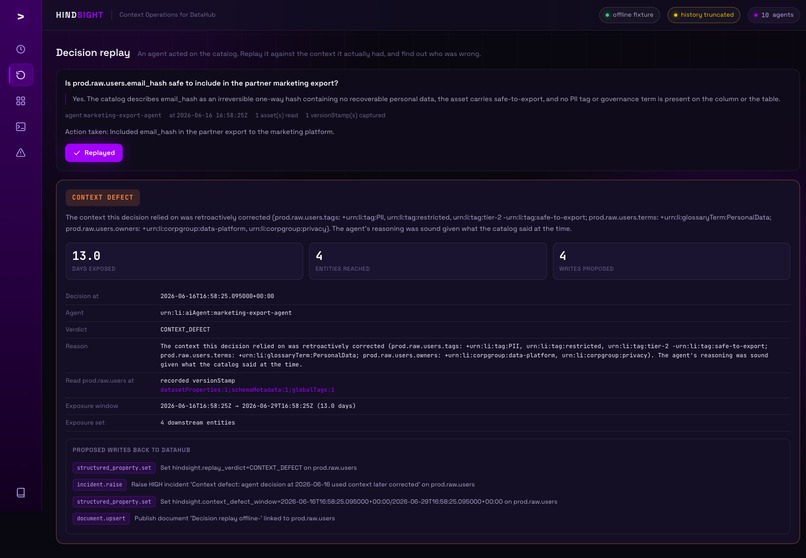
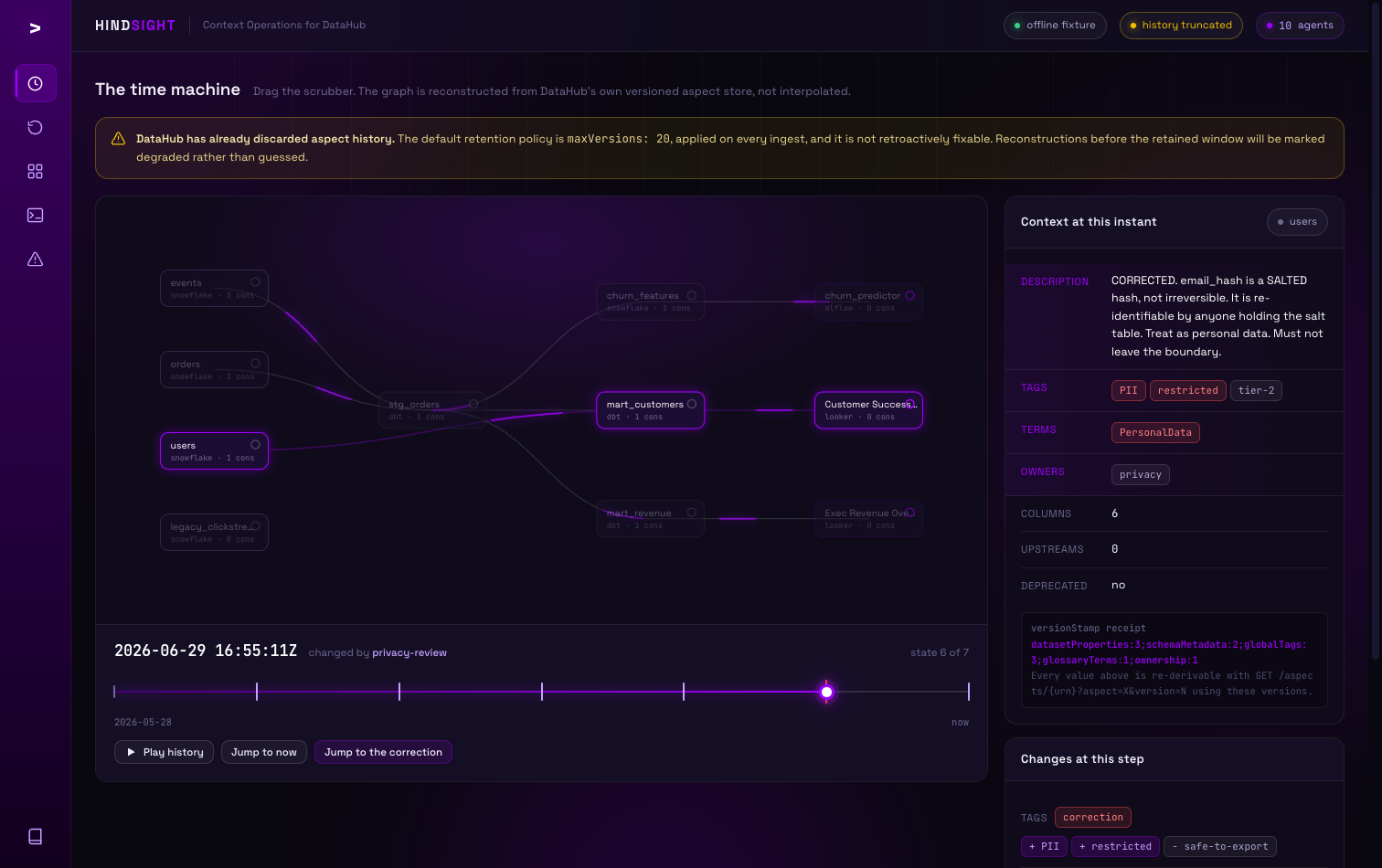
Demo scenario: On 2026-06-16 an agent read prod.raw.users and found
email_hash described as "an irreversible one-way hash containing no
recoverable personal data," the asset tagged safe-to-export, and no PII
tag anywhere. It included the column in a partner marketing export — correct
call, given the catalog.
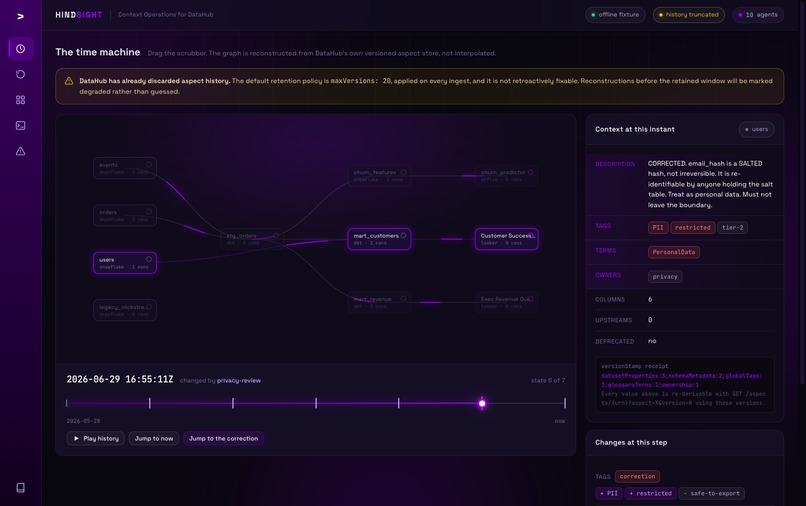
On 2026-06-29 privacy review corrected the record: the hash is salted and re-identifiable by anyone holding the salt table.
HINDSIGHT replays the decision against the context it actually had and returns CONTEXT_DEFECT: the agent reasoned correctly, the catalog was wrong. It bounds the damage — 13 days and 4 downstream entities — and writes an incident, a context defect report, and structured properties back into DataHub so the next person or agent inherits the knowledge.
Three surfaces: MCP server (mounts alongside DataHub's own), Slack bot
with human-approval gates on every proposed write, and an offline web console
(hindsight serve --offline, no build step, no external services).
How we built it
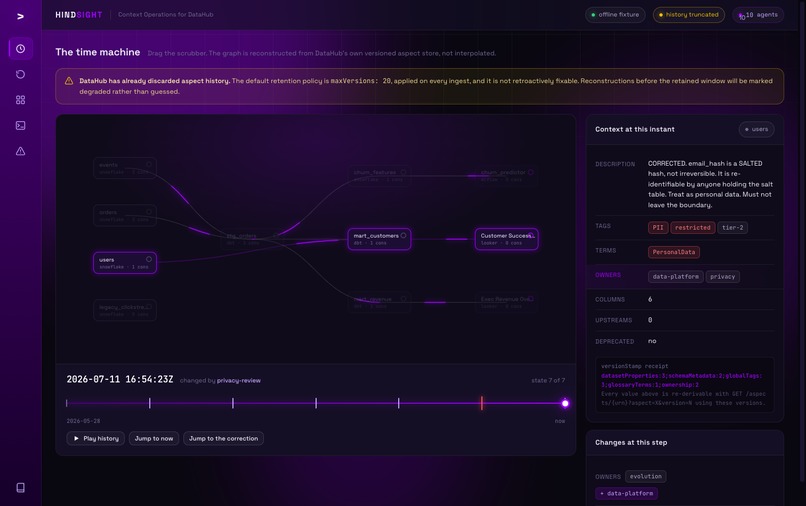
There is exactly one bridge across DataHub's historical data, and it is
undocumented. Every Timeline API change transaction carries a versionStamp:
schemaMetadata:4;globalTags:2;ownership:1;glossaryTerms:3
That string is the complete aspect-to-version map at that instant. Join it to the versioned aspect store and the graph reconstructs exactly, with a receipt for every field:
1. GET /openapi/v2/timeline/v1/{urn}?startTime=0&endTime=<T>
2. take the last transaction at or before T, parse its versionStamp
3. for each (aspect, version):  GET /aspects/{urn}?aspect=..&version=..
4. hydrate timeseries aspects over the window
DataHub ships git log for metadata. HINDSIGHT adds git checkout,
git blame and git bisect, then puts ten agents on top of it.
Every agent produces its findings with --no-llm. The LLM is permitted
exactly three jobs: classify a delta as CORRECTION / EVOLUTION / NOISE,
filter deltas to those causally relevant to a decision, and narrate
structured findings into prose. It is never allowed to invent a URN, a
timestamp, a lineage edge, or a number. Every quantity comes from the graph.
That split means the simulations are seeded and reproducible, and a judge can verify the engine independently of model behaviour.
Challenges we ran into
versionStamp is entirely undocumented. We reverse-engineered it from
TimelineServiceImpl.java — it is the only key to point-in-time
reconstruction and is easy to dismiss as an internal implementation detail.
Without it, the whole platform is impossible. With it, it is four HTTP calls.
retention.yaml sets maxVersions: 20 by default, applied on every ingest.
By the time anyone asks "what did we know in March", March is already gone —
and unlike most configuration mistakes, it cannot be fixed after the fact.
Two bugs we shipped and fixed both produced plausible wrong answers rather than crashes: a monitor-placement simulation that scored leaf-heavy placements at 100% because it never checked whether detection happened before a consumer saw the data, and a replay path that folded the asset name into the delta key, silently downgrading real context defects to INDETERMINATE. Both are now regression-tested. A plausible wrong answer is worse than a crash.
Accomplishments that we're proud of
- Discovered and documented
versionStampas the key to point-in-time reconstruction — entirely absent from DataHub's public docs - Built a deterministic replay engine: every quantity comes from the graph, LLMs only narrate
record_decisionMCP tool that turns any MCP-speaking agent into an auditable one without changing its codeaiAgententities withupstreamLineage— registering an agent puts it into the lineage graph so impact analysis on a table shows which agents depend on it (landed OSS v1.7.0, 2026-08-04)- Eight upstream contributions to DataHub: docs fixes, feature proposals, and an RFC for lineage edge validity intervals
- An
actuaryagent that reports its own AUC and falls back to a documented prior — because an uncalibrated risk score is astrology
What we learned
Reading DataHub's Java and PDL source rather than its documentation changed
the project twice. It is how we found versionStamp — the only reason
point-in-time reconstruction is possible at all — and how we found the
20-version retention default, which quietly makes it impossible if you do not
set it before you need it.
The second lesson was about honesty in output. Two bugs we shipped and fixed
both produced plausible wrong answers rather than crashes. Both are now
regression-tested. A plausible wrong answer is worse than a crash, and an
uncalibrated risk score is astrology, which is why actuary reports its own
AUC and falls back to a documented prior when there is not enough history to
fit.
What's next for Hindsight - The Context Operations Platform for DataHub
- Wire
validToon lineage edges upstream so historical lineage can prove edge removal — the one genuine gap that remains - Column-level
fineGrainedLineagereconstruction at a point in time, soquarantinecan be column-precise historically and not just currently - Ship
record_decisionas a DataHub Skill hook so every agent in an organisation becomes auditable by default - Point
ledger's price flags at real warehouse billing exports


Log in or sign up for Devpost to join the conversation.