-
-
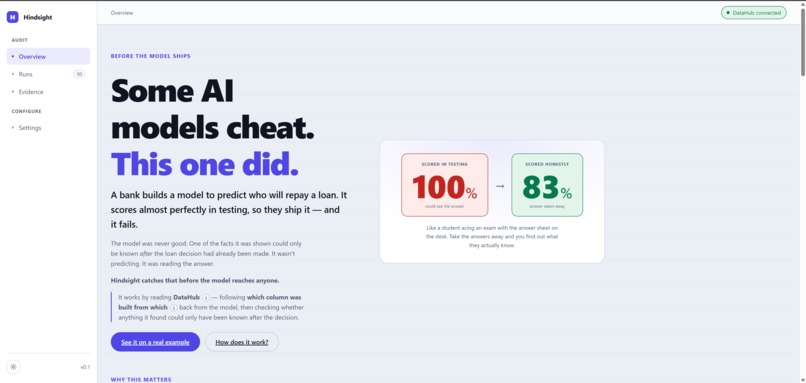
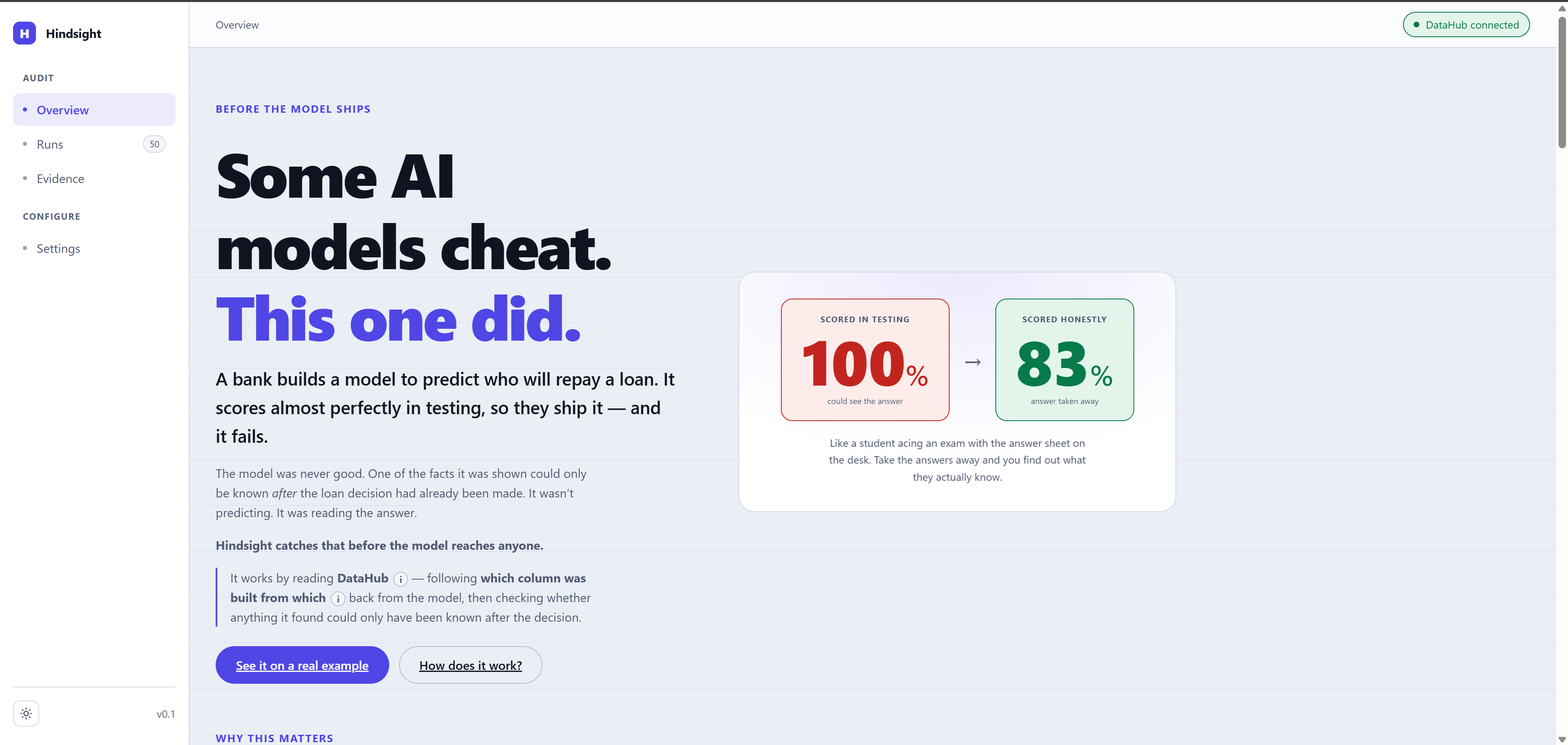
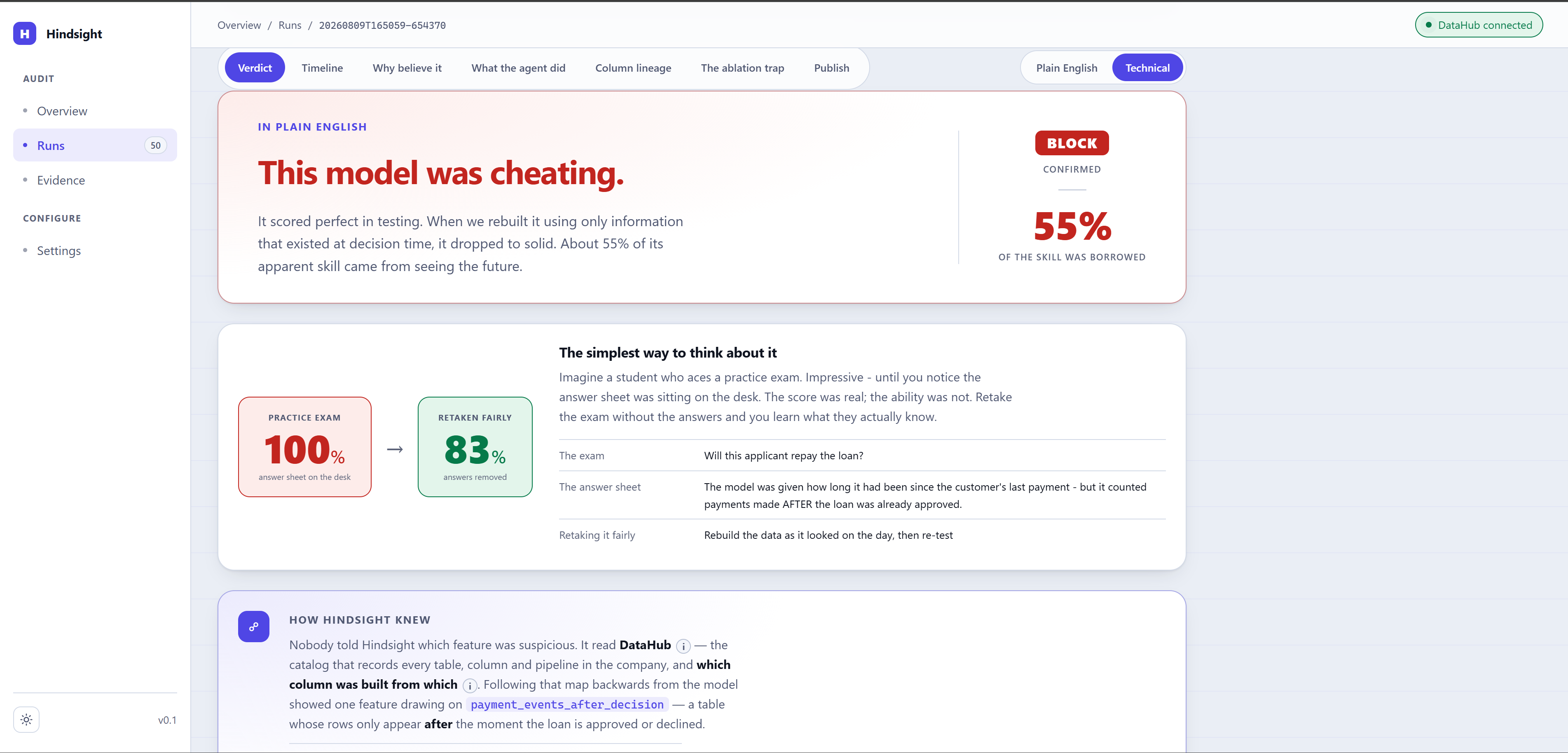
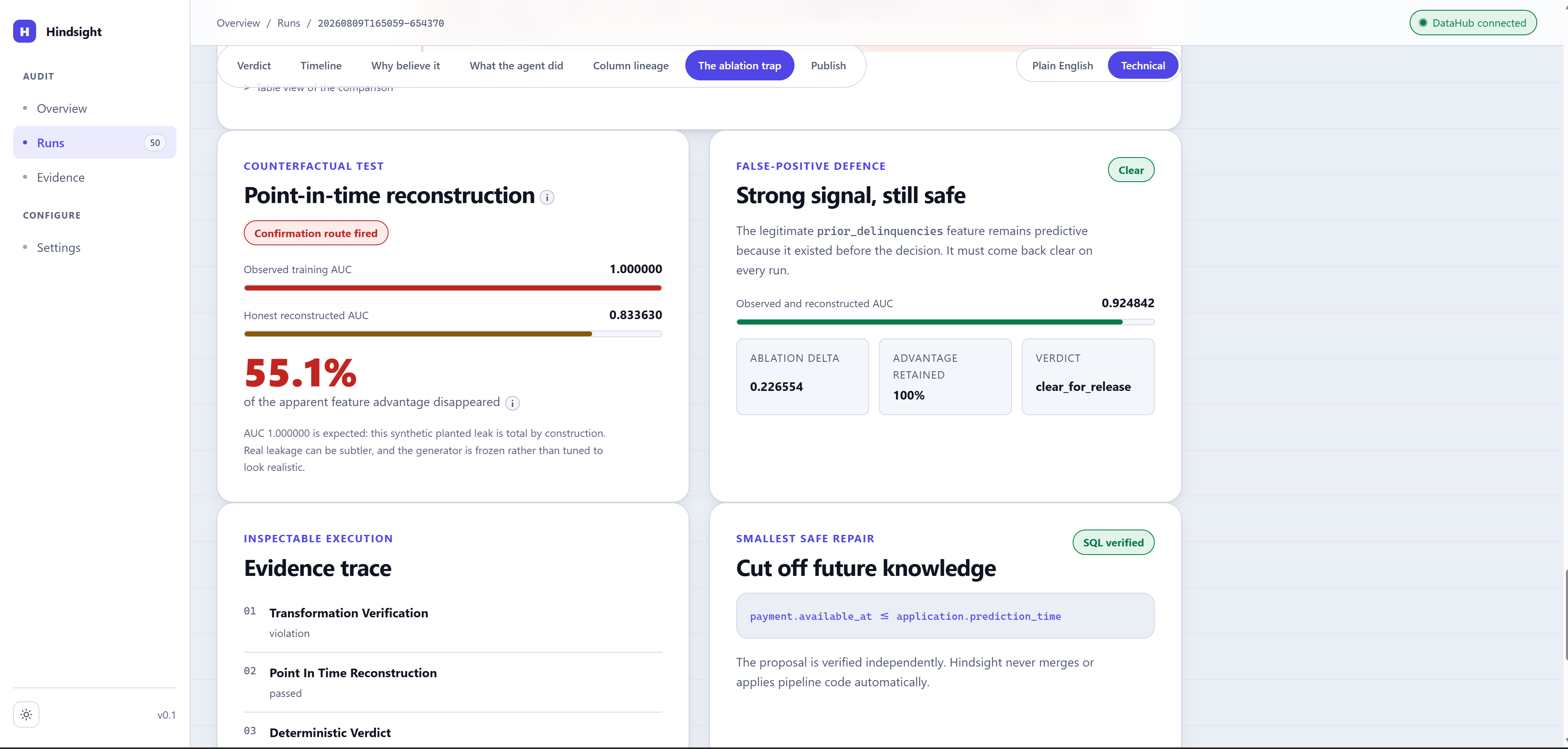
The model scored 100% in testing. Take away the fact it should never have seen, and it scores 83%. That gap is the whole problem.
-
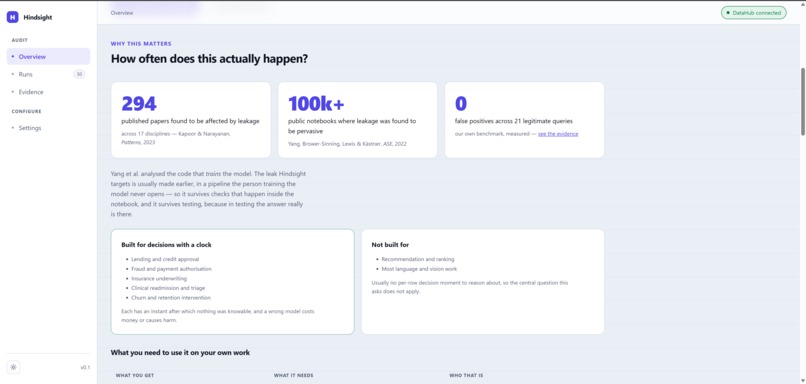
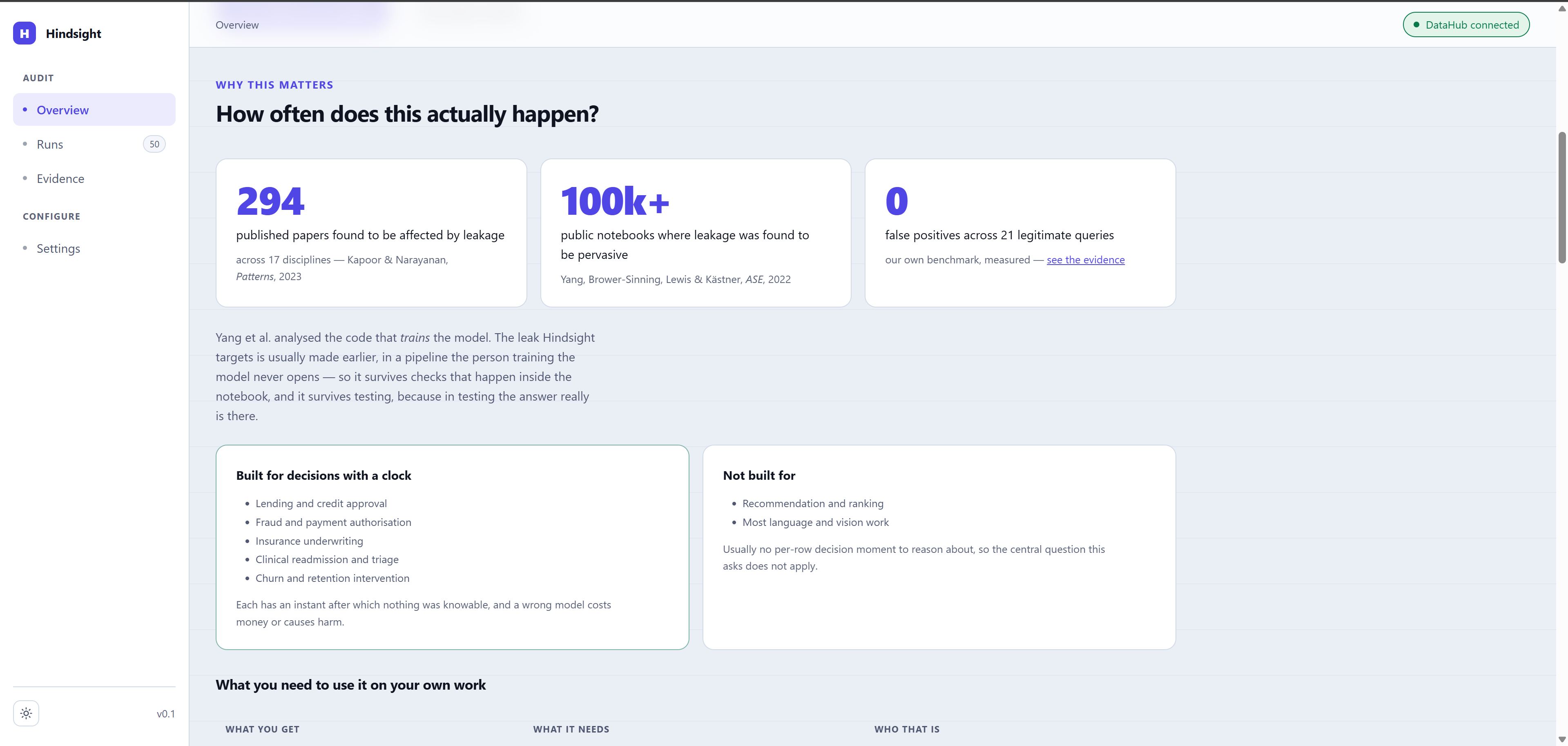
Leakage is not rare. 294 published papers and over 100,000 notebooks. The panel also names the work this is not built for.
-
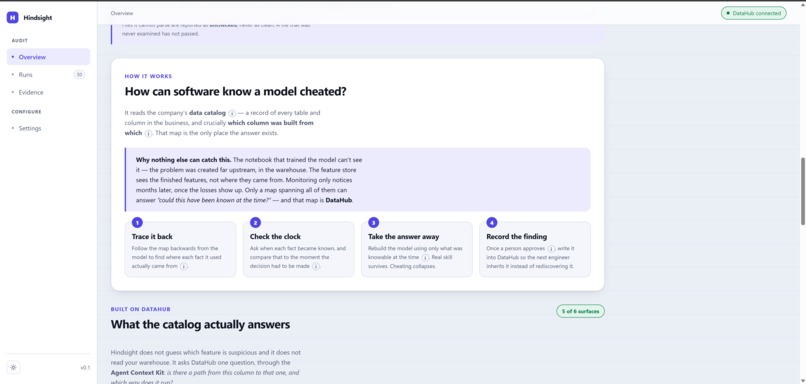
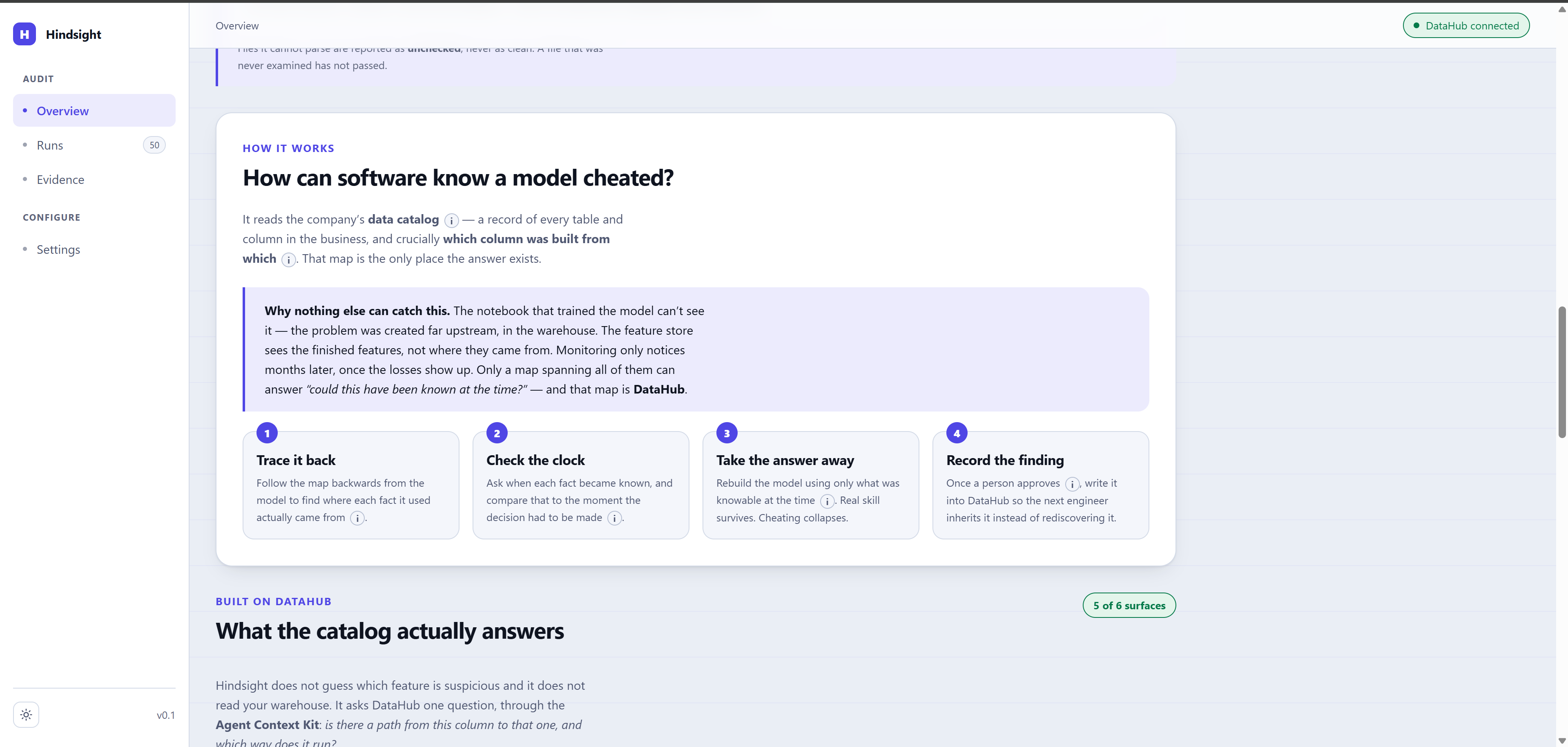
Four steps, and only the first one needs a catalog. Trace it back, check the clock, take the answer away, record the finding.
-
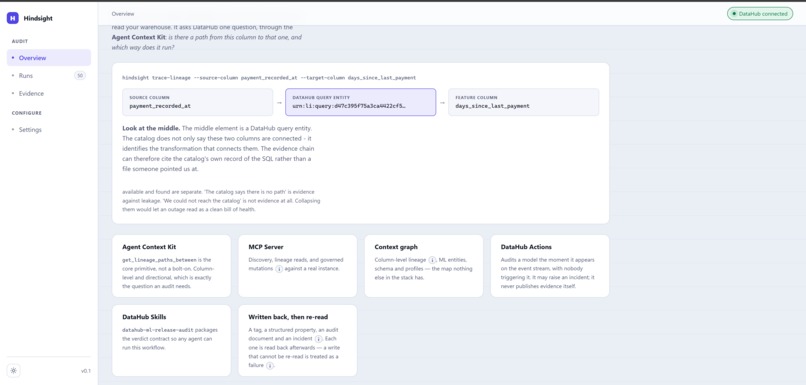
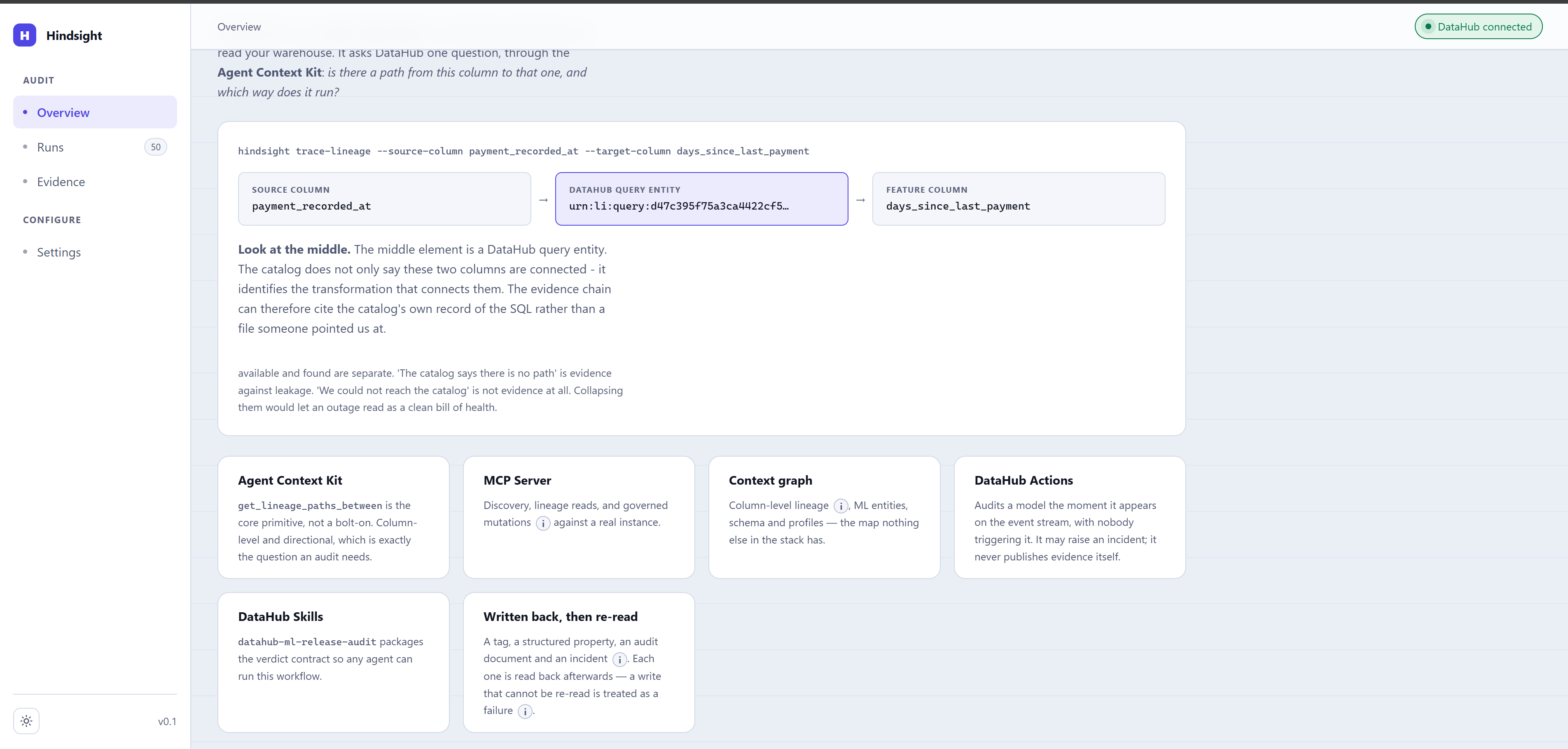
The question Hindsight asks DataHub. The middle hop is a query entity, so the evidence cites the catalog's own record of the SQL.
-
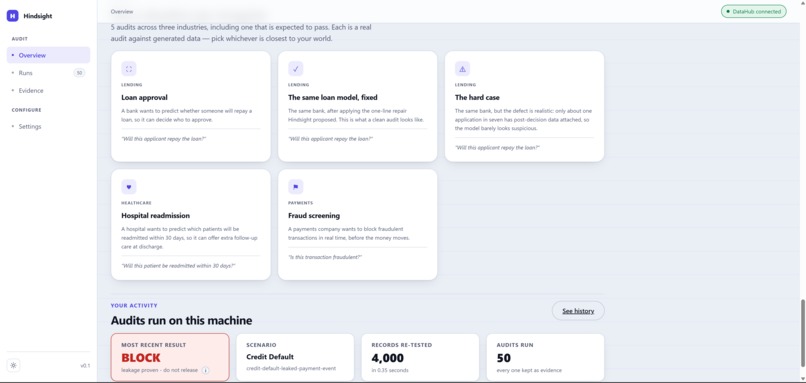
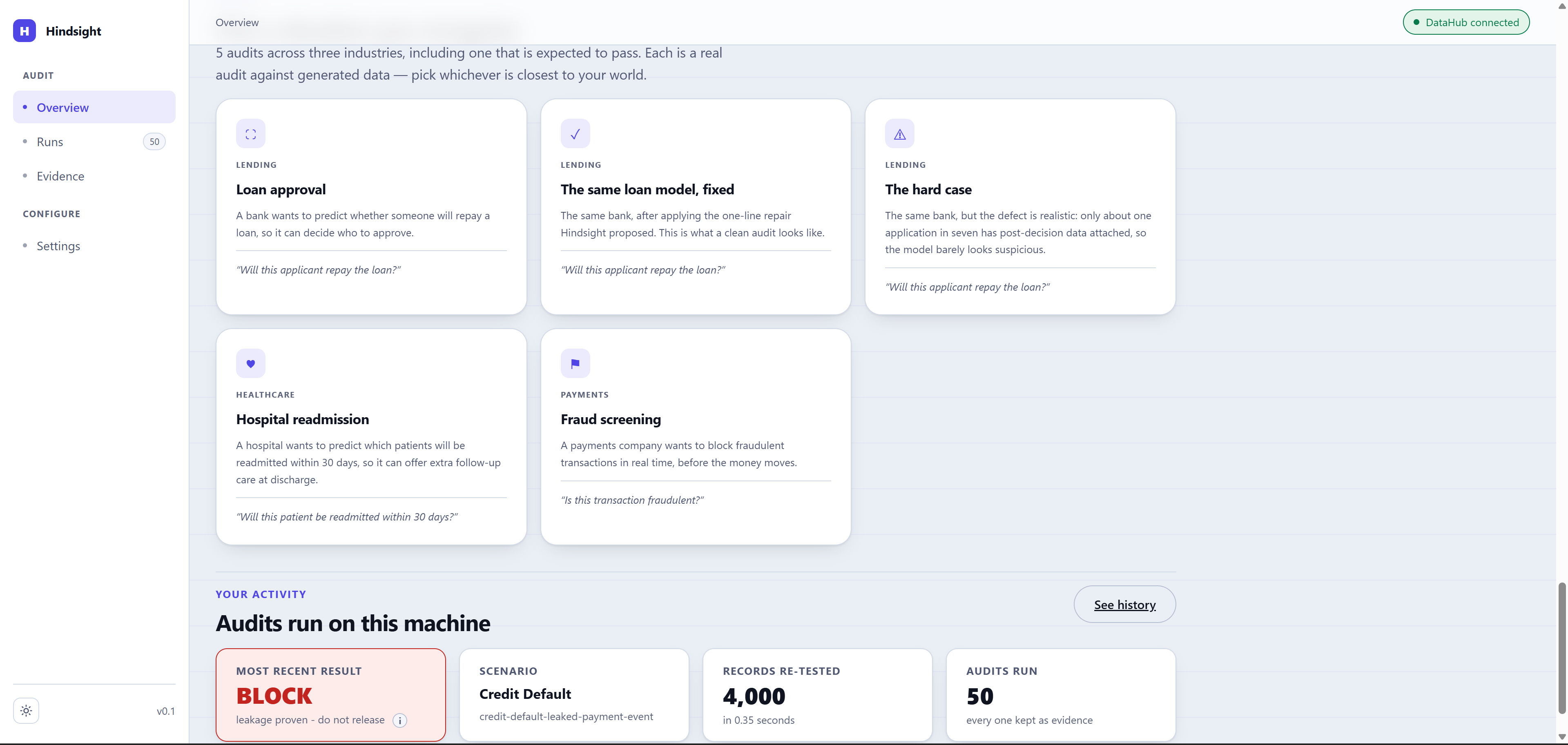
Five audits across three industries. One is expected to pass, because a gate that can only say no is not really looking.
-
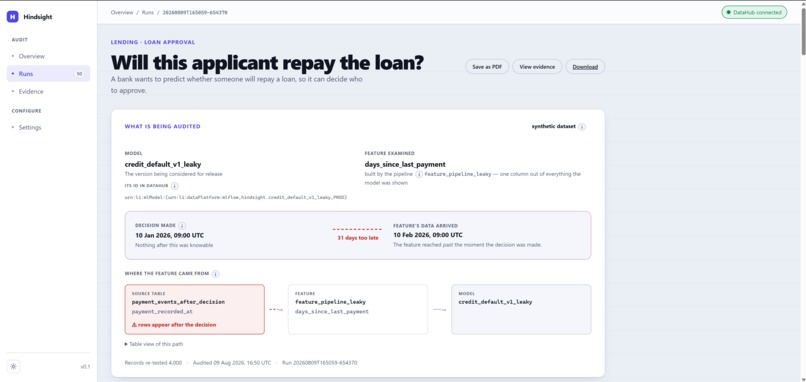
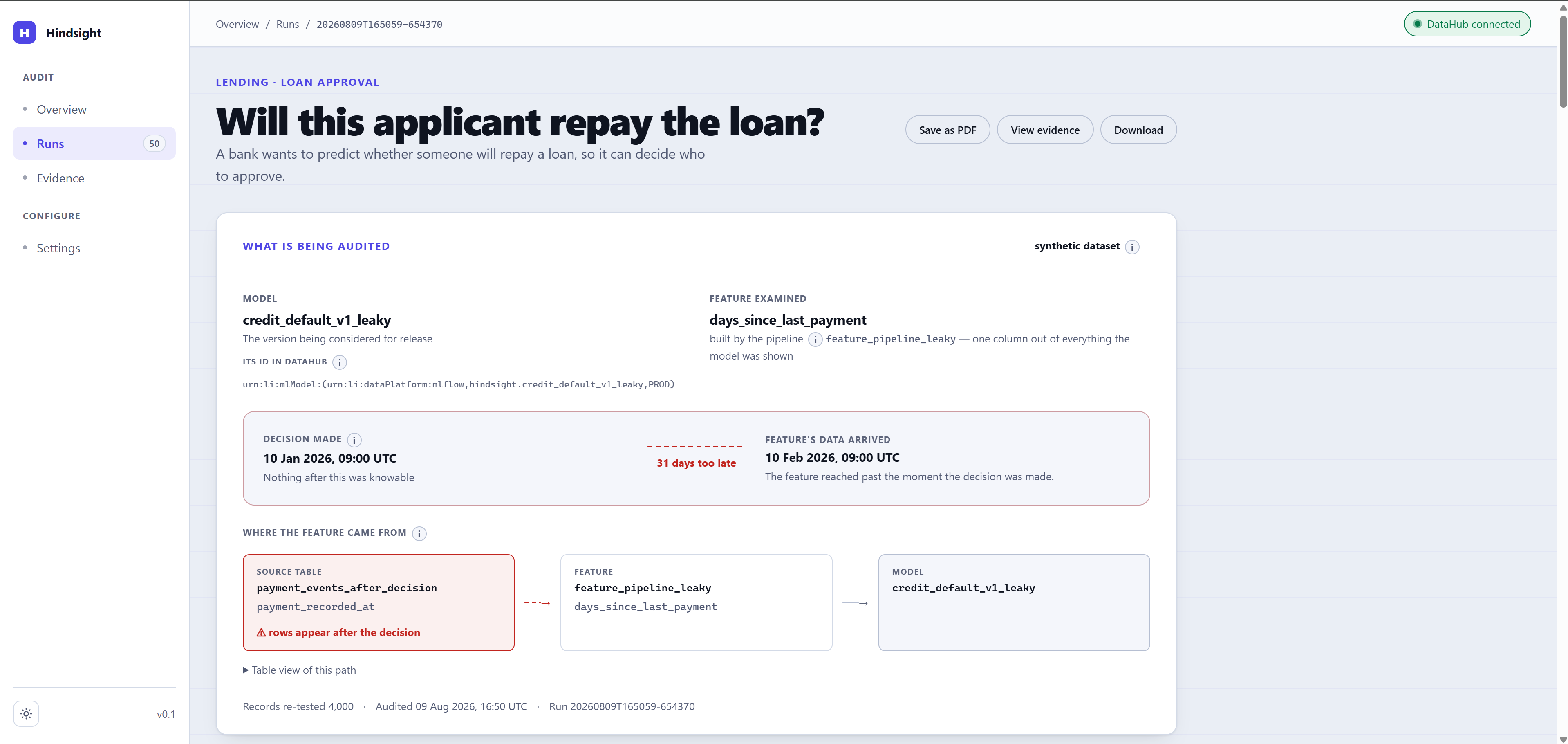
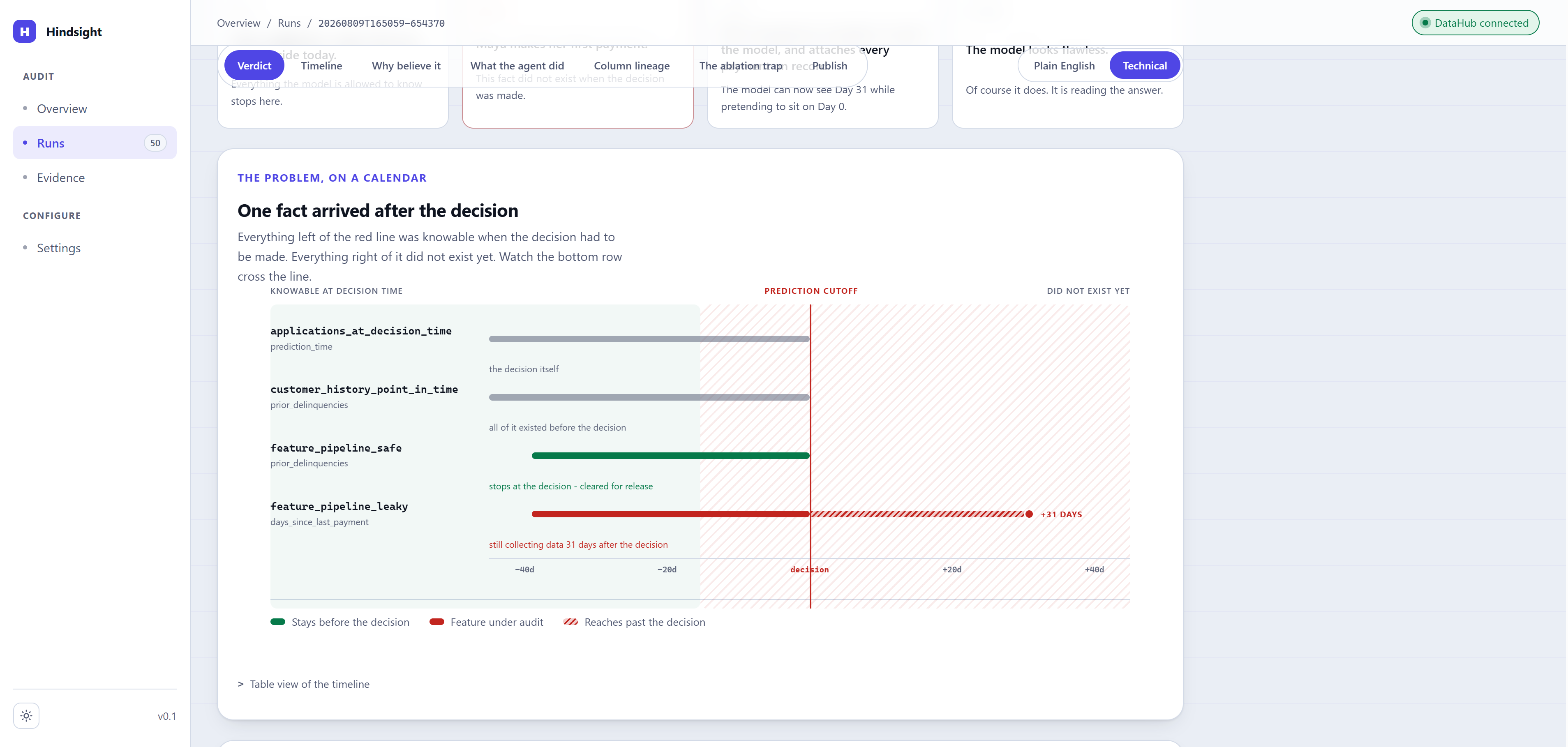
What is being audited: the model, the one feature, and the 31 day gap between the decision and the day that feature's data arrived.
-
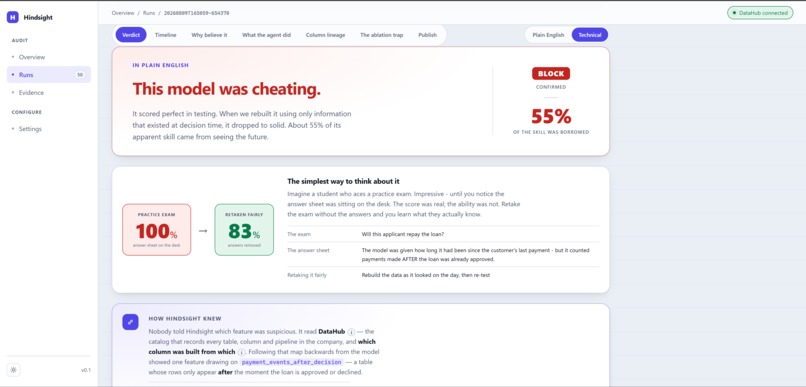
The verdict in plain English. Blocked, confirmed, and 55% of the model's apparent skill came from seeing the future.
-
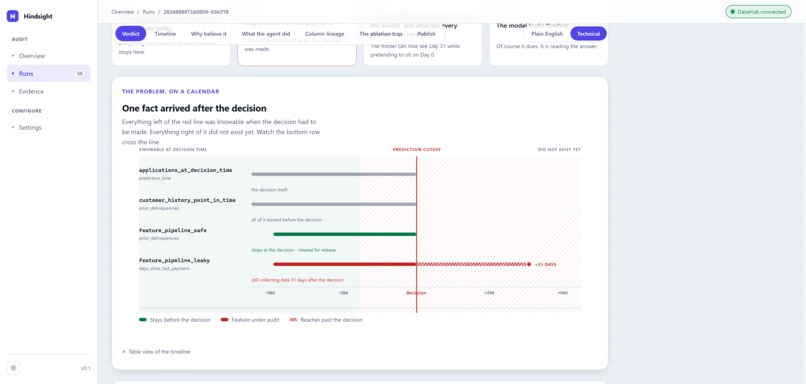
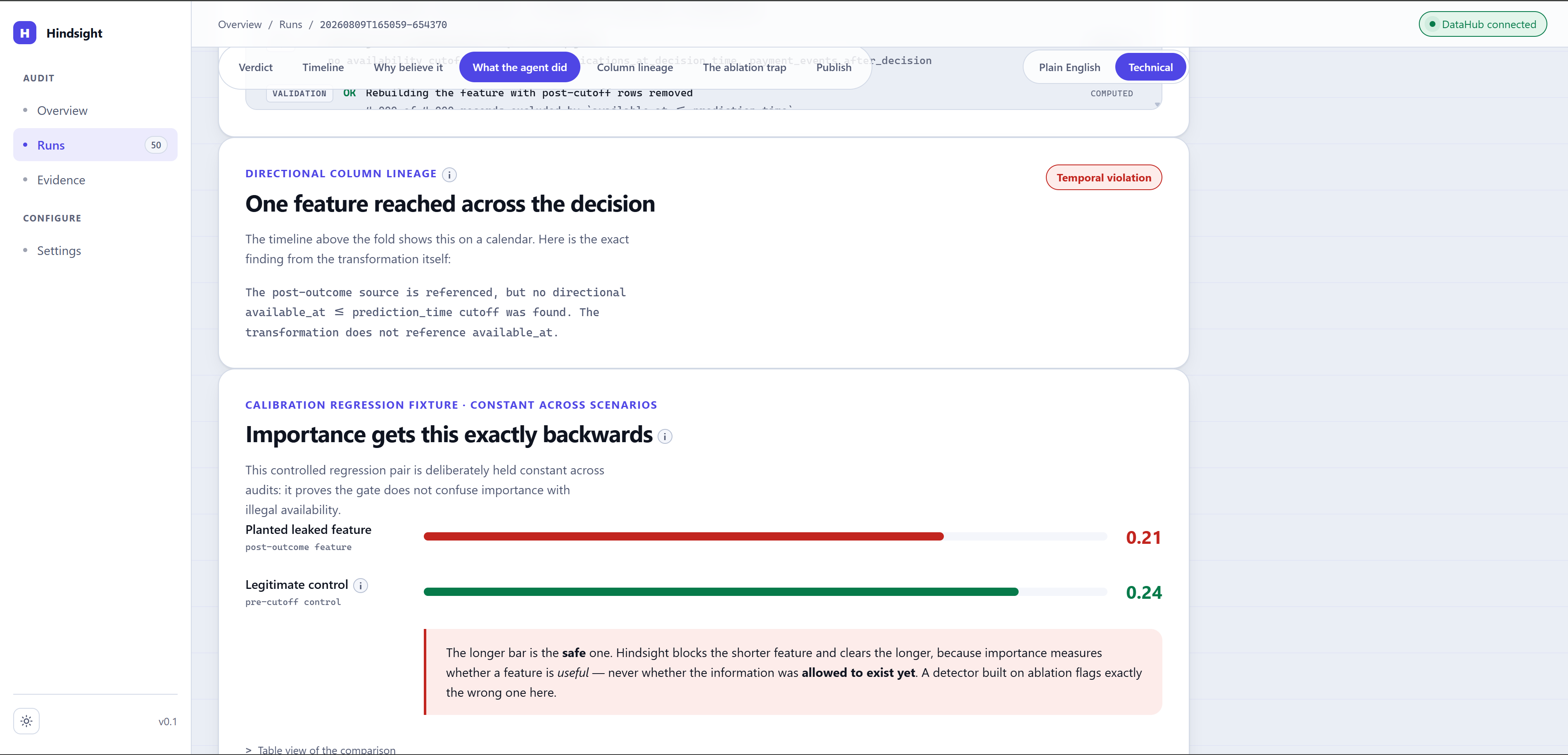
The same finding on a calendar. Everything left of the red line was knowable. Only the bottom row reaches past the decision.
-
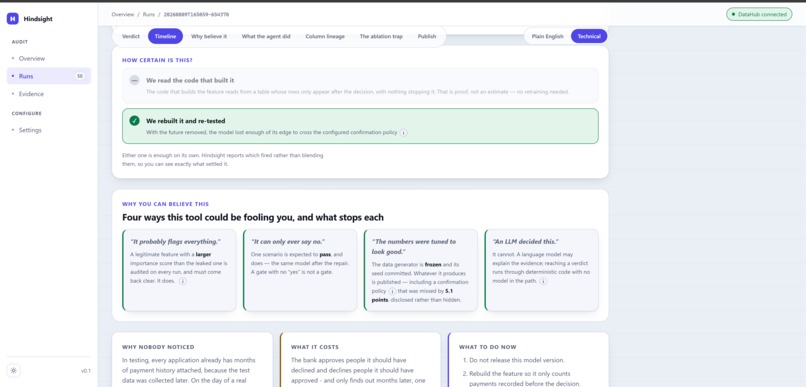
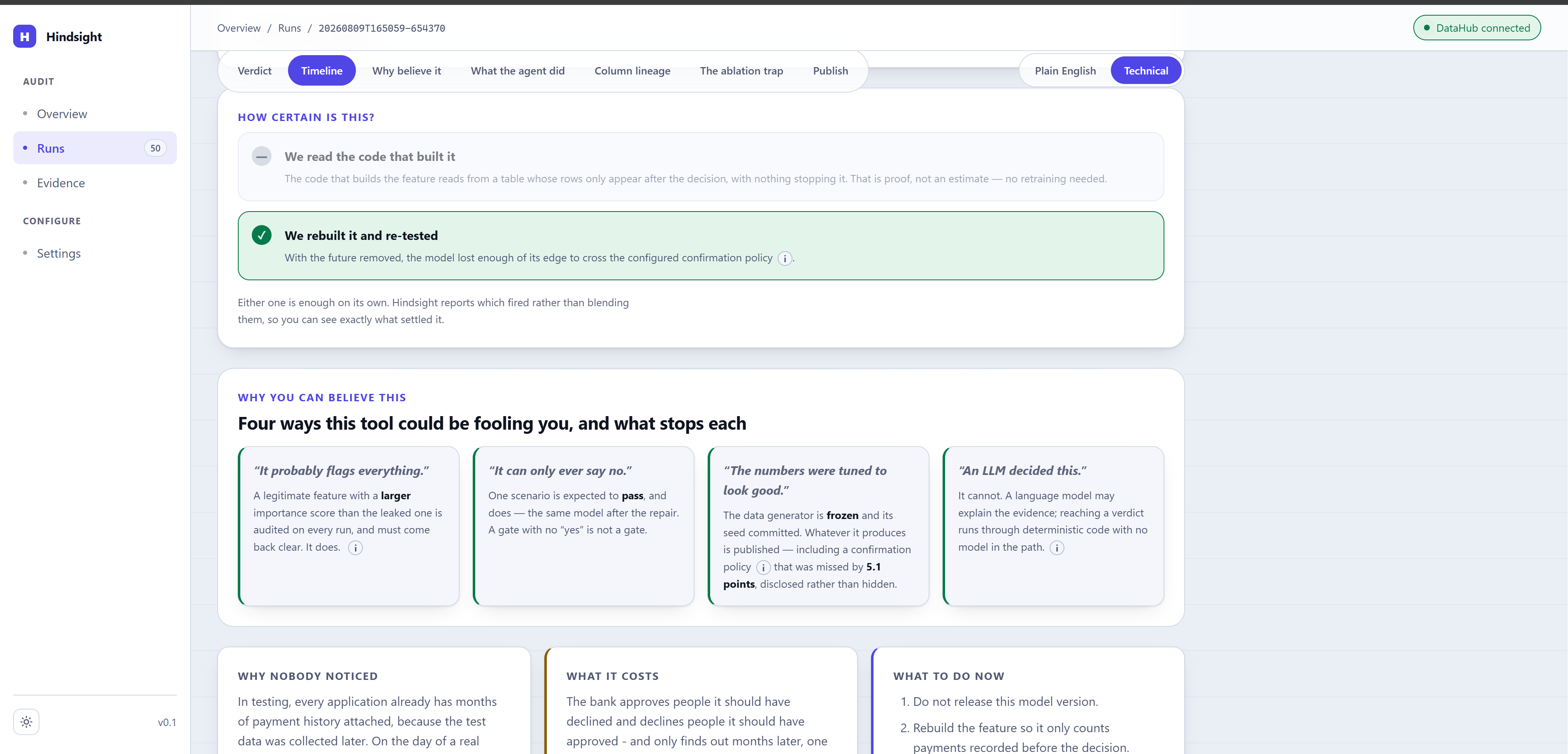
Two independent routes to confirmation, and four ways this tool could be fooling you with what stops each one.
-
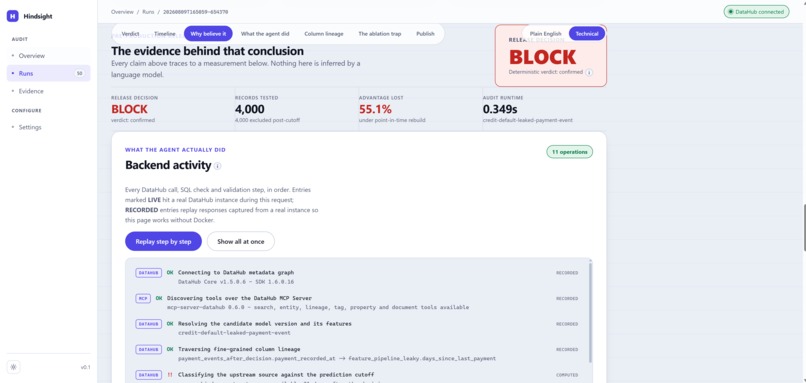
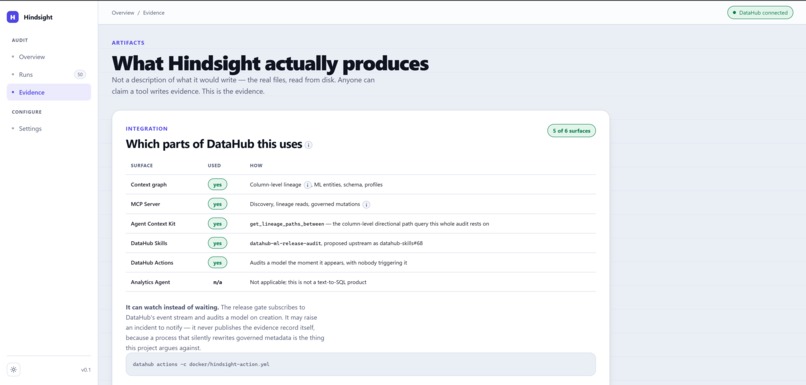
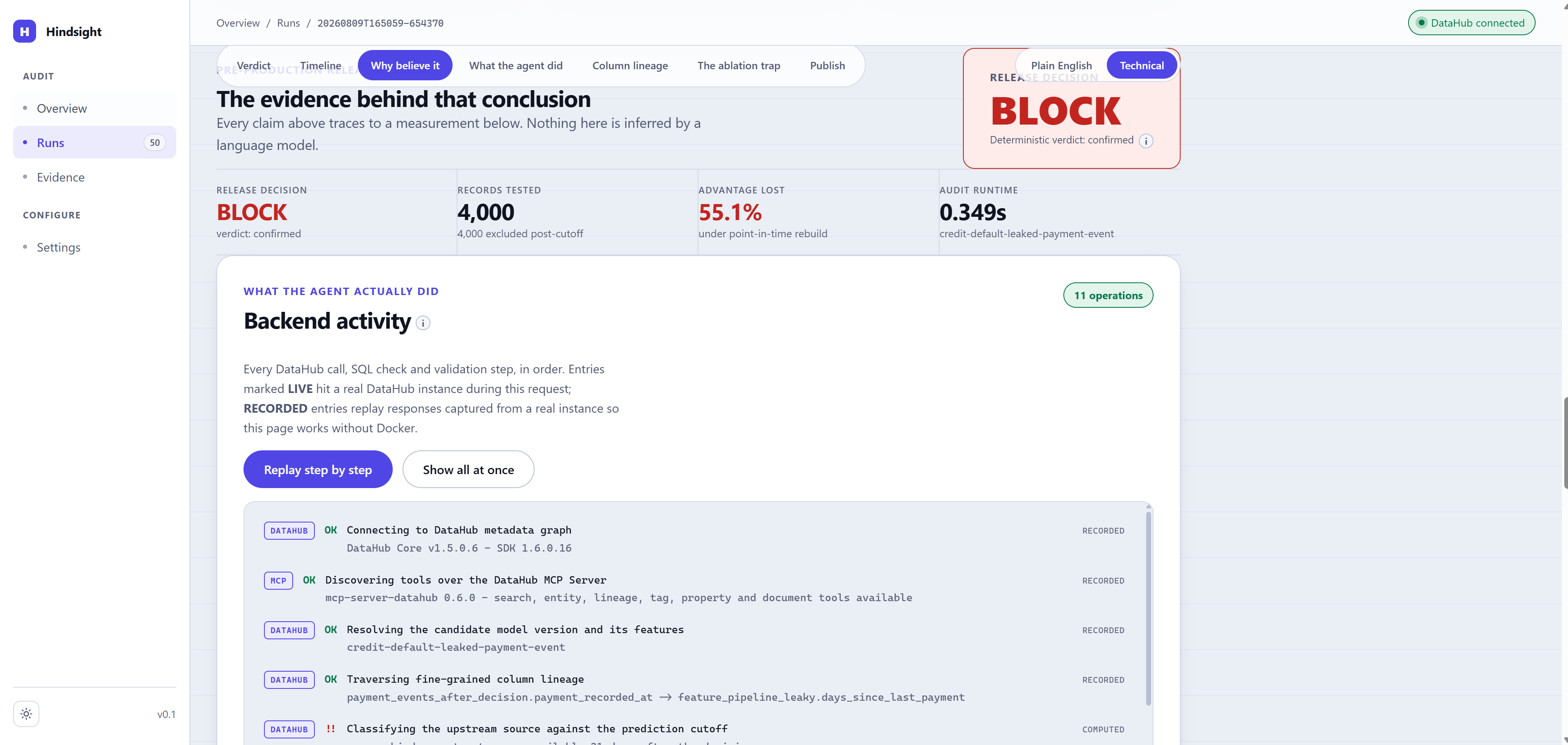
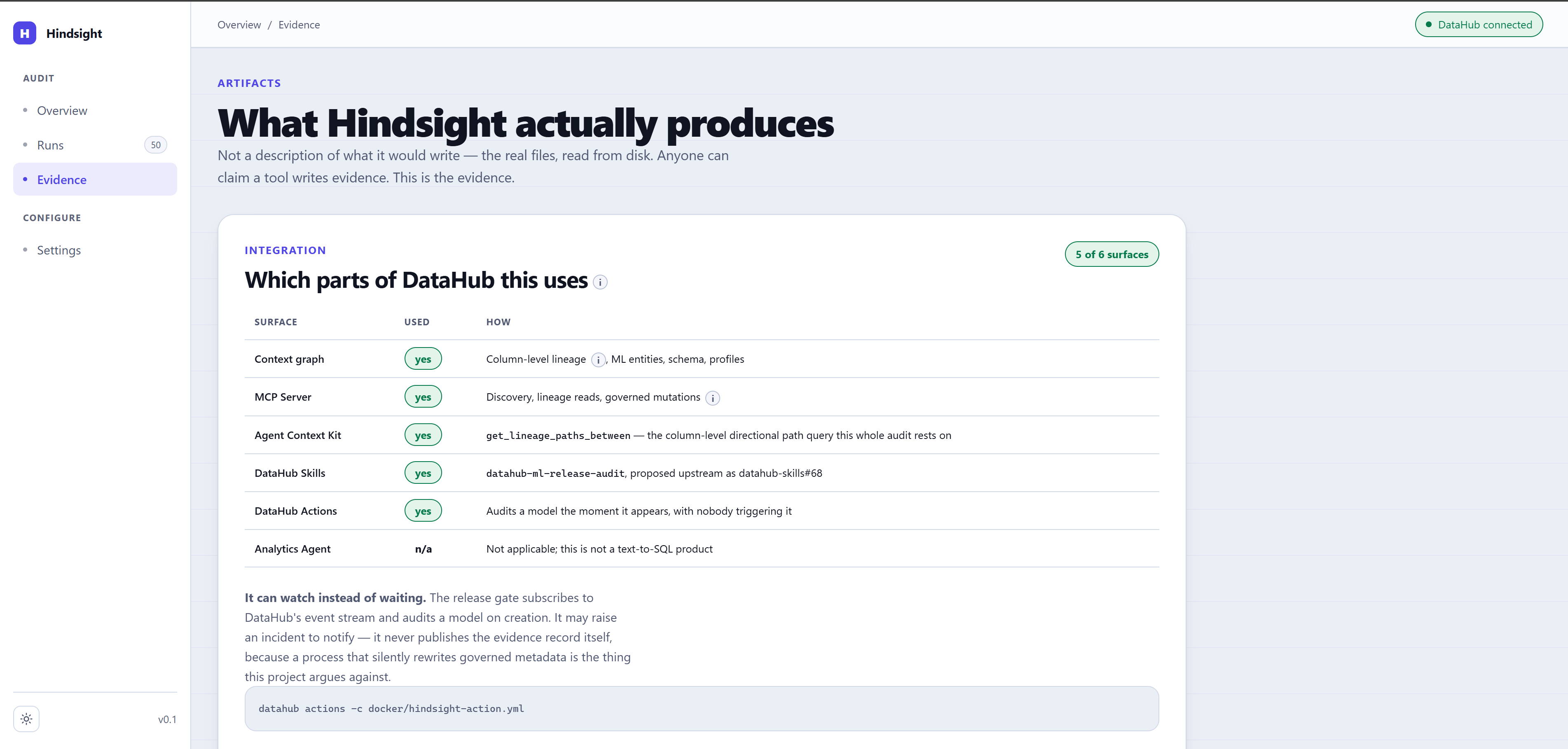
Every DataHub call the audit made, in order, including the MCP Server and the fine-grained column lineage traversal.
-
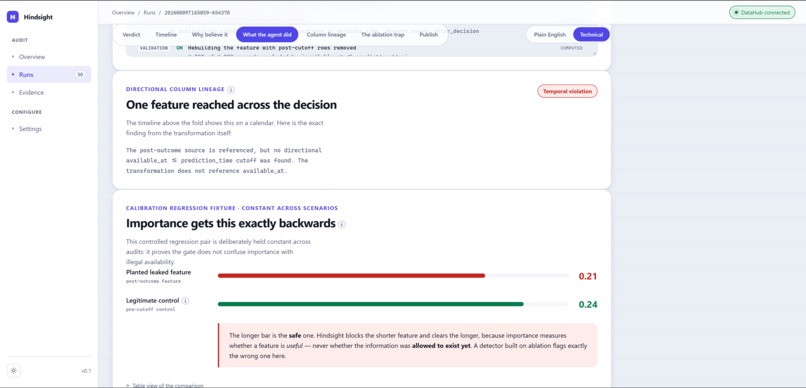
The moment that matters. The legitimate feature scores higher on importance, and Hindsight clears it and blocks the other one.
-
Release decision, records tested, advantage lost and runtime, with the full backend trace underneath it.
-
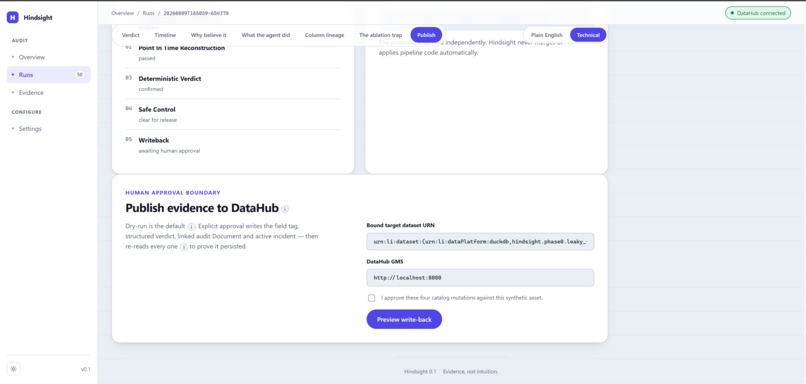
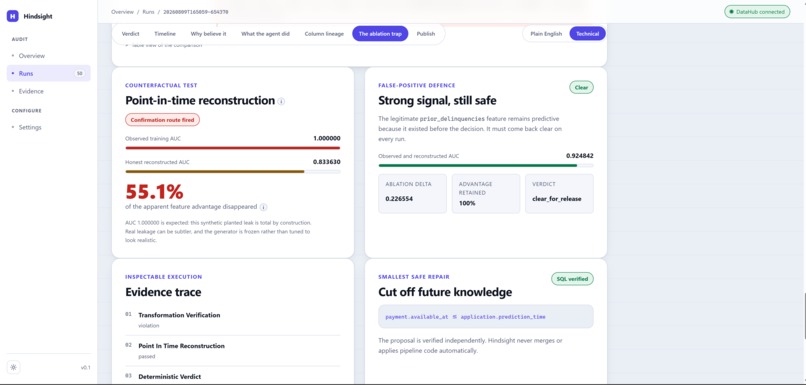
Rebuild the feature as of the decision and 55% of its edge vanishes. The legitimate control keeps 100% of its own.
-
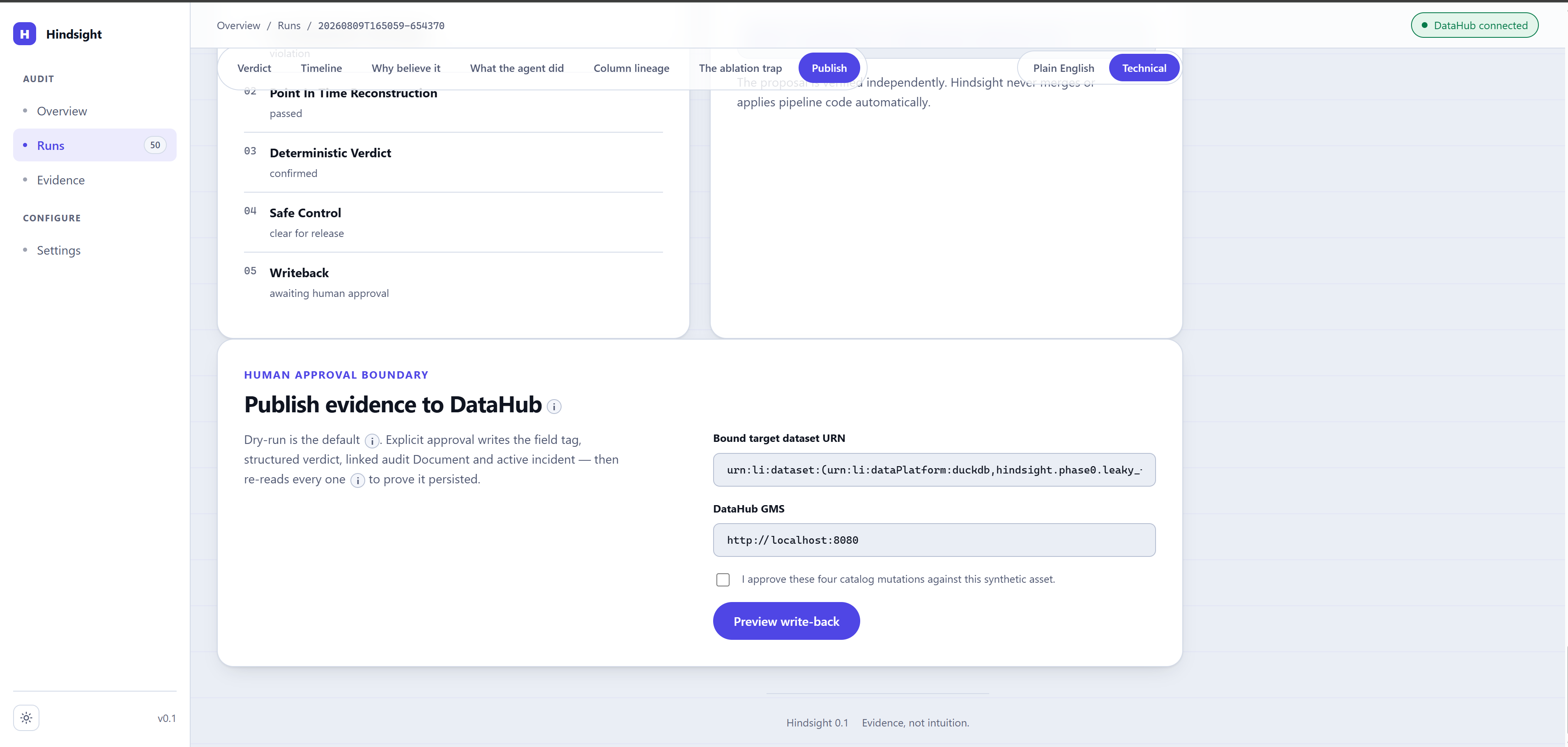
The human approval boundary. Nothing reaches the catalog until a person ticks the box, and dry run is the default.
Inspiration
A bank builds a model to predict who will repay a loan. It scores almost perfectly in testing. They ship it. It fails.
The model was never good. One of the facts it was shown could only be known after the loan decision had already been made, so in testing it was reading the answer, and in production that answer does not exist yet. This is target leakage.
It is not a rare curiosity. Kapoor & Narayanan traced it through 294 papers across 17 scientific disciplines (Leakage and the Reproducibility Crisis in ML-based Science, Patterns 2023). Yang, Brower-Sinning, Lewis & Kästner found it pervasive across 100,000+ public notebooks (arXiv:2209.03345, ASE 2022). Kaufman, Rosset & Perlich gave it its formal definition back at KDD 2011.
What makes it hard to catch is where it happens. The mistake is not in the notebook. It is upstream, in a data pipeline nobody on the ML team ever opens:
- the training notebook cannot see it, the defect was created before
read_parquet - the feature store sees finished features, not where they came from
- monitoring notices months later, once the losses arrive
- a data quality tool finds nothing wrong, every value is valid
Answering "could this have been known at the time?" needs a map spanning raw tables, transformations, features and models. That map is DataHub's column-level lineage.
What it does
Hindsight is a release gate. Point it at a model and it does four things, then hands you an exit code your CI can act on.
1. Trace it back. It asks DataHub one question through the Agent Context Kit: is there a path from this column to that one, and which way does it run? The answer comes back with the middle hop naming a query entity, so the evidence cites the catalog's own record of the transformation rather than a file we pointed it at.
2. Check the clock. For each source it compares when the rows became knowable against the moment the decision had to be made. In the shipped loan example the decision is 10 Jan 2026 and the feature's data arrived 10 Feb 2026. Thirty-one days too late.
3. Read the code. It parses the transformation with sqlglot looking for an
available_at <= prediction_time guard. If a post-outcome source is joined with no guard,
that is proof, and no retraining is needed.
4. Rebuild and re-test. It reconstructs the feature in DuckDB using only records that existed at the cutoff, retrains, and measures what survives. A leaked feature loses its advantage. A legitimate one keeps it.
Then, only after a human ticks approval, it writes the finding back into DataHub as a field tag, a structured verdict property, a linked audit Document and an active incident, and re-reads every one to prove it persisted. A write that cannot be read back is treated as a failure.
The result that shows it is not theatre
| Feature | Importance (ablation delta) | Hindsight verdict |
|---|---|---|
| Planted leaked feature | 0.21 | confirmed, blocked |
| Legitimate control | 0.24 | clear_for_release |
The safe feature scores higher, and Hindsight clears it anyway.
That is the whole argument. Importance tells you what a model leaned on. It cannot tell you whether the model was allowed to know it. A detector built on importance flags exactly the wrong feature here, which is why this pair is a permanent regression test rather than a demo prop.
What ships
- Five audits across three industries: loan approval, the same loan model after repair, a deliberately subtle variant, hospital readmission, and fraud screening. One is expected to pass, because a gate that can only say no is indistinguishable from one that is not looking.
- A
scan-sqlmode that walks a whole dbt project with no DataHub and no seeded data. Files it cannot parse are reported as unchecked, never as clean. - A feature sweep for when you do not know which feature is guilty: it ranks every candidate by advantage lost to the cutoff, not by importance.
- An evidence console with a Plain English / Technical toggle, a printable record, and a panel listing every DataHub call the audit made, in order.
- A DataHub Action deployment that audits a model the moment it appears, with nobody triggering it.
How we built it
A deterministic evidence engine with no LLM in the decision path. A language model may explain evidence in prose. It can never promote a verdict.
Verdicts are a calibrated lattice: insufficient_metadata to needs_review to
high_confidence to confirmed, plus clear_for_release. confirmed is reachable by two
independent routes:
- a deterministic SQL and time proof, or
- a point-in-time collapse, where the advantage vanishes once the future is removed.
Either is sufficient alone, and the console reports which one fired rather than blending them, so you can see exactly what settled it.
DataHub is reached through the MCP Server for discovery, lineage and governed mutations, the Agent Context Kit for the column-level directional path query the whole project rests on, and the Python SDK for typed ML metadata and write-back.
Stack: Python, DuckDB, sqlglot, scikit-learn, FastAPI and Jinja with no framework JavaScript.
Challenges we ran into
Importance cannot confirm leakage. Our first verdict model let a plain ablation delta
reach confirmed. But removing any strong feature drops accuracy. We rebuilt the lattice so
importance is structurally unreachable as a confirmation branch, and added the higher-scoring
control that must come back clear on every run.
A graphic that lied about time. The cutoff timeline drew the decision line at 58% for visual composition while the axis computed it at 52.9% from the real dates. On a graphic whose entire job is being trusted about time, that is fatal. The window is now symmetric so a single linear scale puts the cutoff at dead centre, and a test asserts the drawn line and the computed tick agree.
A status light that always said "connected." The console asserted a healthy DataHub
connection whether or not one existed, which is precisely the kind of unevidenced claim this
project exists to catch. It now probes, distinguishes not configured from unreachable, and
disables publishing when the catalog cannot be written.
A false negative wearing a pass. Run against dbt-labs/jaffle-shop, a public project written by someone with no knowledge of this tool, every model came back clean. Jinja templating made them unparseable, and unparseable was falling through to "no post-outcome source found". They are now reported as unchecked, never as clean.
Accomplishments that we're proud of
- 42 benchmark cases, 0 false positives, 0 false negatives, sweeping the defect from reaching every record down to two percent of them. Below forty percent reach the statistical route stops firing and the deterministic proof still catches it. That is the measured argument for having two independent routes.
- It works on data we did not create.
examples/adapter/is committed CSV in a different domain, with different column names and a different leak mechanism. - The control that cannot be allowed to fail. The legitimate feature with the higher importance score is re-audited on every single run, and the build breaks if it is ever flagged. "It does not just block everything" is enforced, not asserted.
- A frozen generator with a committed seed, and the collapse threshold margin published (5.142 percentage points) rather than hidden. Whatever it produces is what we publish.
- Three contributions back to DataHub, all found by building this:
#18705 (merged) documents a
required field the incidents tutorial omitted;
#18822 stops
datahub docker quickstartcrashing on legacy Windows code pages, which we only hit because we develop and run CI on Windows as well as Linux; datahub-skills#68 adds an ML release-audit skill.
What we learned
Being trusted matters more than being impressive.
Nearly every hard call came down to refusing to overstate. Publishing the threshold margin
instead of burying it. Keeping insufficient_metadata as a real answer, because "we could not
reach the catalog" is not evidence of anything. Separating available from found in the
lineage response, so an outage can never read as a clean bill of health. Saying plainly which
parts do not yet work on your own data.
The sharpest lesson came from our own bugs. Twice we shipped something that reported success without checking: a status light that asserted a connection it never probed, and a scanner that called unparseable files clean. Both are the exact failure this project exists to prevent, and we only found them by testing against work we had not written ourselves.
What's next for Hindsight
- Direct warehouse adapters. Point-in-time reconstruction already runs on mapped CSV/Parquet snapshots in long or wide form. Connecting straight to Snowflake and BigQuery is the remaining transport work.
- The other two analyzers: training and serving skew, and degenerate feedback loops where a model's own output re-enters its training data.
- Upstreaming the skill, so any DataHub user gets the release-audit workflow without installing us.
One honest boundary, stated here as it is in the README: point-in-time reconstruction needs an availability timestamp. A nightly overwrite that keeps no history cannot be audited this way by anyone, including us, because the information needed to answer the question was never stored.
Built With
- agent-context-kit
- datahub
- docker
- duckdb
- fastapi
- github-actions
- jinja
- mcp
- pytest
- python
- railway
- ruff
- scikit-learn
- sqlglot
- uv
- uvicorn

Log in or sign up for Devpost to join the conversation.