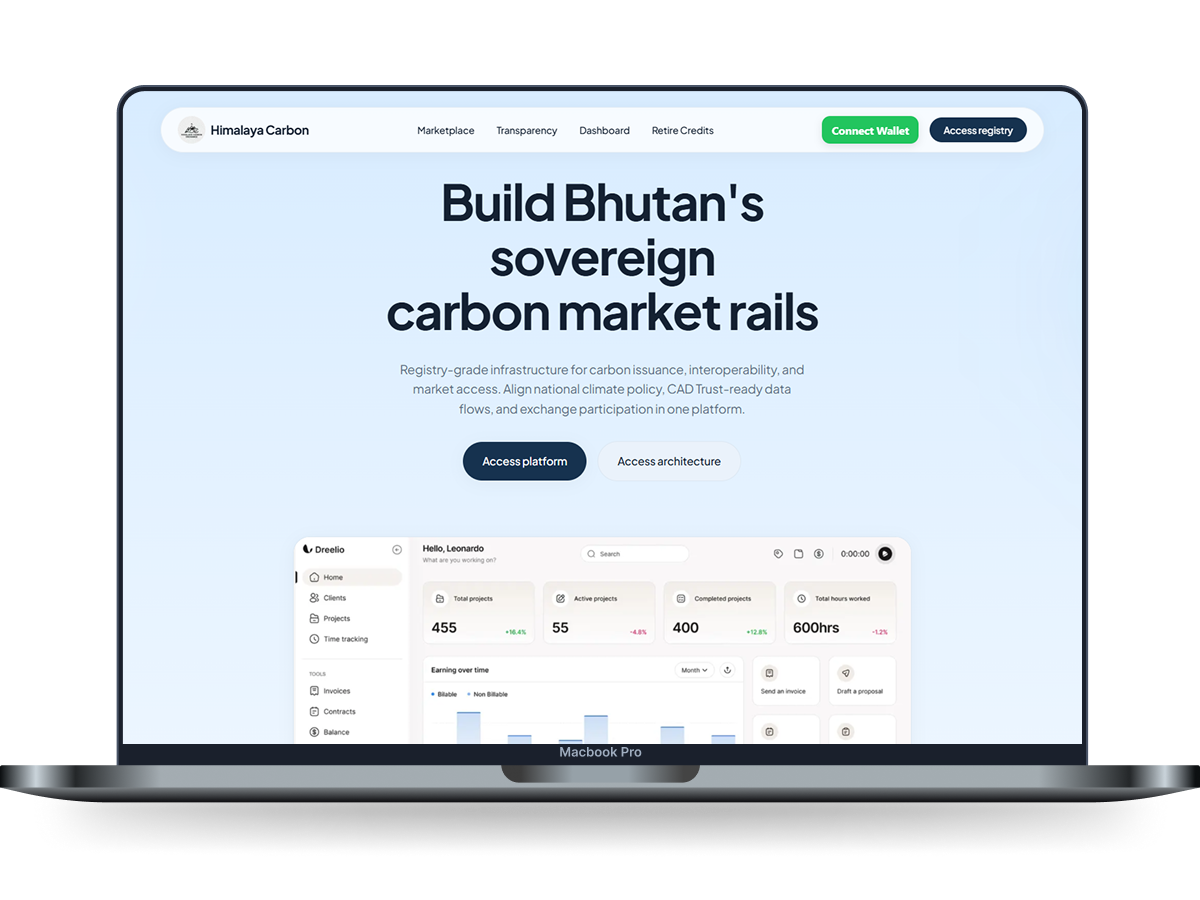
Himalaya Carbon Exchange
Technical documentation for the current repository state of the Himalaya Carbon Exchange prototype.
This project combines:
- A
Next.jsApp Router web application viem-based blockchain reads and server-side writeswagmi+RainbowKitwallet connectivity- Solidity contracts for a sovereign carbon registry and pool primitives
- Mocked and semi-realistic API flows for registry synchronization, retirement verification, RFQ intake, and CAD Trust lifecycle events
The codebase presents a production-style sovereign carbon market UX, but several modules are still prototype or simulation layers. This README documents what is actually present in code as of March 11, 2026.
1. Repository Purpose
The repository models a sovereign carbon exchange where:
- a national registry is treated as the source of truth
- locked registry units can be mirrored on-chain as ERC-1155 credits
- authorized institutions can be whitelisted to hold or receive credits
- credits can be retired on-chain
- a retirement receipt can be transformed into a certificate-like response
- liquidity and market structure concepts are represented in UI and contracts
Important constraint: the application is not itself a full registry implementation. The landing page and supporting code position it as a market layer synchronized with an external sovereign registry.
2. Tech Stack
Frontend
Next.js 16.1.6React 19.2.3- App Router under
src/app - Tailwind CSS v4 via
@tailwindcss/postcss framer-motionlucide-react
Web3 / Data
viemwagmi@rainbow-me/rainbowkit@tanstack/react-query
Validation / Utilities
zod- Node
crypto clsxtailwind-merge
Smart Contracts
- Solidity
^0.8.20 - OpenZeppelin
@openzeppelin/contracts
3. Current Feature Set
Implemented in code:
- marketing landing page
- wallet provider setup for Polygon and Polygon Amoy
- marketplace page with mock inventory and RFQ submission
- dashboard page with static metrics
- admin page for whitelist management
- retirement page with direct browser-side contract write
- simulator page to generate signed registry payloads
- transparency page combining mock API data and on-chain reads
- project detail pages driven by route params
- API routes for registry status, participants, lock/mint, CAD Trust sync, RFQ intake, and retirement verification
- Solidity contracts for registry and pool constructs
Partially implemented or simulated:
- sovereign registry bridge
- CAD Trust synchronization
- certificate issuance
- market inventory, pricing, compliance metrics, and analytics
- administrative access control
Not implemented in this repository:
- database or persistent storage
- authentication/session system
- automated test suite
- contract deployment pipeline
- contract compilation script/tooling in
package.json - real CAD Trust or registry outbound integrations
4. Project Structure
.
|-- contracts/
|   |-- HimalayaCarbonRegistry.sol
|   |-- CarbonPool.sol
|   `-- CarbonPoolFactory.sol
|-- docs/
|   |-- dashboard_overview.md
|   `-- implementation_report_mar_2026.md
|-- public/
|   |-- docs/
|   `-- images/
|-- src/
|   |-- abis/
|   |-- app/
|   |   |-- actions/
|   |   |-- api/
|   |   |-- dashboard/
|   |   |-- marketplace/
|   |   |-- projects/[id]/
|   |   |-- retire/
|   |   |-- simulator/
|   |   `-- transparency/
|   |-- components/
|   |-- constants/
|   |-- docs/
|   `-- lib/
|-- API.md
|-- ARCHITECTURE.md
|-- DOCSTRINGS.md
`-- README.md
5. Application Modules
UI Pages
src/app/page.tsx- landing page
- frames the platform as a registry-synchronized market layer
src/app/marketplace/page.tsx- marketplace UI
- uses local/mock inventory
- posts RFQs to
/api/market/rfq
src/app/dashboard/page.tsx- user dashboard
- largely presentation-oriented with static content
src/app/dashboard/admin/page.tsx- admin-facing whitelist management UI
- fetches
/api/registry/participants - invokes
updateParticipantAuthorizationserver action - labels itself restricted, but there is no real auth layer
src/app/retire/page.tsx- user-driven retirement flow
- connected wallet calls the registry contract directly
- then posts transaction hash to
/api/retire/verify
src/app/simulator/page.tsx- test harness for HMAC-signed registry lock payloads
src/app/transparency/page.tsx- combines mock registry status data and on-chain project count
src/app/projects/[id]/page.tsx- project detail page from route-derived mock content
Shared Components
The landing page is composed from src/components/:
Navbar.tsxHero.tsxLogoTicker.tsxFeatures.tsxBentoGrid.tsxPricing.tsxFooter.tsxButton.tsxProviders.tsx
Server Actions
src/app/actions/sovereign.ts- server-side participant authorization update
- uses relayer wallet
- no session check is implemented
src/app/actions/simulate.ts- returns an HMAC signature for simulator payload generation
Shared Libraries
src/lib/blockchain.ts- creates
publicClient - creates
walletClientfromPRIV_KEY - exports
mintFromRegistry() - hard-codes Polygon Amoy for server-side chain operations
- creates
src/lib/security.ts- defines
RegistryMetadataSchema - signs and verifies HMAC payloads
- logs audit events
- falls back to a hard-coded development secret if env var is missing
- defines
src/lib/certificates.ts- creates certificate objects from retirement context
- not fully grounded in event-derived project metadata
src/lib/dex.ts- DEX/liquidity helpers
- currently not a core runtime dependency of active routes
Constants and ABI
src/constants/index.ts- registry ABI export
- UI constants
- includes a registry address constant used by some code paths
src/abis/HimalayaCarbonRegistry.json- ABI artifact used by the application
6. Smart Contracts
contracts/HimalayaCarbonRegistry.sol
Primary on-chain registry contract.
Key characteristics:
- ERC-1155 based
OwnableERC1155Supply- holds per-project metadata in
projectData - keeps a whitelist in
authorizedParticipants - restricts non-mint/non-burn transfers to authorized recipients
Core data model:
ProjectStatus:Pending,Authorized,Issued,Retired,Cancelled,TransferredProjectMetadataincludes:- project name and external project ID
- batch / serial metadata
- vintage year
- Article 6 authorization flags
- corresponding adjustment flag
- methodology
- registry link
- total issuance
- retired amount
Core functions:
mintCarbonCredit()batchMintCarbonCredits()getProjectIds()getProjectCount()getProject()setParticipantAuthorization()setArticle6Status()setCorrespondingAdjustment()retire()uri()
Core events:
CarbonMintedCarbonRetiredArticle6StatusUpdatedParticipantAuthorizedCorrespondingAdjustmentRecorded
contracts/CarbonPool.sol
Represents pooled exposure around registry assets using an ERC-20 style wrapper. This expands the market design beyond the registry contract, but the pool layer is not fully wired into the live app flows.
contracts/CarbonPoolFactory.sol
Owner-controlled pool deployment contract. The repository includes the Solidity source, but no build or deployment pipeline is declared in package.json.
7. API Surface
All route handlers live under src/app/api/.
Registry
GET /api/registry/status
Returns mock registry summary data:
- total locked units
- active serial batches
- last audit timestamp
- jurisdiction
- status string
This is not backed by live registry infrastructure.
GET /api/registry/participants
Returns a hard-coded participant list. It does not read on-chain whitelist state.
POST /api/registry/participants
Purpose:
- update participant authorization on-chain via relayer
Requirements:
X-Registry-Signatureheader- JSON body with
participantAddressandstatus
Behavior:
- validates request body
- simulates
setParticipantAuthorization - submits transaction through relayer wallet
POST /api/registry/lock
Purpose:
- accept a signed sovereign registry lock payload
- mint credits on-chain using
mintCarbonCredit
Security:
- validates
X-Registry-Signature - validates payload via
RegistryMetadataSchema
Behavior:
- transforms inbound metadata into contract struct shape
- sets
status = 2(Issued) - sets
correspondingAdjustmentFinalized = false - calls
mintFromRegistry() - logs a security audit action
POST /api/registry/lock/test
Development helper that posts a built-in mock payload to http://localhost:3000/api/registry/lock.
This is environment-specific and assumes the app is running locally on port 3000.
CAD Trust
GET /api/registry/cad-trust/status
Returns mock global/network status values.
POST /api/registry/cad-trust/sync
Simulates lifecycle synchronization and returns:
- synchronization status
- generated GIN-like ID
- gateway name
- timestamp
- metadata hash
- lifecycle event
No real outbound API call is made.
Market
POST /api/market/rfq
Accepts RFQ submissions with fields such as:
- buyer
- project ID
- amount
- target price
- purpose
Current behavior:
- minimal validation only
- generates a pseudo-random RFQ ID
- no persistence
- no workflow engine, notification, or CRM integration
Retirement
POST /api/retire/verify
Purpose:
- verify a retirement transaction receipt
- locate a
CarbonRetiredevent - generate a certificate object
Behavior:
- waits for transaction receipt
- rejects reverted transactions
- scans logs from the configured registry address
- decodes
CarbonRetired - calls
generateImpactCertificate() - patches amount and beneficiary from event data
8. End-to-End Flows
Flow A: Registry Lock to On-Chain Mint
- External caller signs JSON payload with shared HMAC secret.
- Caller posts payload to
POST /api/registry/lock. - Route verifies signature and schema.
- Route converts payload into
ProjectMetadatacontract struct. src/lib/blockchain.tssimulates and submitsmintCarbonCredit.- Transaction hash and receipt metadata are returned.
Assumption:
- the relayer account is the contract owner
This is not validated at startup.
Flow B: Admin Whitelist Update
- Admin page loads and fetches
/api/registry/participants. - User submits an address or toggles an existing participant.
- Client calls
updateParticipantAuthorization()server action. - Server action simulates and writes
setParticipantAuthorization. - UI waits, then refreshes participant list.
Limitation:
- there is no authentication or role check in the code
Flow C: Retirement Verification
- User retires credits from
/retireusing connected wallet. - UI waits for tx confirmation.
- UI posts
txHashtoPOST /api/retire/verify. - Route scans receipt logs for
CarbonRetired. - Certificate object is generated and returned.
Limitation:
- certificate generation is only partially event-derived
Flow D: Simulator
/simulatorbuilds a payload string.generateTestSignature()signs it with HMAC.- The UI submits payload plus signature to
/api/registry/lock. - This lets developers test the sovereign lock-to-mint flow locally.
9. Environment Variables
Copy .env.example to .env.local.
Required for normal startup
NEXT_PUBLIC_RPC_URL- Polygon Amoy RPC URL
- used by server public client and wallet provider transport
NEXT_PUBLIC_RAINBOW_PROJECT_ID- WalletConnect project ID
NEXT_PUBLIC_REGISTRY_ADDRESS- registry contract address used by server-side write flows and client reads
Required for server-side write flows
PRIV_KEY- relayer private key
- must correspond to an account able to execute owner-only contract functions
Required for signed registry bridge flows
REGISTRY_BRIDGE_AUTH- shared HMAC secret for lock and participant API calls
Present in .env.example but not materially used in current code
NEXT_PUBLIC_RPC_URL_MAINNET- used only in wallet provider transport config for Polygon mainnet
NEXT_PUBLIC_CHAIN_IDNEXT_PUBLIC_CAD_TRUST_API_URLCAD_TRUST_AUTH_TOKENNEXT_PUBLIC_VERCEL_ENVNEXT_PUBLIC_ENABLE_ANALYTICSVULN_AUDIT_NOTIF_EMAIL
Security note
If REGISTRY_BRIDGE_AUTH is missing, src/lib/security.ts falls back to:
test-lock-token-2026
That is acceptable only for local development and should be treated as insecure outside a test environment.
10. Local Development
Prerequisites
- Node.js 20+
- npm 10+
- access to a Polygon-compatible RPC endpoint
- WalletConnect project ID
- deployed
HimalayaCarbonRegistrycontract if you want real blockchain flows
Install
npm install
Run
npm run dev
Then open http://localhost:3000.
Available scripts
npm run dev
npm run build
npm run start
npm run lint
There is no test script and no contract-specific script in package.json.
11. Deployment Notes
The repository contains app code and contracts, but it is not a full deployment system.
For a functional deployment you would still need:
- deployed contracts
- owner/relayer key management
- environment-specific RPC configuration
- production auth for admin operations
- persistence for RFQs, audit logs, and certificates
- operational monitoring
- secure secret management
- contract ownership verification during boot or health checks
12. Known Gaps and Risks
- No authentication for
/dashboard/admin - No session/role enforcement in
updateParticipantAuthorization() - Some APIs return mock or hard-coded data while presenting live-system terminology
- Participant list API is not sourced from chain state
- Transparency page mixes mock API values with live contract reads and hard-coded issuance numbers
- HMAC secret has an insecure fallback
- Contract and frontend can drift if
src/constants/index.tsand env-based addresses differ - Retirement certificate generation is only partially tied to decoded on-chain event data
- RFQs are not persisted and IDs are not guaranteed unique
- No automated tests
- No contract compile/deploy/test tooling declared in the npm scripts
- Relayer ownership assumptions are implicit, not verified
13. Recommended Production Hardening
- add authentication and authorization for admin surfaces
- remove the default HMAC secret fallback
- add a real datastore for RFQs, audit trails, participants, and certificates
- derive all transparency metrics from verifiable state
- validate contract ownership and chain configuration on startup
- add contract build/deploy/test tooling
- add unit, integration, and end-to-end tests
- replace mock CAD Trust and registry adapters with real service clients
- unify registry address configuration into a single source of truth
14. Companion Documents
The repo already includes additional documentation:
- ARCHITECTURE.md
- API.md
- DOCSTRINGS.md
- docs/implementation_report_mar_2026.md
- docs/dashboard_overview.md
This README should be treated as the top-level technical source of truth for setup, architecture, runtime behavior, and current implementation limits.

Log in or sign up for Devpost to join the conversation.