Both projects have its own pdf version of the jupyter notebook in the repository.
Project 1: High-speed Aerial Transportation System
Design
- Mechanical Part
- Container / transport capsule
- Catch & Release System
- Driving Moduler
- Rail
- Control System
- Air traffic control
- Navigate system

JUST like flying a Kite!
Why?!
Compare with Railway/Metro
Construction
- Rail system
- Less weight to support: cheaper to build
- Space saving: no need to stay on ground, less cost on landspace
- Flexible: no need to tunnel through mountain, easier to cross river (catch & release to glide over river)
- Container / transport capsule
- Separate from power system: safer and less dependance on metal frame
- Lighter: less/lighter material, (compared to airplane, and also train)
- Easier to design & manufacture: less electric control system (compared to both)
- Driving Moduler
- Standard: easier to upgrade & scale
- Isolated from passengers: safer, less regulation
- Rail system
Operation
- Space efficient
- It's the future, for growing population & skyscraper, Better view!
- Higher traffic density, less traffic jam
- Energy efficient
- Easier to drive: less weight on the rail, less wear for the rail
- Aero-efficient: less energy consumption, check the calculation!
- Robust
- Easier maintenance: power system indepedent
- Emergency proof: container can act as glider, waterlanding
- Fast recovery after damage
- Space efficient
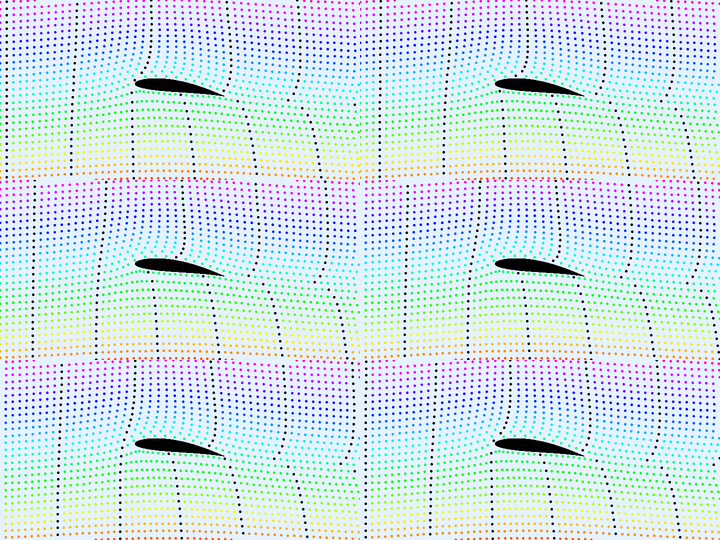
The very rough model
Force Analysis
- Lift: Bernoulli's pressure equation
- Weight: gravity + pressure
- Thrust: driving power
- Drag: air-resistance

Lift by pressure
$$L={\tfrac 12}\rho v^{2}S C_{L}$$
where
- $L$ is lift force,
- $\rho$ is air density,
- $v$ is true airspeed,
- $S$ is the wing area, and
- $C_{L}$ is the lift coefficient at the desired angle of attack, Mach number, and Reynolds number
- not considered in the setup, benefit more if included
Why HATS is good
- Lift is dangerous for any ground transportation
- Even worse, racing cars are designed to turn such pressure downwards, more wear for tires and road & cost more energy $$L_{ground}= - {\tfrac 12}\rho v^{2}S C_{L}$$
Cars/trains don't have wing, so wing area $S$ is small. But we can be more generous, let's assume $L{ground}=0$_
Drag by air resistence
$$F_{D}\,=\,{\tfrac 12}\,\rho \,v^{2}\,C_{D}\,A$$
- $F_{D}$ is the drag force, which is by definition the force component in the direction of the flow velocity,
- $\rho$ is the mass density of the fluid,
- $v$ is the flow velocity relative to the object,
- $A$ is the reference area, and
- $C_{D}$ is the drag coefficient – a dimensionless coefficient related to the object's geometry and taking into account both skin friction and form drag, in general $C_{D}$ depends on the Reynolds number.
Let's be broad again
Assume trains are also designed to be aero-efficient
A little bit of Math
- Driving force
- HATS
- for container: $L_c = W_c$, drag force is $F_D = T$, here $T$ is the tension as traction
- for driving moduler:
- $F_{thrust} = \mu W + T = \mu m_{d}g + F_D = \mu m_{d}g + \frac{1}{2}\rho v^2 C_D A$
- the first term is the friction caused by the weight of the moduler
- Ground Transportation
- Assume no lift, and assume aero-efficient:
- $F_{thrust/drive} = \mu W + \frac{1}{2}\rho u^2 C_D A = \mu (m_{d} + m_p)g + \frac{1}{2}\rho v^2 C_D A$
- Analytically, there is still contribution from $m_p$, which is the weight from passenger and frame!
- Assume no lift, and assume aero-efficient:
- Traditional Airplane
- During cruise, $L = W$, $F_{thrust} = \frac{1}{2}\rho v^2 C_D A$, which looks better than HATS
- BUT
- They fly higher, so $E_{lift} = (m_d + m_p) g h$ which is huge
- They are bigger with power system on board, $A\uparrow$ => $F_D \uparrow$
- Flight distance, the arc, $l = (R_{earth} + h) \theta$, is larger
- HATS
Wraping up
- Power:
- $P = F v$
- Energy:
- $E = P t = P \frac{l}{v} = F l$
- For HATS:
- $E = \mu m_{d}g R_{earth} \theta + \frac{1}{2} \rho v^2 C_D A R_{earth} \theta$
- For trains, no need to compare at all
- For airplane:
- $E = (m_d + m_p) g h + \frac{1}{2}\rho v^2 C_D A (R_{earth} + h)\theta$
General conclution
$\mu$ is coefficient of kinetic friction, it's very small for sliding friction
- exact comparision will need futher test and will be comparable to the ratio of $h_{cruise}/R_{earth}$
If we break down the thrust force for airplane, turbofan engine are more efficient and it relys on conservation of momentum.
- ${\displaystyle \mathbf {F_{thrust}} =\mathbf {v} {\frac {\mathrm {d} m}{\mathrm {d} t}}}$, the latter term is mass flow
- In general, ${\mathbf {P}}^{2}\propto {\mathbf {F_{thrust}}}^{3}$
- So for airplane, it is actually, $E = (m_d + m_p) g h + F_{thrust}^{3/2} l / v = (m_d + m_p) g h + (\frac{1}{2} \rho v^{4/3} C_D A / l^{2/3})^{3/2}$
Hey!
- #CBRE, will this helps the community/environment?
- #Exxon, could this be the future of transportation?
Extra realistic factors
- $g$ is not a constant, $g\sim \frac{G M_{earth}}{(R_{earth} + h)^2}$
- $\rho$ is a function of height, $\rho = f(h) = h^{\alpha}$
- There is also Dynamic Pressure applied on Trains and Cars
- draging string has weight and suffers air resistence
- ...
What's more
- luggage store in driving moduler
- extra charge for flying in higher track
- container & driving modular should be modularized, like train
- docking system to swap container
- X-wing, micro aerial tunnel, be bold!
- ...

Project 2: Apply NN to recover the theory of diffraction
My idea is that morden science is closely related to technical innovation. But back in the 80s and 90s, mechanical engineering and manufactory is still in the infancy, as well as data sampling and analytic methods. Even though the foundation of morden science is considered solid and proven, there is still chance that the perspective we have is not the only solution. Just like Newtonian gravity theory is an approximation of general relativity.
To explore and test it out, I first decide to do a simulation based on established theory to get example data. Diffraction is one of the most classic phenomenon that is well explained but also is explosured to the dawn of Quantum mechanics. To make it more realistic, I add white noise as systemactical error due to measurement and try to use ML, (a straightforward neural network in this case) to reveal the nature of the problem. But due to the high percision it required to realize the numerical experiment, I run into some data format issue that couldn't be solved in short timeframe.
So I decide to use gaussian process regression with the morden statistical method, Bayesian inference to catch the hidden nature from a small uniform random sampling data set. I put flat prior to avoid any prejustical knowledge about model and GP returned a reasonable good result, without excluding the possibility of alternative diffraction theory. See Cell 43 and Cell 45. The red dots are sampled based on theory, black dots with flat error bar are the data used to explore the model space. The color density indicates the probability and Cell 26 shows the fructuation from measurement.
My next step is to establish a mechanical system based on raspberrypi and step motor to stimulate in real case. Use the data measured in a large scale to revisit my temperate conclusion.
1-D diffraction
$\frac{I(x)}{I(0)}= \left[ \frac{\sin(\frac{\pi b}{\lambda}\frac{x}{D}) }{(\frac{\pi b}{\lambda} \frac{x}{D} )} \right]^2$
- $b$: slit width
- $\lambda$: wavelength
- $D$: distance to screen
Interpretion
- There is room for alternative form of diffraction equation, but sampling is very biased and uneven
- Flat prior, is too big.
- Gaussian process regression can incooperate with biased sampling, which is more realistic
- I am not good at TensorFlow
Built With
- bayesian-statistics
- gaussianprocessing
- jupyter-notebook-&-physics
- tensorflow
