Inspiration
The project started from my desire to find a better way to capture the moments that happen in my life. I have kids, an intense professional life, and many things happening around me. While we capture countless moments with our cameras, they often get lost among thousands of photos. I've also tried journaling many times, both with apps like Day One and Apple's Journal app. But each time I found it overwhelming and not engaging enough to maintain as a habit.
I wanted to find a way to make it much simpler for people to talk about their day and capture memories they could easily rediscover later. More importantly, I wanted these memories to surface naturally without requiring active searching.
Since I was leaving my previous company Omada, I also wanted to get back into coding, specifically exploring AI. I saw artificial intelligence as the perfect opportunity to achieve this goal of effortless memory capture and meaningful recall.
What it does
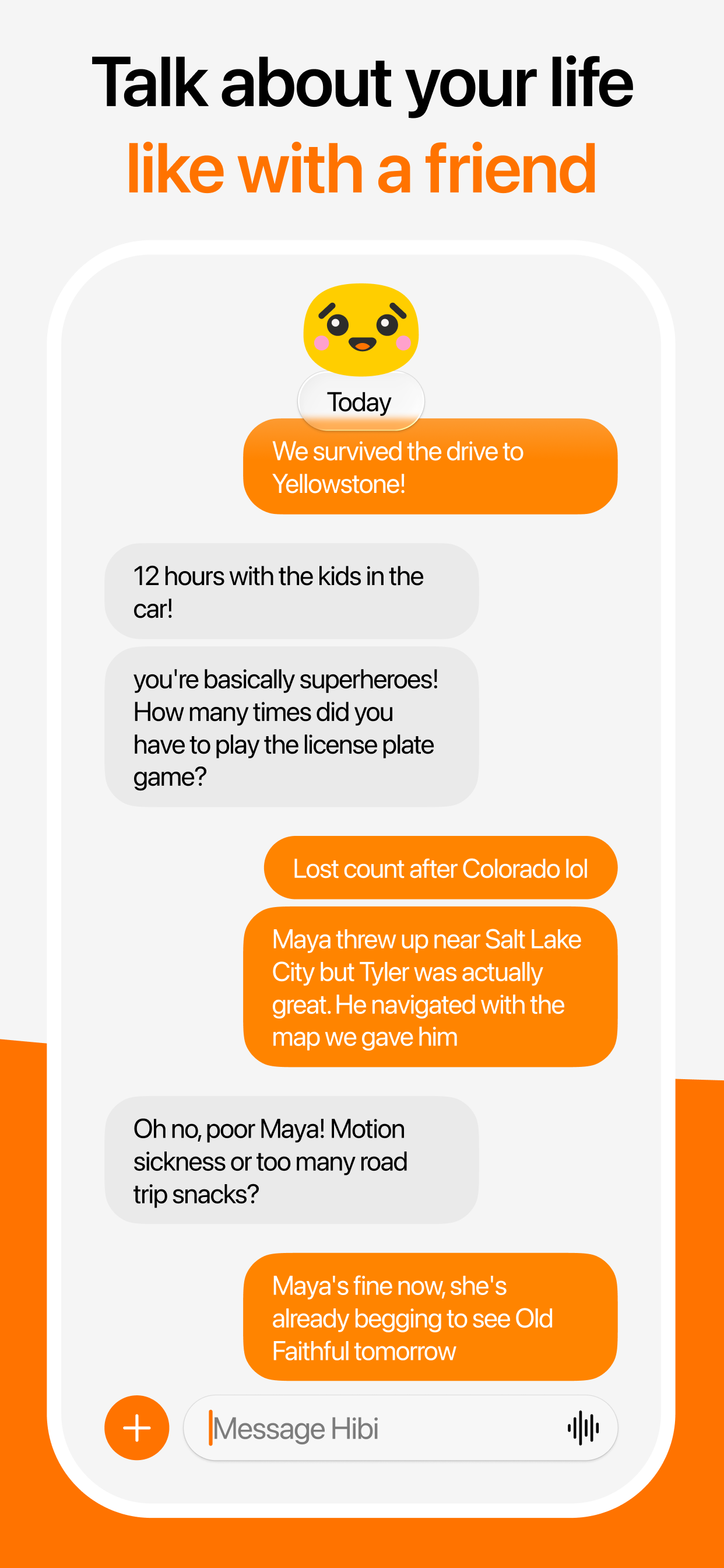
hibi is a "memory friend" like having a companion always available to hear about your day, whether it's small moments or bigger events. This friend listens, asks thoughtful questions to draw out more details, and learns about you over time to have increasingly meaningful conversations that reflect your unique life and personality.
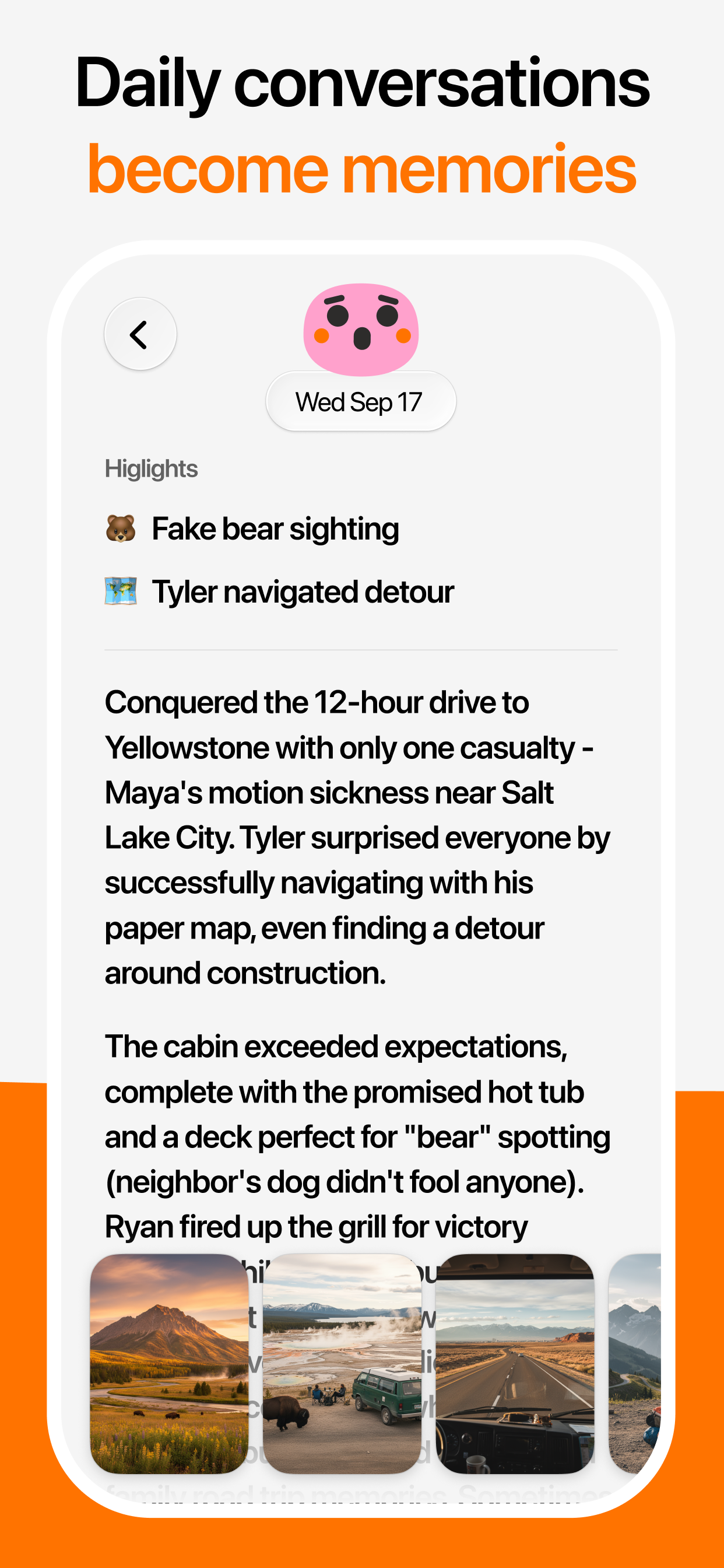
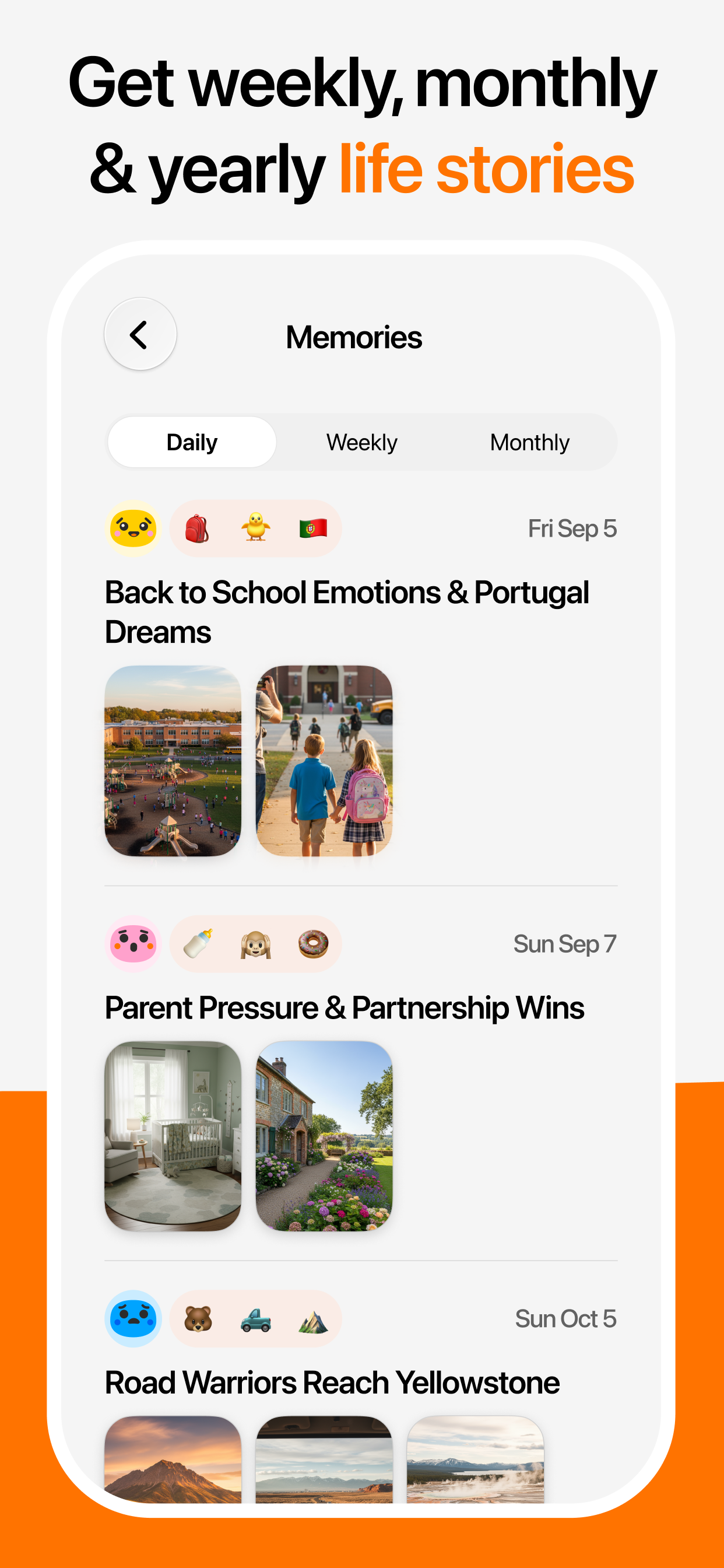
Each day, hibi transforms your conversations into a beautiful daily memory something you'll genuinely enjoy reading days or weeks later. To make your life story even more accessible, hibi also creates recaps of your weeks, months, and years, featuring the biggest highlights, narrative arcs, and your best photos. Instead of scrolling through every single day, you can easily see what happened last August or during your entire previous year.
Features:
- Chat system: Talk about your day while hibi interacts naturally and asks engaging questions to help you share more
- Daily memory creation: Get an automatically generated journal entry capturing your day's most meaningful moments
- Long term storytelling: Receive weekly, monthly, and yearly recaps that highlight your life's biggest moments and patterns
- Transparent profile building: See exactly what hibi learns about you and how it builds a rich understanding of who you are
How I built it
hibi has been built with these technologies:
- Vercel / I also started to use Vercel AI SDK but finally i ended using directly the OpenAI SDK
- Native Swift UI
- OpenAI Models - GPT 5 with different reasoning levels an verbosity + GPT 5 mini for other tasks
- Neon Database
- Chroma DB as a vector database
- Inngest in order to manage all background tasks. This tool makes is so much easier to handle long running task, or every task that I need to handle everynight.
- OneSignal for Push Notifications
- Langfuse for prompt management and observability, but finally I've moved observability to PostHog where I have all my stats
- PostHog for analytics + LLM observability (I wanted to try something else than Amplitude, and I am really impressed by the pace of feature release PostHog has)
- RevenueCat for mobile revenues
- ASO.dev to handle all App Store stuff
I've coded all the front and backend my self using these AI coding tools:
- Claude Code -> Really the main tool I used to assist me
- Codex from Open AI. More recently I've started to use it in cursor for the backend and since they introduced the codex model it is really impressive
Challenges I ran into
Here is a list of the main challenges I've ran into and continue to:
Context engineering: The core of everything. What you feed the model shapes the answers and the recaps. You need to decide what to extract, how to store it, when to use it. You can’t just dump every conversation into the model. When the context grows, the performance drops ("Context Rot" as the Chroma db team called it in this paper: https://research.trychroma.com/context-rot ) . Many approaches exist (function calling, vector databases, RAG) but the right solution depends on the product. It's still a work in progress in order to have always the right data that is saved, updated, and feed into the LLM.
Model cost management and observability: You want the best experience, but you also need to control costs and response time. That means monitoring every generation: time, price, function calls, cache hits. Releasing an AI product without this is like releasing a product without analytics, it simply makes no sense. I use PostHog new LLM analytics observability tool in order to monitor the cost, and speed of each request. I try different models, and different levels of reasoning and verbosity (for GPT 5) in order to each the right balance between speed, cost and quality.
Testing: The hardest part. Classic testing is deterministic. With LLMs it is not. Inputs don’t always lead to the same outputs. That is also why they can feel magical. There are evals, but they are hard to set up. I spent a lot of time testing use cases, adjusting prompts and context. Small changes can have a huge impact. The only way is to test quickly with many users.
Assistant identity and behavior: The heart of the product. You can shape it but never fully control it. My goal was to avoid the pitfalls of many current AI companions. hibi is not here to be your therapist or your lover. hibi is here to listen to your day, help you talk about it, and extract long-term memories you will want to keep forever. He also learns more about you over time so the conversations and the memories get better. Finding the right balance between asking enough questions without making it feel endless is still a work in progress.
Accomplishments that I'm proud of
This project has big ambitions. It’s not an easy one. As I explained in the previous section, the challenges I’ve faced were real. That’s why I’m really proud of releasing this first version of hibi so quickly (just 4–5 weeks of work) and having such a solid foundation to keep building on.
I’ve been building consumer products for 15 years, and I’ve learned a lot from past mistakes that I want to avoid with hibi. One of them is hiding too long from the outside world because you don’t feel proud enough of your project. I know now that you’ll never feel 100% satisfied. This time, I decided to go public right away and keep building in the open. That’s why I published this tweet: https://x.com/adulong/status/1971577184675397833
It wasn’t an easy move for me, but I’m committed to continuing in this spirit.
What I've learned
What I’ve learned is closely tied to the challenges I described earlier. Building a consumer AI product is not easy, but it also feels magical. One of the biggest challenges is managing the output. Before AI and LLMs, a program’s output was deterministic. Now, you can have as many different outputs as you have users.
Managing the companion’s personality, controlling costs, and handling the knowledge it gathers from users are all difficult, but they’re also what makes building today so exciting. I’ve improved a lot in each of these areas, and I’m ready to keep iterating quickly to adapt to how users want to experience hibi.
I’m really excited for what’s coming in the next few weeks!
What's next for hibi
I've just released the first version of hibi, and this is truly just the beginning. My vision is for hibi to become your complete personal memory companion. It should be the place where you can share anything, and hibi will transform into a living memory that knows you, your life, your goals, and the people around you. You'll be able to ask questions about anything that's happened in your life, and hibi will surface those moments and weave them into meaningful stories.
For the next iterations, I will focus on:
- Enhancing conversations Improving how hibi interacts with users to make conversations feel even more natural and engaging
- Proactive memory triggers Giving hibi the ability to reach out based on what it knows about your life. For example, if you mention taking your kids to soccer tomorrow, hibi will automatically follow up to ask how it went
- Extended timeline creation Building monthly and yearly recaps that capture the broader arc of your life's story ** Relationship mapping** Detecting the people you mention and creating individual profiles for each person, showing your relationship dynamics, how they evolve over time, and the memories you've shared together
The goal is to create something that feels less like an app and more like a trusted companion who truly knows your life story.
Built With
- chromadb
- claudecode
- inngest
- langfuse
- neon
- next.js
- onesignal
- openai
- posthog
- revenuecat
- swiftui
- vercel

Log in or sign up for Devpost to join the conversation.