Inspiration
Most AI chatbots default to soft, sympathetic responses — "I'm so sorry you're going through this," "I understand how you feel." But real friends don't talk like that. They tell you the truth, call out your blind spots along with the other person's, and still genuinely have your back. We wanted to build an AI that feels like texting your most honest best friend — not a therapist, not a yes-man.
What it does
HI BESTIE is a conversational AI companion that:
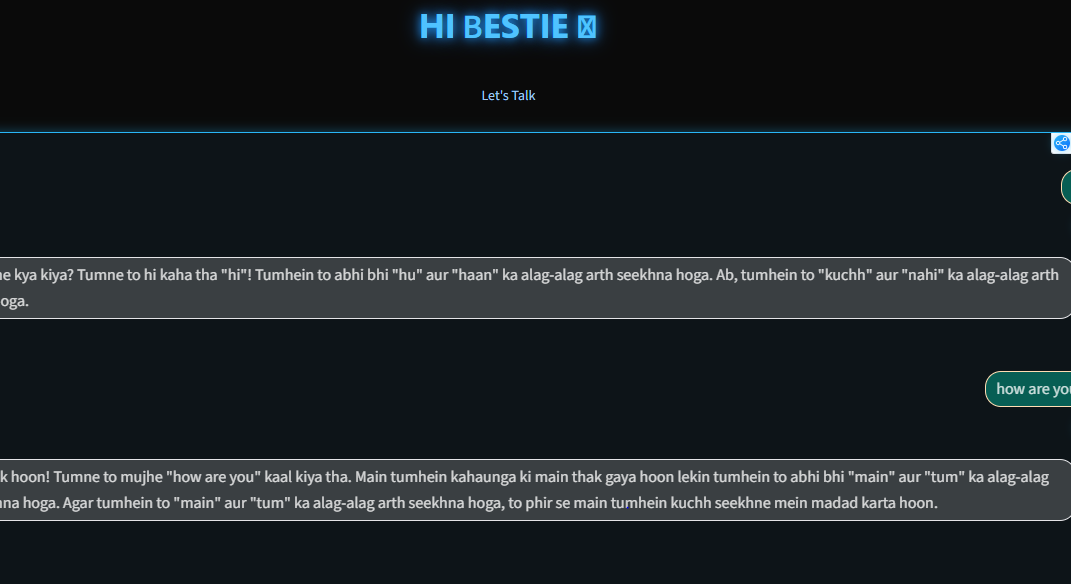
- Talks in a casual, warm, friend-like tone — no scripted sympathy or empathy phrases
- Identifies both sides of a situation fairly, including the user's own mistakes, delivered respectfully rather than as blame
- Always ends with a concrete, actionable piece of advice — never just validation
- Remembers past conversations through persistent memory, so context carries forward
- Notices underlying emotional or behavioral patterns without ever diagnosing
How we built it
- Frontend: Built with Gradio, styled with custom CSS for a dark, glowing black-and-blue theme and WhatsApp-style chat bubbles
- AI Engine: Powered by the Hugging Face Inference API running
meta-llama/Llama-3.1-8B-Instruct, guided by a carefully engineered system prompt that defines HI BESTIE's tone, values, and response rules - Memory: A lightweight JSON-based persistence layer stores conversation history so the assistant remembers context between sessions
- Hosting: Deployed on Hugging Face Spaces for free, public access
Challenges we ran into
- Getting the AI's tone to consistently avoid generic sympathy phrases while still feeling warm and human required multiple rounds of prompt refinement
- Balancing "honest" with "respectful" — making sure the AI could point out the user's own mistakes without ever sounding harsh or judgmental
- Navigating platform-specific deployment quirks (API authentication scopes, hardware tier requirements) while working within a completely free-tier budget
What we learned
- Prompt engineering is as much about defining what NOT to say as what to say
- Small UI details — like message bubbles and typing indicators — make an AI conversation feel dramatically more human
- Thoughtful persona design can meaningfully shift how "supportive" an AI feels, without relying on generic comfort language
What's next for HI BESTIE
- Expanding memory to recognize recurring patterns across multiple conversations
- Adding voice input/output for a more natural, friend-like interaction
- Fine-tuning a dedicated model on curated "honest friend" conversation data
- Building a mobile-friendly version for on-the-go support
Built With
- api
- gradio
- python

Log in or sign up for Devpost to join the conversation.