-
-
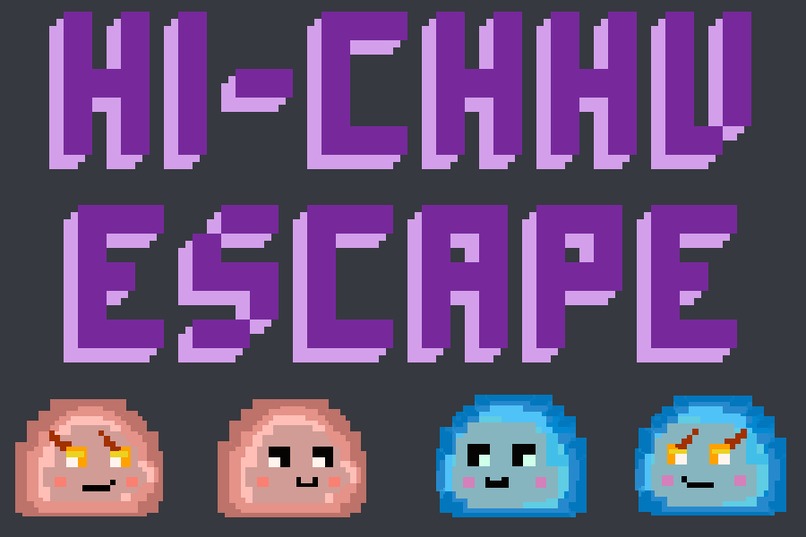
thumbnail
-

blue slime
-

pink slime
-

fire blue slime
-

fire pink slime





Inspiration
When we thought of "exploring the unknown", the first thing that came to mind were popular games such as Temple Run, Subway Surfers, or Luigi's Mansion: Dark Moon. We wanted to create a game, which encouraged quick thinking, where players with limited visibility had to complete a task that would otherwise be easy to solve.
What it does
Upon opening the game, the player is presented with a start screen, which instructs them to choose a slime to begin the game. The game features an alternate dimension that can be activated by flipping the switch on the start screen. In the alternate dimension, the slimes' appearance changes and the game difficulty increases. During gameplay, the slime navigates around the map based on the player's keyboard inputs. You'll notice that as the player moves, the character leaves behind a slime trail. The player is only able to see a 2.5 block radius around its current position and must use the paint trail to deduce where the portal out of the maze is located. A timer in the lower left corner records how much time has elapsed since the game began. Once the slime has escaped, a screen displays the player's time, along with a restart button that returns the player to the start screen.
How we built it
We used C++ and SFML to create our game. Using Board and Tile classes, we stored all of the attributes of our game map in a 2D vector and used conditional statements to print various images and sprites depending on the current state of the game. We also used a recursive backtracking algorithm to generate a random, valid maze for the player.
Challenges we ran into
We found that many of the challenges and limitations we encountered were born from our inability to execute ripe ideas with the resources we had. Instead of using resources that games developers may use such as proper game engines like Unity or any other gaming-oriented software, we made the best out of the resources we knew how to use and found common nodes to bridge our ideas together.
Accomplishments that we're proud of
As first time hackers, we're proud that we were able to create a functional product, research and implement a popular maze algorithm generator to create random mazes for our users. We also created all of the graphics and images in our game from scratch!
What we learned
Game development requires fine empathy skills. When collaborating with a group of peers, it is easy for decoherence to evolve from our ability to create ideas, but lack the immediate knowledge to implement them. Thus, in moments when we want to truly understand the way we want to tackle the problem as an individual, we also have to struggle with communicating our hypotheses. No one ever knows what is going on in your head. It is your job as a teammate to listen thoroughly and understand each other's struggles and make each other's jobs easier.
What's next for Hi-Chhu Escape
In the future, we'd like to add a multiplayer option, where users can race against each other to determine who can escape more quickly, and more features, such as special attributes possessed by each slimes and enemies that will pursue the slimes. We also wanted to store and display high scores for the game, but seemed to be defeated by time.
GitHub repo link
https://github.com/EmelyChhu/Hi-Chhu-Escape
Team Leader
Emely Chhu (Discord: emely#9632)
Built With
- c++
- sfml


Log in or sign up for Devpost to join the conversation.