Inspiration
Ethereum checkpoint sync allows a beacon node to start significantly faster than replaying the chain from genesis. However, a node operator commonly obtains checkpoint data from a centralized HTTP provider.
This creates an important security and availability question: how can a user obtain checkpoint data from providers that are not trusted to choose the chain or alter the checkpoint?
BeaconBoot was inspired by our work tracing Lighthouse from client startup, through its HTTP and P2P networking stacks, task scheduling system, BeaconProcessor, and finally BeaconChain state import.
What it does
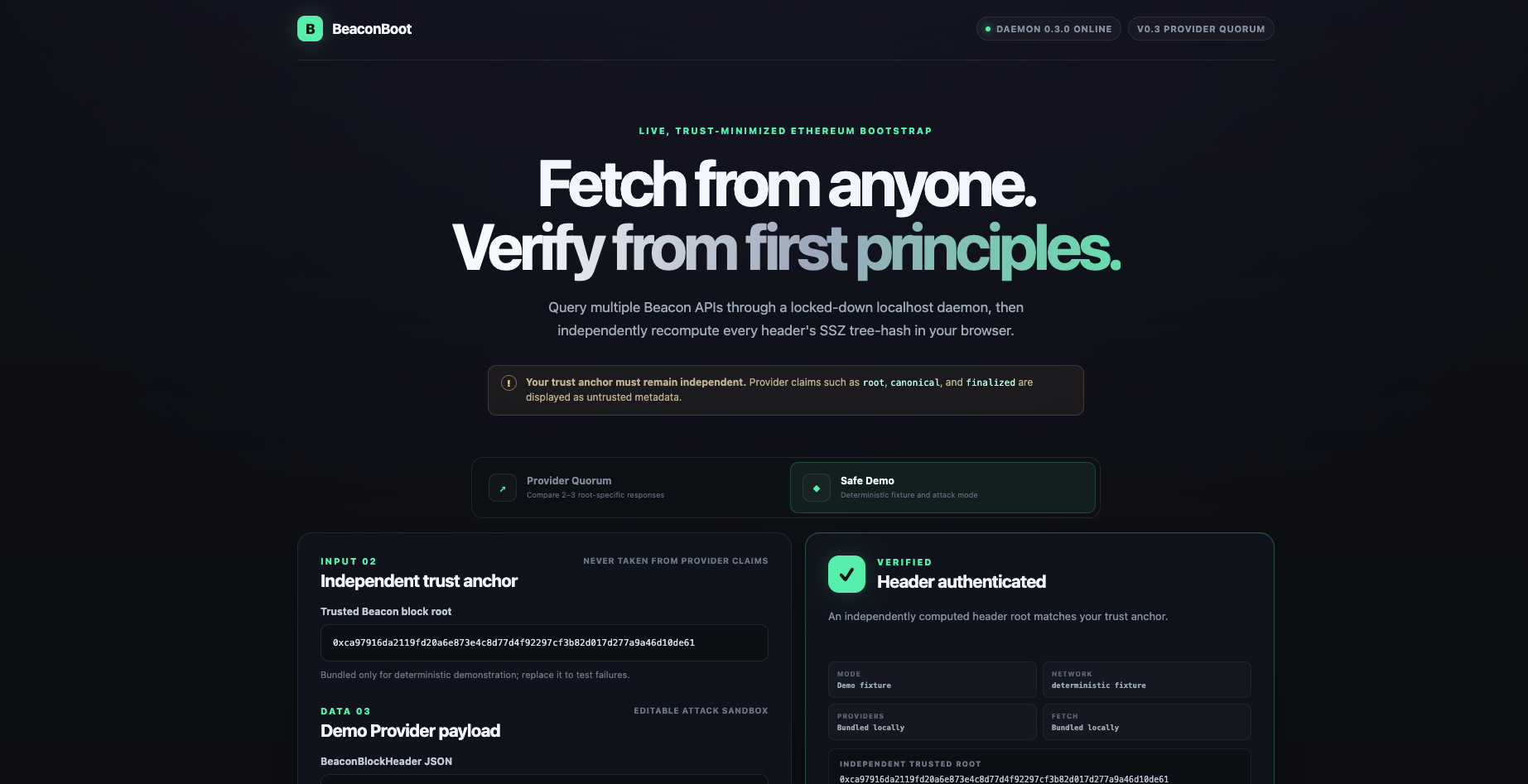
BeaconBoot starts from an externally authenticated finalized beacon block root.
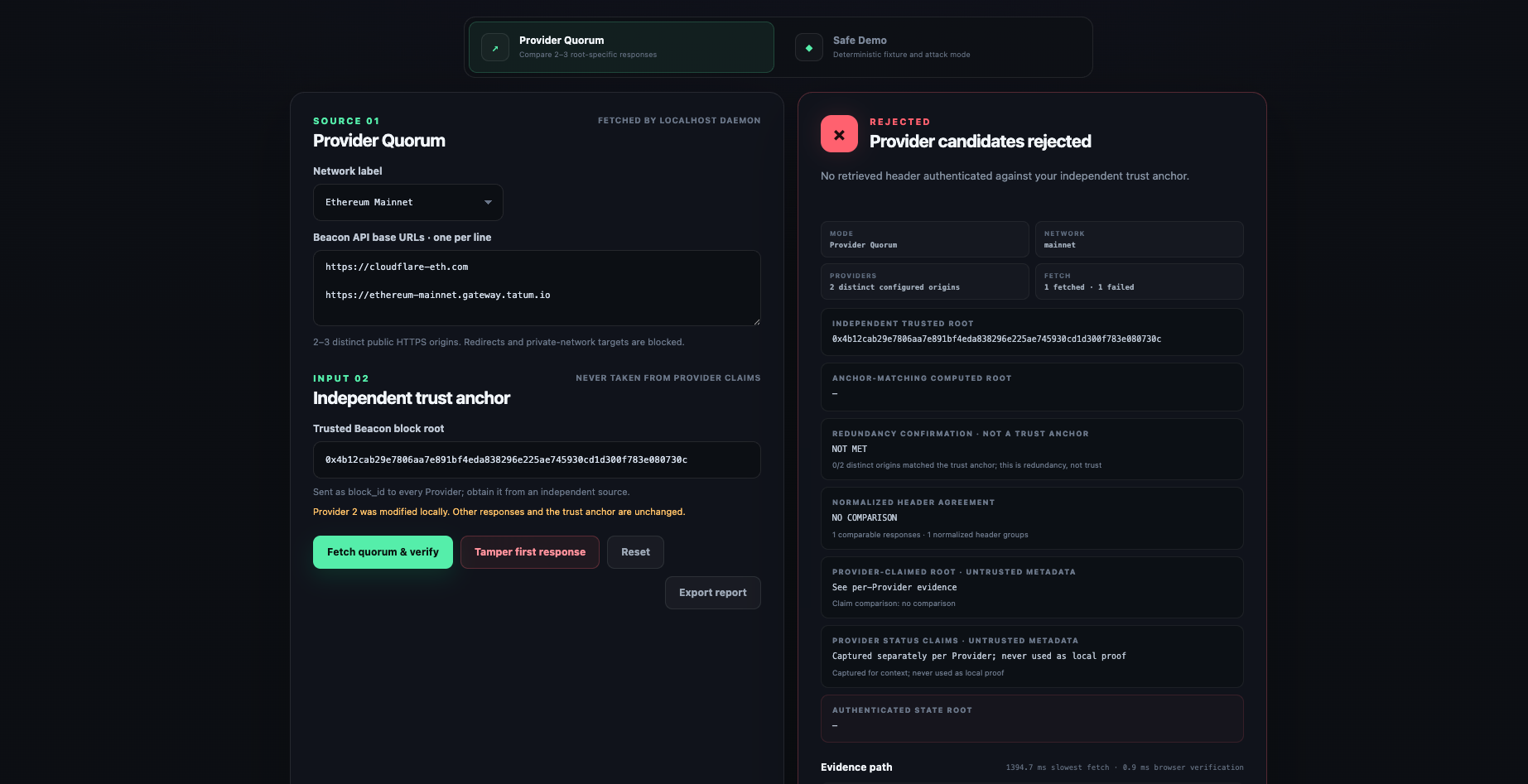
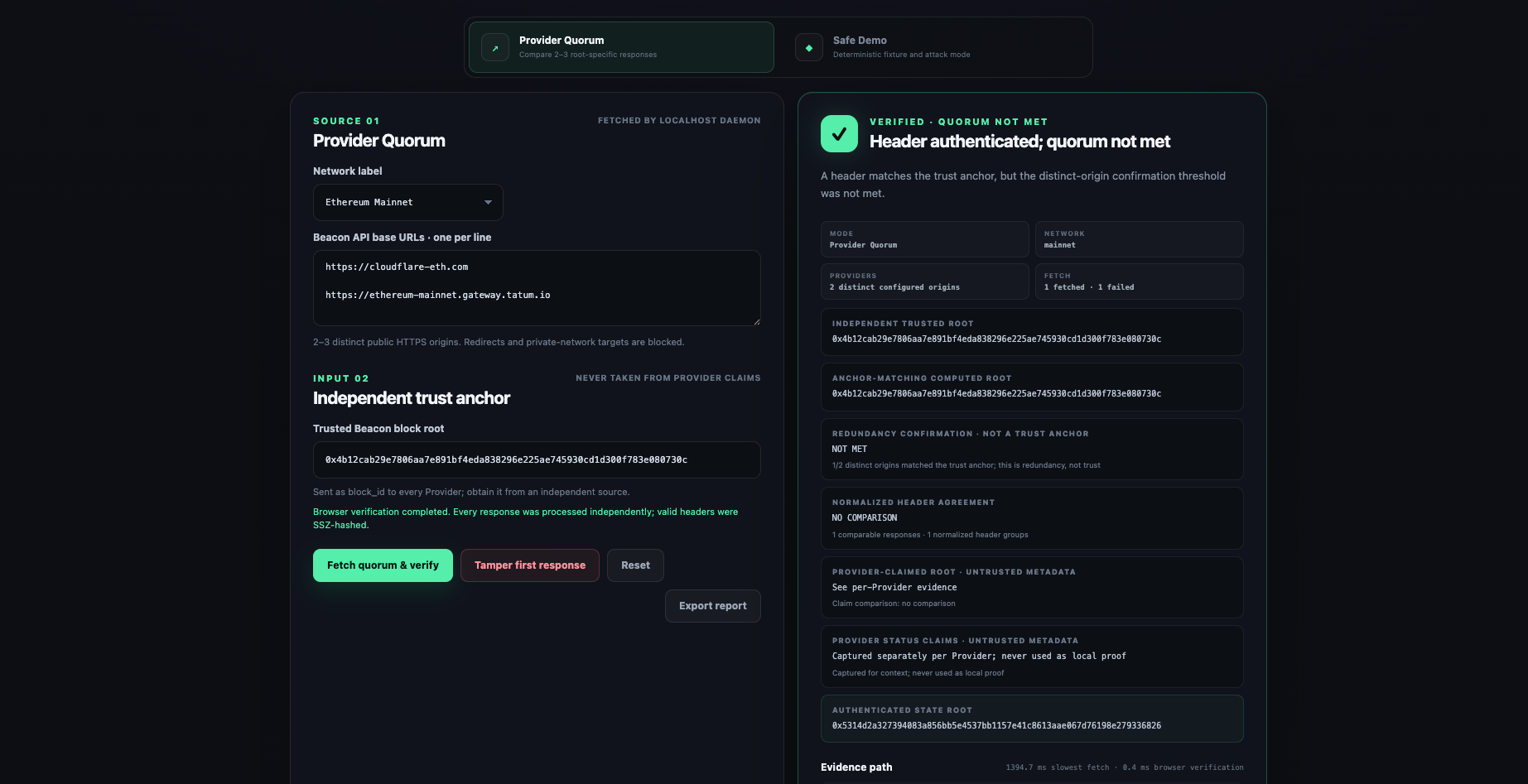
The prototype accepts a BeaconBlockHeader response from an untrusted provider, computes its SSZ tree-hash root locally, and compares it with the trusted block root. Only a matching header can produce an authenticated state root.
The demo also allows users to tamper with fields such as state_root or body_root. Any mutation changes the computed block root and is rejected.
The provider is therefore trusted for availability, not correctness.
How we built it
The current browser prototype implements the SSZ tree-hash computation for the five-field BeaconBlockHeader:
- Encode
slotandproposer_indexas little-endian SSZ chunks. - Add
parent_root,state_root, andbody_root. - Pad the container to eight leaves.
- Merkleize the leaves using SHA-256.
- Compare the computed root with the externally trusted finalized root.
The application is built as a static TypeScript application using the Web Crypto API, allowing it to run without a trusted backend.
The architecture is designed to integrate with Lighthouse. A future local bootstrap controller will verify block and state data from several providers, expose only verified checkpoint data through a localhost-compatible endpoint, and start Lighthouse using that local endpoint.
Challenges
The most important challenge was defining the trust boundary correctly.
A decentralized provider network does not remove the need for a trusted starting root. BeaconBoot does not allow a provider to select that root. It begins with a root authenticated externally, eventually by an Ethereum light-client trust chain.
We also learned that a complete verified BeaconBlockHeader already authenticates its state_root. A separate state-root field proof does not add security if the complete header is already available.
Another architectural challenge is that Lighthouse's normal P2P network starts after BeaconChain construction, while decentralized checkpoint acquisition must happen before the chain exists.
What we learned
We learned how Lighthouse separates network polling, semantic routing, task scheduling, and consensus-state mutation:
- libp2p drives network protocols through polling.
- NetworkService connects libp2p with upper-layer channels.
- Router classifies gossip and RPC events.
- NetworkBeaconProcessor wraps work into executable tasks.
- BeaconProcessor controls priority and worker concurrency.
- BeaconChain performs verification, fork-choice updates, and database commits.
This separation helped us design the verifier as a transport-independent component.
Current prototype
The submitted v0.1 prototype verifies BeaconBlockHeader responses and demonstrates deterministic rejection of corrupted provider data.
It does not yet claim to download and verify a complete BeaconState or automatically launch Lighthouse.
What's next
Over the next development phase we will:
- Query multiple checkpoint providers concurrently.
- Download the exact checkpoint block and BeaconState.
- Perform fork-aware SSZ decoding.
- Verify
hash_tree_root(state) == authenticated_state_root. - Produce a typed
VerifiedCheckpointBundle. - Serve the verified bundle through a localhost checkpoint API.
- Launch Lighthouse with the verified local endpoint.
- Investigate a bootstrap-only P2P transport and light-client trust-root acquisition.
Built With
- api
- beacon
- consensus
- crypto
- css3
- ethereum
- github
- html5
- javascript
- layer
- lighthouse
- merkle
- sha-256
- ssz
- trees
- typescript
- vite
- vitest
- web

Log in or sign up for Devpost to join the conversation.