-
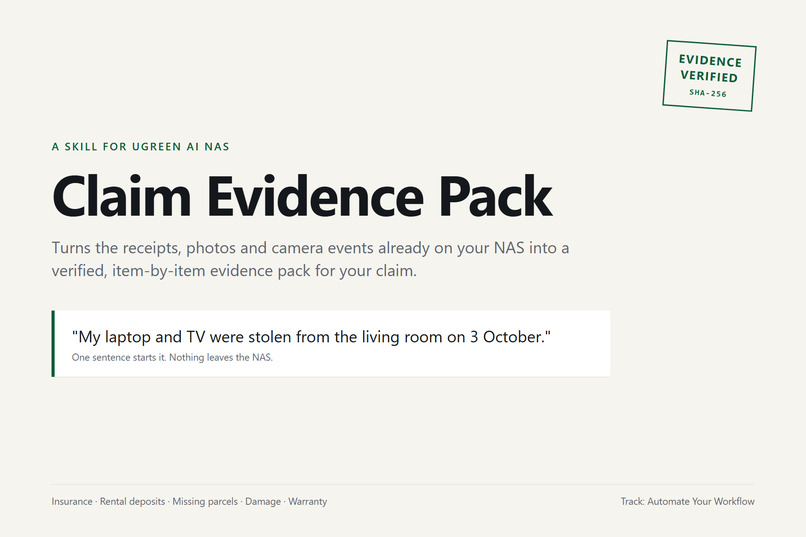
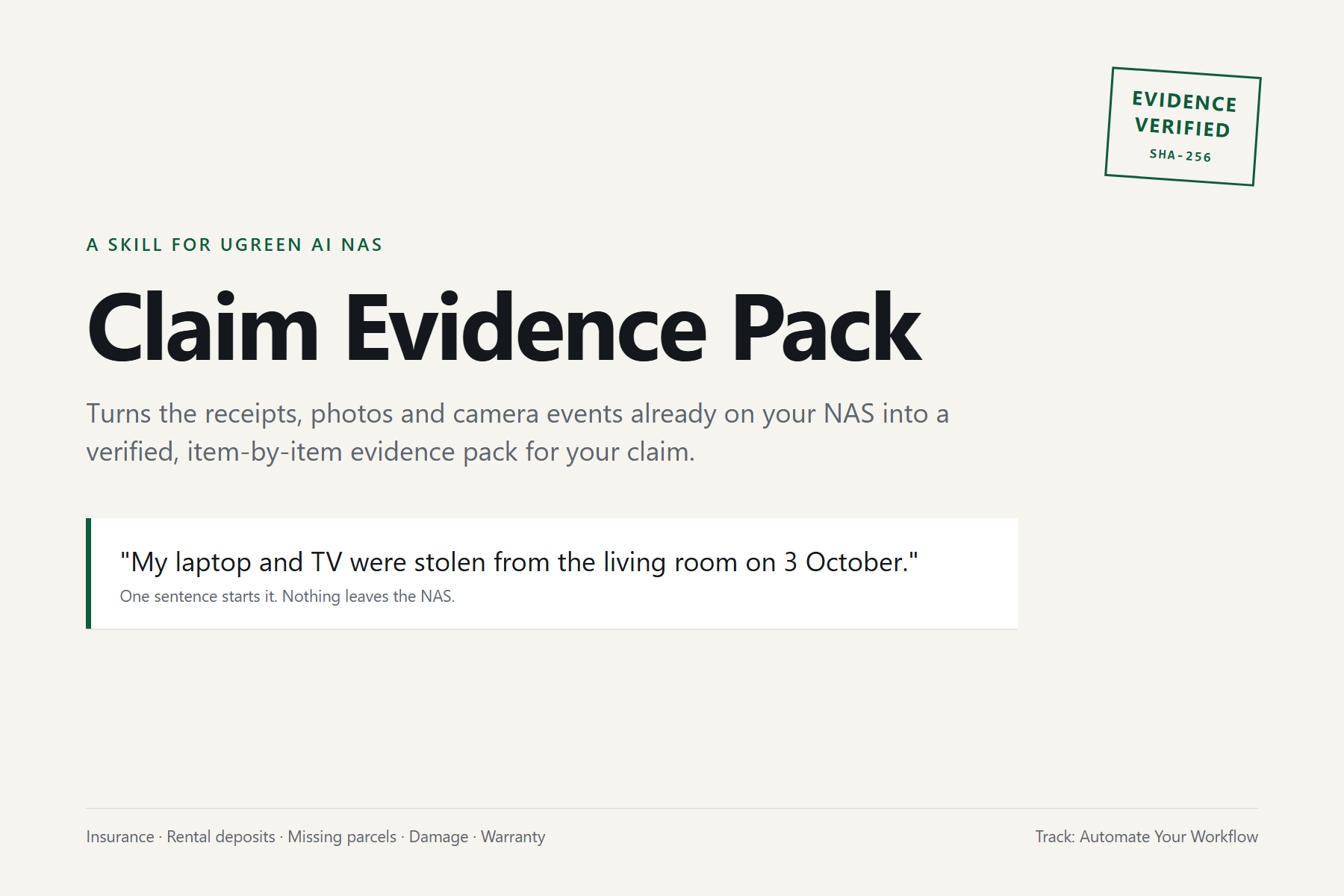
Your NAS already holds the proof. This Skill finds it.
-
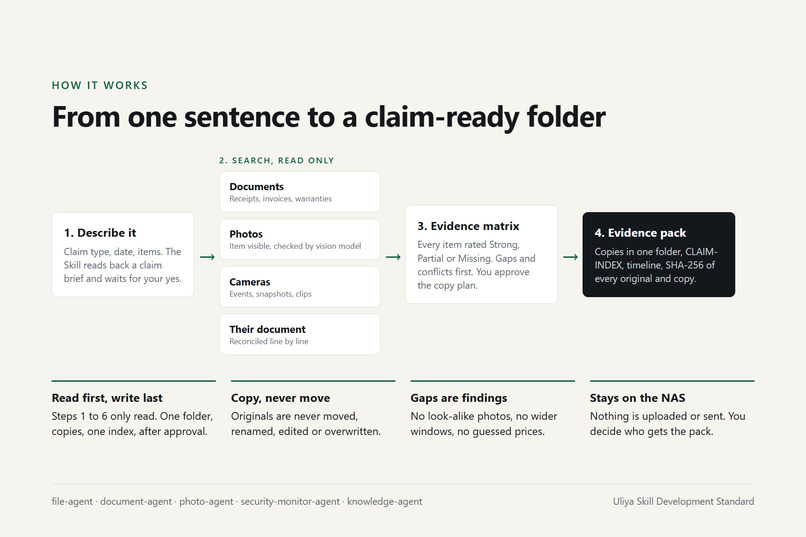
One sentence in, a verified evidence folder out.
-
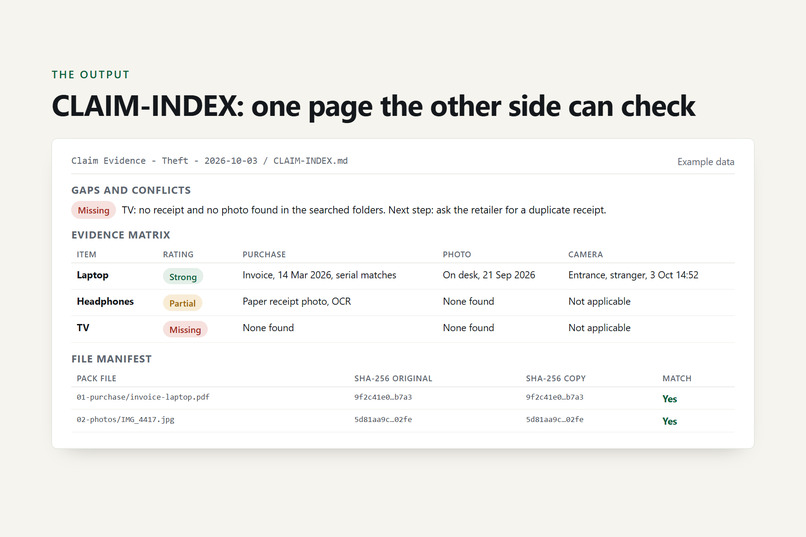
Every item rated, every gap shown, every copy hash-checked.
-
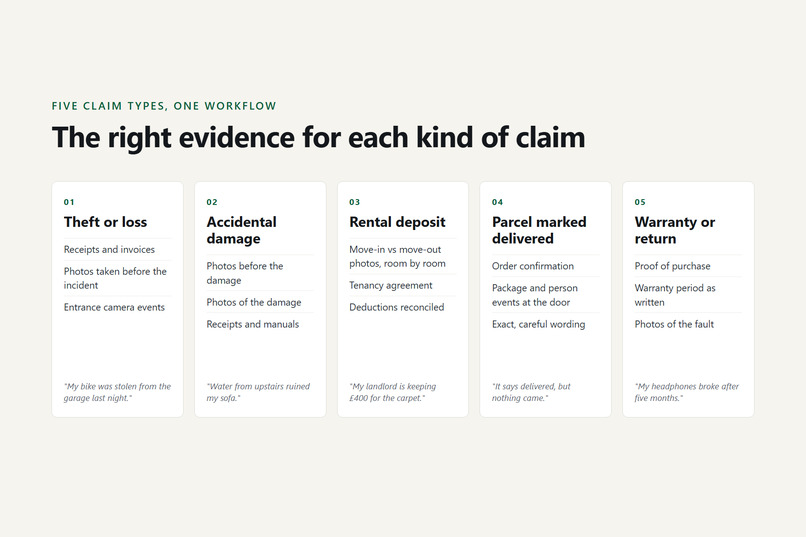
Five claim types, one workflow.
Inspiration
When something goes wrong (a burglary, a landlord keeping your deposit, a parcel marked "delivered" that never came), the other side always asks for the same thing: proof. Proof that you owned it, what it cost, and when it happened.
That proof usually already exists on your NAS:
- the receipt is sitting in a downloads folder,
- a holiday photo happens to show the TV,
- the door camera caught the courier, or didn't.
Finding it by hand takes hours, at the worst possible moment, and claims are often refused because people can't produce it.
Claim Evidence Pack turns the data you already own into the proof you need.
What it does
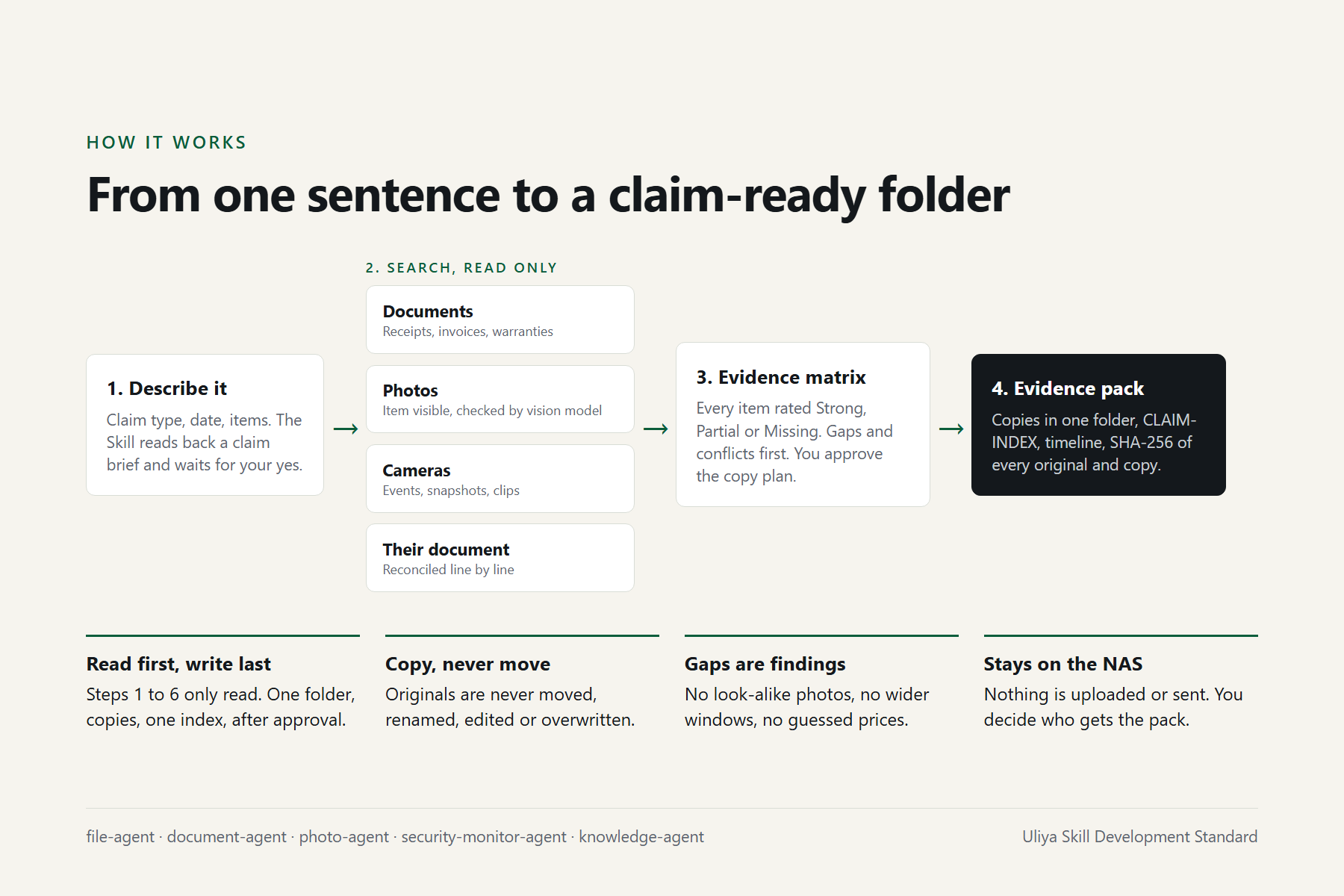
You describe the incident in one sentence:
"My laptop and TV were stolen from the living room on 3 October."
Claim Evidence Pack then:
- Finds proof of purchase: receipts, invoices, order confirmations and warranty cards, including photographed paper receipts read with OCR.
- Finds proof of ownership or condition: photos that show each item, confirmed by the NAS vision model, never a look-alike.
- Checks the cameras: events in the incident window, with snapshots and clips.
- Reconciles your evidence against the other side's document, such as a landlord's deduction letter or an insurer's claim list.
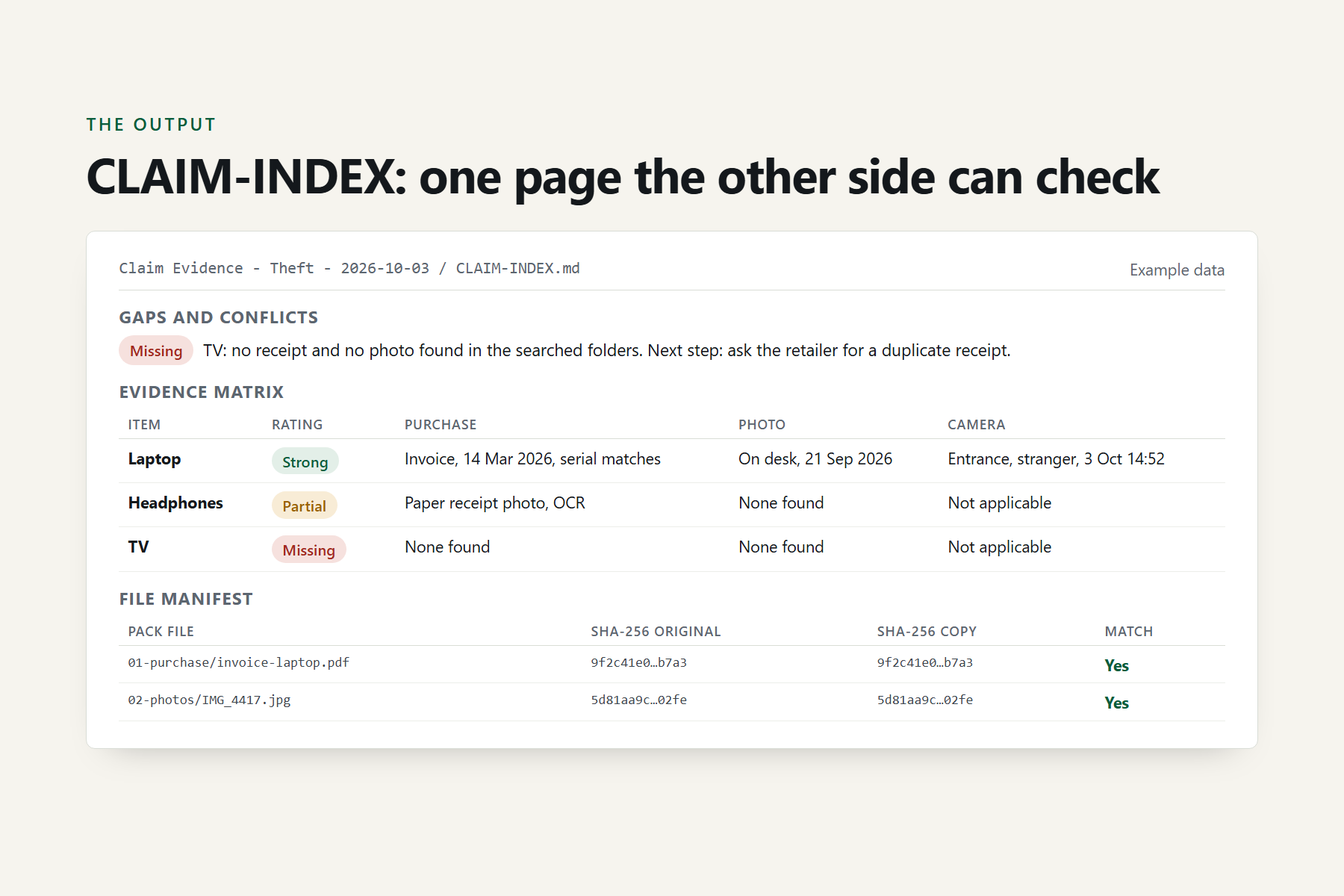
- Rates every item as Strong, Partial or Missing, with the gaps listed first.
- After you approve, copies (never moves) everything into one folder with a
CLAIM-INDEXand a SHA-256 fingerprint of every original and every copy.
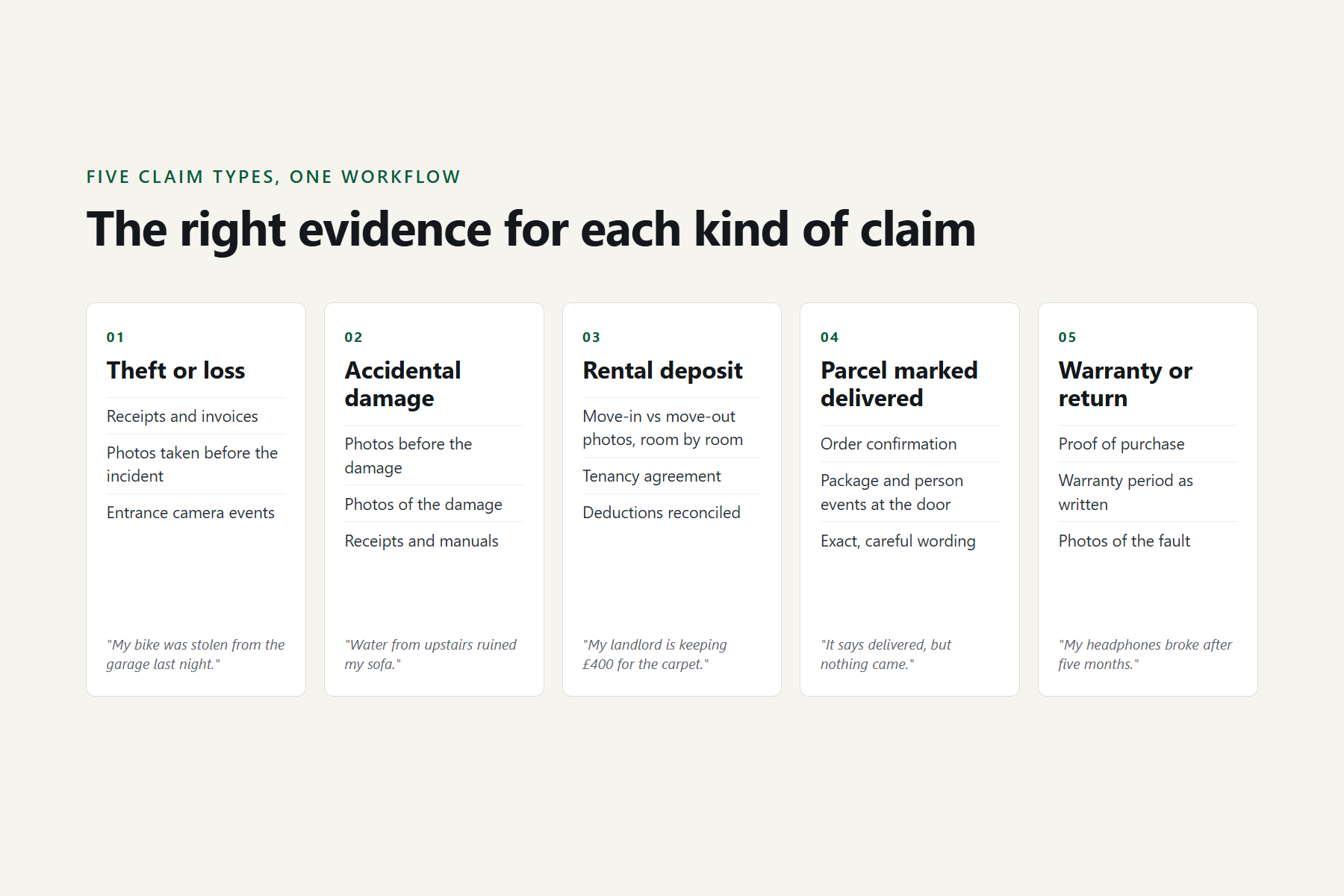
Five claim types, one workflow
| Claim type | Key evidence |
|---|---|
| Theft or loss | Receipts + photos before the incident + camera events |
| Accidental damage | Photos before and after + receipts |
| Rental deposit dispute | Move-in vs move-out photos, room by room + tenancy agreement |
| Parcel "delivered" but missing | Order confirmation + entrance camera package events |
| Warranty or return | Proof of purchase + warranty period + photos of the fault |
How I built it
Claim Evidence Pack is an orchestration Skill built to the Uliya Skill Development Standard with UGREEN's UGOS Skill Creation Tool.
The parent Skill delegates self-contained instructions to five registered NAS experts:
| Expert | Used for |
|---|---|
file-agent |
Search scope, finding files, stat, sha256sum, creating the folder, copying |
document-agent |
Extracting receipts and invoices, reconciling against the other side's document |
photo-agent |
Photo search, metadata, vision-ocr, vision-vlm |
security-monitor-agent |
Cameras, event timeline, event snapshots and clips |
knowledge-agent |
Saving CLAIM-INDEX |
Design rules:
- Each step receives only the real results of the step before it.
- Steps 1 to 6 only read. The only writes (one folder, copies with no overwrite, one index) happen after the user approves the plan, through the NAS approval gateway.
- All five delegation states (
completed,failed,cancelled,waiting_user,waiting_approval) are handled, and an incomplete run is reported as a partial pack. - The package passes the kit's static checker with 0 errors and 0 warnings.
Challenges I ran into
- Honest evidence. An AI that fills gaps is dangerous in a claim. The Skill treats a missing receipt as a finding, never substitutes a similar photo or widens a search window, and words camera results precisely: > "No event recorded by this camera in this window", never "the parcel was not delivered".
- Proving nothing was altered. Every copy is hash-checked against its original, and the hashes go into the index so the recipient can verify them.
- One workflow, five claim types. Each type needs different time windows: a deposit dispute pairs move-in and move-out photos room by room, and a damage claim needs before and after photos. These live in claim-type playbooks, so the core workflow stays the same.
Accomplishments that I'm proud of
- It combines five of UGREEN AI NAS's six capability areas (files, documents, albums, surveillance and knowledge) in one workflow.
- Nothing leaves the NAS, and nothing is sent. You review the pack and decide who gets it.
- Every pack is verifiable: item-by-item ratings, a dated timeline, a search record and SHA-256 hashes.
What I learned
The most useful thing an AI agent can do with private data is often not to generate anything: it should assemble the data carefully and be exact about what it did not find.
What's next for Claim Evidence Pack
- Testing on a real UGREEN AI NAS: recognition of household items, OCR on paper receipts, and camera-evidence export.
- A proactive "home inventory" mode that builds your evidence before anything goes wrong.
- Translating the index for claims made in another language.
Built With
- markdown
- ugos
- ugreen
- uliya
