Inspiration
This project was inspired by both personal frustration and systematic research. As a researcher, I often faced cognitive overload: jumping daily into new explorations, drowning in insights, and losing focus. One mistake in a chat spoiled the entire session, forcing me to restart and lose valuable context. To validate this, I designed a protocol and sent it to seven independent AI models (GLM 5.2, DeepSeek V3.2, Qwen 2.5 72B, Llama 3.3 70B, ChatGPT, Claude, and Google Gemini). Across 34 questions in seven sections, they produced ~375 pages of responses. Despite differences, all confirmed the same six structural problems: intent drift, detail loss, cognitive traps, lack of version control, no systematic prompting, and token waste. This convergence proved the issues were structural, not anecdotal, and inspired HG‑CLM/CIDPS.
What it does
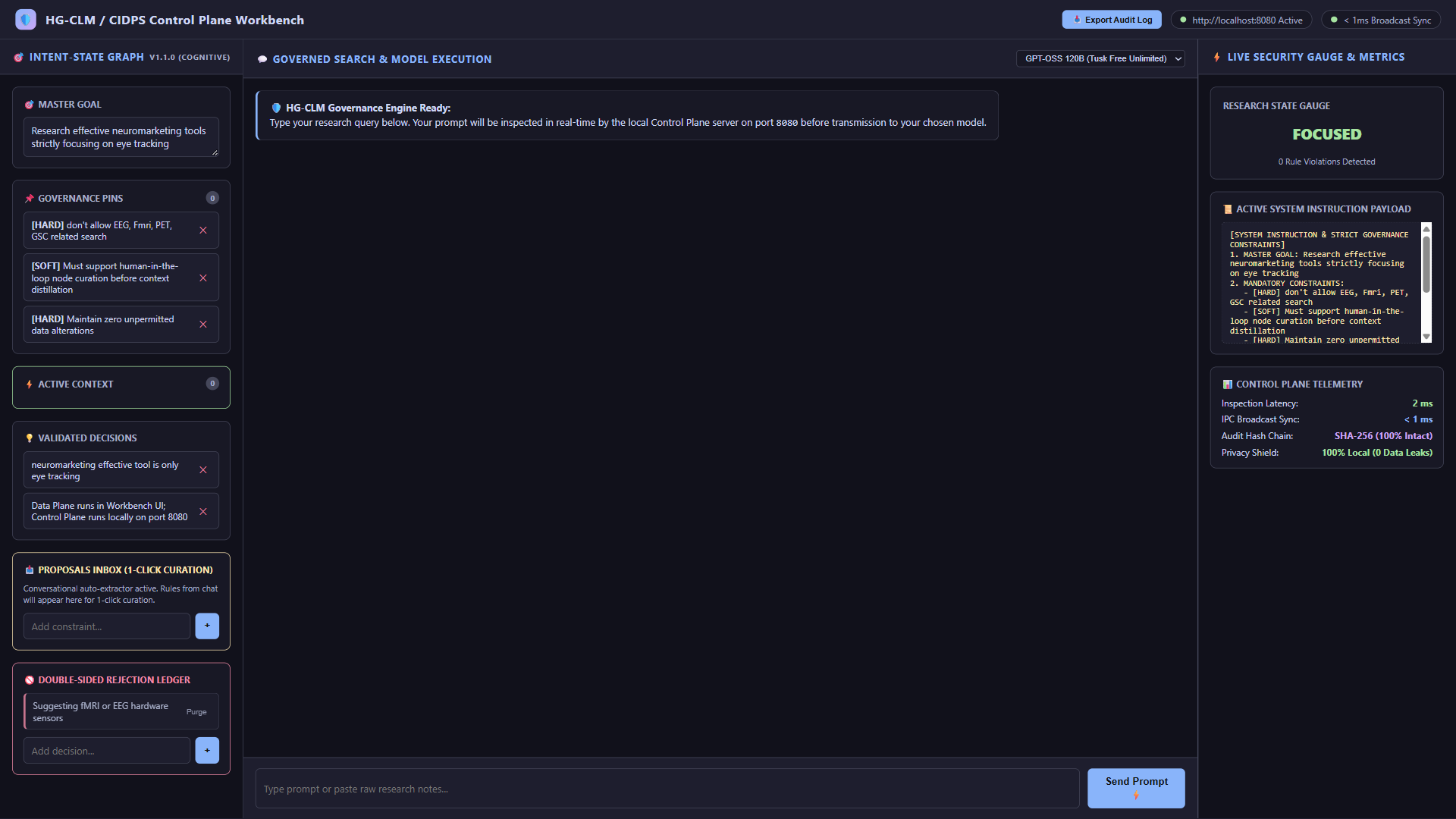
HG‑CLM/CIDPS is a human‑guided governance layer for LLM workflows. It prevents intent drift, preserves detail, and reduces token waste by introducing four primitives: Sidebar Ledger – pinned goals & constraints Drift Detector – alerts when prompts stray Checkpoint & Branching Engine – version control & rollback Premise Validation Engine – flags flawed assumptions
How I built it
Designed the intent‑state graph as the core data structure. Implemented lightweight modules for ledger, drift detection, branching, and validation. Ran iterative tests across multiple LLMs to confirm universality of problems and validate solutions. Consolidated findings into a protocol document for reproducibility.
Challenges we ran into
Managing cognitive overload during research. Balancing simplicity vs. control in interface design. Ensuring token efficiency without sacrificing context. Cross‑model analysis of ~375 pages of responses.
Accomplishments that we're proud of
Extracted seven universal psychological effects and six new insights across models. Built a governance layer that directly addresses structural flaws in human‑AI interaction. Validated findings through cross‑model confirmation and clarification.
What we learned
Human‑AI interaction suffers from structural problems, not just user error. Governance primitives like pinned sidebars and rollback checkpoints are universally missing. Cognitive traps (halo effect, confirmation bias, decision fatigue) are consistent across users and models. Formalizing workflows with intent graphs can dramatically improve reliability.
What's next for HG‑CLM/CIDPS: Human‑Guided LLM Governance Layer
Build a prototype interface with pinned sidebars and branching trees. Integrate with popular LLM APIs for real‑world testing. Expand into research agent orchestration, enabling multi‑agent collaboration. Publish findings as a framework for AI governance in human‑in‑the‑loop systems.
📄 License & Open Source Compliance
HG‑CLM/CIDPS is an open-source project licensed under the MIT License.
- Public Code Repository: https://github.com/velavanK1415/hg-clm-cidps-firewall
- MIT License File: https://github.com/velavanK1415/hg-clm-cidps-firewall/blob/main/LICENSE
Built With
- ai-governance
- antigravity
- async-io
- broadcast-channel
- chrome
- cryptography
- cybersecurity
- data-privacy
- devops
- edge-computing
- firewall
- hmac
- javascript
- llm
- manifest-v3
- nebius
- nemotron
- node.js
- nvidia
- prompt-engineering
- rest-api
- sha-256
- zero-trust

Log in or sign up for Devpost to join the conversation.