
HeyEnso
Inspiration
Marketing teams are expected to understand customers, competitors, market trends, creators, and campaign performance all at once. In practice, this work is fragmented across search engines, app stores, social platforms, spreadsheets, analytics tools, and advertising dashboards.
We wanted to build something that feels less like another dashboard and more like a capable marketing team.
HeyEnso is inspired by the idea that every business should have access to specialized teammates who can investigate problems, gather evidence, explain what they found, and help turn insights into action. Instead of asking users to become research experts, HeyEnso lets them work with a team of AI agents through a simple conversational experience.
What We Built
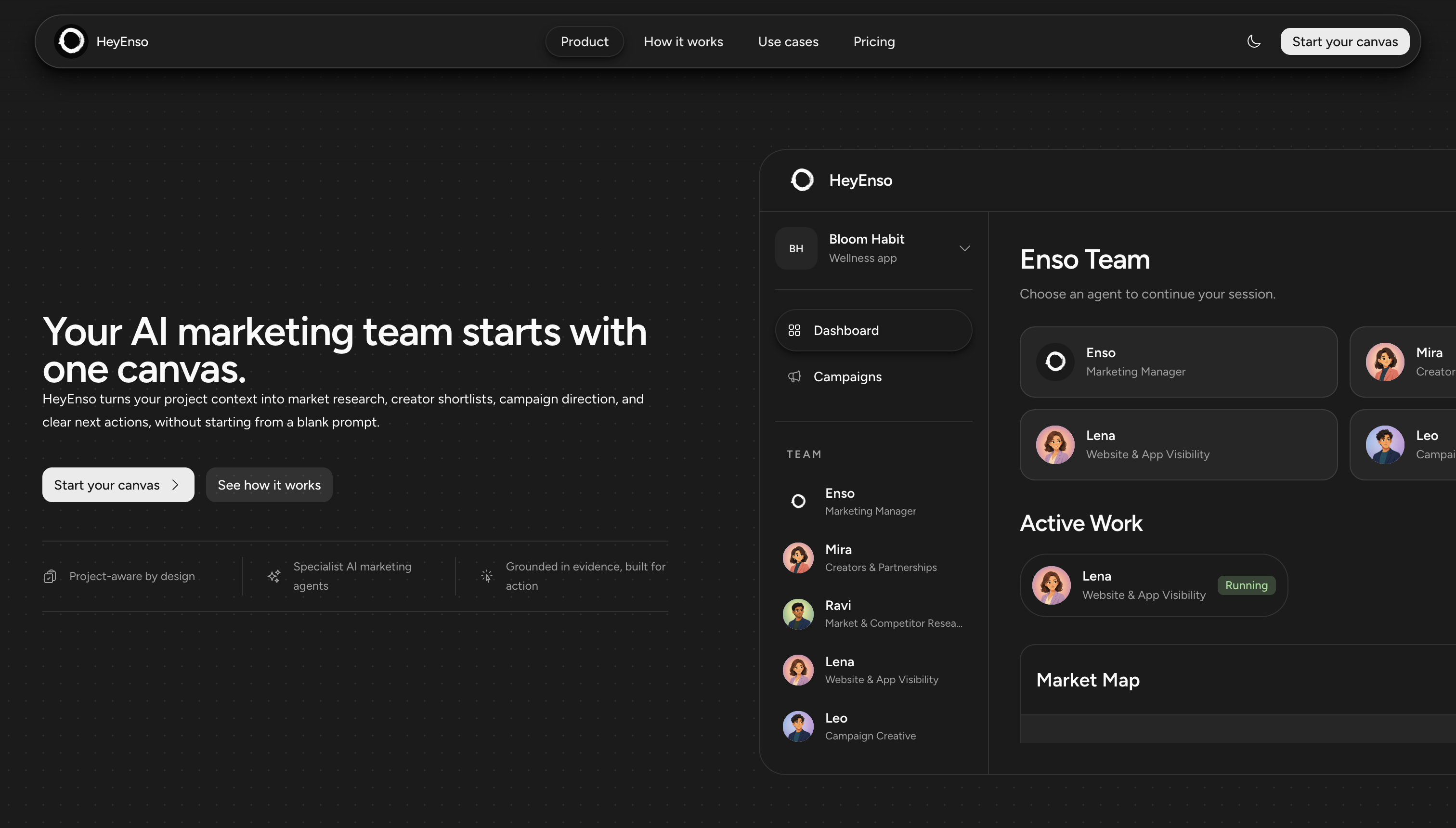
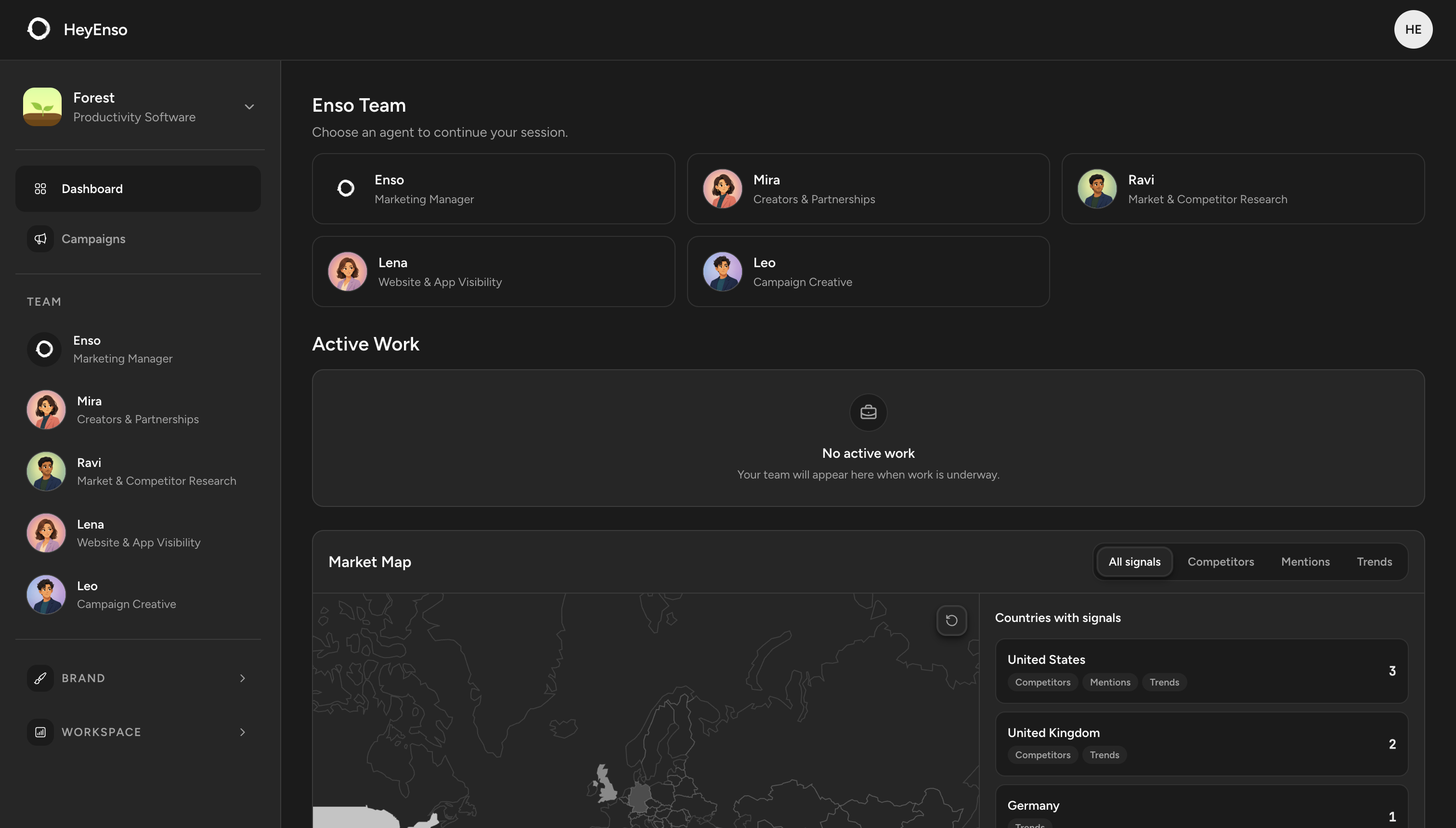
HeyEnso is an AI-powered marketing team made up of specialized agents:
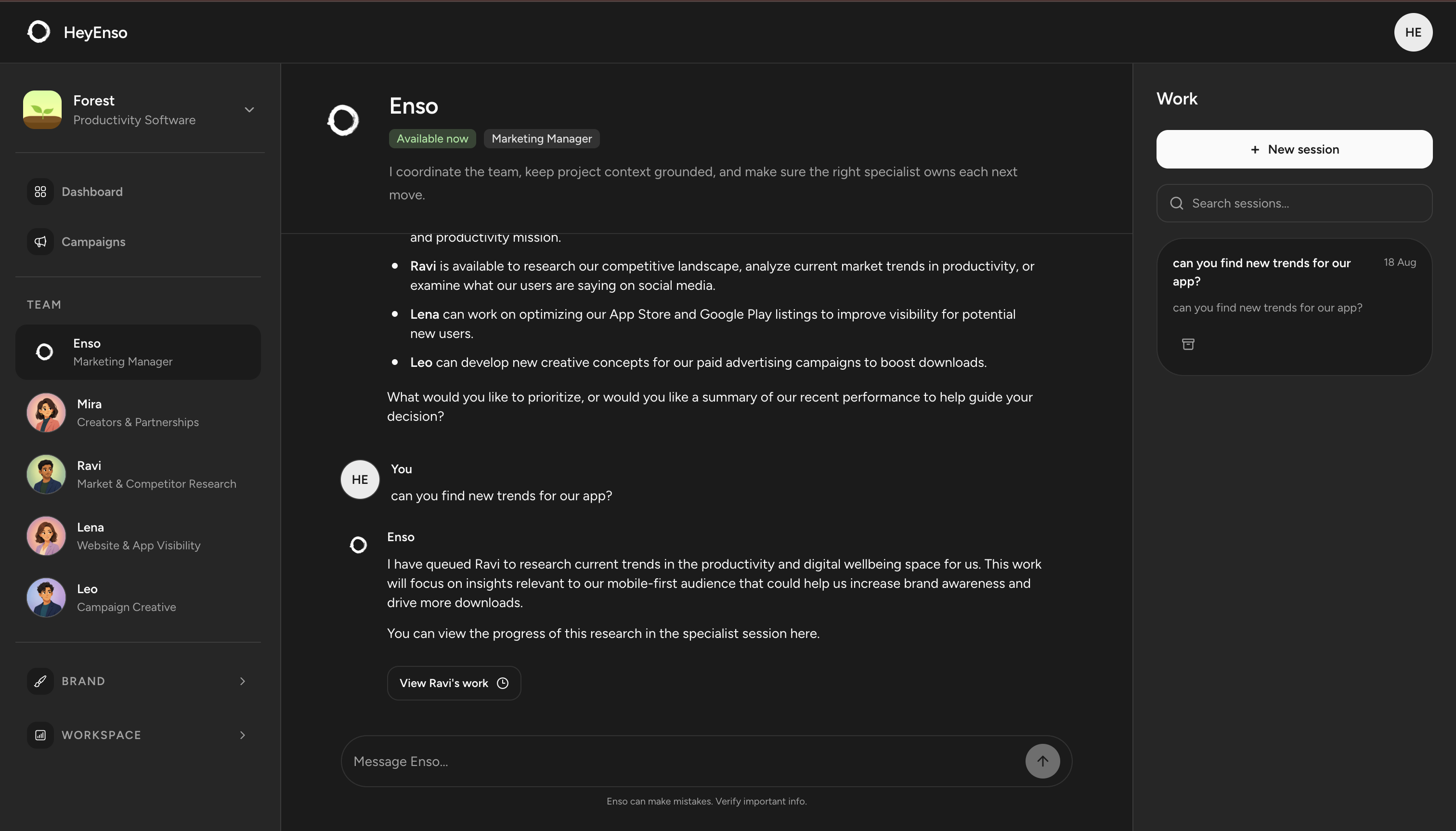
- Enso acts as the marketing manager and coordinates work.
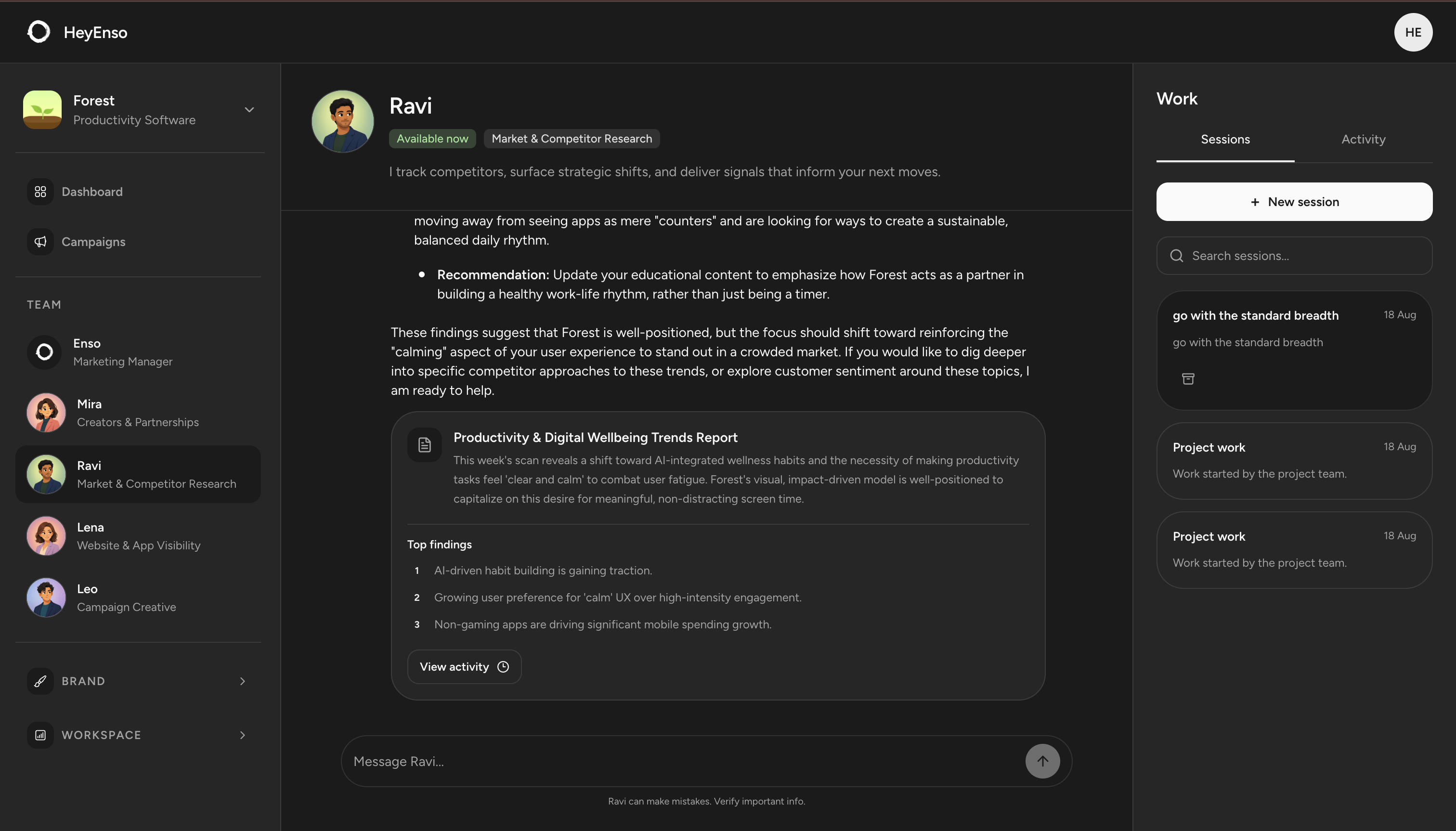
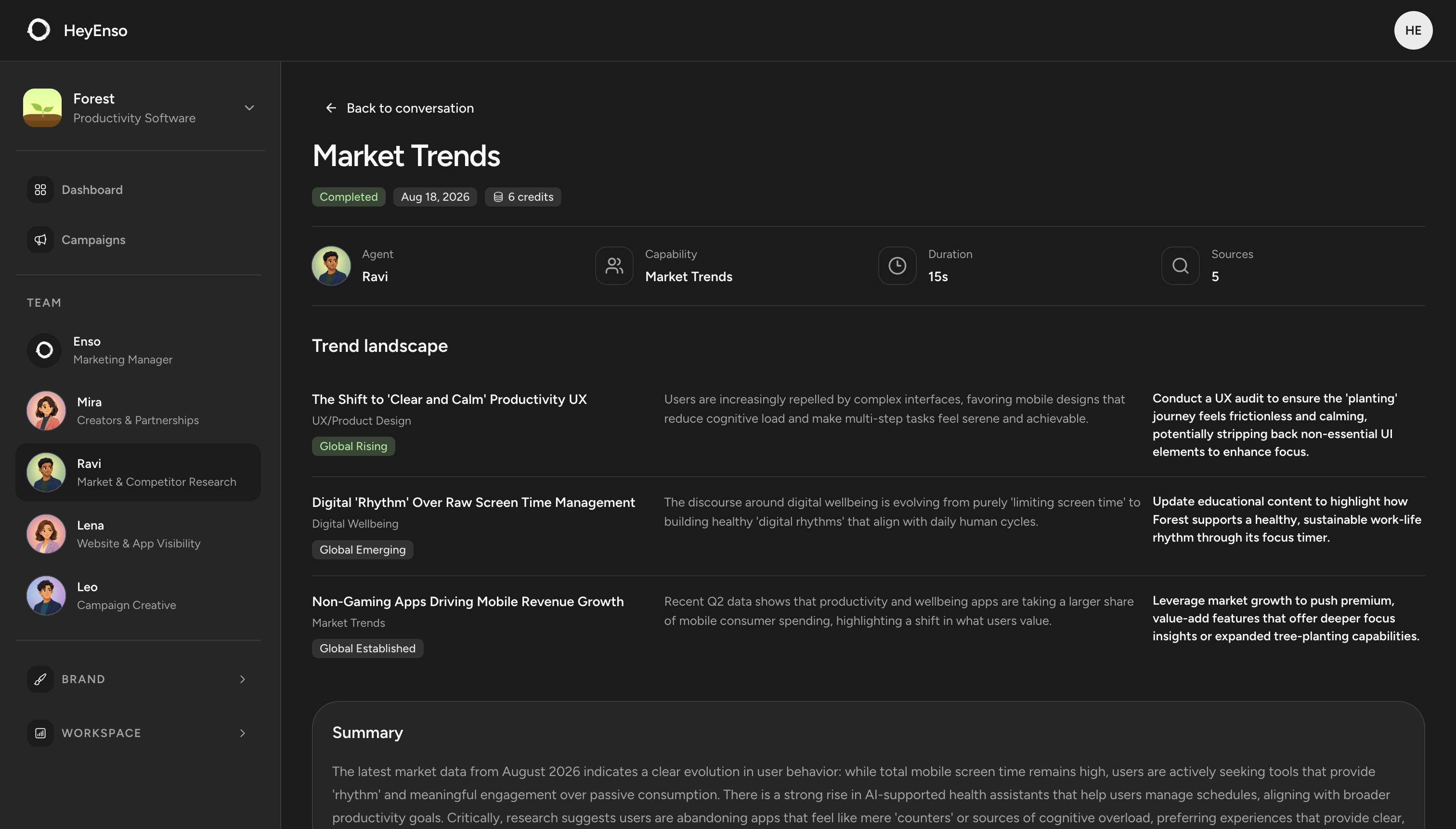
- Ravi researches competitors, market trends, and customer sentiment.
- Lena analyzes website and app listing visibility.
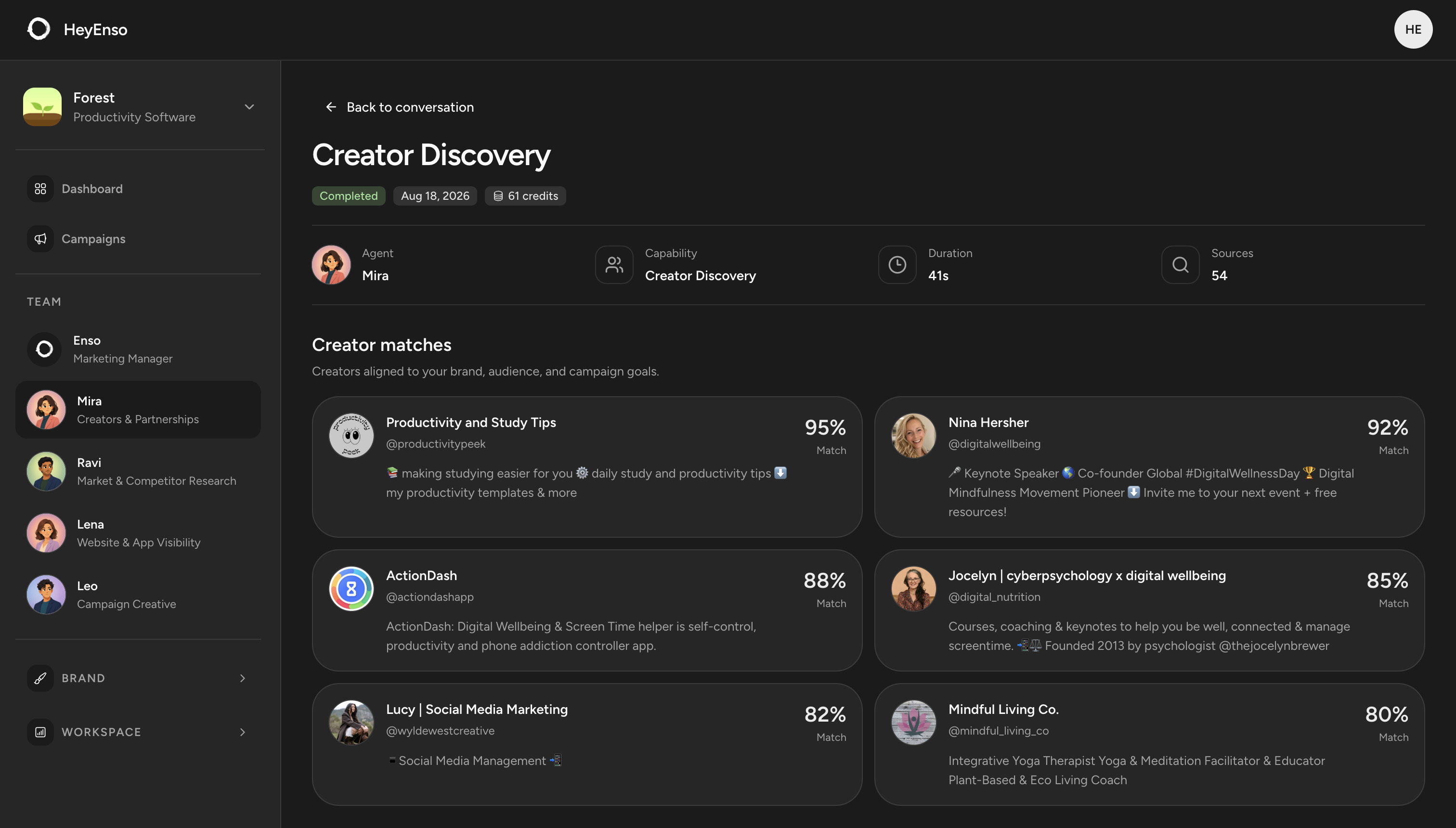
- Mira discovers relevant creators and partnership opportunities.
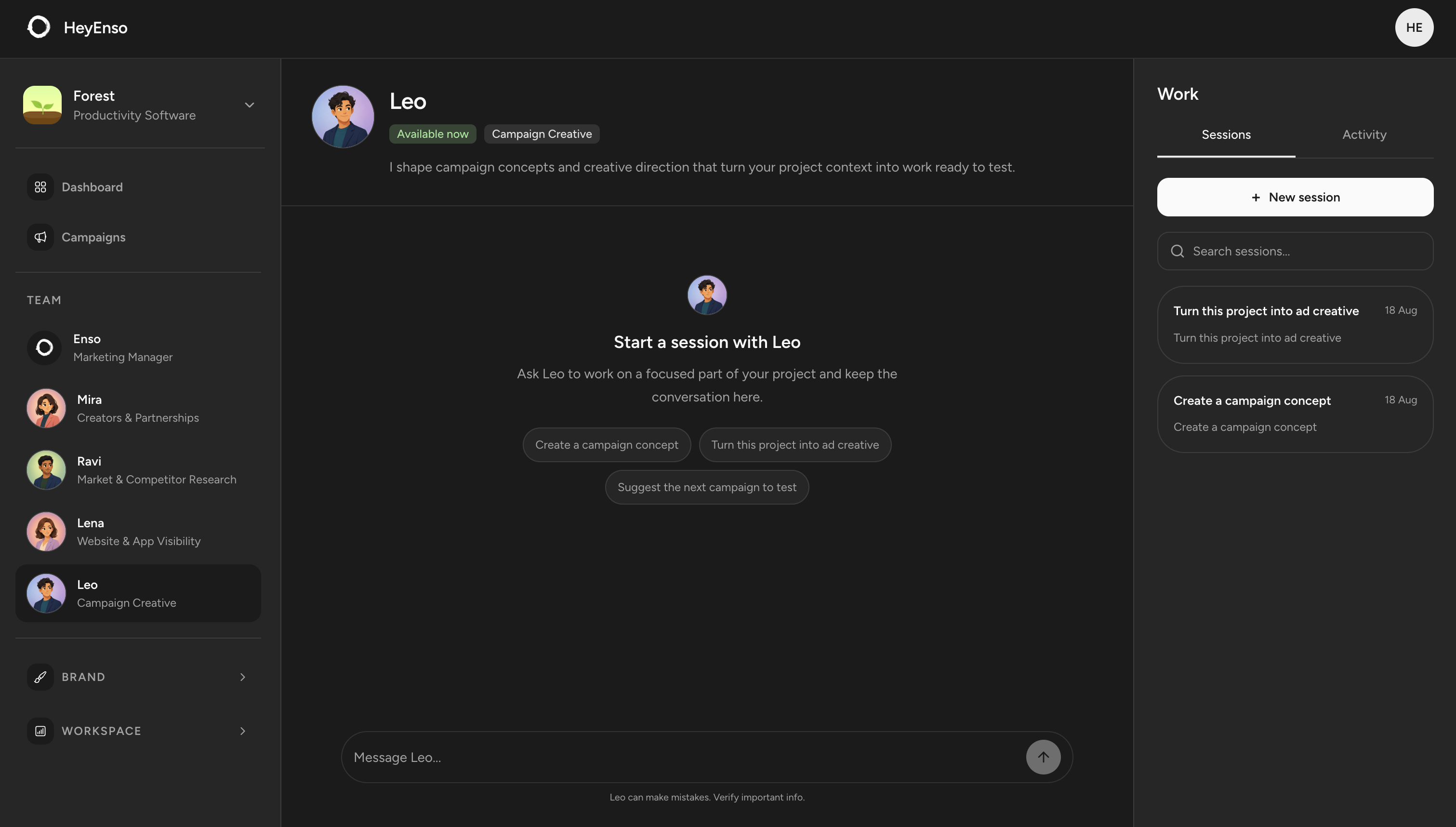
- Leo develops campaign creative concepts.
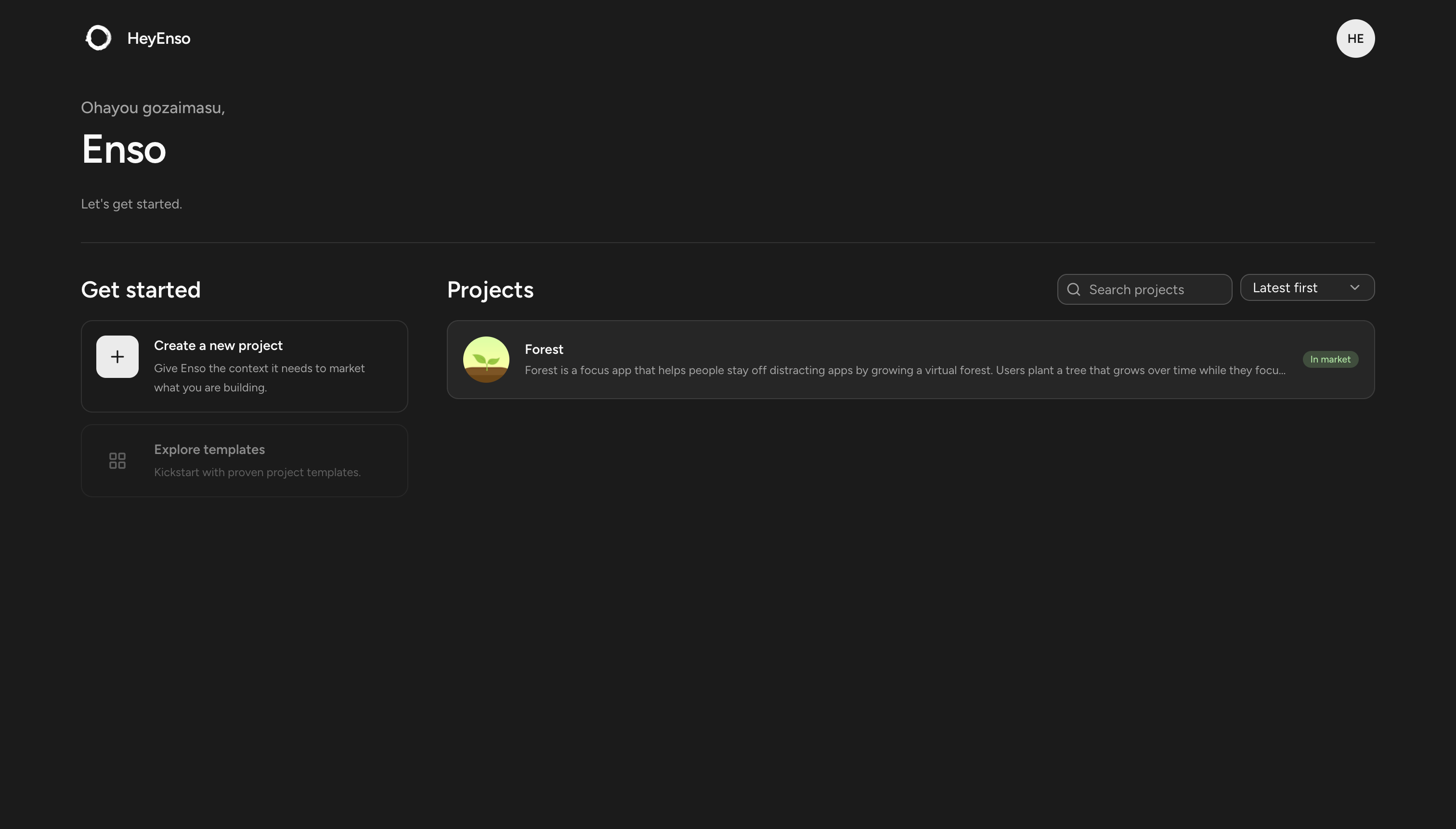
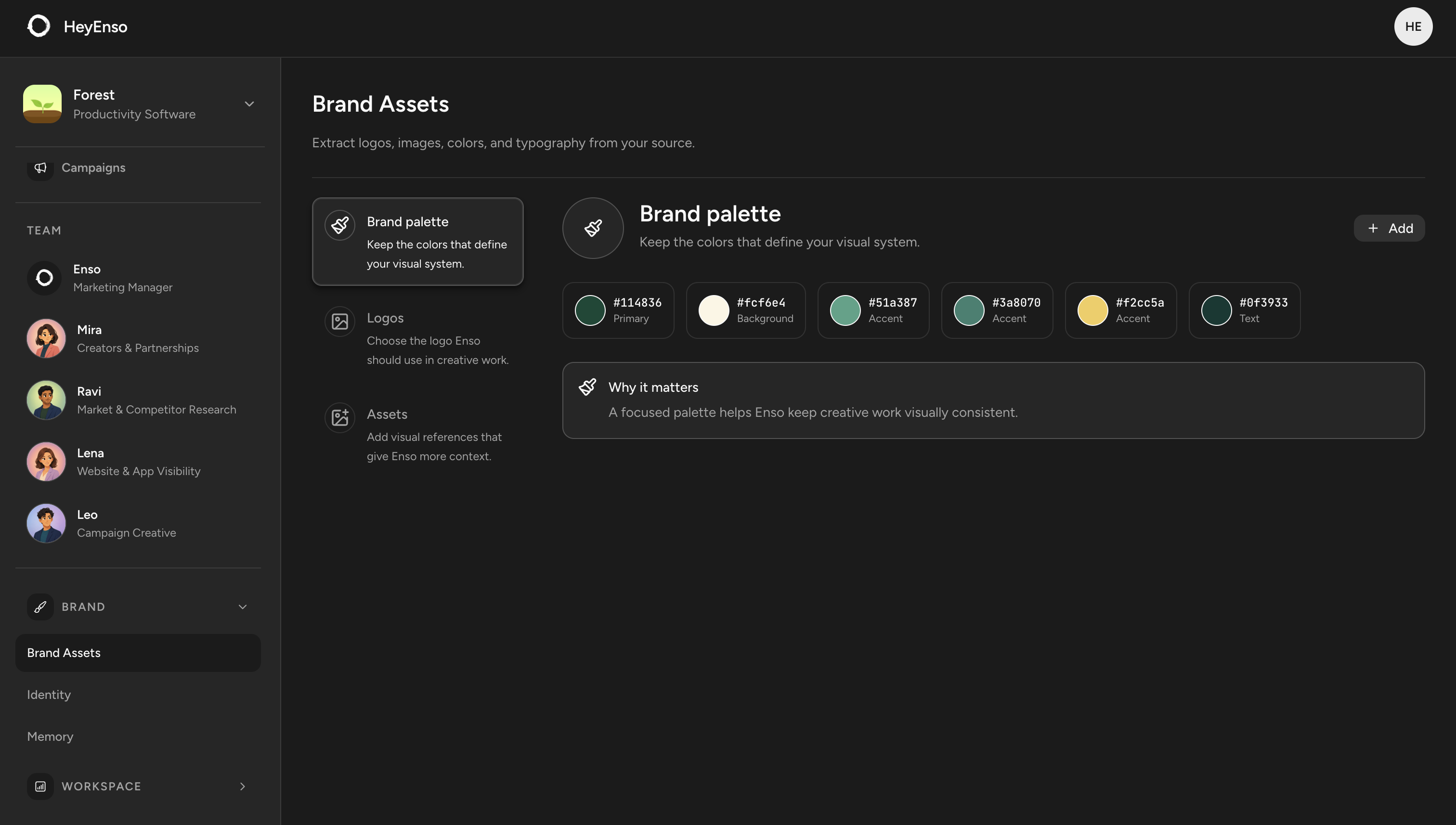
A user can create a project by providing a website, app, or social profile. HeyEnso then builds a grounded understanding of the project, including its identity, audience, category, platform scope, official links, and goals.
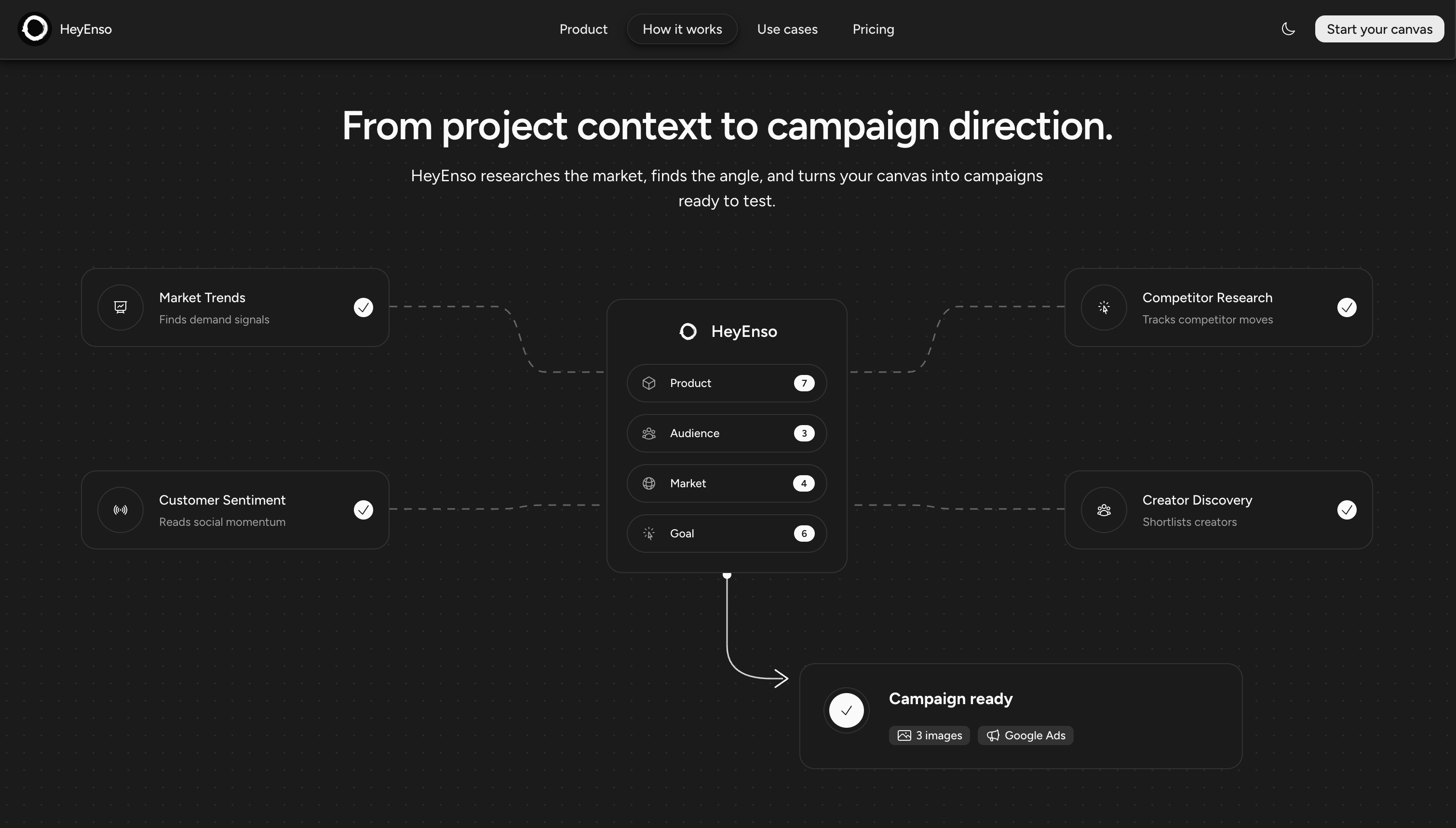
From there, users can delegate work to the appropriate agent. Each agent researches a specific area, saves its findings, and presents the results in a clear activity view with supporting evidence, recommendations, source links, and structured summaries.
The system is designed so that agents remain aware of the project they are working on. For example, a mobile-only product should not receive competitor or trend research focused on desktop or console platforms. Project context, official links, audience information, and time context are passed consistently to the agents and their tools.
How We Built It
The frontend was built with Next.js and TypeScript. It provides the project workspace, agent team interface, activity views, research panels, campaign workflows, onboarding experience, billing screens, and responsive light and dark themes.
The backend runs on Firebase Cloud Functions and Firestore. Firebase handles authentication, project data, agent sessions, activity runs, saved research, usage tracking, and persistent project context.
We used Genkit and Gemini-powered generation to coordinate the agents and structure their responses. Each capability has a defined input and output schema so that agent results can be validated and rendered reliably in the frontend.
External research and data collection are handled through services such as:
- Apify for public Instagram and other data extraction workflows.
- Exa for web search and page-content research.
- Firebase Storage for project and generated media assets.
- Stripe for Pro plans and credit packs.
The application also includes a usage and credit system. External tool calls consume credits while normal conversation does not, making the cost model clearer for users. Low-credit states are communicated before project creation, and tool calls can stop safely when the user has no remaining credits.
Challenges We Faced
One of the biggest challenges was keeping the agents grounded in the correct project context. A generic research prompt can easily produce plausible but irrelevant results. We addressed this by creating a compact project grounding contract containing the project's identity, description, category, audience, platform scope, official links, goals, and distinctive terms.
Another challenge was coordinating multiple external tools. A single capability may need to search the web, inspect store listings, fetch social posts, retrieve comments, and then synthesize the evidence. We had to carefully isolate channel failures, preserve source URLs, avoid fabricated evidence, and return useful empty states when reliable data was unavailable.
We also had to deal with changing third-party APIs. Instagram extraction, in particular, required separate post and comment workflows. Posts must first be discovered and converted into valid post URLs before the comment scraper can run. Provider maintenance, changing actor identifiers, different response shapes, and missing public comments all required defensive handling.
Building a consistent experience across asynchronous work was another challenge. Agent runs may take several seconds, external providers may fail, and results may arrive at different times. We created activity states, previews, run summaries, loading states, error handling, and saved results so users can understand what is happening without needing to inspect the underlying system.
Finally, we focused heavily on making the interface approachable for non-technical users. Internal capability names, provider terminology, platform-specific language, and technical statuses were replaced with clearer user-facing language. The goal was to make the system feel like a helpful team rather than a collection of developer tools.
What We Learned
We learned that reliable AI products need more than good prompts. They need strong context boundaries, structured schemas, source validation, persistent memory, clear tool contracts, and safe failure behavior.
We also learned that specialization improves reliability. Instead of asking one general-purpose assistant to perform every task, assigning focused responsibilities to different agents makes the system easier to reason about and gives users a clearer mental model.
Another important lesson was that the user interface is part of the agent experience. A research result is much more useful when the user can immediately understand what was found, why it matters, where it came from, and what action to take next.
Most importantly, we learned that AI should reduce complexity for the user, not expose more of it. HeyEnso is designed around that principle: the user describes the goal, the right teammate does the research, and the result comes back as an understandable piece of work.
What's Next
We plan to expand HeyEnso with deeper campaign workflows, more reliable social and app-store research, richer cross-agent collaboration, improved source verification, and additional integrations.
Our long-term vision is for HeyEnso to become an always-available AI marketing team that helps businesses move from uncertainty to informed action faster.
Built With
- Next.js
- TypeScript
- Firebase Authentication
- Firebase Cloud Functions
- Firestore
- Firebase Storage
- Genkit
- Gemini
- Apify
- Exa
- Stripe


Log in or sign up for Devpost to join the conversation.