-
-
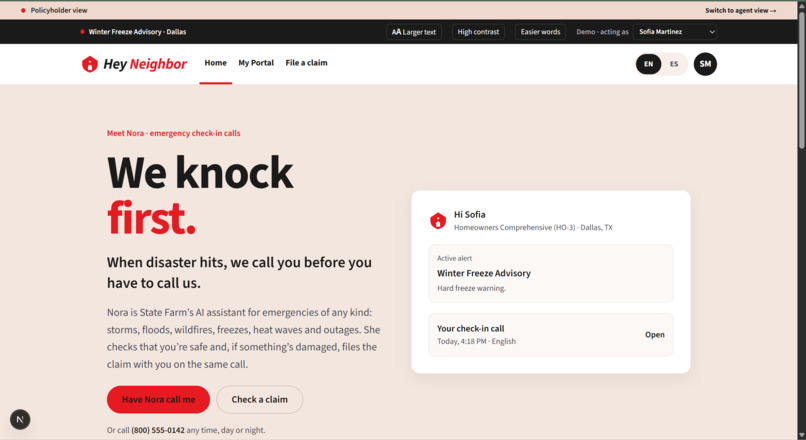
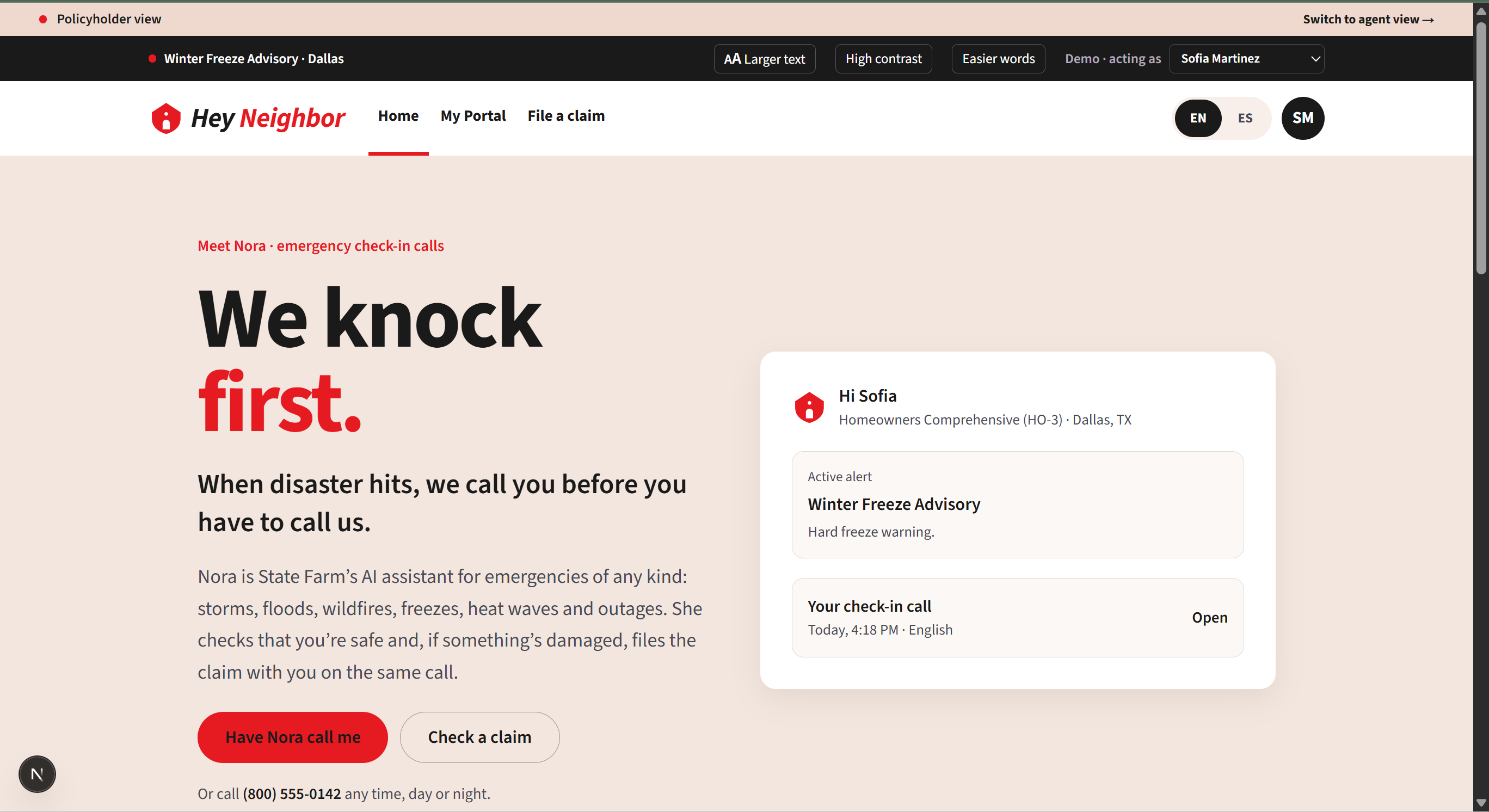
Hey Neighbor's proactive "We knock first" homepage, displaying active winter freeze alerts and emergency check-in status
-
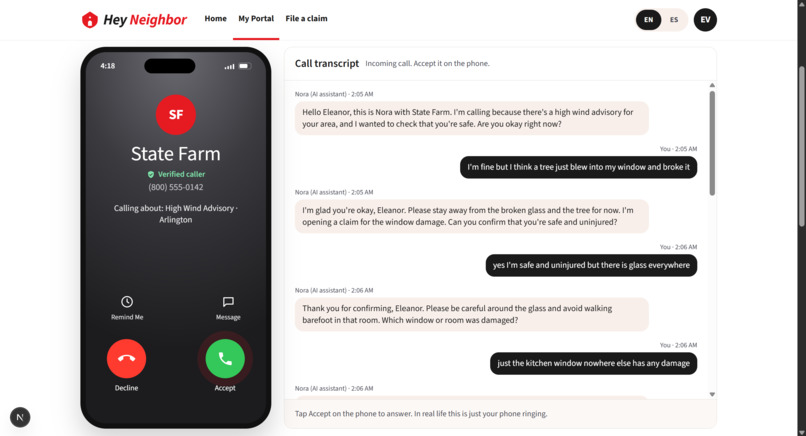
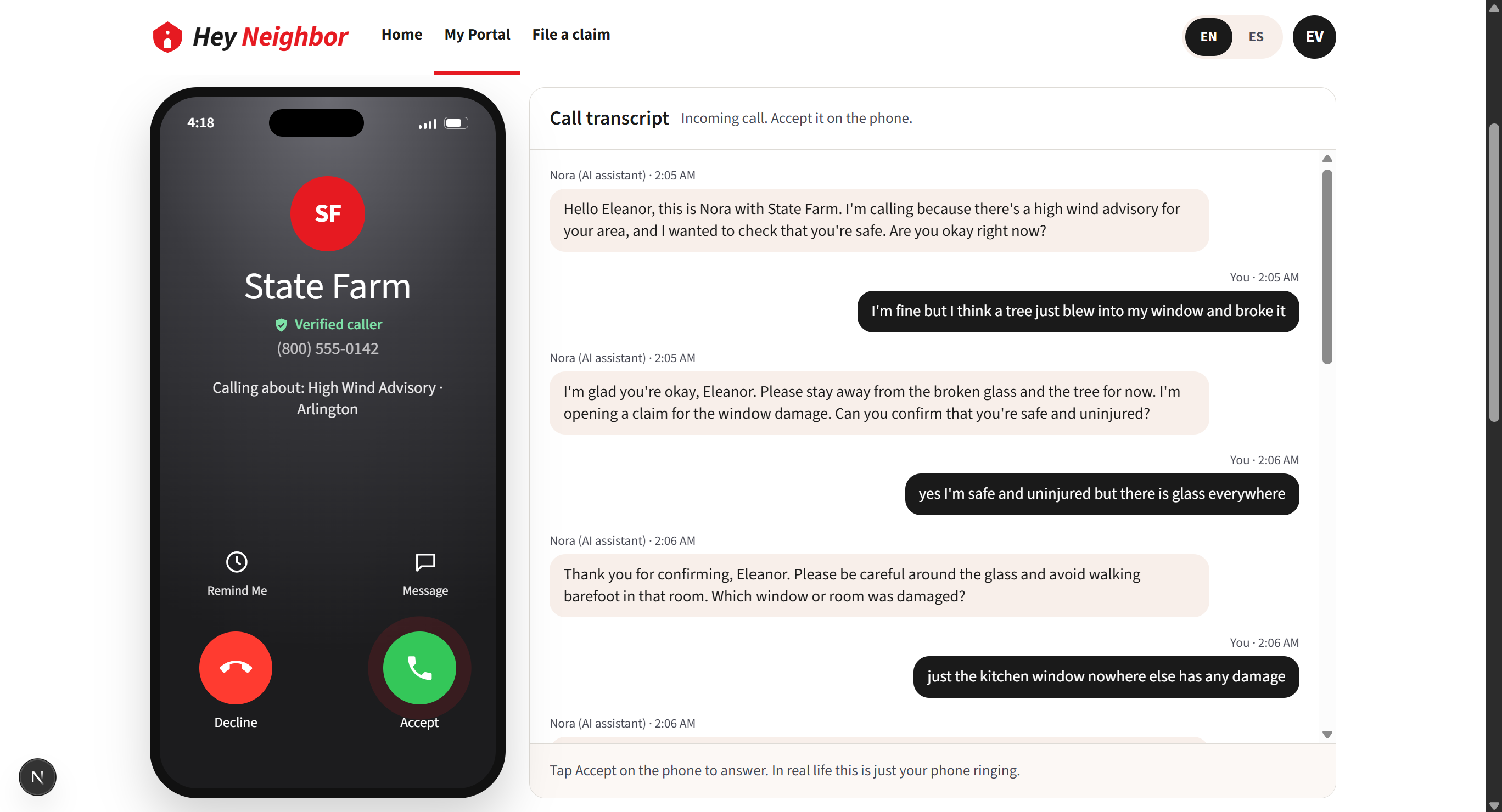
Simulated iOS call interface capturing real-time speech transcripts and initiating automated damage intake during an alert
-
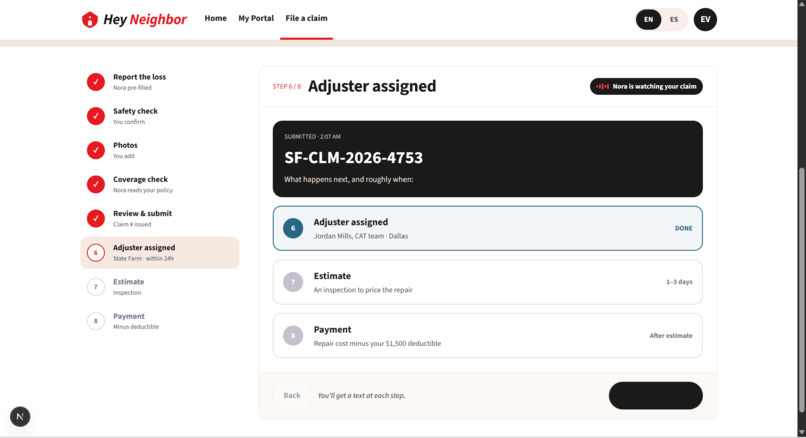
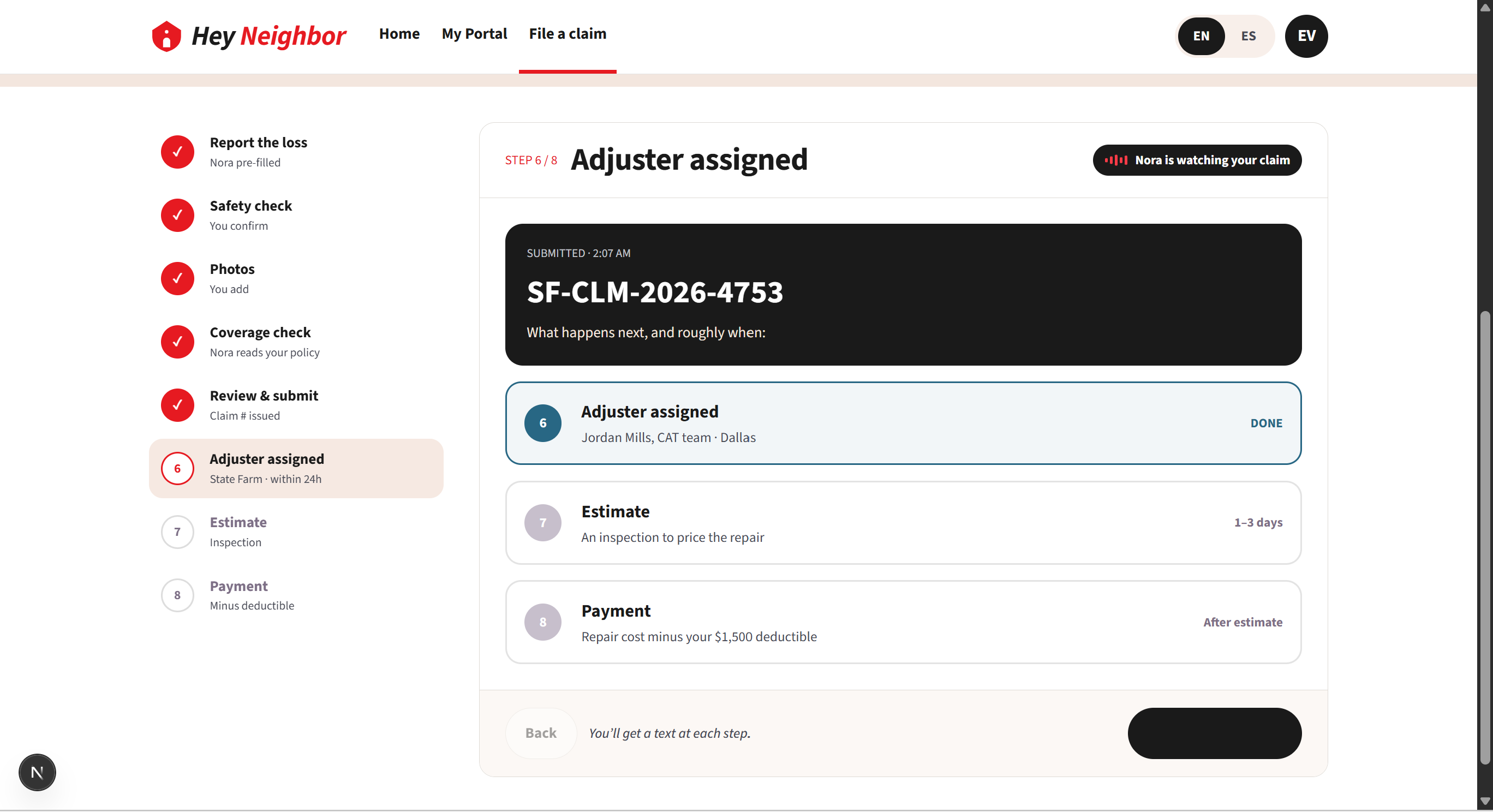
Live four-step claim tracker showing pre-filled damage details, adjuster assignment, and transparent payout estimates
-
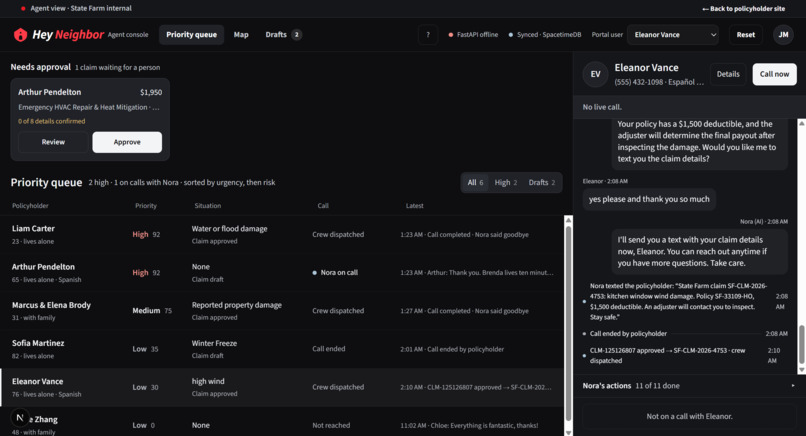
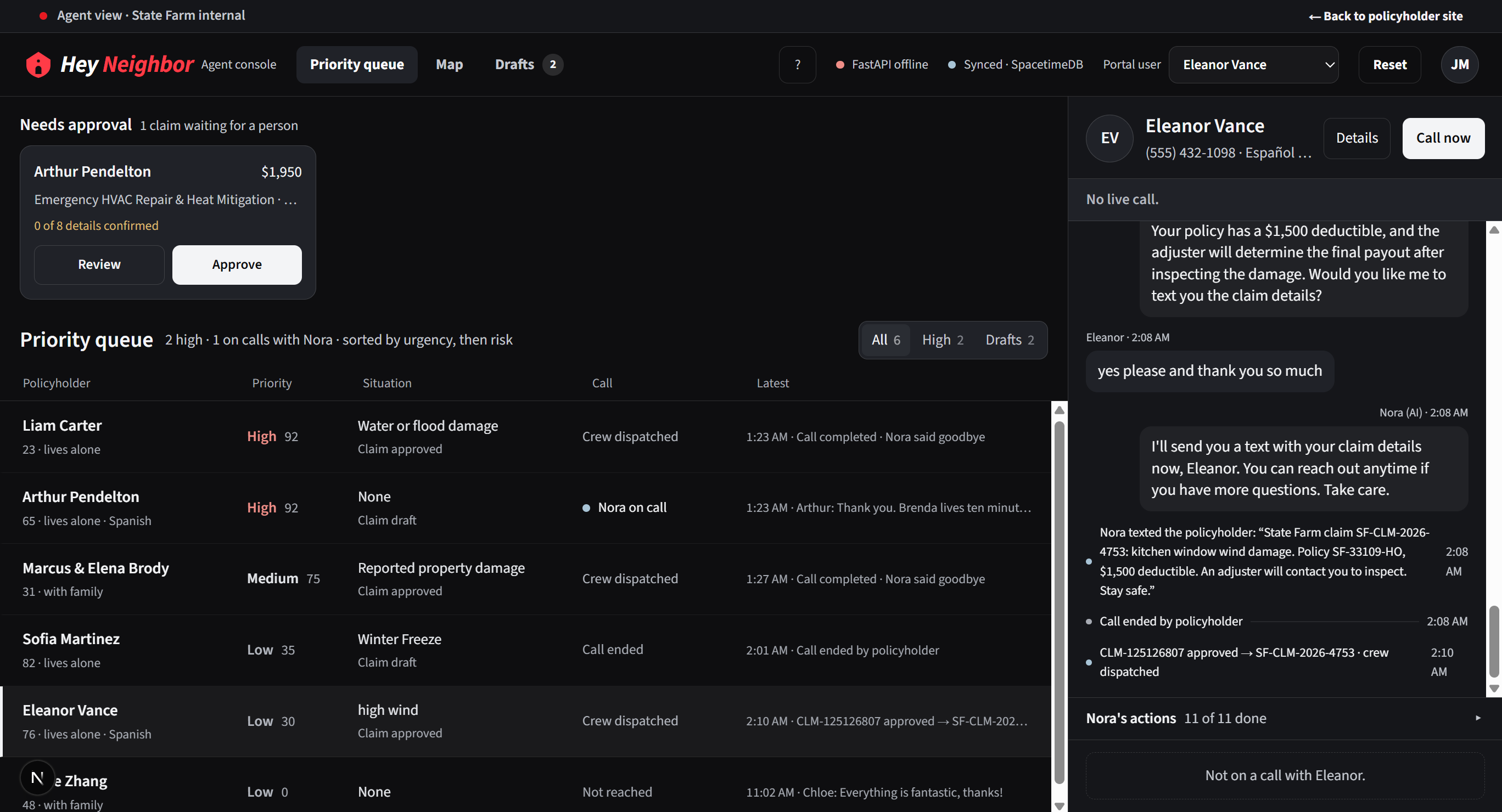
Dark-mode catastrophe agent console sorting policyholders by live risk scores and flagging unconfirmed claim details
-
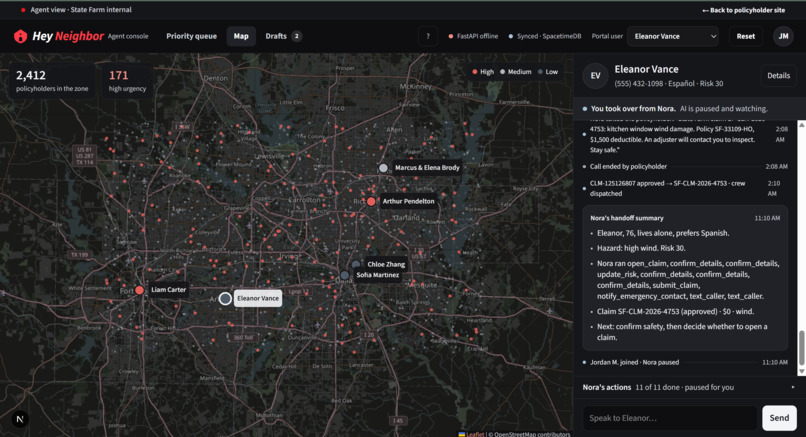
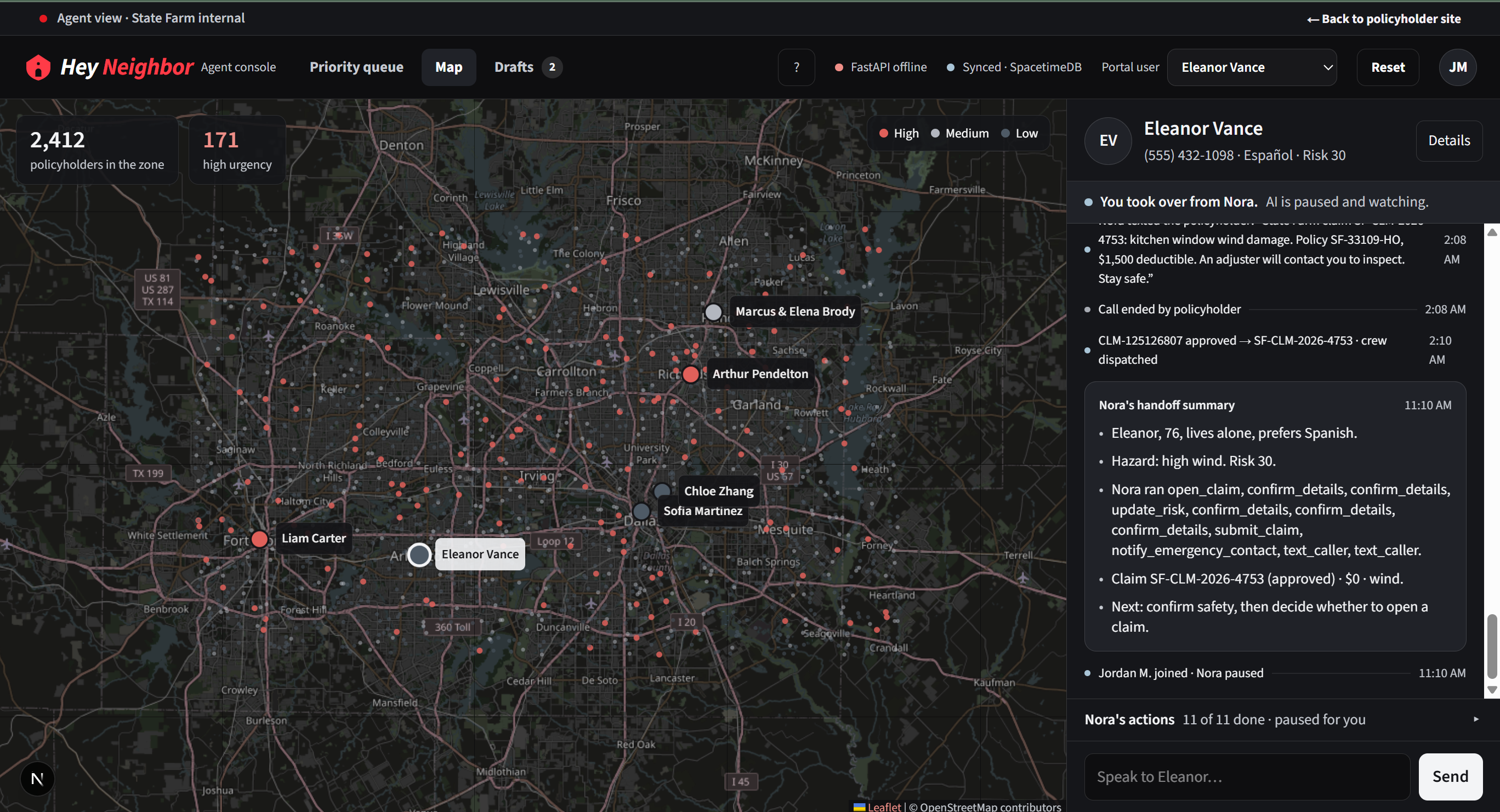
Interactive DFW geospatial disaster map pairing thousands of reactive policyholder pins with Nora's automated handoff summaries
-
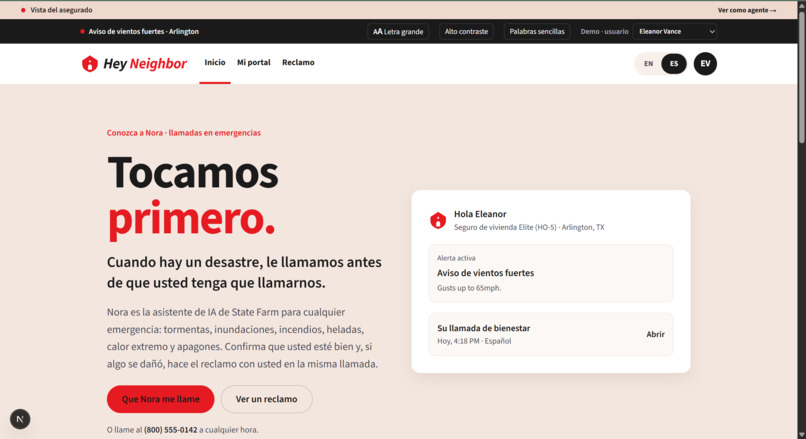
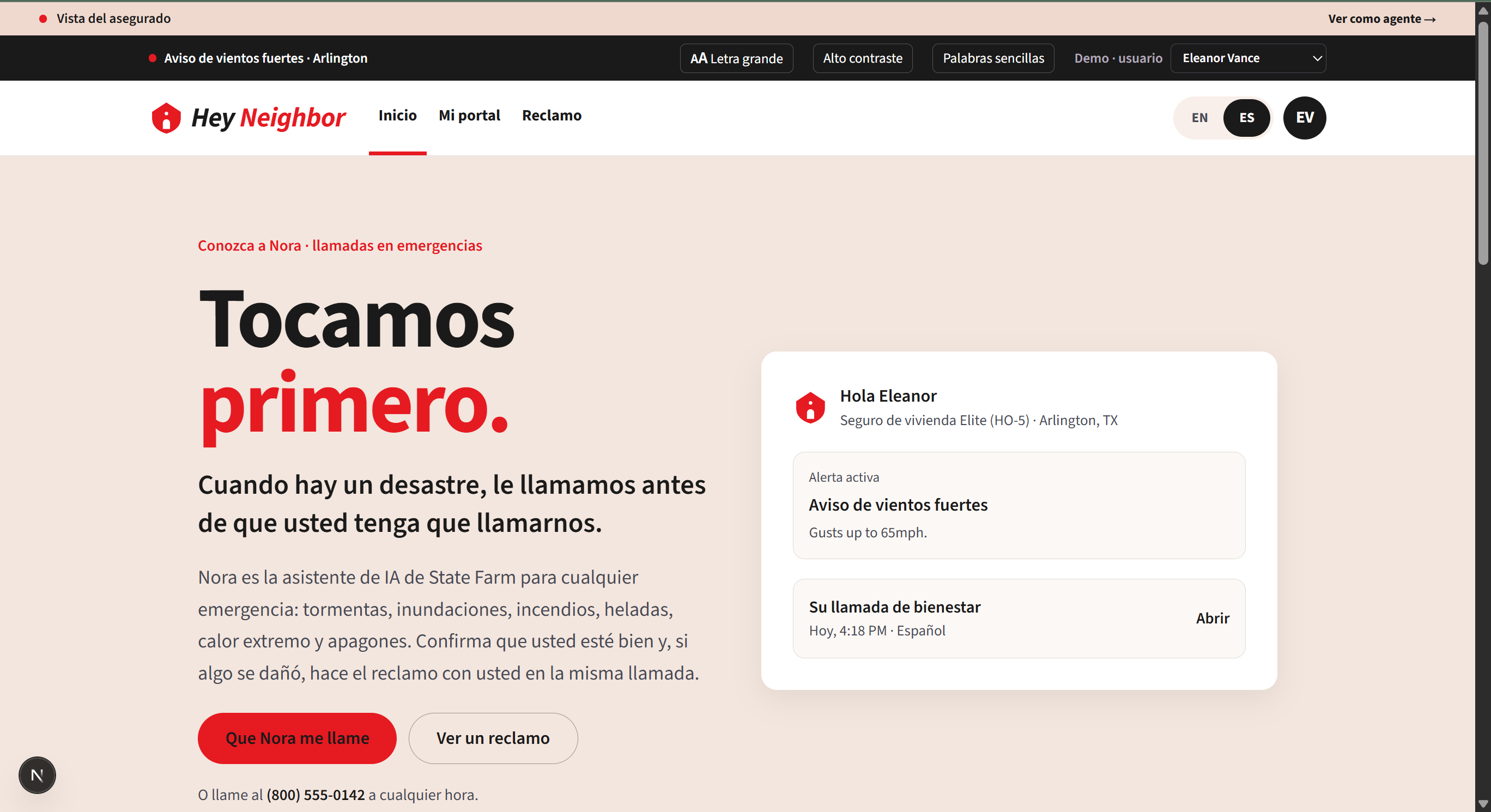
Fully localized Spanish support ("Tocamos primero") with accessible design controls like "Palabras sencillas" (Easier Words)
HeyNeighbor
We'll call you before you have to call us. We knock first.
An AI-powered disaster response assistant that proactively checks on policyholders, helps them navigate emergencies, and connects them with human insurance agents when they need support.
Inspiration
When a disaster happens, people are often expected to figure everything out themselves. They have to recognize the danger, contact their insurance company, explain what happened, understand their coverage, and begin navigating a claims process while already dealing with an emergency.
But what about the people who have the hardest time doing those things?
An elderly person living alone, someone who doesn't speak English, or someone without reliable access to technology might not know where to start. They may need help the most, but they are also the least likely to reach out for it.
We wanted to rethink that experience.
Instead of waiting for policyholders to call their insurance company, what if their insurance company could check on them first?
That idea became HeyNeighbor. We wanted to create something that felt less like an automated insurance system and more like a neighbor checking in. Someone who notices when something is wrong, asks if you're okay, helps you figure out what to do next, and makes sure you aren't left navigating everything alone.
What It Does
HeyNeighbor is a proactive disaster-response assistant built around an AI agent named Nora.
When a disaster such as a freeze, flood, wildfire, storm, heat wave, or power outage affects an area, HeyNeighbor can initiate outreach to affected policyholders. Nora checks on their safety, provides practical guidance, gathers information about potential property damage, and helps prepare insurance claims.
Rather than forcing customers through complicated forms, Nora handles the interaction as a conversation.
If a situation requires additional assistance, Nora can connect the policyholder to a human insurance agent. The agent can review the conversation, access the customer's information, intervene, and approve claims.
HeyNeighbor has two main interfaces:
- Policyholder experience: A conversational interface where customers can receive calls, communicate with Nora, review claim information, and access assistance.
- Agent experience: A dashboard where insurance agents can monitor active calls, prioritize policyholders, review transcripts, intervene in conversations, and manage claims.
The goal is to make disaster response more proactive, accessible, and human-centered.
Why HeyNeighbor Fits the Tracks
State Farm Track
HeyNeighbor reimagines how an insurance company responds to disasters. Instead of relying entirely on customers to initiate contact, the system proactively reaches out, checks on policyholders, helps gather damage information, and connects people with human agents when needed.
Design Track
The project focuses on making an otherwise stressful process easier to navigate. It includes bilingual conversations, live captions, simplified language, accessibility options, emergency contacts, and separate interfaces designed around the needs of policyholders and insurance agents.
NVIDIA Track
NVIDIA Nemotron, accessed through NVIDIA NIM, powers Nora's conversational reasoning and structured action generation. Rather than only generating responses, the model can identify when an action is appropriate, such as preparing a claim, updating a risk level, or requesting human assistance.
Spacetime Track
SpacetimeDB acts as the shared source of truth for the application. It maintains policyholder information, active calls, transcripts, triage priorities, and claims so that changes made during a customer interaction can be reflected in the agent experience.
The Policyholder Experience
HeyNeighbor is designed to make the customer experience feel like a conversation rather than an insurance application.
Nora's calls
- Proactively checks on policyholders during simulated disaster scenarios.
- Asks about immediate safety before moving into insurance-related questions.
- Communicates in English or Spanish.
- Uses conversational questions to gather information about property damage.
- Provides practical next steps based on the situation.
- Helps prepare claims using available policyholder information.
- Requests permission before submitting claims or notifying emergency contacts.
- Offers a transfer to a human agent whenever the customer requests additional help.
Accessibility and communication
- English and Spanish language support.
- Live captions and conversation transcripts.
- Simplified language options.
- Larger text and high-contrast accessibility settings.
- Keypad shortcuts for common actions.
- Emergency contact management.
- Text-message communication and suggested replies.
- A claim timeline and web-based claim form.
The intention is to make sure customers have multiple ways to understand and interact with the system, rather than assuming everyone communicates in the same way.
The Agent Experience
Proactive outreach is only useful if the people responding can understand what is happening and act on it.
HeyNeighbor includes an agent console designed to help human agents manage disaster-related interactions.
Agents can:
- View a priority-ranked queue of affected policyholders.
- See policyholders on an interactive map of the Dallas-Fort Worth area.
- Review active calls and conversation transcripts.
- Monitor customer safety, vulnerability, and reported property damage.
- Join conversations and take over when human assistance is needed.
- Review claim information and make changes.
- Approve claims through a dedicated approval workflow.
The dashboard uses risk prioritization to help agents identify which policyholders may need attention first. Instead of treating every interaction as equally urgent, the system considers factors such as environmental danger, individual vulnerability, property risk, and previous history.
The agent remains involved in important decisions. Nora can help organize information and prepare claims, but human oversight remains part of the process.
How We Built It
HeyNeighbor uses a multi-layer architecture that separates the customer interfaces, AI reasoning, application logic, and shared application state.
1. Frontend
We built the application using:
- Next.js 16
- React 19
- TypeScript
- Tailwind CSS v4
- Framer Motion
- Leaflet
The frontend contains both the policyholder portal and the agent console.
For the simulated calling experience, we use browser-based speech recognition and text-to-speech through the Web Speech API, with Web Audio API support for audio interactions.
2. Backend and Orchestration
We use FastAPI as the backend orchestrator.
The backend manages conversations, session memory, model requests, action validation, and database updates.
Some of the implemented API endpoints include:
/api/health/api/call/start/api/chat/api/transcript/api/call/join/api/call/end/api/triage/api/claim/api/claim/approve
This layer is important because the AI model does not directly control the application. Instead, the backend validates the model's structured outputs and determines which actions can be executed.
3. NVIDIA Nemotron and NVIDIA NIM
Nora uses NVIDIA Nemotron through NVIDIA NIM for conversational reasoning.
The model generates structured JSON responses containing conversational replies, actions, and suggested responses.
Depending on the interaction, Nora can request actions such as:
open_claimupdate_riskconfirm_detailsnotify_emergency_contacttext_callersubmit_claimtransfer_to_agentset_languageend_call
This allows the assistant to move beyond simply answering questions. It can identify the next appropriate step in a workflow and communicate that action to the backend.
We also designed safety constraints into Nora's behavior:
- Prioritize immediate safety before insurance questions.
- Ask one question at a time.
- Respond in the customer's preferred language.
- Avoid making assumptions about the cause of damage.
- Only discuss coverage using available policy information.
- Request consent before submitting a claim or notifying an emergency contact.
- Transfer to a human agent when requested.
- Avoid inventing information when the AI service is unavailable.
4. SpacetimeDB
SpacetimeDB provides the shared application state for HeyNeighbor.
It maintains information across several tables:
customerspoliciesactive_callstriage_queueclaims
Reducers handle operations such as initializing the simulation, updating transcripts, changing risk levels, creating claims, and approving claims.
This allows the policyholder experience and agent dashboard to work with the same underlying information. When an agent joins a call or updates a claim, the change can be reflected across the application rather than existing separately in each interface.
5. Risk-Based Prioritization
One of the most important parts of HeyNeighbor is determining which policyholders may need attention first.
We designed a configurable priority model that considers four categories:
- Environmental risk (E): The severity of the disaster affecting the policyholder.
- Vulnerability (V): Individual circumstances that may make responding more difficult.
- Property risk (P): Potential damage or exposure to the customer's property.
- History (H): Relevant previous information about the policyholder.
The overall risk score is calculated using the following formula:
S = min(100, wₑE + wᵥV + wₚP + wₕH)
The vulnerability component accounts for factors such as age, living alone, and communication barriers:
V = 0.5 × (A / 100) + 0.3 × L + 0.2 × F
Where:
- (S): Overall risk score (capped at 100)
- (E): Environmental risk
- (V): Household vulnerability
- (P): Property risk
- (H): Historical risk
- (w_E, w_V, w_P, w_H): Weights assigned to each risk category
- (A): Age
- (L): Whether the policyholder lives alone
- (F): Communication or technology barriers
The resulting score helps organize the agent queue and identify people who may need earlier outreach. It is intended as a prioritization aid, not an automatic determination of coverage, eligibility, or claim approval.
Challenges We Ran Into
One of our biggest challenges was connecting conversational AI to actual application behavior.
A typical chatbot can generate a response, but HeyNeighbor needs to do more than talk. It needs to update risk information, prepare claims, notify the appropriate people, and keep the agent dashboard synchronized.
We addressed this by separating the AI's reasoning from the backend's execution. Nemotron generates structured actions, while FastAPI validates and processes them.
Another challenge was keeping the policyholder and agent experiences consistent. Information gathered during a call needs to be available to the agent without requiring the customer to repeat everything. SpacetimeDB helps provide a shared source of truth for these interactions.
We also had to consider how people communicate during emergencies. A system that only works well for someone who is comfortable with technology or speaks English would miss many of the people it is supposed to help. This influenced our decisions around bilingual conversations, captions, simplified language, and human-agent transfers.
Finally, we had to think carefully about the limits of AI in insurance. Nora should be able to help gather information and guide customers, but it should not make unsupported promises about coverage or remove the need for human judgment.
Accomplishments
We are proud to have built a working prototype that connects several parts of the disaster-response process into one experience.
Some of our biggest accomplishments include:
- Building two connected interfaces for policyholders and insurance agents.
- Integrating NVIDIA Nemotron through NVIDIA NIM for conversational reasoning and structured actions.
- Using SpacetimeDB as shared application state across the customer and agent experiences.
- Creating a simulated proactive calling workflow.
- Implementing English and Spanish conversation support.
- Building a risk-based triage queue and interactive DFW map.
- Creating a claim preparation and human approval workflow.
- Incorporating accessibility features into the policyholder experience.
- Designing safety constraints and human oversight into the AI workflow.
Most importantly, we built something that demonstrates how an insurance company could change the way it responds to people during emergencies.
What We Learned
This project taught us that building a useful AI assistant involves much more than connecting a language model to a chat interface.
The model needs context, the backend needs control over its actions, and the application needs a reliable way to keep information synchronized.
We also learned that the design of an AI system matters just as much as its technical capabilities. During an emergency, people need clear communication, accessible interfaces, and the ability to reach a real person.
We wanted HeyNeighbor to demonstrate that AI can help make services more responsive without removing the human support that people may need most.
What's Next
Our current project is a prototype using simulated policyholders, disaster scenarios, calls, messages, and insurance workflows.
To move HeyNeighbor toward a real-world deployment, we would need to:
- Integrate reliable emergency alerts and geographic risk data.
- Connect secure production telephony and SMS services.
- Integrate with authorized insurance policy and claims systems.
- Validate and improve the risk-prioritization model using appropriate real-world data.
- Expand language support and accessibility testing.
- Strengthen privacy, security, reliability, and system monitoring.
- Evaluate the system for fairness and ensure that risk scores do not disadvantage particular groups.
- Continue refining the human-agent workflow and escalation process.
Our long-term goal is to make proactive outreach a meaningful part of disaster response, helping insurance companies identify people who may need assistance before those people have to ask.
Built With
Next.js, React, TypeScript, Tailwind CSS, FastAPI, Python, NVIDIA Nemotron, NVIDIA NIM, SpacetimeDB, Leaflet, Framer Motion, Web Speech API, Web Audio API.
HeyNeighbor
We'll call you before you have to call us. We knock first.
Because being a good neighbor means not waiting for someone to knock on your door. Sometimes, you knock first.
Built With
- next.js
- python
- rust
- typescript
