-
-

Hexpair icon
-

Hexpair icon rounded
-
App Screenshot
-
App Store Screenshot 1
-
App Store Screenshot 2
-
App Store Screenshot 3
-
App Store Screenshot 4
-
App Store Screenshot 5
-
App Store Screenshot 6


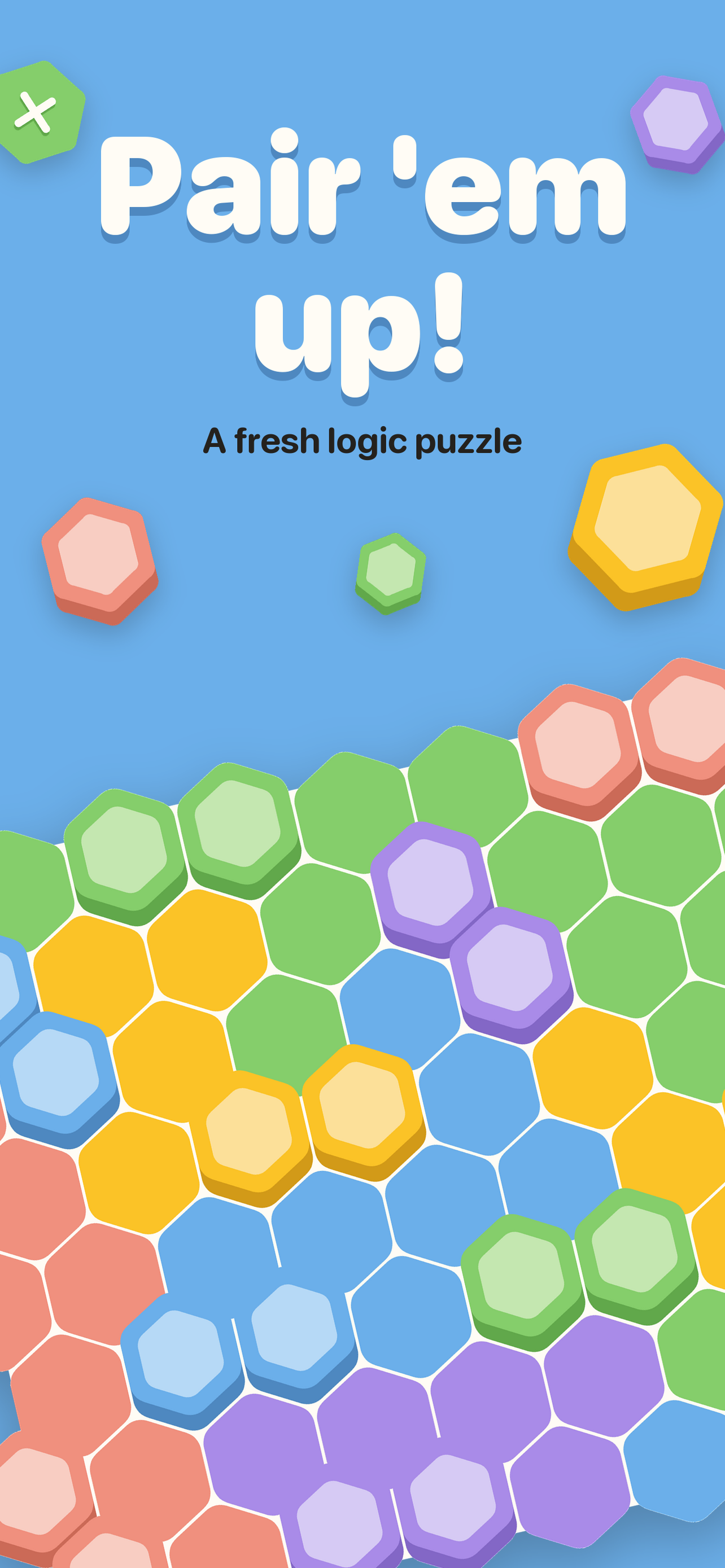
A calm deduction puzzle for people who love games like Sudoku, Queens and Nonograms. Hexpair is Norinori on a hex board, a classic made fresh. 3000 levels and daily puzzles to compete with friends.
- What problem it solves. Norinori is one of the best calm logic puzzles there is, and it has barely made it to the phone. Hexpair is the version we always wanted to play.
- Who it's for. People who love puzzle games like Sudoku, Queens and Nonograms, and anyone who wants a game they can pick up and put down on the bus or in a waiting room.
- What it lets you do. Solve 3000 levels in three sizes, from easy ones you can solve on autopilot to hard ones that make you think. Play the daily puzzles and compete with friends and family, or see how fast you solved them compared to the rest of the world. Free hints, a playable tutorial, and progress that follows you between iPhone and iPad.
- How it makes money. The first levels of every ladder, the daily puzzles and hints are free. Hexpair Pro is a one-time purchase that unlocks all 3000 levels, forever. If you don't want to pay, you can watch one rewarded ad to open the next batch of levels instead. No ads on the puzzle screen, ever.
- What makes it different. Hexpair makes a 20-year-old pencil puzzle feel like it was designed for touch. Nobody had put Norinori on a hexagonal board before, and the puzzle is better there: the rules get simpler and the move you make most becomes one smooth swipe. And no guessing, ever. Every level is solvable by logic alone.
- Award categories. Best Game, RevenueCat Design, Catvertising.
A game for people who love Sudoku, Queens and Nonograms
We love puzzle games like Sudoku, Queens and Nonograms. Games that are almost mindless once you know the rules and play the easy levels, but make you think when you turn up the difficulty. They are the perfect mobile games. Quick to pick up and put down. On the bus, before a doctor's appointment or while watching TV. You wind down on the bus home from work with a few easy puzzles, or you sharpen your brain with a hard level in a waiting room. Hexpair is built for exactly those moments.
Norinori is one of our favourites, and it has barely made it to the phone. So that was the problem we wanted to tackle for this year's Shipaton: how do you make a game we love work smoothly on a mobile device?
Making Norinori work on a phone
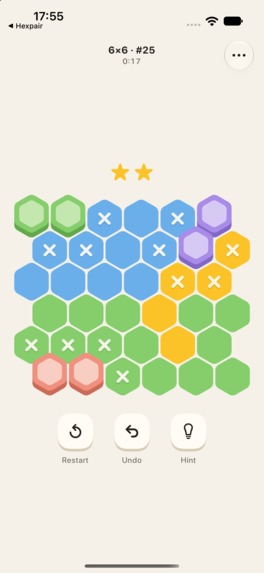
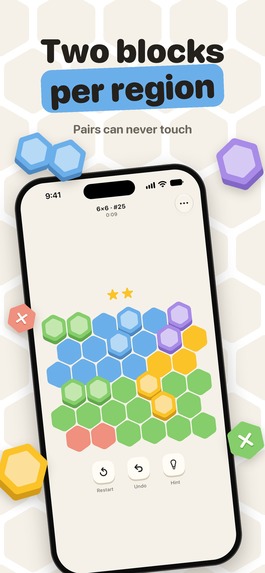
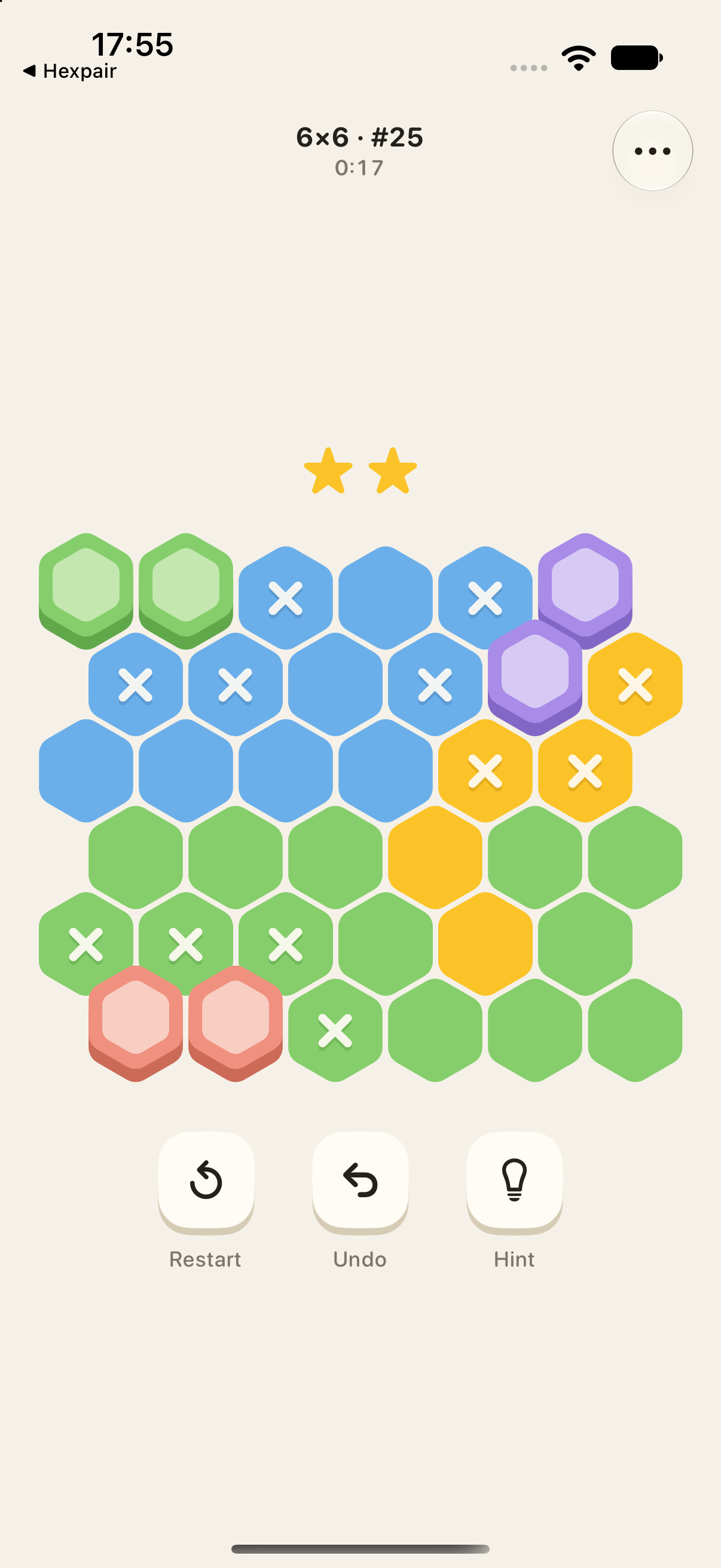
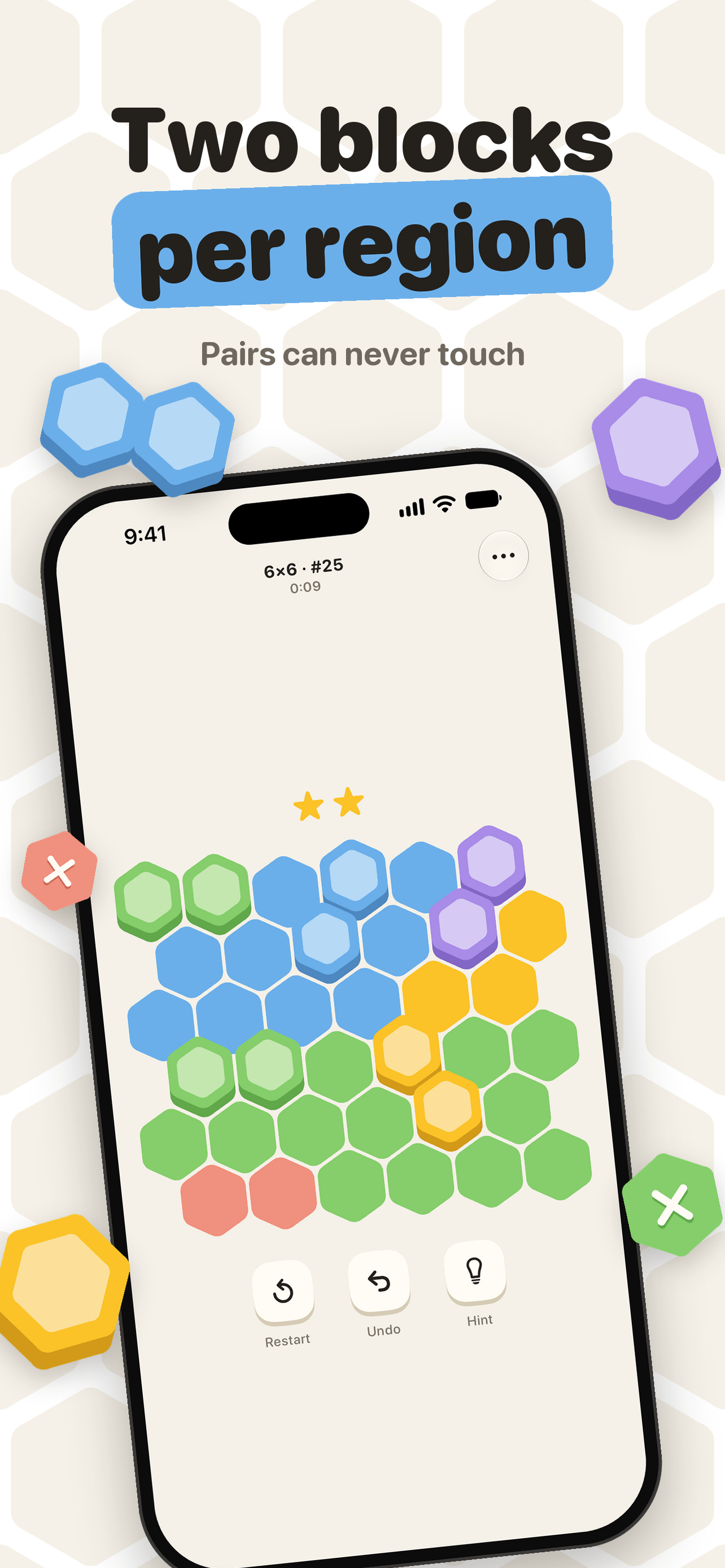
The game only has a few rules. The board is divided into regions. In every region you place exactly two blocks. Every block needs a partner, two blocks side by side, and no two pairs may touch. That's it. Pairs are allowed to cross region borders, which is where the thinking starts.
The rules were never the hard part. The controls were. Once you place a pair, every cell that shares an edge with it must stay empty, so you mark those with an X. Corners don't count, only edges. That sounds fine on paper, but on a phone it fought us. On a square grid you cannot swipe around a pair without also hitting the corner cells, so every swipe left marks nobody wanted, and we kept cleaning up after our own thumbs.
Then came an idea that might fix the corner problem. What if the board was made of hexagons? On a hex board there are no corners. Every cell around a pair is a real neighbour, so every one of them needs an X, and a single continuous swipe around the pair should mark exactly the right cells and nothing else.
We built it to find out. The first time we played on the hex board, it clicked. It felt right. It was a new twist on a game we already liked a lot, and it made it feel fresh, fun, and much smoother on a phone. And the assumption about the X marks held: one swipe around a pair, clean, every time. The corner problem was gone.
With the board settled we could obsess over the rest of the controls. We experimented a lot with how you place a block versus an X, and ended up with double tap for a block and single tap or swipe for an X, because you place way more X marks than blocks, and a tap or a swipe is faster. Nobody had put Norinori on a hex board before, and it turns out the puzzle is better there.
What playing it is like
You start with a tutorial that helps you understand first, then do. A few short animations show the board, the goal and how pairs work, one sentence at a time, at your own pace. Then you place your first blocks on a real board, and solve your first five easy levels with help that only steps in if you get stuck. By the end you have solved real puzzles without reading a wall of rules.
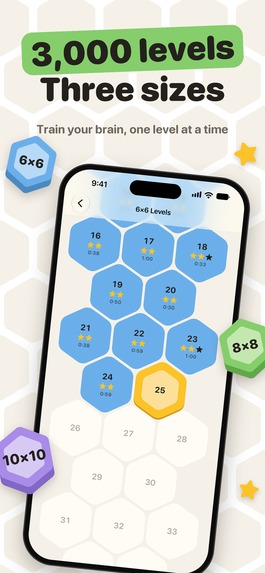
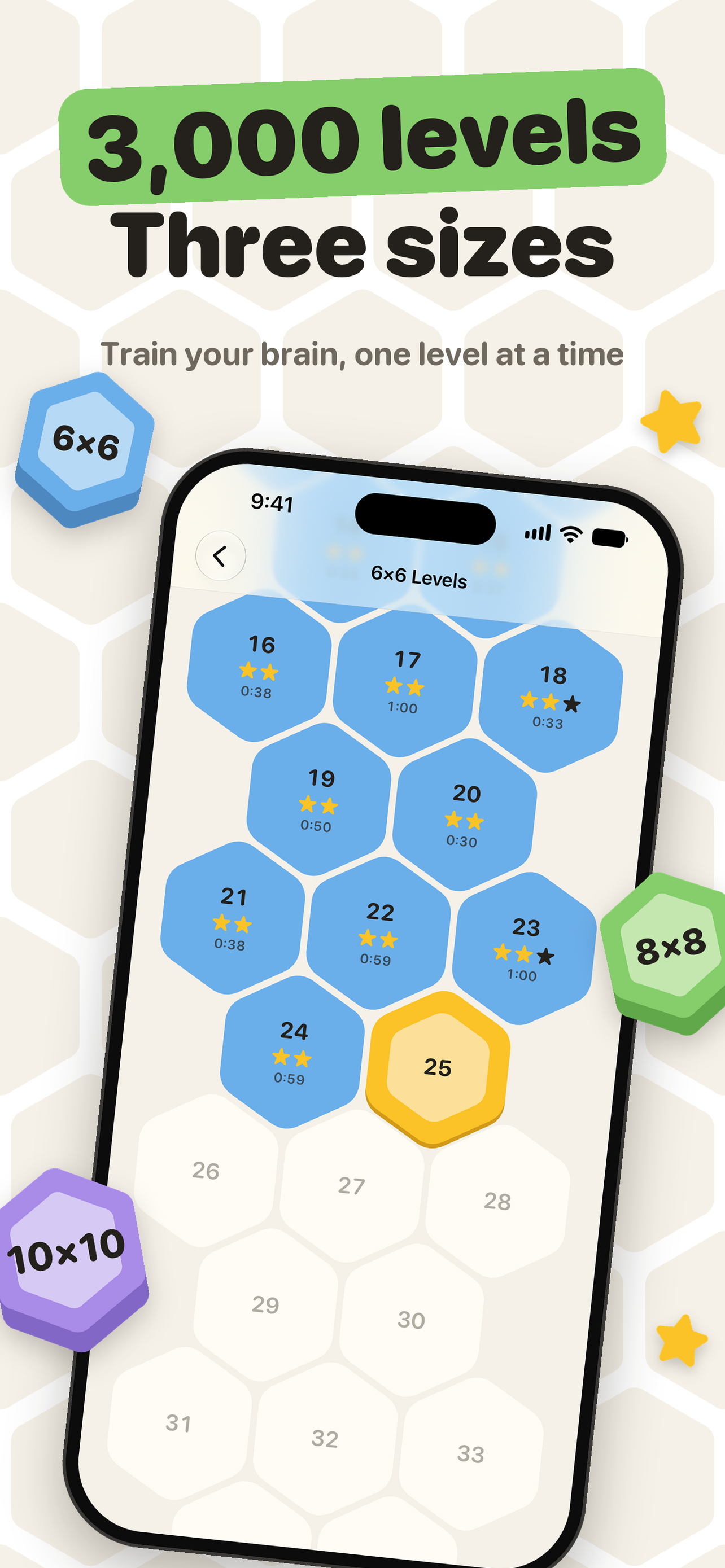
Then you pick a size. 6×6, 8×8 or 10×10, each with its own ladder of 1000 levels. The first levels are easy on purpose, the kind you solve on autopilot. The difficulty climbs from there, and then it keeps varying, so a hard one is followed by a breather and the ladder never turns into a grind. Every level is verified to have exactly one solution you can reach by logic, so you are never stuck guessing.
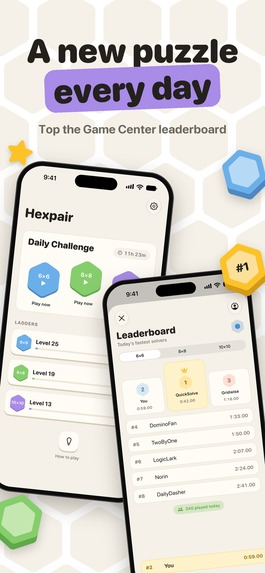
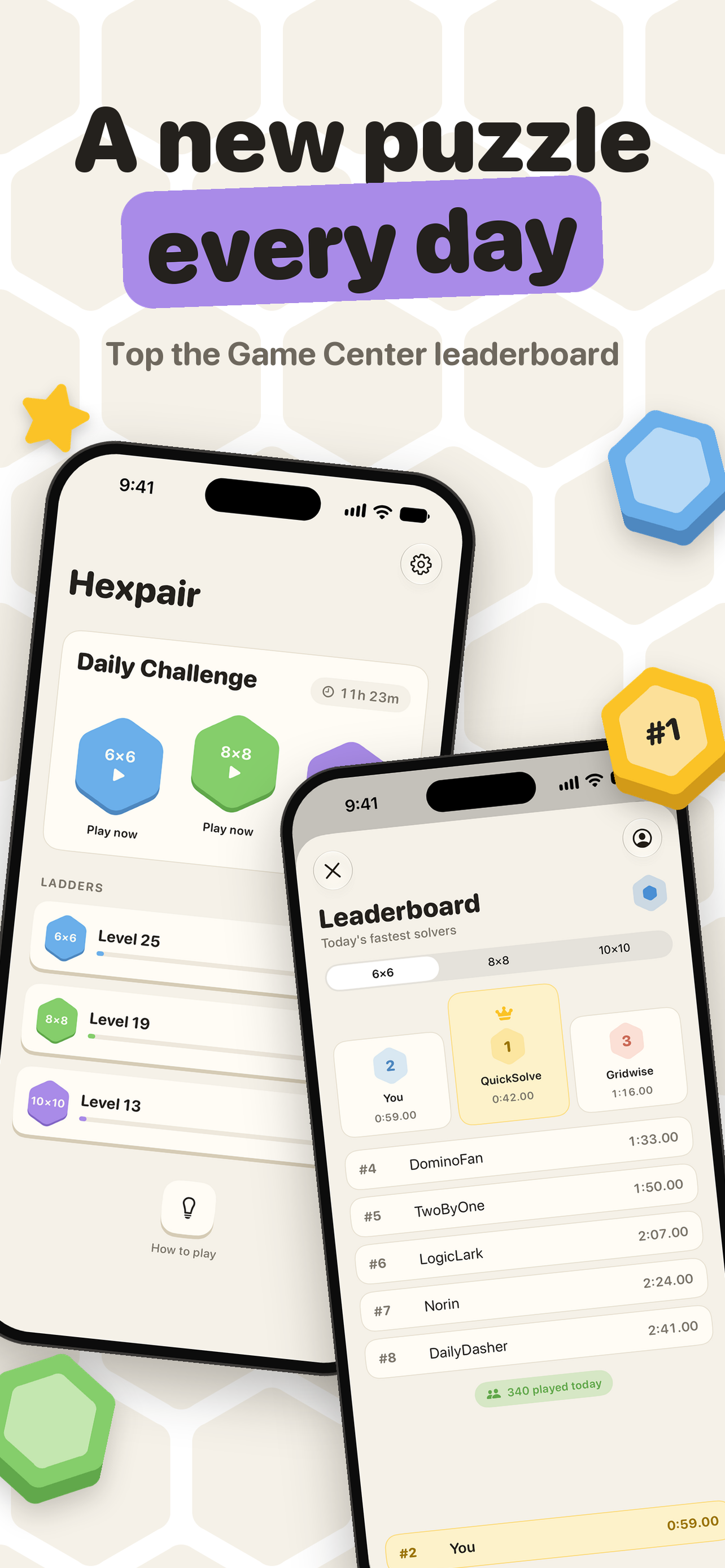
Every day there are three new daily puzzles, one per size. Everyone in the world gets the same board at the same moment, you get one attempt, and your time goes on a Game Center leaderboard. Compete with friends and family, or see how you did against the rest of the world.
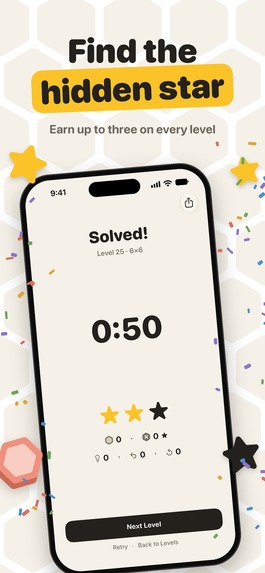
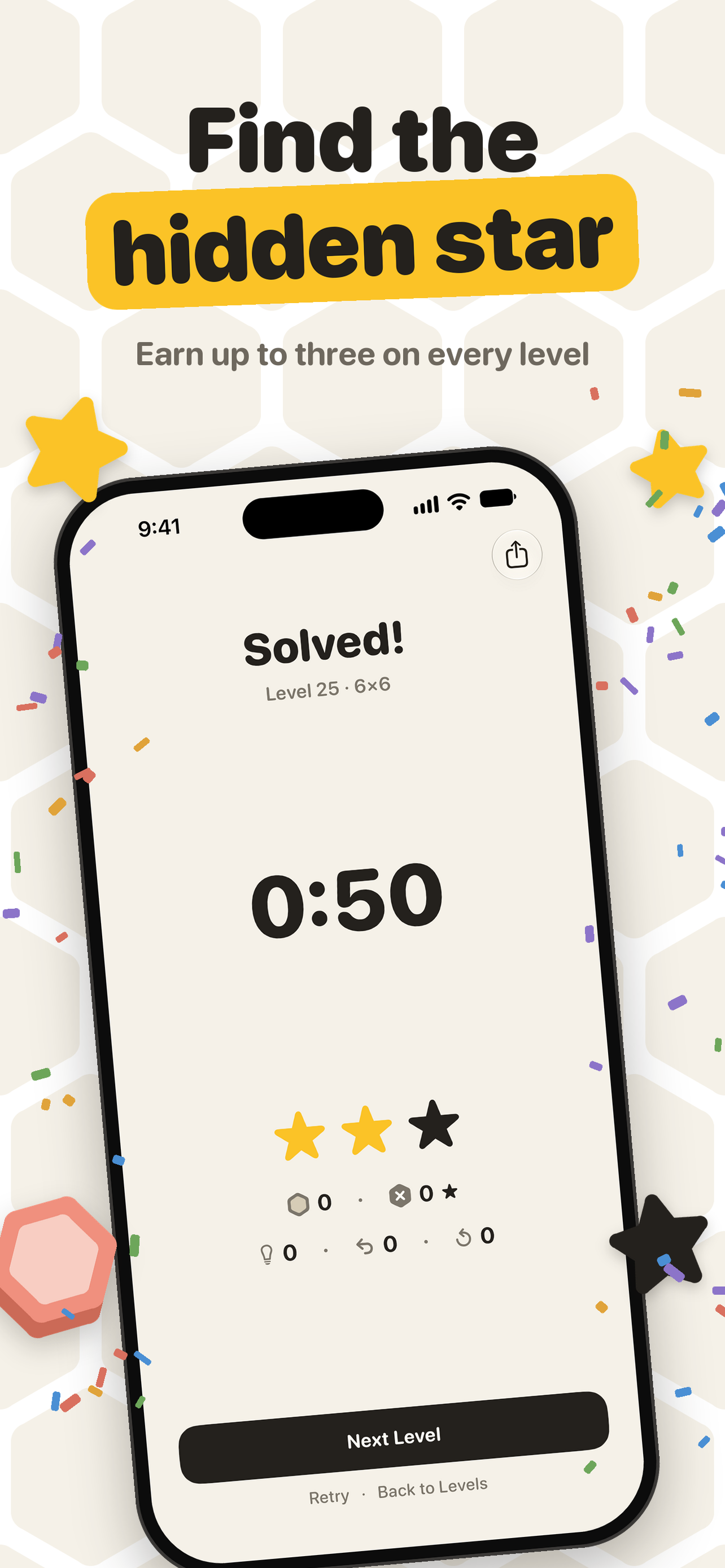
Hints are free, always. Every level is rated with two gold stars, and using a hint costs you one of them, never money. There is also a hidden third star for a perfect solve. Your progress syncs over iCloud, so the ladder you climbed on the iPad on the couch is right where you left it on the iPhone on the bus. And the puzzle screen has nothing on it but the puzzle. No banners, no pop-ups, nothing pulling your attention away from the board while you solve.
How it makes money
We wanted a model that fits how these games are actually played, so we made a few deliberate choices.
The daily puzzles are free for everyone, because they are the reason to come back tomorrow. The first levels of every ladder are free too, generous enough that you get hooked before you ever see a price. Hints are free, because charging for help punishes exactly the player who needs it.
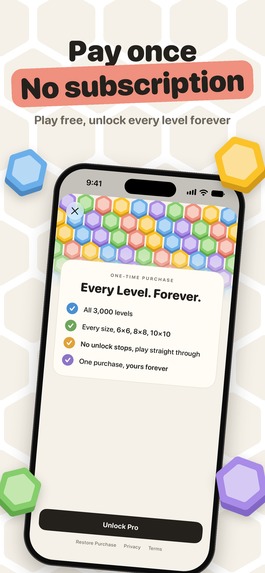
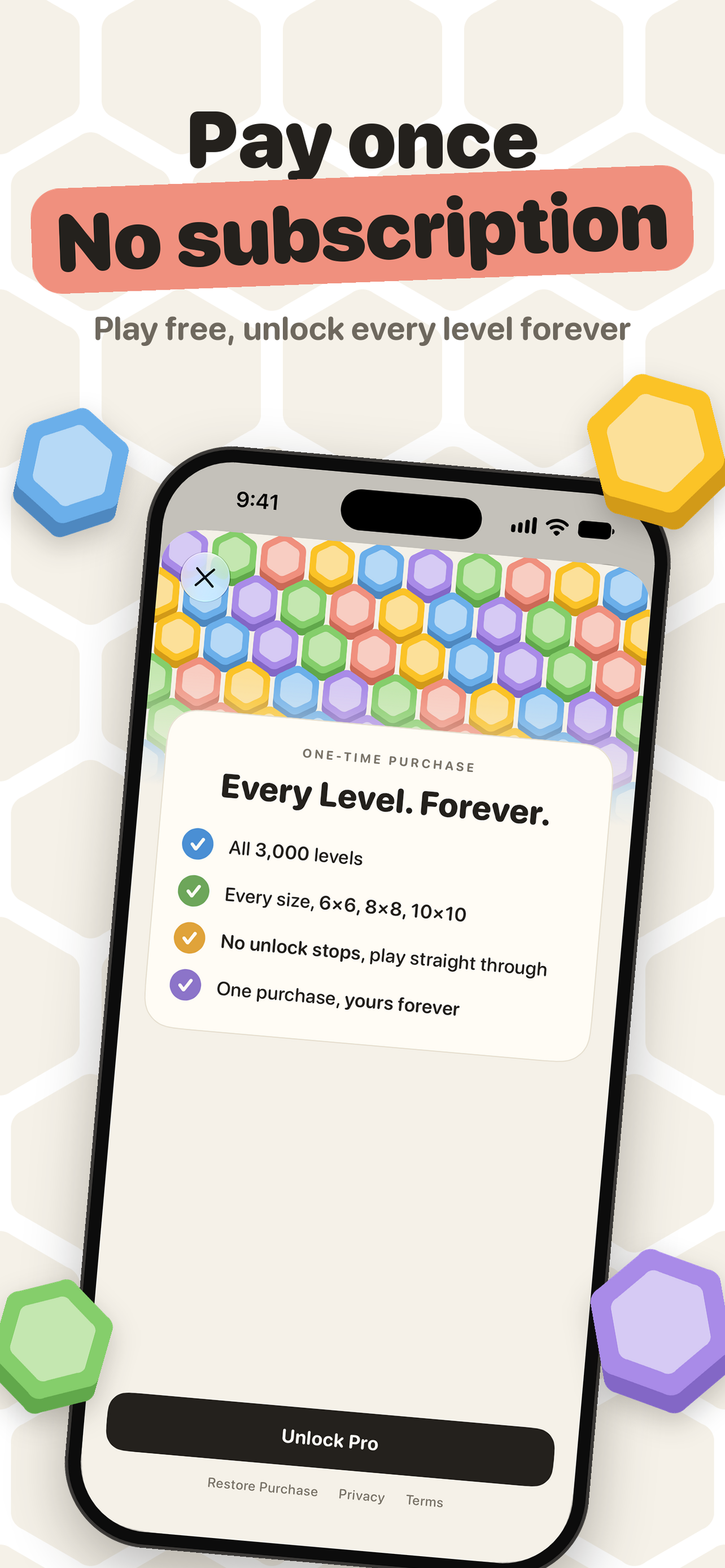
When the free levels run out you get two choices. Hexpair Pro is a one-time purchase that unlocks all 3000 levels, forever. No subscription, because puzzle players buy, they don't subscribe. Or you can watch one rewarded ad and open the next batch of levels for free. We went with this hybrid so that people who want to keep playing can unlock everything once, and people who don't want to or can't pay still get to play.
The ad is offered only at that moment, when you have reached the end of your free levels and asked for more. Never between levels, never mid-puzzle, never on the puzzle screen. That keeps the game clean and never breaks the flow of solving. Purchases run through RevenueCat, ads through RevenueCat Ads.
Under the hood
Early on we made a decision that shaped everything: the phone never generates a puzzle. Generating good Norinori is slow and sometimes fails, and no player should ever stare at a spinner. So the generator, the solver and the difficulty grader live in a separate Swift package that runs on a Mac. It produces thousands of puzzles, checks that every one has exactly one logical solution, scores how hard it is, and bakes the result into the app. A level opens instantly, and there is no loading state and no failure state, because there is nothing that can fail.
The part that took longest was the difficulty score. A number that says "hard" is easy to compute. A number that matches how hard a puzzle feels to a human took weeks of solving, comparing, and adjusting.
The daily puzzles come from a small server, built so that nobody can peek at tomorrow's puzzle. When you are competing with friends on a leaderboard, everyone has to see the board for the first time at the same moment.
What we learned
The biggest one is that the board shape was a control decision, not a visual one. We changed the whole geometry of the game to make one swipe feel right, and that turned out to be the thing that makes Hexpair Hexpair.
The second is that difficulty is a feeling, not a number. The first difficulty score was mathematically sound and wrong. Puzzles it called hard felt easy, and some it called easy stopped us cold. The only fix was solving a lot of puzzles ourselves and adjusting the score until it agreed with our gut.
And the third: ship the content, not the machine. Moving generation off the phone made the app simpler and faster, and left nothing on the phone that can fail.
Awards
- Best Game. Hexpair takes a niche Japanese pencil puzzle and makes it genuinely fun on a phone. Pure deduction, 3000 levels with one logical solution each, three ladders that get harder but keep breathing, and a daily shared by the whole world.
- RevenueCat Design. The shape of the board is the control scheme. One idea, the hex, carried from the first tap to the last screen.
- Catvertising. The ad is a way to play, not a price for playing. One rewarded ad, one place, only when the player asks for more. Never on the puzzle.
What's next
Hexpair is new and the audience is still small, but the early signs are good. Two players have already bought Hexpair Pro, which is a strong share of the people who have found the game so far. The game works for the people who get into it. Our job now is to get more people there.
First, the onboarding. Too many new players leave before the rules click, so we are polishing the tutorial until everyone who opens the game understands how to play. That is the most urgent fix.
Second, marketing. The game converts well, it just needs more people to find it.
And we keep making new levels, so the players who stay always have more to solve.


Log in or sign up for Devpost to join the conversation.