-
-
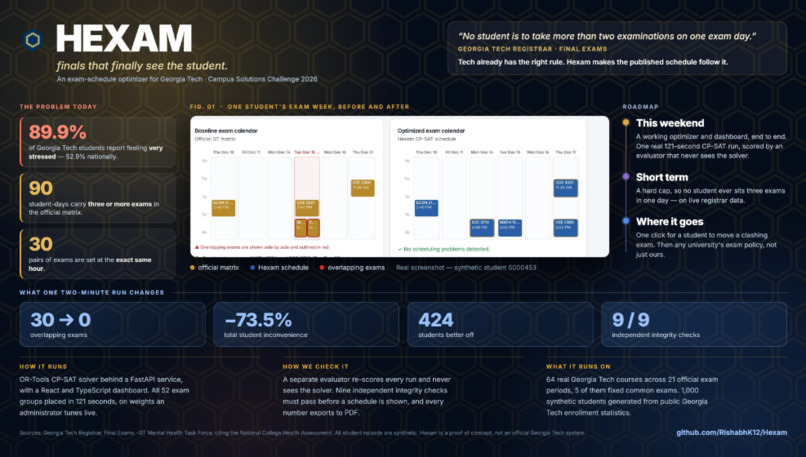
Hexam One Pager
-
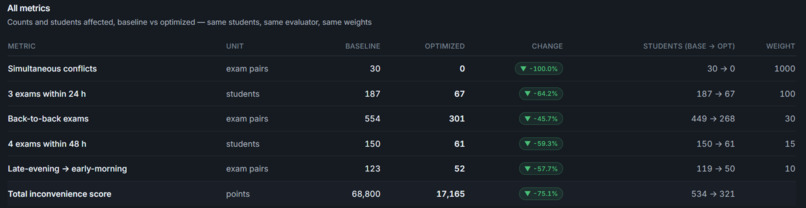
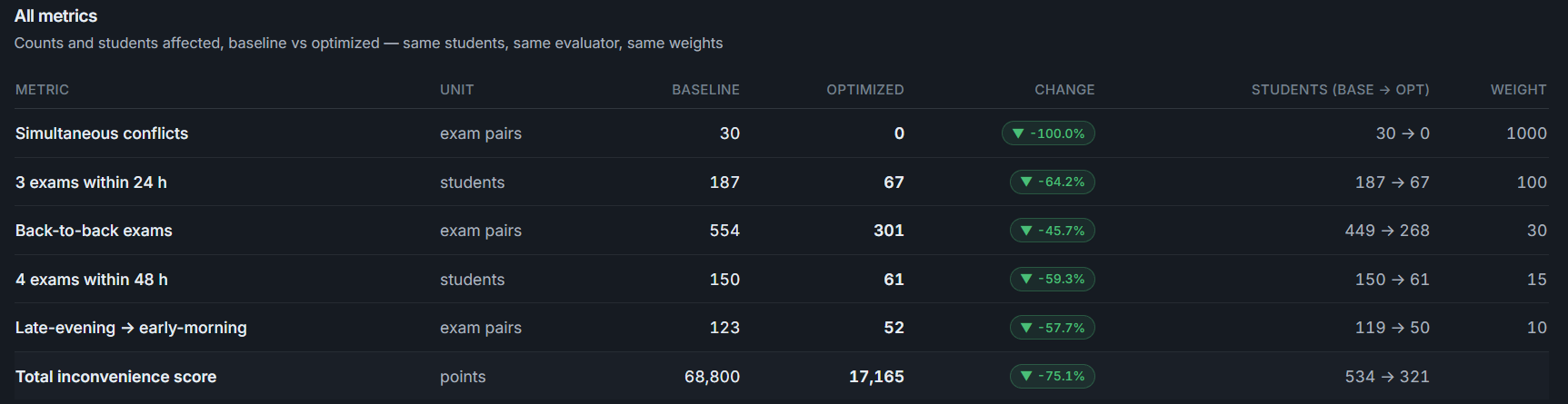
Aggregate comparison of the current Georgia Tech schedule and the optimized Hexam schedule.
-
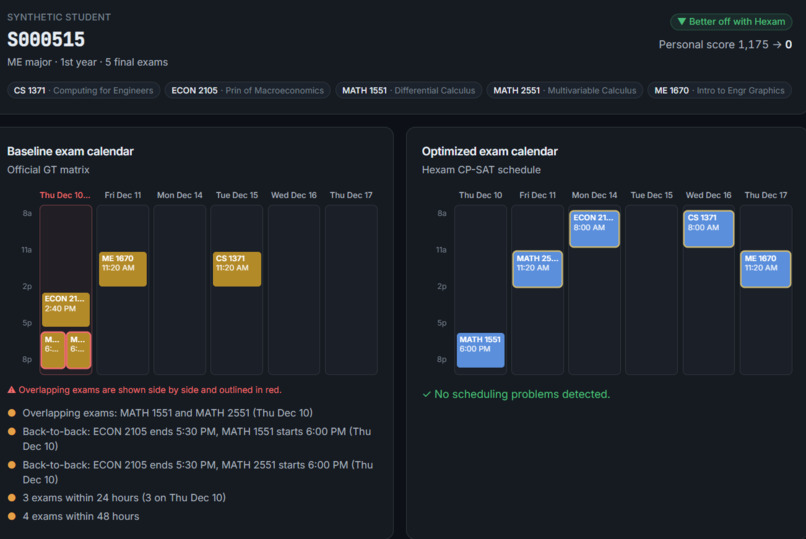
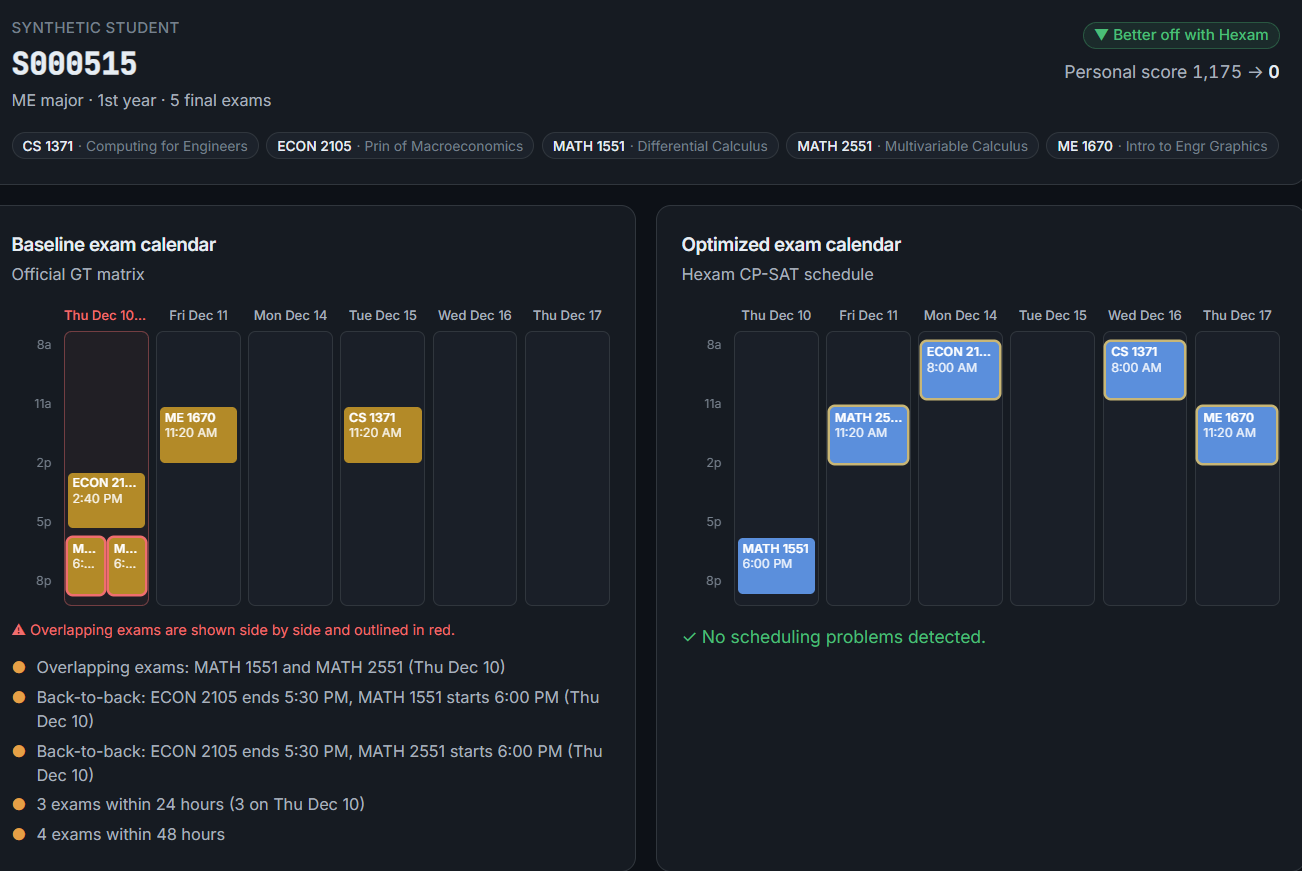
The before vs. after of a student's exam schedule
Inspiration
As Georgia Tech students, all of us know the dread of finals week a little too well. Some chaotically battle 3 brutal final exams in a 24-hour window, while others sit idle for days on end. When we looked at the standard formulaic exam matrices used by the registrar, we realised that while they do prevent direct time overlaps, they completely ignore human cognitive loads and recovery time between exams. We wanted to apply our engineering and computer science backgrounds to solve a problem that directly impacts our campus community every single semester: turning a rigid, stressful finals week into an optimized schedule centered around our students.
What it does
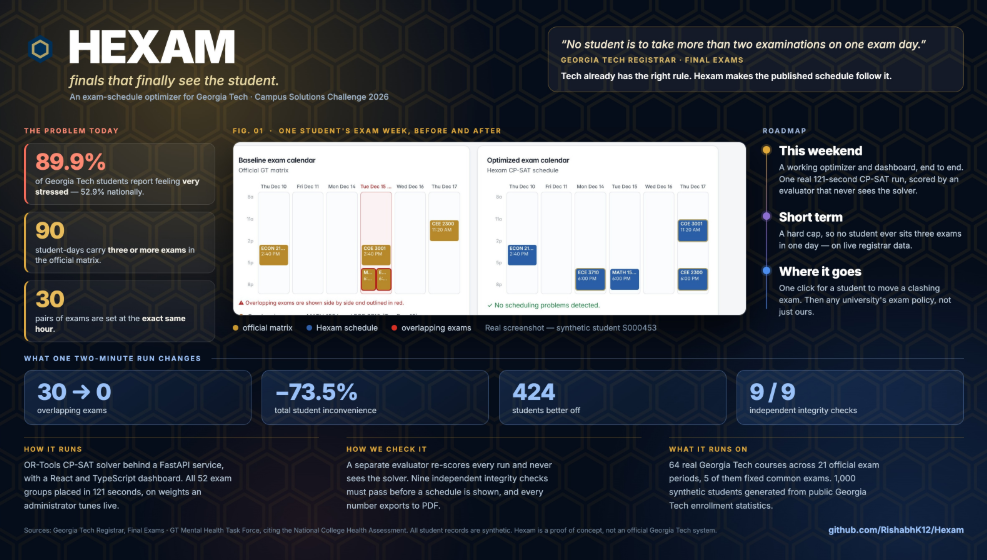
Hexam is an exam scheduling optimization platform designed specifically for Georgia Tech’s finals. It takes a real course catalog and official exam periods, looks at which courses students take together, and reassigns exam groups to periods so that students get more room between exams. Hexam treats student conflicts as hard constraints, so no student ever has two exams at the same time. It then works to reduce the patterns that wear students out, including three exams in 24 hours, back-to-back exams, four exams in 48 hours, and a late-evening exam followed by an early-morning one. A hybrid optimizer does the work, first running a Kempe chain local search and then handing the result to a CP-SAT algorithm to refine it and prove its quality. A separate evaluator scores every schedule against Georgia Tech’s official Fall 2026 exam matrix. We tested it on 1,000 synthetic students built from public GT data. A dashboard shows the before-and-after for the whole campus and for each student, and you can export a full PDF comparison report.
How we built it
We approached Hexam as a classic combinatorial optimization problem paired with an accessible web interface. The optimization engine was a Uvicorn backend built in Python and FastAPI, formulating exam timetabling as a graph-coloring and constraint-optimization problem. Course groups act as nodes, shared student enrollments act as weighted edges, and exam time slots act as colors, allowing us to minimize edge-weight penalties across consecutive time blocks. We implemented a CP-SAT solver to tackle our problem, as it specializes in optimizing solutions with quantized possibilities. As for the additional tools we used, we used Git and GitHub to organize our collaborative codebase. The frontend & visualizations are on a responsive web dashboard using React, Vite, Tailwind CSS, and more. This allows us to render complex multi-day exam grids and visualize metrics to show optimizations compared to traditional scheduling baselines. To process the data, we used structured course-catalog datasets to simulate realistic Georgia Tech enrollment overlaps to test edge cases across massive lecture sections.
Challenges we ran into
With hundreds of Georgia Tech courses and tens of thousands of intersecting student schedules, in a simulated run with just 20 courses and 60 possible exam time slots, our code would have to navigate through \(20^{60}\) possible exam schedules, making brute-forcing impossible. Instead, we refined our heuristics and pruning strategies so the solver could converge on a near-optimal schedule in seconds rather than hours. We tried three different pruning algorithms: a one-phase, a two-phase, and a hybrid pruning model. Through our testing, the hybrid pruning model, although more complex, saved the engine a lot of runtime when solving for an optimal exam matrix by implementing a Kempe chain. This allowed us to reach a final exam layout just as good in 2 seconds, compared to the one-phase pruning solution that took 120 seconds to give a solution equal in inconvenience score.
Accomplishments that we're proud of
On simulated Georgia Tech course loads, Hexam significantly reduced the number of students facing consecutive or same-day exams compared to standard rule-based scheduling. With the algorithm, we were able to completely remove same-time exam conflicts and reduce the total inconvenience experienced by students during finals week by 77%. Seeing our algorithm ingest a dense web of overlapping classes and output a clean, conflict-free schedule in real time was our biggest breakthrough of the weekend.
What we learned
This project gave us an appreciation for the many real-world applications of operations research and constraint programming, proving that algorithms we study in class can directly improve student life. We also learned how critical data modeling is. By structuring our conflict graphs cleanly from the start, scaling the solver and debugging edge cases was much easier under the time limit of the weekend.
What's next for Hexam
We envision directly ingesting live enrollment data and historical GPA/difficulty metrics to weight exam spacing by course rigor. Incorporating physical classroom capacities across campus buildings (like Clough, Howey, and Scheller), proctor availability, and extended-time accommodation blocks into the core solver would add to its viability. We also hope to launch a lightweight tool where Georgia Tech students can plug in their upcoming semester CRNs to preview projected finals clusters before registration closes.


