
Inspiration
Every context switch leaks something — the tab you meant to revisit, the term you meant to look up, the next step you had clearly in mind. Browsers treat everything as disposable tabs; note apps live in a window you never open. HEX started as a question: what if the thread of work — not the tab — was the unit your desktop organized around?
What it does
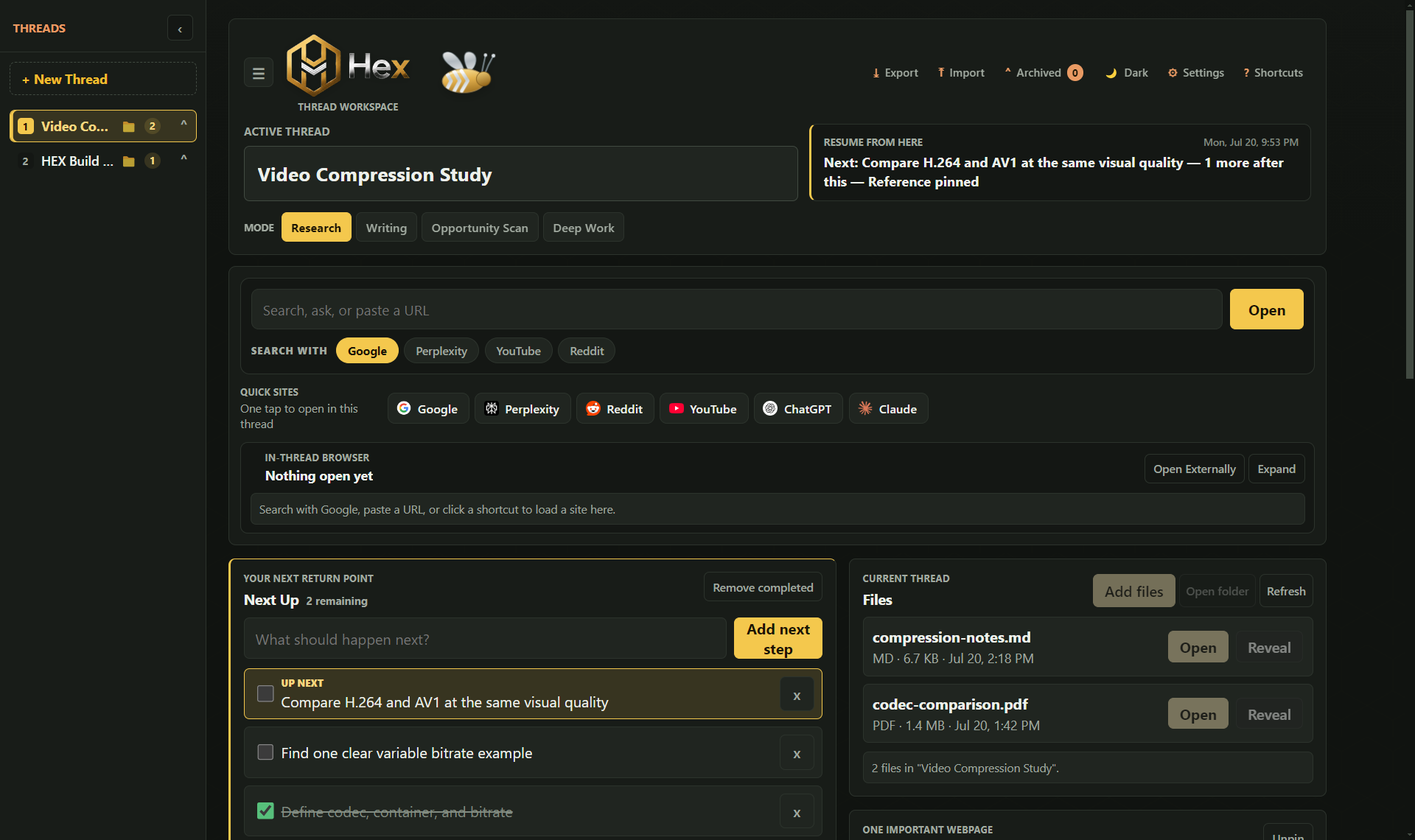
HEX is a local-first Windows companion that floats at the edge of your screen. Click the tab and it expands into the current thread of your work:
- Pins: press
Ctrl+Shift+Hin any application and your clipboard becomes a pin on the active thread. A contextual lookup attaches a concise sourced definition, and a review mode quizzes you one pin at a time until "Review" becomes "Understood." HEX tracks what you learned, not just what you saved. - Next Up: park a thought before you switch contexts — with age chips, one-tap reordering, and undo.
- The bee: drag the mascot anywhere; drop files, links, or text onto it and they're collected into the active thread. The bee is the collector — HEX is the comb.
- Codex Dock: every thread can connect to a persistent GPT-5.6 session via the official Codex SDK, scoped to that thread's folder with explicit read-only or write permissions. Your thread's context becomes the model's context.
How we built it
HEX was built with Codex and ships with Codex inside. Feature packages were written as markdown specs with hard constraints and acceptance checklists, then handed to Codex (gpt-5.6-sol) — which built them across the Electron main process, preload bridge, and renderers in single autonomous passes. Its work is committed under Codex authorship with CLI session IDs in the commit messages: run git log --author="Codex" in the repo. A long-running interactive Codex session drove the rest of the build, from the draggable bee to the light-mode theme.
Challenges we ran into
Getting drag-and-drop capture to coexist with Electron's security model (file paths only resolve in the preload layer), keeping one codebase coherent across two renderer surfaces, and making an ambient overlay that never steals focus from real work.
What we learned
Spec-driven agent development works: tight constraints plus an acceptance checklist turned Codex into a reliable feature contractor whose diffs passed tests on the first run.
What's next
Thread export for durable backups, richer review scheduling for pins, and deeper Codex Dock workflows — letting the model act on everything a thread already knows.
Built With
- css
- electron
- gpt-5.6
- html
- javascript
- node.js
- openai-codex-sdk


Log in or sign up for Devpost to join the conversation.