-
-
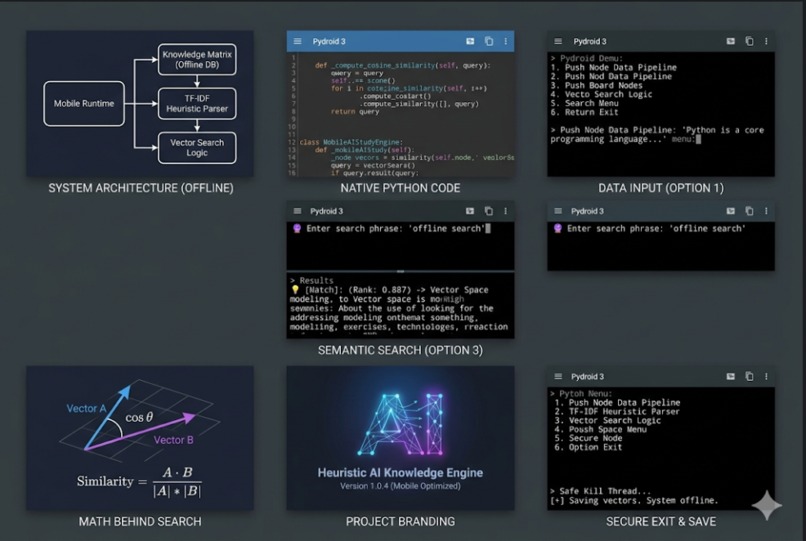
System Architecture and Core Features Demo
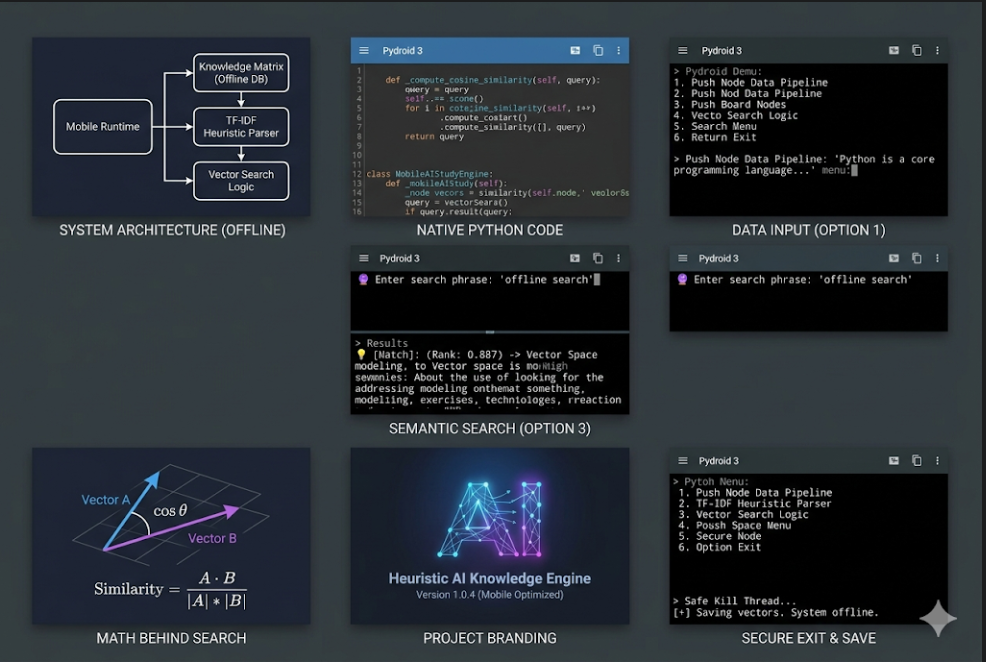
💡 Inspiration
Most academic assistants require high-speed internet and heavy machine learning packages, making them unusable for students with limited data or lower-end mobile devices. I wanted to build a completely self-sustaining, lightweight semantic search engine that runs flawlessly offline.
⚙️ How I Built It
The architecture is engineered entirely from scratch in pure Python without using standard libraries like NumPy or Pandas. It constructs a dynamic Vector Space Model (VSM) using natural language parameters, computing TF-IDF matrices and executing high-dimensional Cosine Similarity formulas via standard mathematical logic to find matching notes.
🛠️ Challenges I Faced
Optimizing multi-dimensional token indexing on a restricted mobile runtime memory was a massive roadblock. Bypassing external vector frameworks meant I had to optimize text processing routines entirely using native Python dictionaries and loops, which forced me to understand the core mathematics behind AI engines deeply.
🎓 What I Learned
I mastered the practical application of linear algebra, heuristic parsing pipelines, data structure optimization for string evaluation, and the end-to-end version deployment flow using GitHub controls.


Log in or sign up for Devpost to join the conversation.