Inspiration
Endometriosis doesn't happen only during medical appointments. It affects everyday life.
Millions of people living with endometriosis experience fluctuating pain, fatigue, and other symptoms. Yet healthcare usually sees only occasional snapshots of their condition.
Patients are expected to remember what happened between appointments: when symptoms started, what changed, which treatments helped, and what might have influenced their wellbeing.
Traditional symptom trackers help, but manual logging can become another burden, especially during difficult days.
HerPattern started with a question:
What if technology could help people understand their bodies without requiring them to constantly document their lives?
Bee inspired a new approach. Its ability to capture and organize everyday context creates an opportunity to make health tracking more natural.
The goal is an intelligent, unobtrusive companion that connects everyday experiences, symptom patterns, and physiological signals to help people understand tomorrow and measure what works.
What it does
HerPattern Bee Companion transforms everyday context into meaningful endometriosis insights.
The experience brings together three complementary sources of information:
- Bee contextual intelligence: User-authorized voice notes, daily summaries, and relevant contextual information help capture experiences that might otherwise be forgotten.
- Apple Watch and wearable signals: Physiological information, where available and authorized, adds another dimension to understanding daily changes.
- HerPattern symptom intelligence: Pain, fatigue, menstrual-cycle information, treatments, and personal observations provide health-specific context.
HerPattern is designed to connect these signals into a personal longitudinal timeline.
The experience focuses on five capabilities:
- Low-effort tracking: Reduce repetitive manual entries by making relevant daily context easier to capture.
- Personalized pattern discovery: Explore relationships between symptoms, routines, activities, and physiological changes.
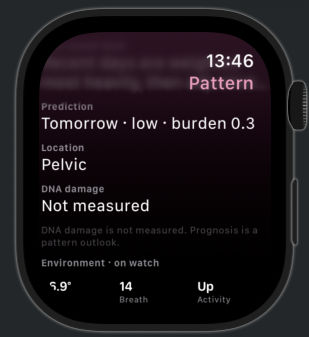
- Next-day planning: Develop personalized symptom-burden forecasts that communicate uncertainty rather than promise certainty.
- Treatment-response tracking: Help users understand how their experiences change after interventions.
- Meaningful health summaries: Organize longitudinal observations into information users can discuss with healthcare professionals.
HerPattern is not intended to diagnose endometriosis or replace medical advice. Its purpose is to make personal health information easier to understand and use.
How we built it
HerPattern began as a patient-first endometriosis intelligence platform, with symptom tracking, longitudinal analysis, and personalized forecasting as its foundation.
The Bee Companion extends this direction toward a more natural, contextual experience.
The architecture is designed around independent components connected through secure interfaces:
- iOS application: The primary experience for symptom tracking, personal insights, and longitudinal health information.
- Apple Watch companion: A lightweight wearable experience for accessible check-ins and relevant health information.
- Bee integration: A connection to user-authorized contextual information captured and processed through Bee.
- Shared backend: Centralized application logic, structured records, and controlled access to user information.
- Personalization layer: Time-series analysis and probabilistic modeling intended to account for individual variation and uncertainty.
Bee's developer ecosystem supports retrieving contextual information such as conversations, voice notes, facts, and daily summaries.
Hackathon-specific implementation: [Insert the Bee interface actually implemented, such as CLI, MCP, or API, the data retrieved, and the working interaction demonstrated.]
The design separates device experiences from shared backend functionality, allowing the mobile app, Apple Watch companion, and future wearable integrations to evolve independently.
Privacy is a core consideration. Health-related context should be incorporated only with meaningful user consent, appropriate access controls, and the ability to review relevant information.
Challenges we ran into
1. Turning everyday context into meaningful health information
Bee provides rich contextual information, but everyday conversations are not structured medical records.
The challenge is identifying potentially relevant observations without treating casual statements as confirmed symptoms or medical facts.
2. Reducing tracking effort without losing accuracy
Automated context can make tracking easier, but users must remain in control of what becomes part of their health history.
The experience needs to distinguish between automatically identified information, explicitly reported symptoms, and model-generated interpretations.
3. Combining different types of information
Voice-derived context, manually entered symptoms, and wearable measurements have different formats, frequencies, and levels of reliability.
Aligning them on a meaningful timeline is essential for useful personalization.
4. Communicating uncertainty
Endometriosis is highly individual. An apparent relationship between daily activities and symptoms does not establish causation.
We approached personalized insights as evidence to explore, not medical conclusions.
5. Designing across devices
A watch interaction should be brief and useful, while the mobile application can provide deeper analysis.
The challenge is maintaining a coherent experience across different devices without overwhelming the user.
Accomplishments that we're proud of
The biggest achievement is bringing contextual AI and personalized women's health intelligence into one coherent product direction.
HerPattern Bee Companion demonstrates how wearable AI can address a meaningful daily problem beyond reminders and general productivity.
We are particularly proud of:
- A patient-first approach: Designing around the realities of chronic pain, fatigue, and fluctuating symptoms.
- A context-aware experience: Exploring ways to reduce the burden of conventional symptom journaling.
- A cross-device architecture: Designing mobile and wearable experiences around shared functionality.
- A longitudinal perspective: Looking beyond isolated measurements toward patterns that develop over time.
- A responsible approach to health AI: Keeping uncertainty, user control, and the distinction between observations and medical conclusions central to the design.
The project also establishes a direction for connecting everyday patient experiences with structured treatment-response research.
What we learned
The most valuable health insight is not necessarily another measurement. It is understanding what changed, when, and why it might matter.
Building around Bee highlighted several important lessons.
First, context matters. Two days with similar symptoms may be very different when sleep, activity, treatment, stress, and personal circumstances are considered.
Second, passive or low-effort data collection is only useful when people understand and control what is being recorded.
Third, personalization is essential. People living with the same diagnosis may experience very different symptoms and treatment responses.
Fourth, health-focused AI must communicate limitations. Finding a pattern does not automatically mean identifying its cause.
Finally, wearable AI has an opportunity to become a bridge between everyday life and healthcare, provided it remains useful, transparent, and respectful of sensitive information.
What's next for HerPattern Bee Companion
Our vision extends beyond symptom tracking.
Near term: Better everyday experiences
- Refine the Bee integration and contextual tracking workflows.
- Improve the iOS and Apple Watch experiences.
- Conduct additional patient testing.
- Evaluate the usefulness and reliability of personalized insights.
- Strengthen user controls for contextual and health data.
Next stage: Personalized treatment intelligence
- Improve next-day symptom-burden forecasting.
- Introduce more structured treatment-response tracking.
- Develop clinician-friendly longitudinal summaries.
- Explore integrations with additional wearable platforms.
- Collaborate with researchers and clinical specialists on validation.
Long term: From personal insights to research intelligence
With appropriate consent, governance, and research partnerships, HerPattern aims to support longitudinal research into symptom patterns, treatment responses, and patient subgroups.
Over time, this could contribute to better study design, evidence generation, and therapeutic research.
Our long-term mission is simple:
Understand tomorrow. Measure what works. Advance discovery.

Log in or sign up for Devpost to join the conversation.