-
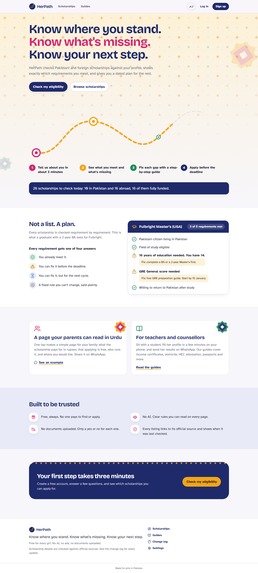
Home Page
-
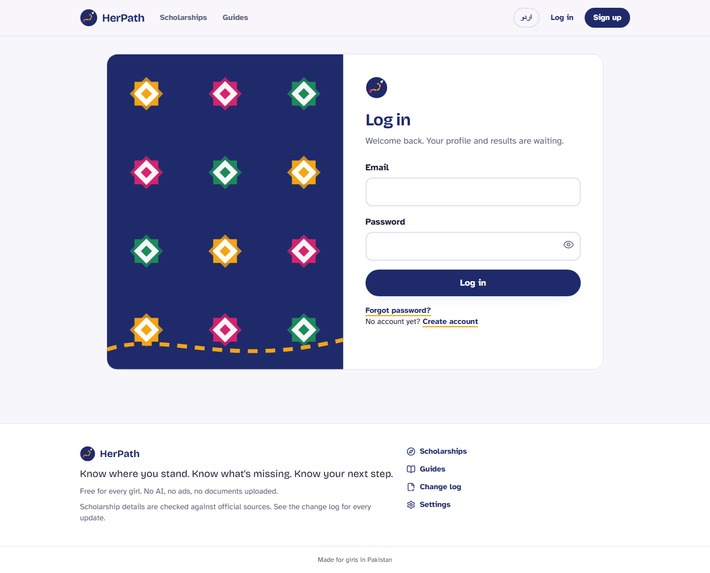
Profile Form
-
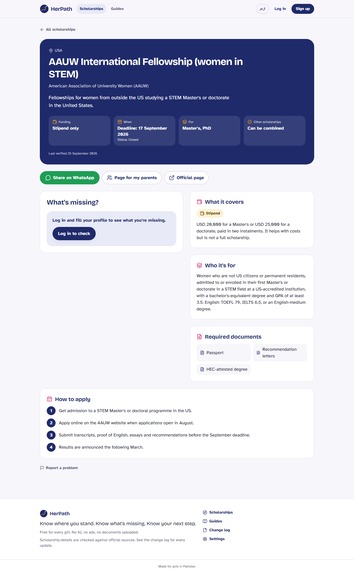
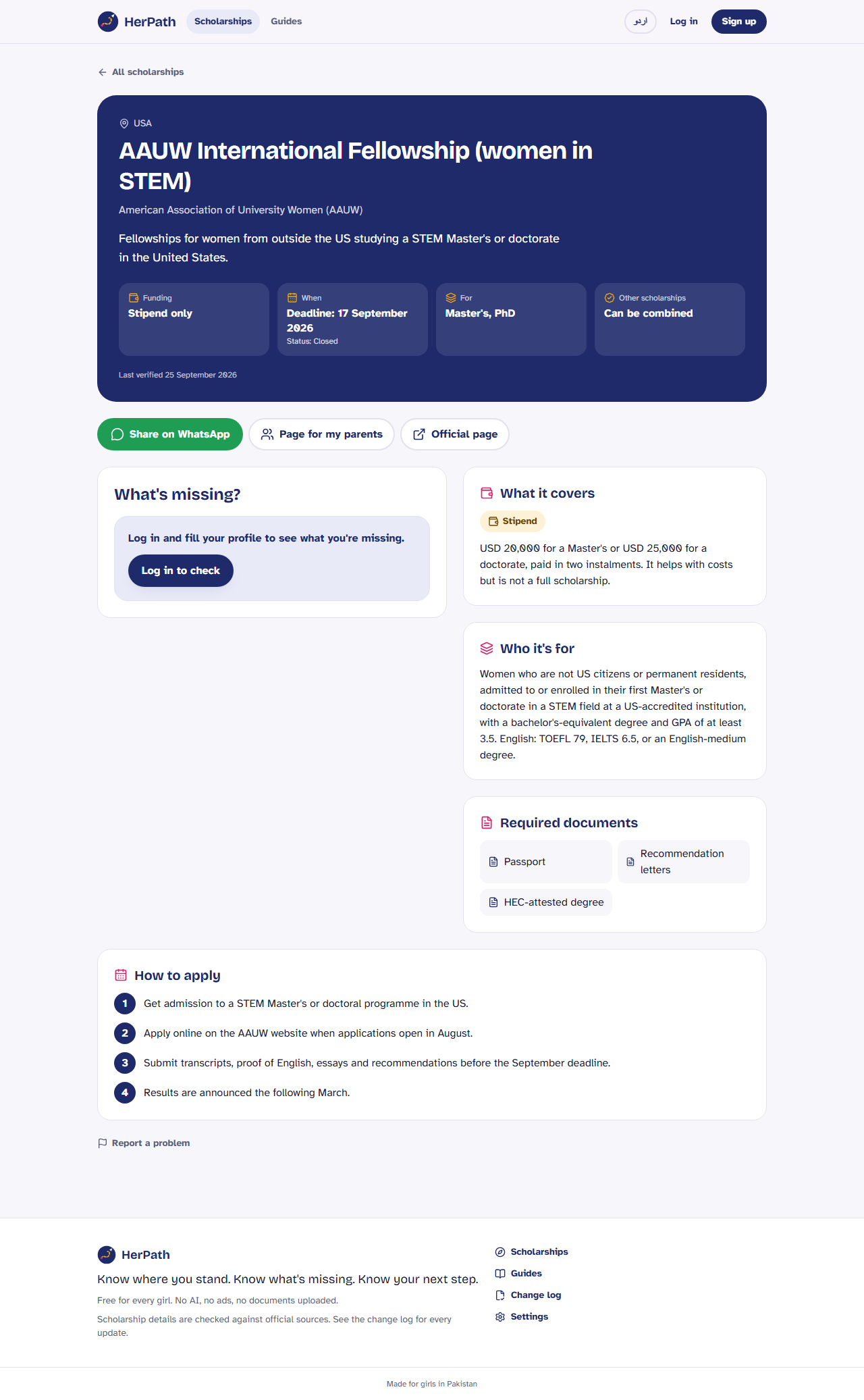
Gap Analyzer and Scholarship Detail
-
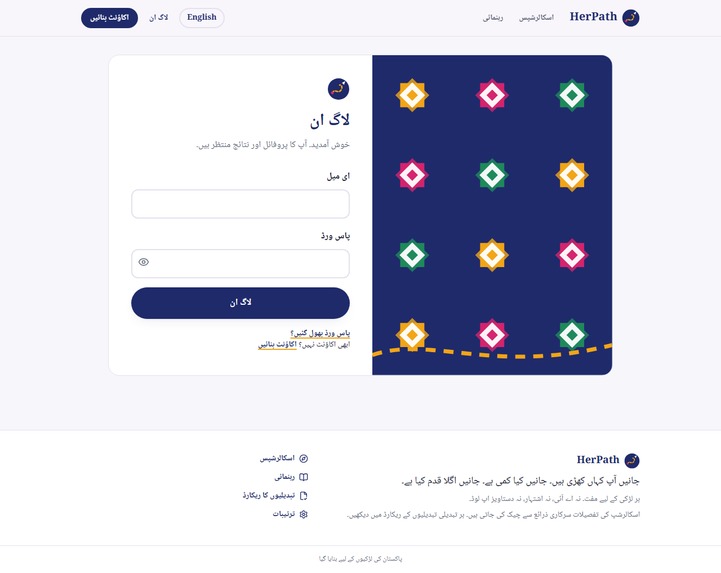
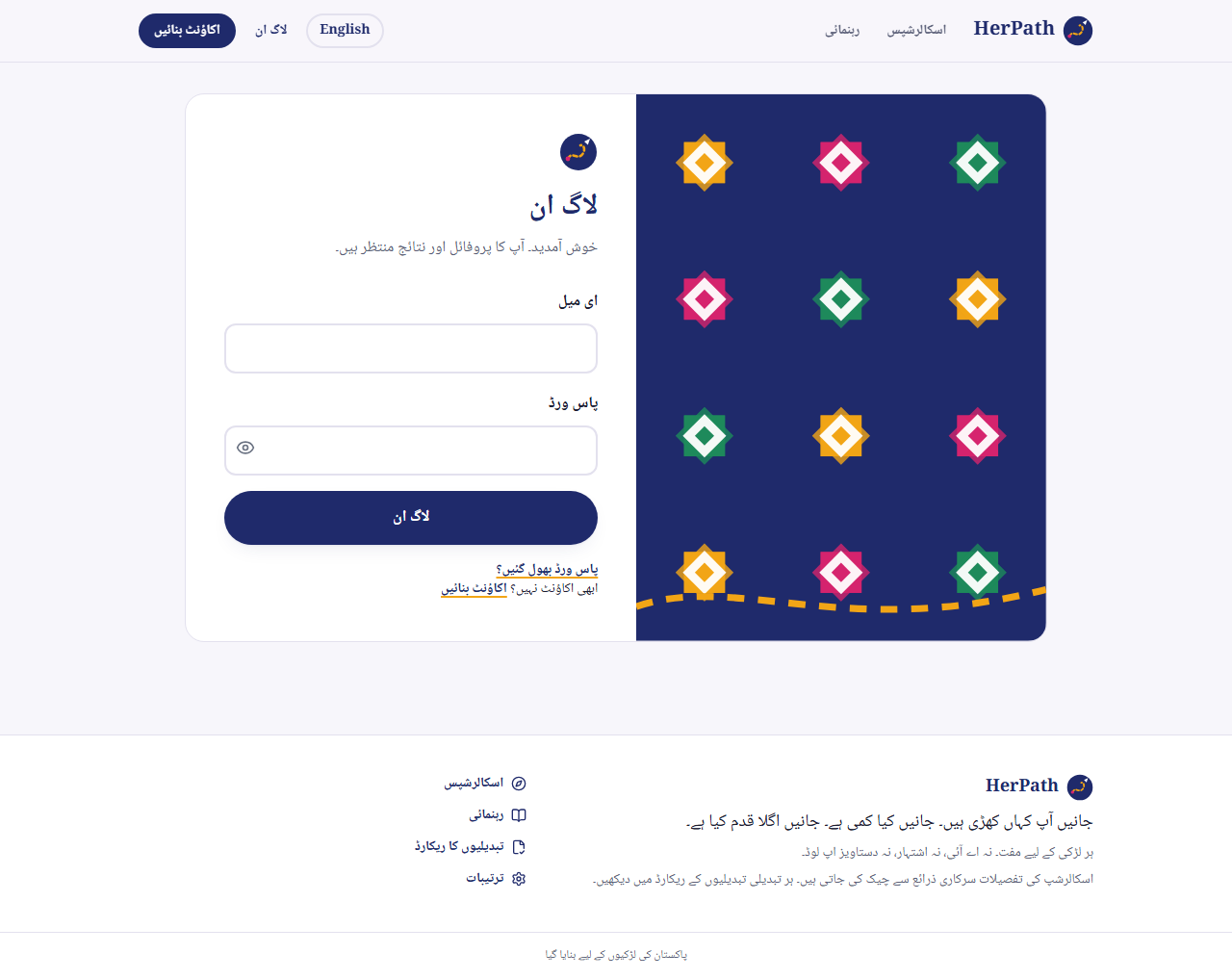
Urdu Mode
-
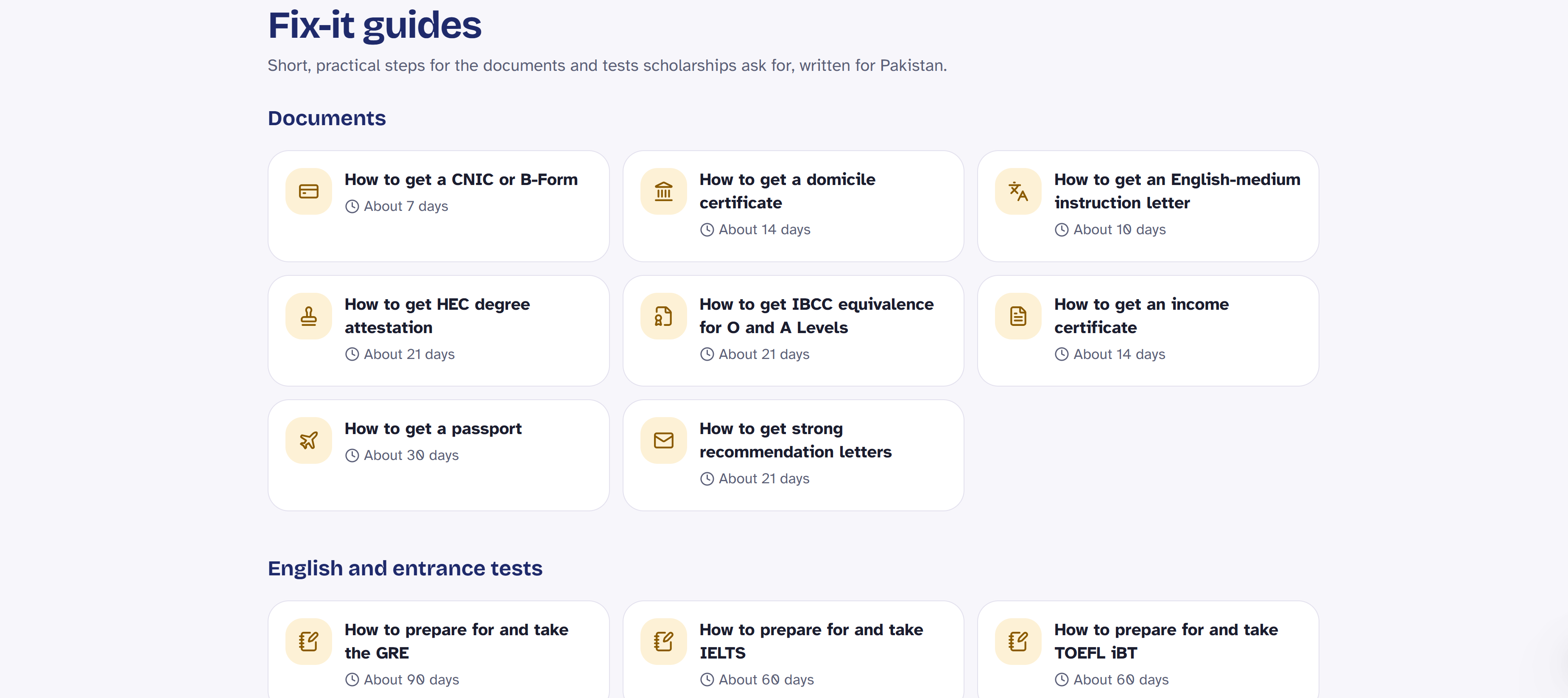
Guides
-
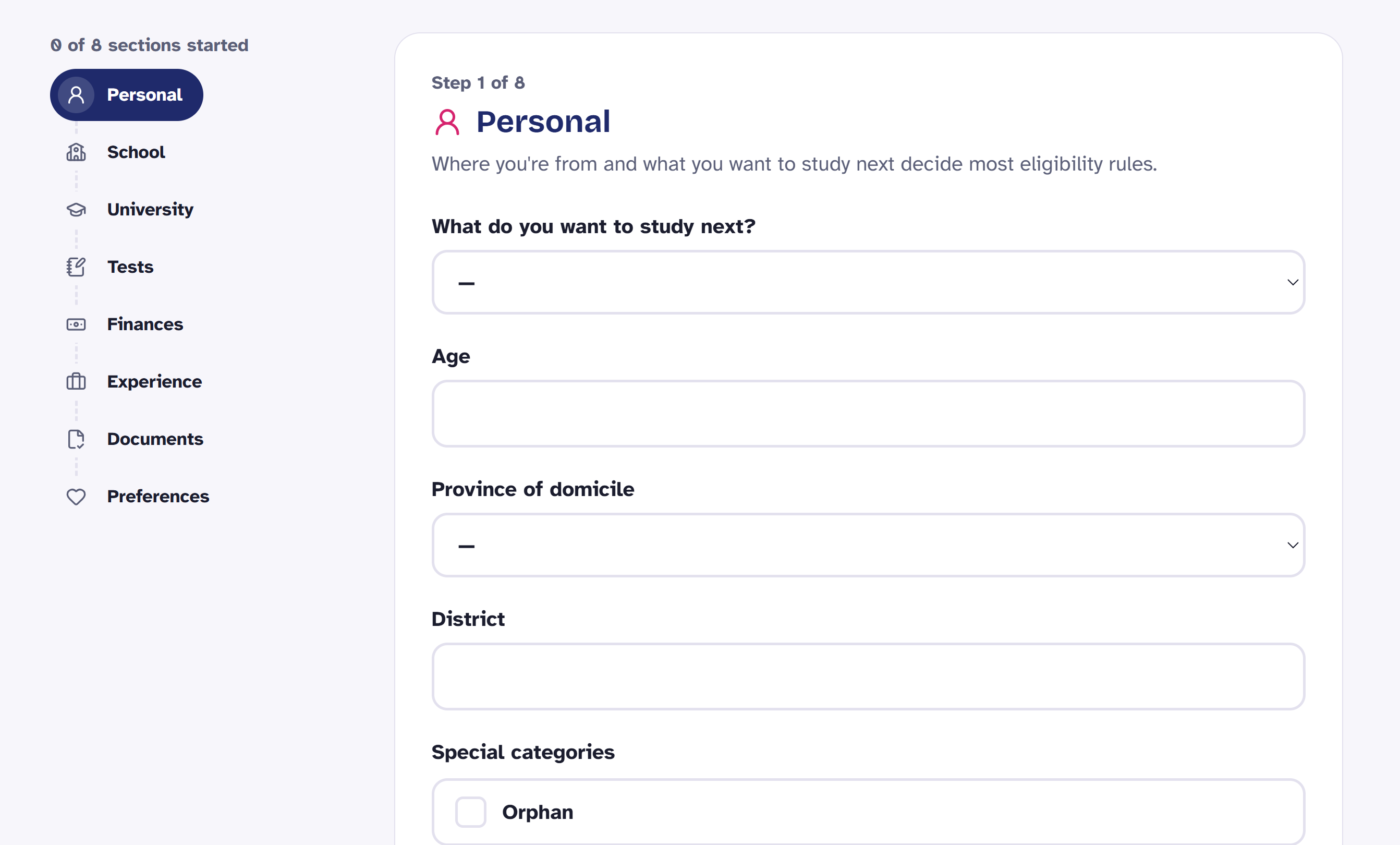
Profile Sections
Inspiration
Our inspiration came from a landmark experiment at the University of Michigan called the HAIL Scholarship. The researchers discovered something counterintuitive: the university didn't need to offer more money. They simply told high achieving, low income students before they applied that they would receive the aid they already qualified for.
The results were stunning:
Applications jumped from 26% to 68% Enrollment more than doubled from 12% to 27% The insight? Uncertainty is one of the biggest barriers holding students back.
We saw this same barrier playing out on a massive scale in Pakistan:
Pakistan has the second highest number of out of school children in the world (25.1 million, ages 5 to 16) Over 13 million girls are out of school, more than boys Pakistan ranks 143rd out of 145 in the World Economic Forum's Global Gender Gap Index The girls who do finish school often have access to scholarships, but the information doesn't reach them. Eligibility rules are scattered across HEC pages, embassy websites, and social media posts, written in dense language about domicile requirements, income caps, and board restrictions. A first generation student has no easy way to tell whether she qualifies or what to do if she doesn't.
We built HerPath to bring certainty to scholarship access.
What it does
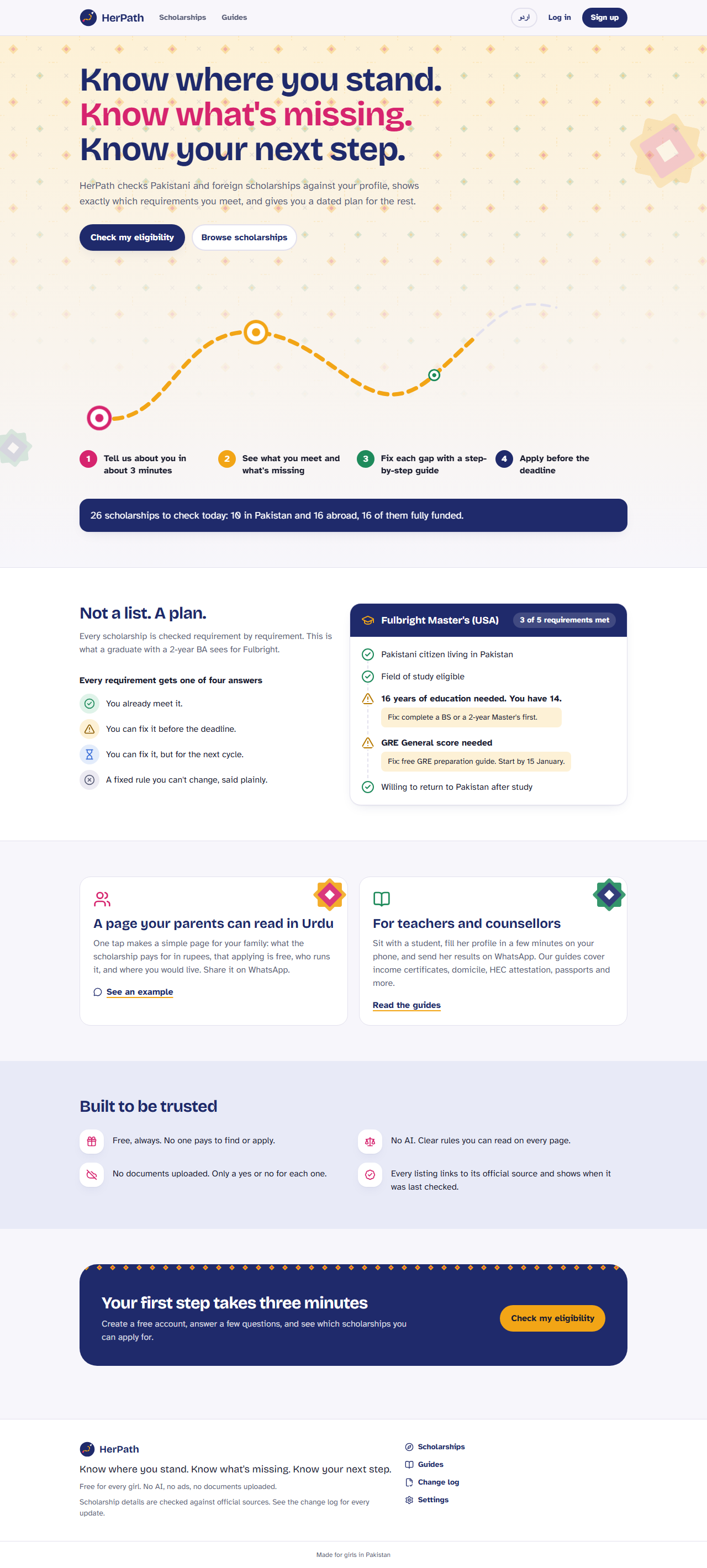
HerPath is a scholarship platform that does three essential things:
Matches her profile to scholarships she actually qualifies for, replacing "here are 500 scholarships" with "you qualify for these 6."
Shows exactly what's missing for scholarships she's close to qualifying for, with a clear explanation of each gap.
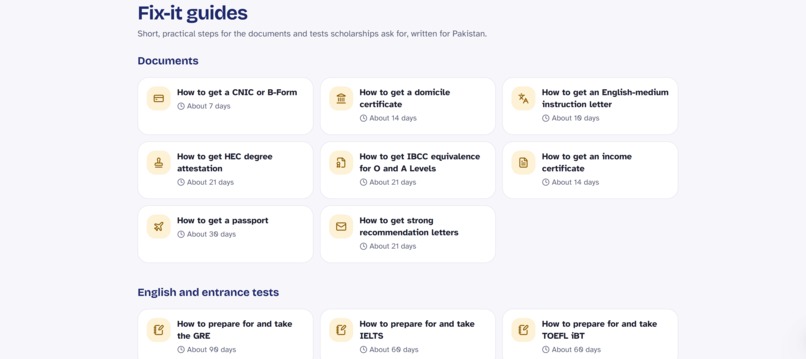
Provides step by step plans to close each gap before the deadline, with Pakistan specific guides for common obstacles like how to get an income certificate, a domicile certificate, or HEC degree attestation.
The Gap Analyzer: The Heart of HerPath
Every scholarship requirement is stored as a structured rule. When a girl fills in her profile, HerPath checks her against each scholarship and returns one of four statuses for every requirement:
MET: she fulfils this requirement FIXABLE: she's missing it, but can fix it before the deadline FIXABLE LATER: she can fix it, but not in time for this cycle NOT ELIGIBLE: a fixed condition she can't change (like domicile)
Real eligibility rules are complex. Many scholarships accept either IELTS or TOEFL or an English medium instruction letter. Fulbright accepts either a 16 year degree or a 4 year BS. So requirements can be grouped as "any one of these," and a rule can apply only in certain conditions. This keeps the analysis honest and shows her the fastest fix, not just any fix.
Example: A Graduate Applicant
Fulbright Master's Degree (USA): 3 of 5 requirements met
MET: Pakistani citizen, living in Pakistan MET: Field of study eligible FIXABLE: 16 years of education required. You have 14 (BA). Fix: Complete a 2 year Master's or a BS degree first. See the Fix It Guide. FIXABLE: GRE General score needed. Fix: Free GRE preparation guide. Start by 15 January to have results before the deadline. MET: Willing to return to Pakistan after study
Results Grouped into Four Tabs
APPLY NOW: she meets every requirement and the application window is open READY WHEN IT OPENS: she meets every requirement; the cycle hasn't opened yet ALMOST THERE: she has gaps she can fix before the deadline FUTURE GOALS: she can reach these in 1 to 2 years with a plan
The "Almost there" tab turns "I don't qualify" into "I qualify if I do these two things."
Other Key Features
Bilingual and mobile first: full English and Urdu interface with right to left layout, optimized for low cost Android phones on slow connections Family Mode: a simple, shareable page in Urdu for her parents explaining what the scholarship covers, that it's free to apply, and where she would study Document Checklist: see which missing documents unlock the most scholarships ("Get your passport and 7 more scholarships open up") Saved Scholarships and Deadline Tracker: bookmark scholarships and track deadlines with conflict warnings Share on WhatsApp: every scholarship and Family Mode page forwards directly on WhatsApp, the way most information travels in Pakistan
How we built it
Architecture
Scholarship database: scholarships are curated in an admin panel and seeded from JSON files in Git. Each scholarship's requirements are stored as structured rules; an invalid rule cannot be saved.
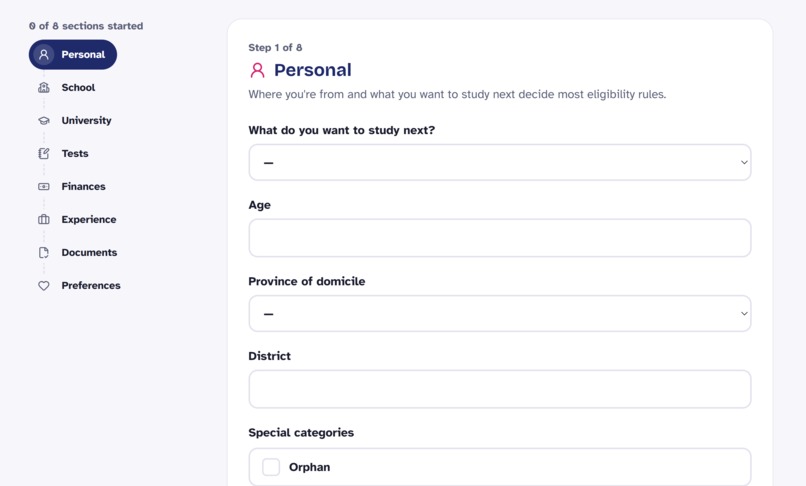
Profile: a short, 3 minute form captures her facts: age, domicile, board, exam scores, tests, family income, work experience, and documents. The profile is saved to her account so she never re enters it.
Matching engine: a Python rule engine on the server compares her profile to each requirement and returns a status. Rules can be grouped as "all of" or "any of," and a rule can apply only under a condition (e.g., an age limit for Master's applicants only).
Readiness score: if a fixed requirement fails, the scholarship is marked "Not eligible." Otherwise, the score reflects how many fixable gaps remain and whether each can be closed before the deadline.
Start by dates: for each fixable gap, we calculate deadline (official, or estimated from the usual opening month) minus the typical processing time for that step. If the start by date has passed, the gap becomes "Fixable later."
Data Curation and Verification
Version 1 launches with 26 carefully chosen scholarships that can reach the most girls:
In Pakistan: HEC Need Based, Benazir (50% reserved for women), provincial funds (PEEF, SEEF, BEEF), university level scholarships, HEC Indigenous PhD Fellowship, and education loans
Abroad: Fulbright, Chevening, Commonwealth, DAAD, Türkiye Bursları, Chinese Government, Stipendium Hungaricum, Erasmus Mundus, Global Korea, MEXT, Gates Cambridge, Eiffel, Australia Awards Pakistan, AAUW, Aga Khan Foundation, and HEC overseas programs
Every listing is hand curated and verified, linked to its official source, and marked with a "last verified" date. A monthly verification calendar checks each listing before its usual opening, and a public change log records every update.
Challenges we ran into
Complex Eligibility Rules
Many scholarships have interdependent, conditional requirements. A scholarship might require either IELTS or TOEFL or an English medium instruction letter. An age limit might apply only to Master's applicants, not undergraduates. Some scholarships allow holding another scholarship; others don't.
We solved this by building a structured rule system with support for "any of" and "all of" grouping, and conditional rules that apply only when certain conditions are met. This keeps the analysis honest and shows her the fastest fix, not just any fix.
Keeping Scholarship Data Fresh
Scholarship programs change. In 2025, funding cuts left Pakistan's Fulbright uncertain; in August 2026, it was renewed. A girl relying on outdated information could miss an opportunity or waste months preparing for one that no longer exists.
We built a verification calendar and maintenance routine:
Cycle based deadlines instead of fixed dates (most Pakistani scholarships announce annually) A "next check" date for each listing, set to about a month before its usual opening An admin panel showing every listing due for verification A public change log recording every update and its source
Designing for Low Connectivity
Most HerPath users will be on low cost Android phones on slow connections. We had to keep the JavaScript bundle small, avoid heavy images, use a Naskh (not Nastaliq) typeface for Urdu with smaller font files that render reliably on budget phones, and build a mobile first, static first design.
Handling Sensitive Data Safely
Many users are teenage girls on shared family phones. We designed for privacy by making accounts email plus password only (no phone number, photo, or CNIC), storing profiles with facts, not documents (no file uploads), allowing her to delete everything in one tap from Settings, and logging out her profile from the device while allowing her to reset her password from anywhere.
Translating Without Losing Clarity
Scholarship terminology is dense: "domicile," "CGPA," "HEC attestation," "IBCC equivalence." We had to translate these accurately for an Urdu speaking audience while keeping explanations short enough for a phone screen.
Accomplishments that we're proud of
A matching engine that's honest: instead of a misleading "90% match" for something she can't apply to, we clearly state fixed requirements she doesn't meet and suggest similar scholarships she can apply for.
Pakistan specific fix it guides: Version 1 ships with five guides (income certificate, domicile certificate, HEC attestation, IBCC equivalence, passport). Each one is written for the Pakistani bureaucratic context, with actual step by step instructions.
A data verification system that actually works: most scholarship portals publish data and abandon it. We built a calendar driven verification routine, a public change log, and a report a problem system so the data stays current.
Transparent, rule based matching with no AI: every match can be traced back to a rule she can read on the scholarship page. No black box algorithms, no mysterious scores.
A bilingual, mobile first design that works on slow connections: it loads fast, handles right to left text properly, and renders Urdu reliably on budget Android phones.
Family Mode: we recognized that many girls' education decisions depend on parental approval. Family Mode explains scholarships in simple Urdu, showing what's covered, that it's free, where she would live, and whether hostel accommodation is provided.
What we learned
Certainty is worth more than money: removing uncertainty by letting girls know exactly where they stand and what to do next is one of the most powerful interventions we can offer. Girls don't need more scholarships; they need to know they qualify for the ones that exist.
Information is not neutral: information scattered across a hundred websites doesn't reach the people who need it most. Reaching girls means going through the people already talking to them: teachers, counsellors, and trusted community organizations. A website that waits to be found repeats the problem it's trying to solve.
Data verification is a feature, not a footnote: scholarship programs change. A "last verified" date on every listing isn't a nice to have; it's essential to trust. We built verification into the product from day one.
Simplifying rules doesn't mean ignoring complexity: eligibility rules are genuinely complicated. Instead of hiding that complexity, we embraced it with structured rules that handle "any of," "all of," and conditional logic, then showed her the simplest path forward.
Language and cultural context matter deeply: translating is not just swapping words. We had to understand how Pakistani families think about scholarships, what bureaucratic processes look like, how to address girls respectfully, and how to build trust with parents who've never encountered systems like this before.
Design for the actual user, not the ideal user: our user is a girl on a shared family phone, on a slow connection, in a context where data costs money. Every design choice from bundle size to font selection to page load time to Urdu text rendering had to serve her reality, not our ideals.
What's next for HerPath
Version 2: Planning and Comparison
Pathway Planner ("Future Me"): a long term roadmap (e.g., Intermediate to BS in Pakistan to work experience to Master's abroad), showing which scholarships open up at each stage and what to prepare now. Scholarship Comparison: side by side comparison of 2 to 3 scholarships on coverage, requirements, readiness, deadline, and effort. Calendar view of all saved deadlines. Essay and Personal Statement Guide with each scholarship's prompts, a structure guide, and a self check list. Success Stories: short profiles of Pakistani women who won these scholarships, from public sources or shared with permission. Women friendly study information: women's universities, hostel coverage, and female quotas highlighted per scholarship and university.
Beyond Version 2
Deadline reminders by SMS or WhatsApp Regional languages: Punjabi, Sindhi, Pashto, and Balochi Provider portal for scholarship organizations to submit and update their own listings Mentorship network connecting applicants with Pakistani women who have won scholarships Counsellor view for one teacher to guide many students from one phone
Scaling Reach
HerPath's long term success depends on reaching girls through trusted channels:
Partner schools and colleges where counsellors can use HerPath with students NGOs and community organizations working on girls' education WhatsApp first sharing so each scholarship can be forwarded easily Printable posters with QR codes for school notice boards in Urdu and English
HerPath: because no girl should miss a scholarship she could have won.
Built With
- django
- docket
- jwt
- nextjs
- postgresql
- python
- react
- restapi
- tailwindcss
- typescript

Log in or sign up for Devpost to join the conversation.