-
-
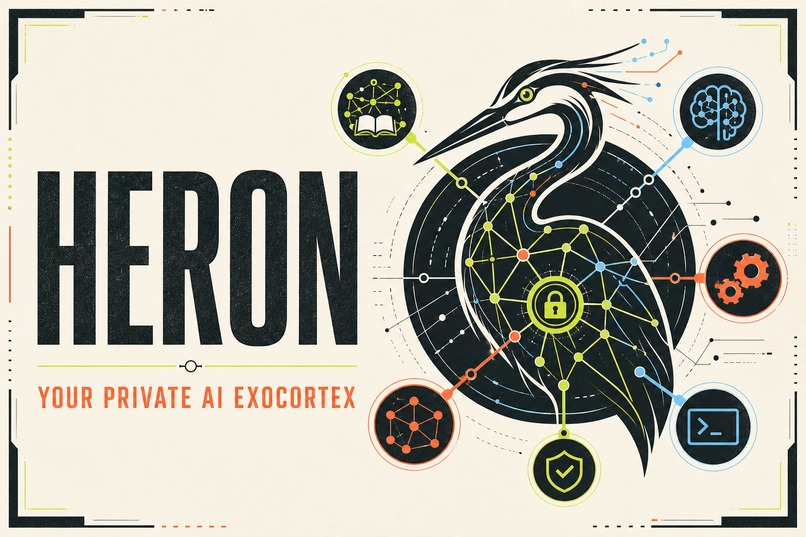
Your personal exocortex system with a powerful feedback loop

The Quantum Heron System
Your living exocortex and intelligent feedback loop—turning what you encounter into what you understand, retain, and use.
Inspiration
We have unprecedented access to information, but most of our tools do very little to help that information compound.
Articles disappear into bookmarks. Videos become vague memories. Notes become disconnected fragments. Learning apps focus on isolated memorization. Even valuable AI conversations are often lost as soon as the chat ends.
I wanted to build something different: a system that could help a person continuously capture information, examine it from multiple perspectives, connect it to existing knowledge, reinforce what matters, and turn it into useful action.
That idea became The Quantum Heron System: a working ecosystem of five connected AI applications that together function as a personal exocortex.
- HeronFeed captures, organizes, synthesizes, and transforms incoming information.
- HeronWatch analyzes videos, claims, arguments, and media through multiple reasoning perspectives.
- HeronLearn turns information into structured learning experiences, quizzes, flashcards, and active recall.
- HeronGraph preserves relationships among sources, concepts, insights, goals, and learning artifacts.
- HeronClient provides a unified conversational interface to the intelligence accumulated throughout the system.
Each application can be useful independently, but the larger goal is to make them operate as parts of the same evolving intelligence.
What it does
The Quantum Heron System transforms fragmented information consumption into a continuous cognitive feedback loop:
$$ \text{Capture} \rightarrow \text{Analyze} \rightarrow \text{Connect} \rightarrow \text{Learn} \rightarrow \text{Apply} \rightarrow \text{Reflect} $$
A user can enter the system through any application.
An article discovered in HeronFeed can become a structured insight, conversation, learning item, or graph connection. A video examined in HeronWatch can produce claims, counterarguments, questions, and relationships to previously encountered ideas. HeronLearn can reinforce those ideas through active recall. HeronGraph makes the resulting knowledge structure visible. HeronClient gives the user a conversational doorway into the context accumulated across the system.
The applications exchange structured context rather than simply linking to one another. This allows information to retain its source, meaning, relationships, and history as it moves through the ecosystem.
The system is built around several principles:
- Continuity: Knowledge should persist across applications and interactions.
- Provenance: Insights should remain connected to the sources and transformations that produced them.
- Multiple perspectives: Important content should be examined through more than one analytical lens.
- Active reinforcement: Useful ideas should return as questions, summaries, flashcards, and connections.
- Human agency: AI should support judgment and reflection, not replace them.
- Compounding value: Each meaningful interaction should improve the value of future interactions.
How I built it
I built the Quantum Heron System as a full-stack, multi-application ecosystem connected through shared infrastructure, identity, structured cognitive objects, and contextual handoff contracts.
The system combines React-based user interfaces with JavaScript, TypeScript, Node.js, Express, and Python services. PostgreSQL and pgvector provide durable storage, semantic retrieval, and support for the evolving knowledge graph. REST APIs and WebSockets allow the applications to exchange information and update their interfaces.
OpenAI models provide the system's primary reasoning layer. They are used to:
- Extract concepts, claims, questions, entities, and relationships
- Generate structured summaries and analyses
- Create quizzes, flashcards, and other learning materials
- Support source-aware conversations
- Examine information through multiple reasoning modes
- Find connections across previously separate interactions
- Transform passive content consumption into active engagement
- Generate reusable structured outputs instead of disposable text responses
One of the most important architectural decisions was to treat model outputs as durable cognitive objects.
Instead of allowing an AI response to disappear inside one chat window, the system can preserve it as a structured object with its source, provenance, relationships, confidence, and potential uses. That object can then move between Feed, Watch, Learn, Graph, and Client.
The applications are independently deployable and connected through production web infrastructure. The broader implementation also includes containerization, authentication, shared data services, testing, and deployment automation.
AI-assisted development was central to my process. I used AI tools transparently as development collaborators for architecture exploration, implementation, debugging, testing, interface refinement, and integration across a project whose scope would normally require a much larger team.
Challenges I faced
The hardest challenge was not building an individual AI feature. It was making five applications behave like different surfaces of the same intelligence.
Cross-application context can quickly become an unstructured collection of summaries. I had to create shared contracts so that articles, video analyses, learning items, graph relationships, and conversations could retain their meaning while moving through the system.
Another major challenge was balancing capability with accessibility. Semantic retrieval, provenance, knowledge graphs, multiple analytical modes, and contextual orchestration are powerful concepts, but exposing all of that machinery can overwhelm a user.
The interface therefore has to translate complex infrastructure into simple actions:
- Read this.
- Analyze this.
- Challenge this.
- Help me understand this.
- Connect this to what I already know.
- Help me remember this.
- Show me why this matters now.
Other challenges included:
- Preserving provenance through multiple AI transformations
- Preventing generated content from becoming detached from its original context
- Coordinating identity and application state across independently deployed services
- Managing latency and cost in multi-stage AI workflows
- Designing useful behavior when one service is unavailable
- Creating a coherent visual language across five applications
- Deciding what the system should automate and what should remain under direct user control
- Unifying earlier experiments and prototypes without losing their strongest features
The system evolved from prior work in media analysis, learning software, retrieval, and knowledge representation. Turning those projects into a coherent ecosystem required rethinking their boundaries and building a shared conceptual and technical architecture.
What I learned
I learned that the value of an AI system is not limited to the quality of its next answer.
A more powerful system preserves the path between:
- What the user encountered
- Where the information came from
- What the model inferred
- What the user accepted, rejected, or questioned
- How the idea connects to earlier knowledge
- Whether the user later understood, remembered, or applied it
I also learned that meaningful personalization requires more than a user profile or a large chat history.
Useful personalization emerges from structured continuity: the user's sources, goals, concepts, questions, decisions, feedback, learning history, and evolving relationships among them.
Most importantly, I learned that a true exocortex should not attempt to replace human thought. It should create a productive feedback loop with it.
The goal is not simply:
$$ \text{AI} \rightarrow \text{Answer} $$
The goal is:
$$ \text{Human} \leftrightarrow \text{AI} \leftrightarrow \text{Evolving Knowledge} $$
Accomplishments I am proud of
I am proud that the Quantum Heron System is not only a concept or interface mockup. It is a working ecosystem of deployed applications with shared infrastructure and meaningful contextual exchange.
I am especially proud of:
- Connecting discovery, media analysis, learning, knowledge graphs, and conversation
- Treating AI outputs as durable and interoperable cognitive objects
- Building provenance and traceability into the system's foundation
- Supporting multiple analytical perspectives within a unified experience
- Creating independently useful applications that become more valuable together
- Designing an architecture capable of expanding into new interfaces and devices
- Building and deploying an unusually broad system as an independent, AI-augmented developer
What is next
The next stage is to make the feedback loop more adaptive, proactive, and accessible.
Future development will improve the system's ability to determine:
- Which ideas matter most to the user's current goals
- Which concepts are weakly understood or likely to be forgotten
- When previously encountered information has become newly relevant
- Where sources agree, conflict, or rely on questionable assumptions
- Which connections are genuinely useful rather than merely similar
- Which question, action, or learning exercise would create the most value next
I also plan to expand multimodal ingestion, user-controlled automation, collaborative knowledge spaces, local-first capabilities, portable context standards, and physical interfaces that surface timely insights outside a traditional application.
The long-term vision is not merely a system that knows more about its user.
It is a system that helps its user become more capable over time.
Explore the system
Built With
- agents
- api
- cloudflare
- docker
- express.js
- gpt
- javascript
- nginx
- node.js
- openai
- pgvector
- playwright
- postgresql
- python
- react
- rest
- retrieval-augmented
- typescript
- vector


Log in or sign up for Devpost to join the conversation.