Inspiration
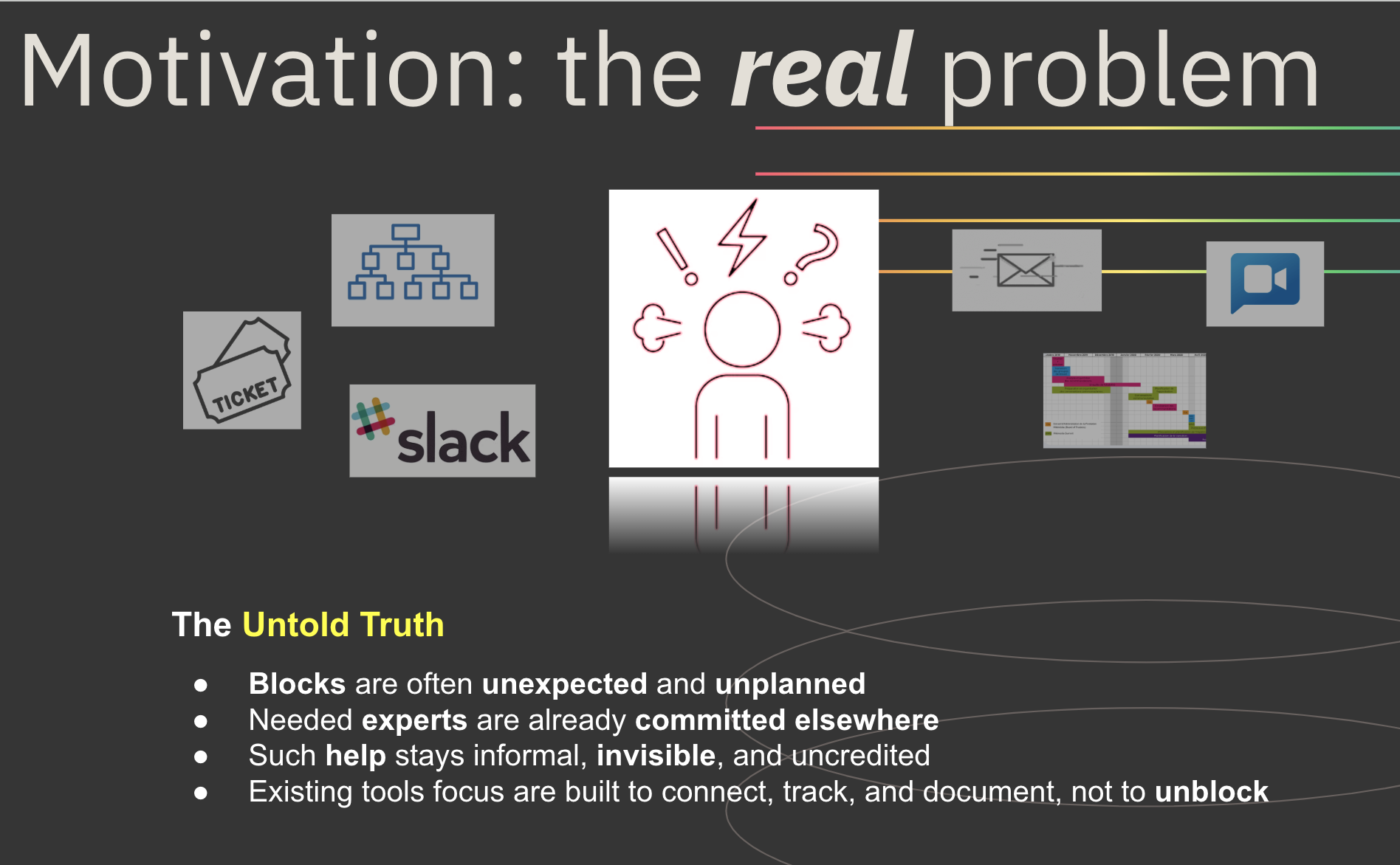
We’ve all had moments where a single expert insight could lift a block or change our direction. In cross-team environments, however, help is informal, people are already busy, and valuable contributions often go untracked—causing collaboration friction to build.
When builders get blocked outside their domain, the challenge isn’t solving the problem, but finding the right expert and justifying the ask. Most tools focus on tracking and documenting work, not unblocking it. As a result, cross-team help remains invisible and under-credited, offering little incentive to step into someone else’s project.
HeroBoard was inspired by this gap. It exists to make expert help discoverable, creditable, and visible—so the heroes who unblock progress get the recognition they deserve.
What it does
HeroBoard is an Gemini3-powered workplace intelligence tool that helps builders unblock progress by identifying the right experts across teams and making help visible and creditable.
The app has three core components:
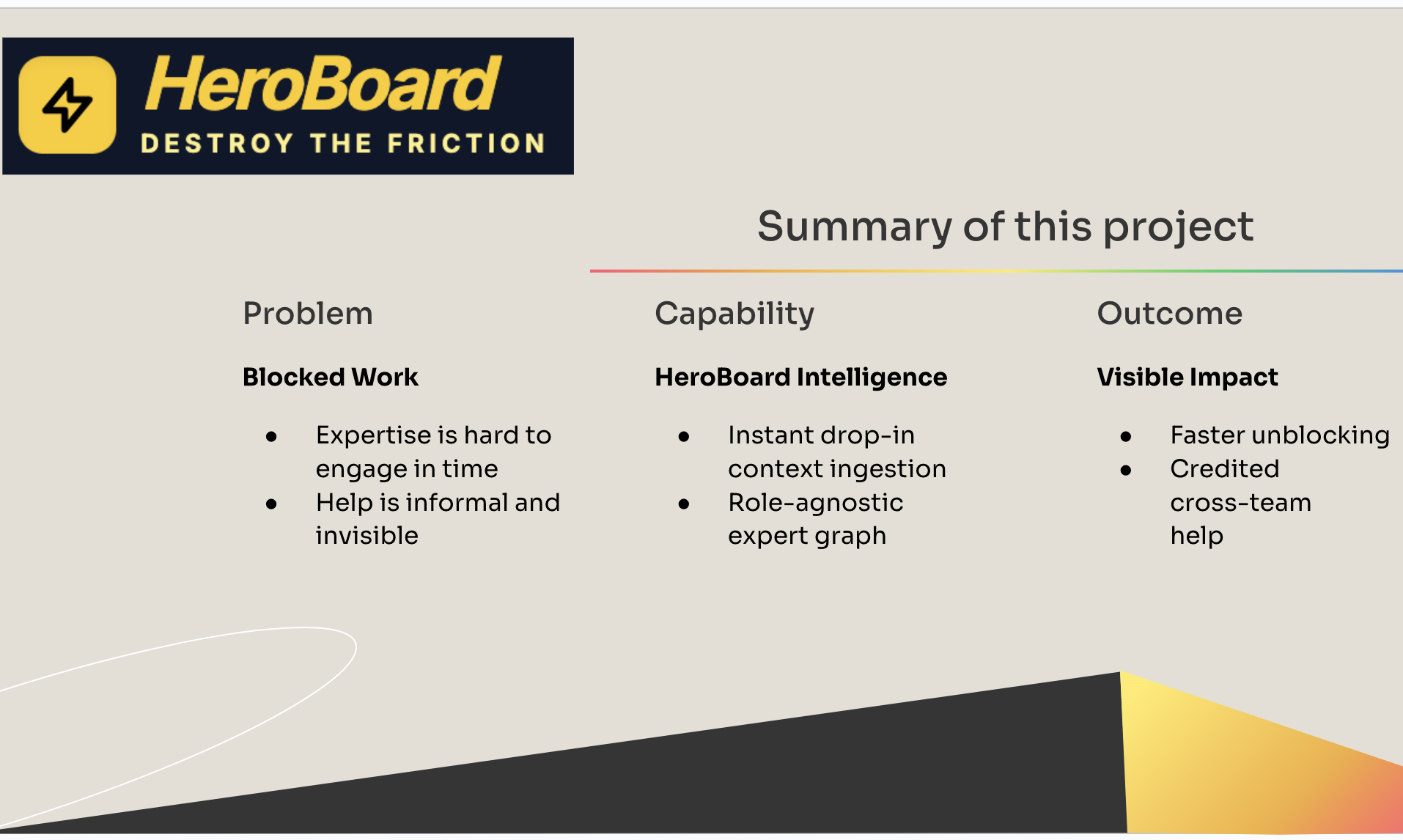
HeroBoard is a Gemini-powered workplace intelligence platform designed to transform invisible cross-team support into measurable impact. The system is built on three core pillars that streamline how experts are found and recognized:
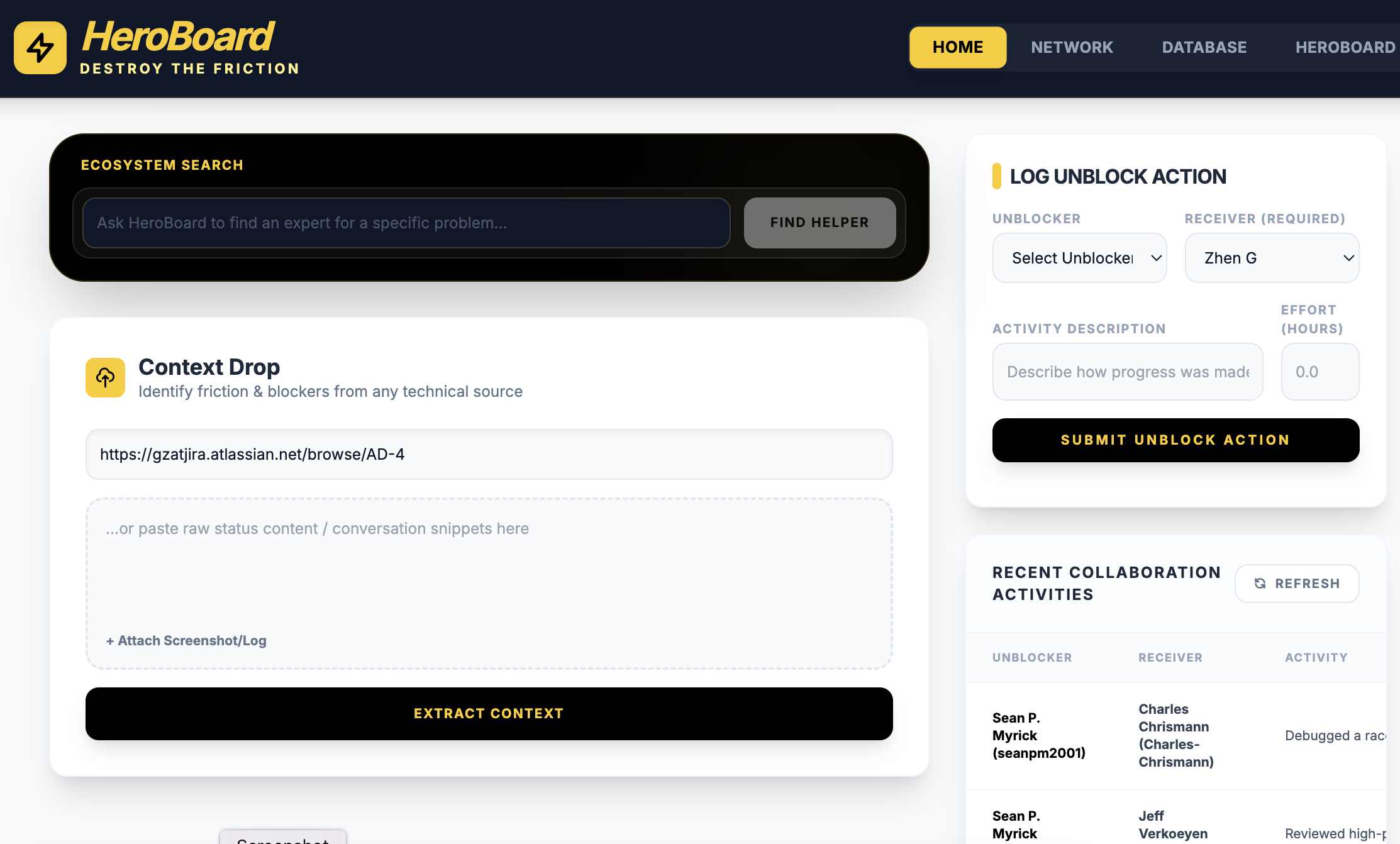
Multimodal Context Extraction HeroBoard eliminates the manual overhead of explaining technical debt or blockers. Leveraging Gemini’s multimodal capabilities, users can drop in text, screenshots, videos, or even raw Jira ticket links. The Context Extractor automatically parses these inputs via tool-calling to identify friction points and define the specific expertise required to move forward.
The Intelligence Map & Expert Network Underlying the platform is a dynamic, cross-disciplinary expert graph. Instead of relying on static org charts, HeroBoard builds its network by analyzing "evidence" from technical artifacts. Using a deep sync function, Gemini parses GitHub repositories—analyzing code, pull requests, and documentation—to map people to their actual skills and collaborative relevance. This creates a role-agnostic network spanning engineering, product, legal, and beyond.
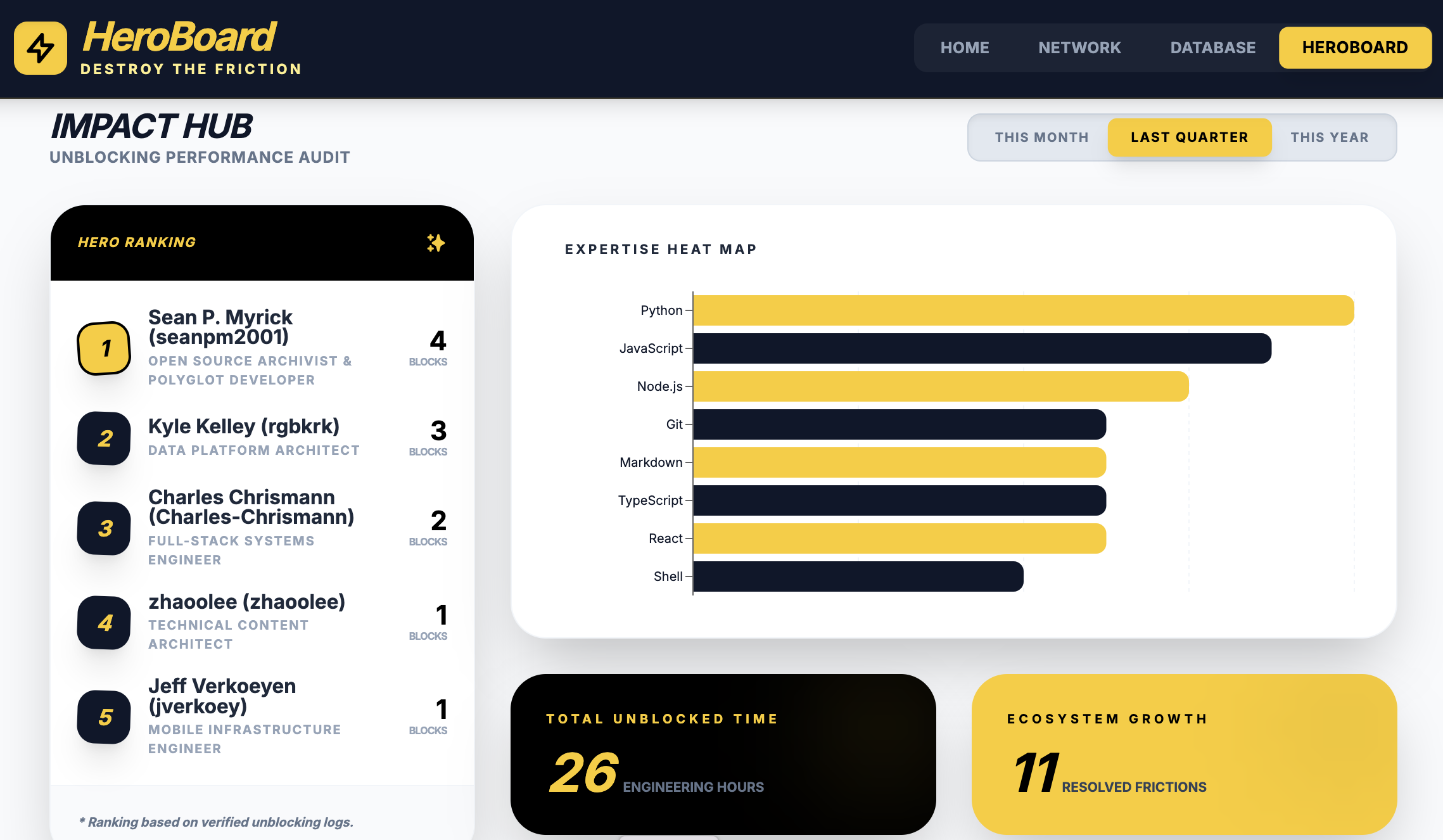
Impact Logging & The HeroBoard To solve the incentive problem, HeroBoard turns informal help into a persistent record of value. When a block is cleared, the activity is logged to a centralized database. This data feeds into the HeroBoard dashboard, which serves two purposes: it publicly recognizes top unblockers as "Heroes" and provides leadership with high-level insights into expertise gaps and resourcing needs across the company.
Together, these surfaces reduce time-to-help, lower collaboration friction, and incentivize cross-team support.
How it is built
At the core is Google Gemini orchestration:
- Gemini 3 Pro handles deep-reasoning tasks like profiling experts via Google Search grounding and repository analysis.
- Gemini 3 Flash powers low-latency friction audits and real-time ecosystem search.
- Function calling bridges the LLM with the Jira REST API to fetch private ticket metadata when Jira links are detected.
- Multimodal support of Gemini 3 enables understanding of frictions from any input source spanning images, meeting recordings, tickets, documents, etc.
- Gemini 3's long-context capabilities enables the approach of using AI to build a "role-agnostic expert graph" based on technical evidence (commits, PRs, project decks, etc) rather than static profiles.
- LLM's reasoning capability enables searching for a combination of skillset in specific context (like deploy open-source LLM on mobile device) rather than single skill (like Typescript or LLM) as keywords.
Challenges we ran into
I spent quite some time fine-tuning the system instructions in Gemini to make sure it could precisely extract the "frictions". It was also a constant game of trial and error to get the AI to trigger tool calls correctly without "hallucinating" help requests. I also had to learn the hard way about browser security when my attempts to pull in live Jira data hit CORS blocks, which was a great lesson in why secure backend-to-backend architecture matters for real-world apps.
Accomplishments that we're proud of
I'm most proud of taking a frustrating problem I’ve personally felt—the way expert help often goes unnoticed—and actually building a tool to fix it. Even though this was my first time using Google AI Studio, I managed to create a working prototype that feels a bit like magic, like when the app "reads" an email and immediately knows exactly which expert should be tagged in to help. I'm excited that I built something that doesn't just find people, but actually gives them credit for being workplace heroes.
What we learned
This project taught me that AI Studio is an incredibly powerful way to move fast; I was able to build an agentic workflow much quicker than I expected. But more importantly, I learned that the biggest challenge in tech isn't always the code—it's understanding the people. I realized that AI's best use case isn't replacing us, but surfacing the hidden value we already provide to our teams. I also learned to embrace the "Prompt-Test-Repeat" cycle, seeing how even a tiny change in phrasing can completely change how helpful a tool feels.
What's next for HeroBoard
Next immediate step is to expand the zero-effort integration for context drop. Currently, the prompt and parsing logic supports Jira ticket intake and general screenshot or text parsing for understanding and extracting context. To achieve zero-effort and zero-interference for using this tool, the app will be enhance to be able to parse additional input format such as Business Operation Model or project progress in Excel format, video recording, and other input.
Built With
- aistuido
- d3.js
- function-calling
- gemini3
- html5
- typescript

Log in or sign up for Devpost to join the conversation.