-
-
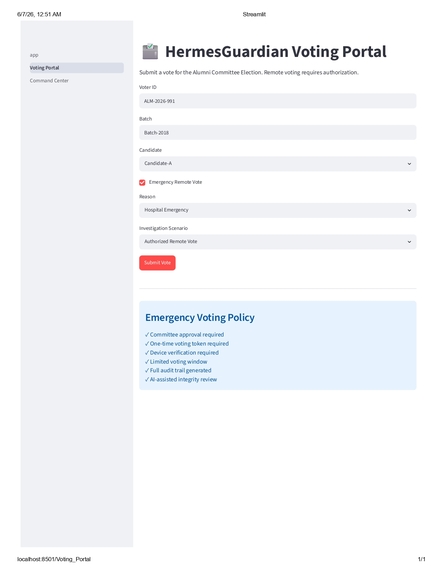
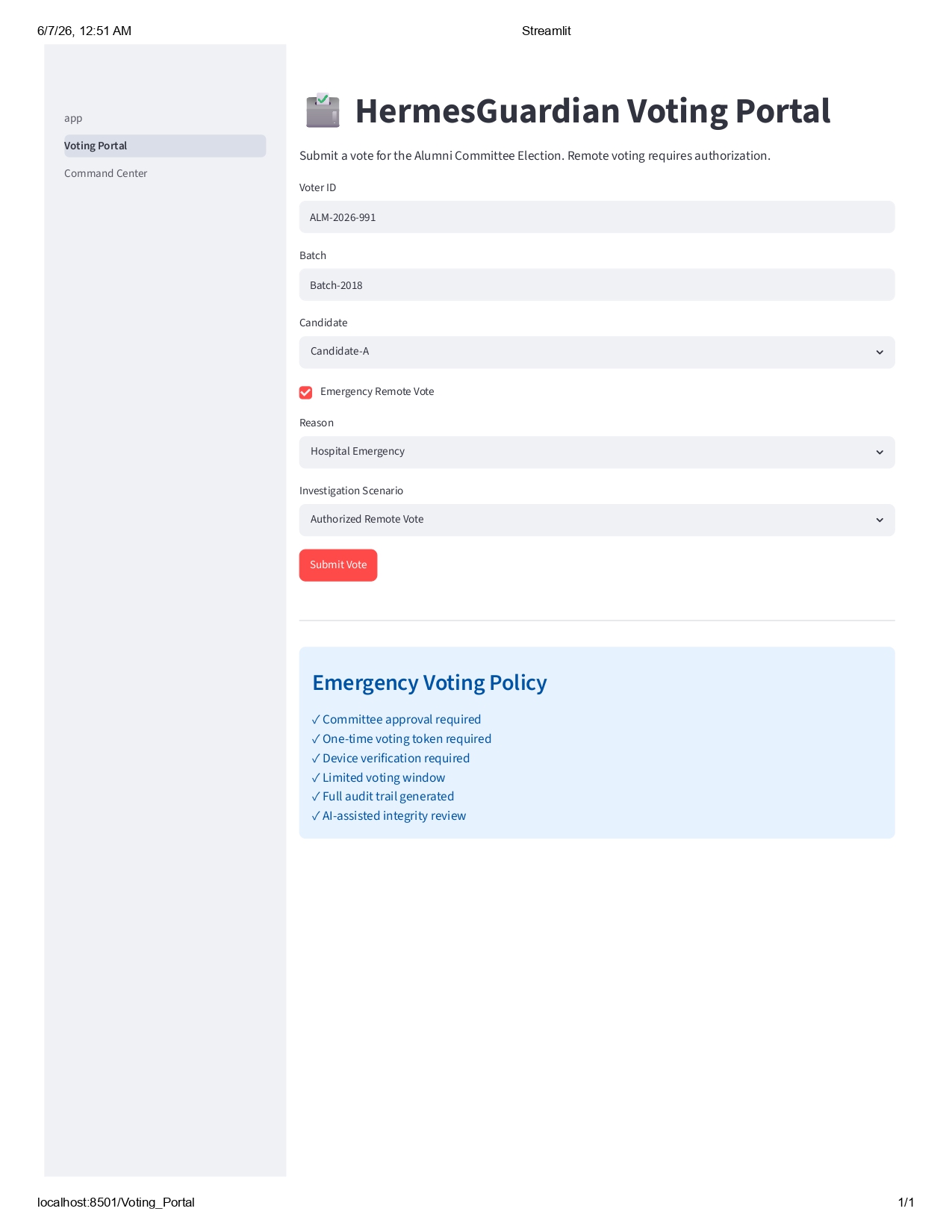
Voting Portal
-
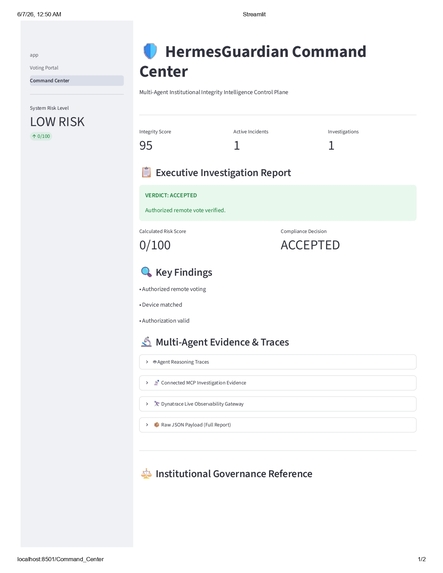
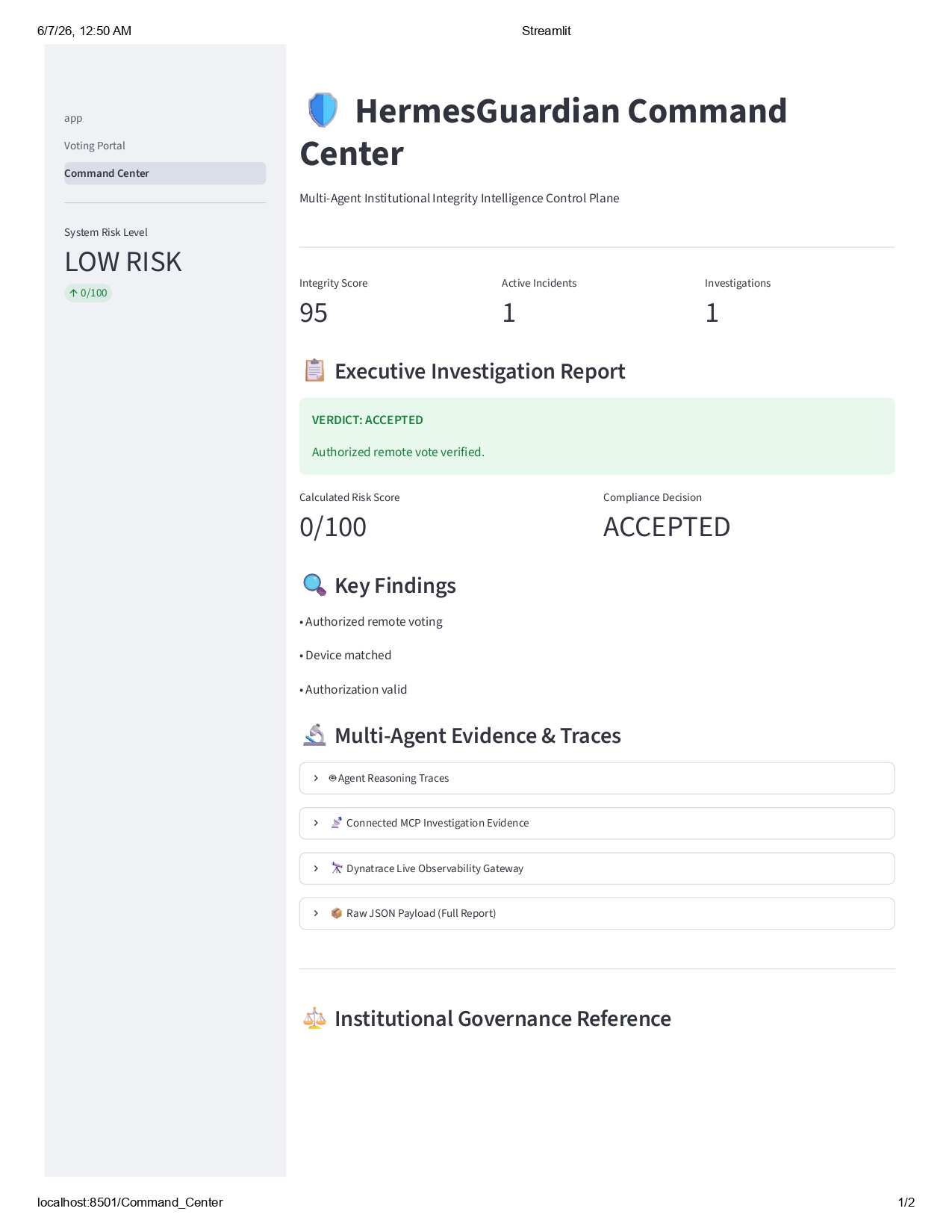
Authorized Remote Voting
-
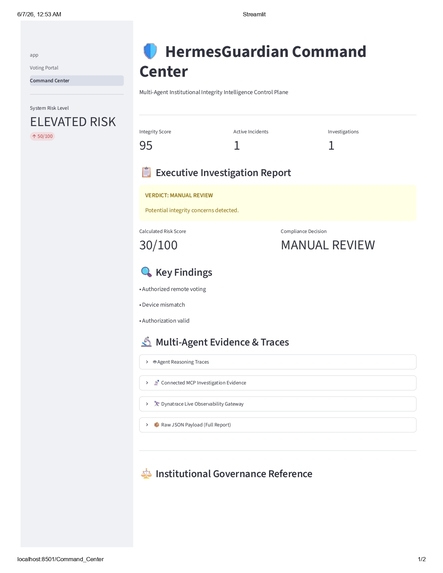
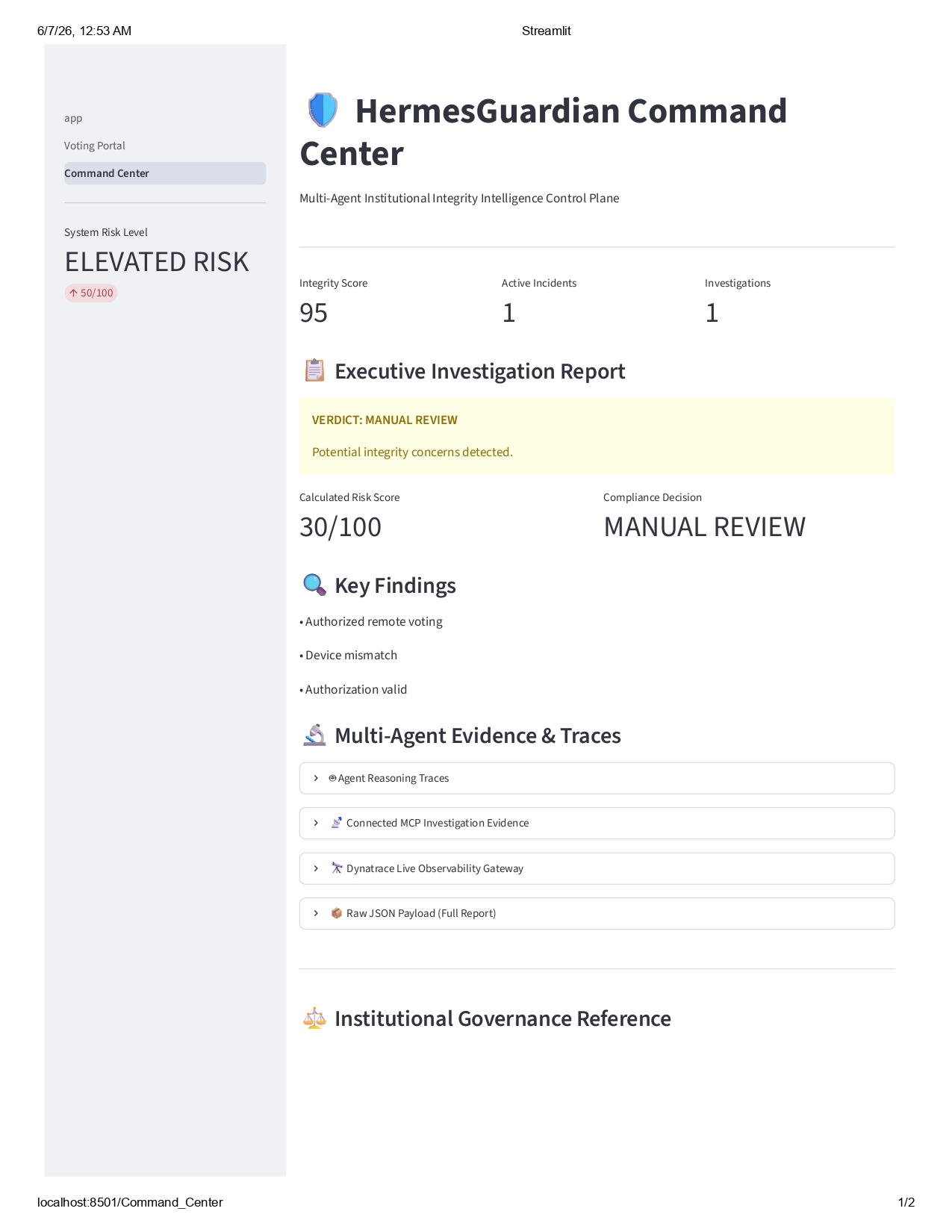
Device Mismatch Events
-
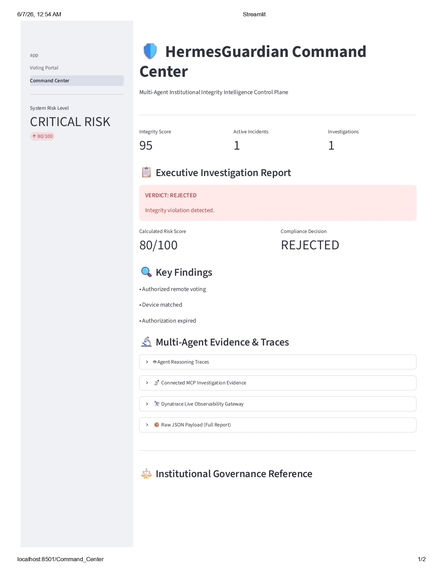
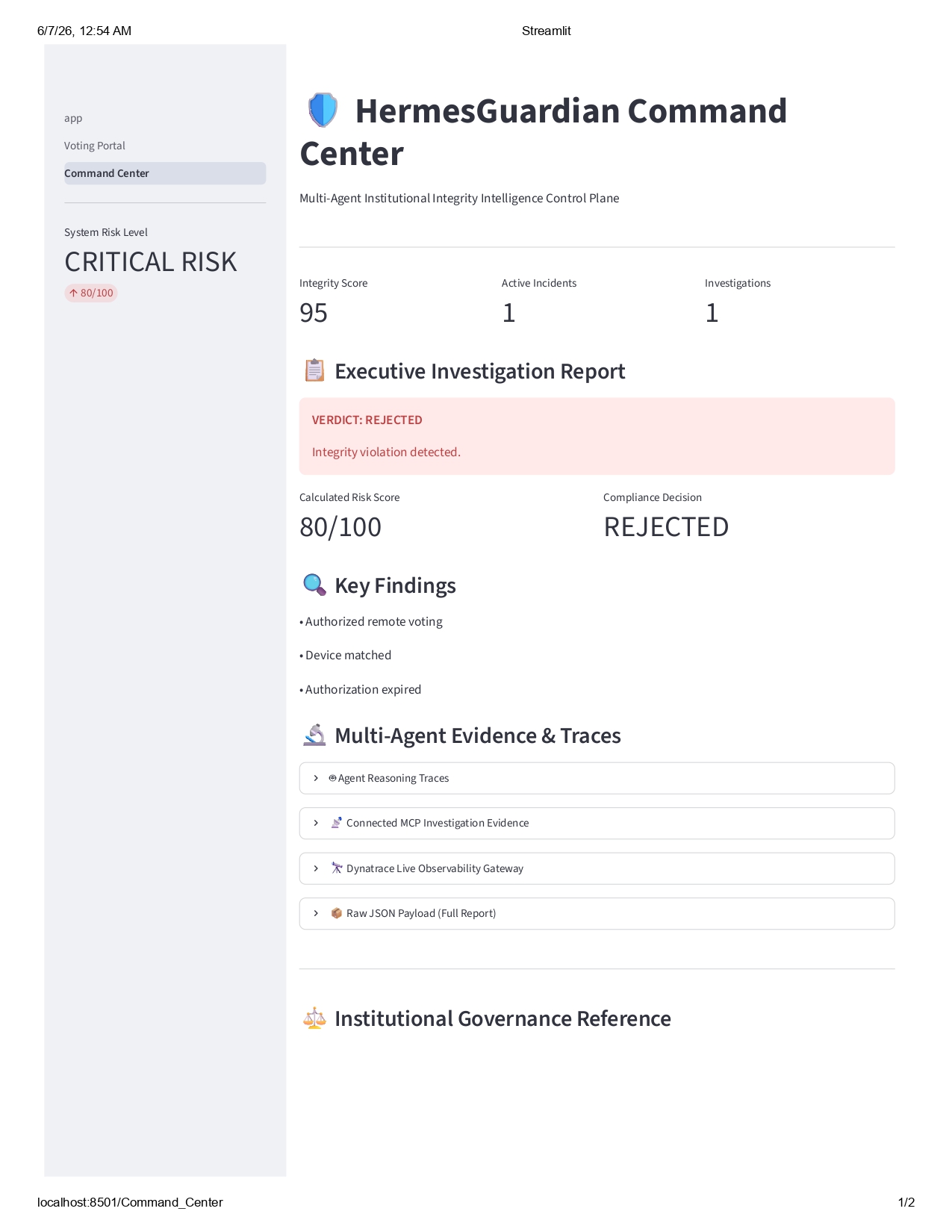
Expired Authorization Events
-
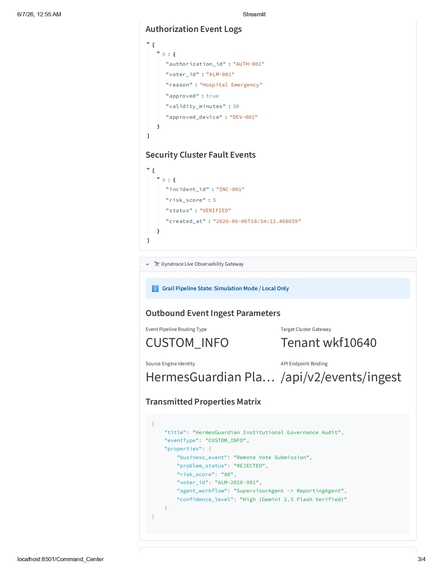
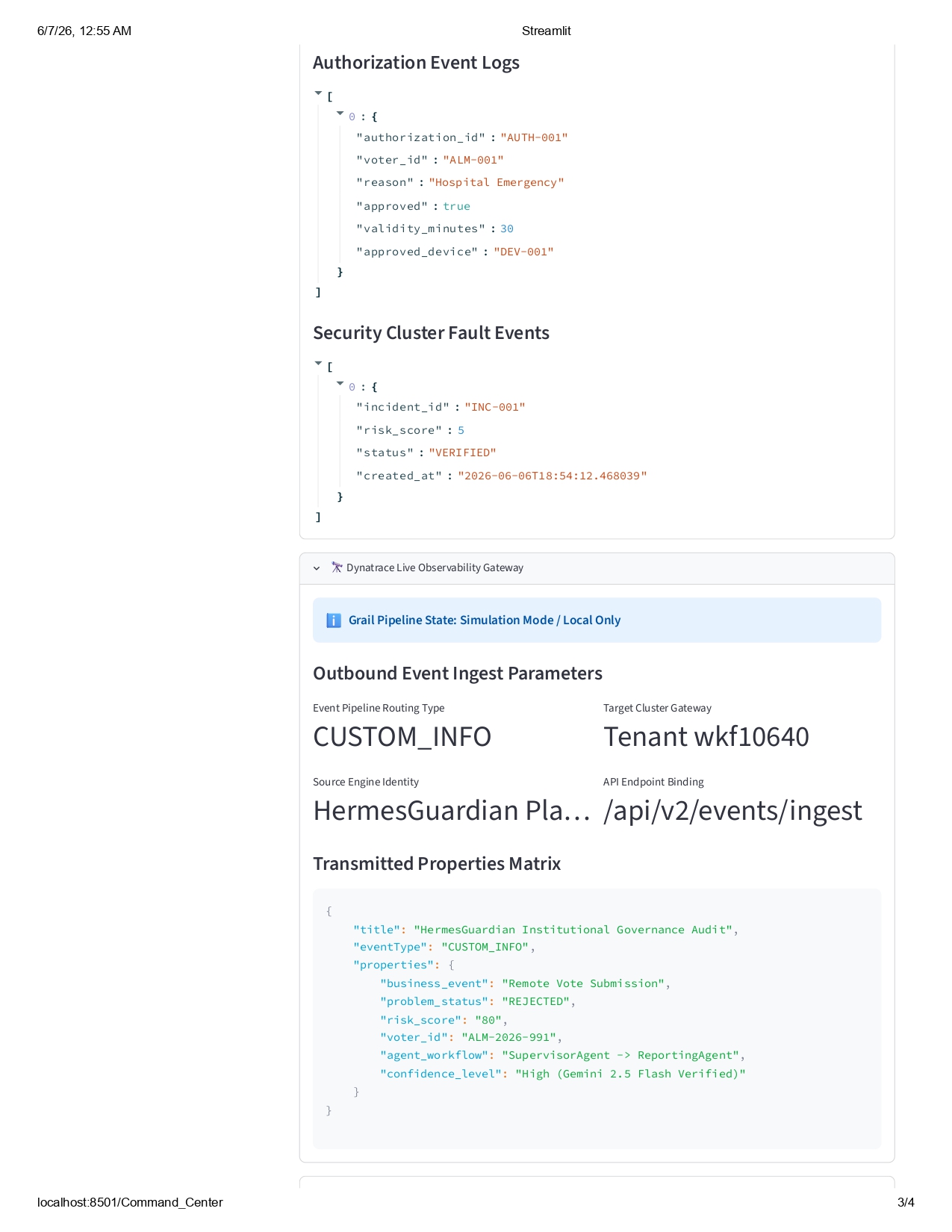
Dynatrace Event Payload Screenshot
-
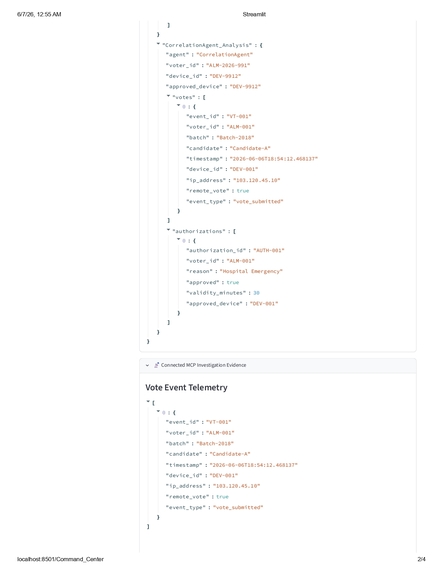
Evidence Explorer
-
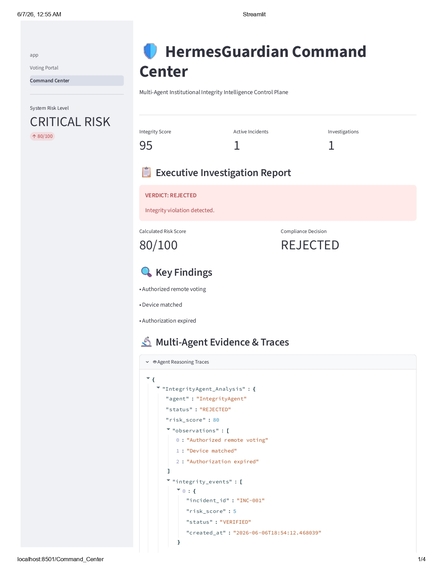
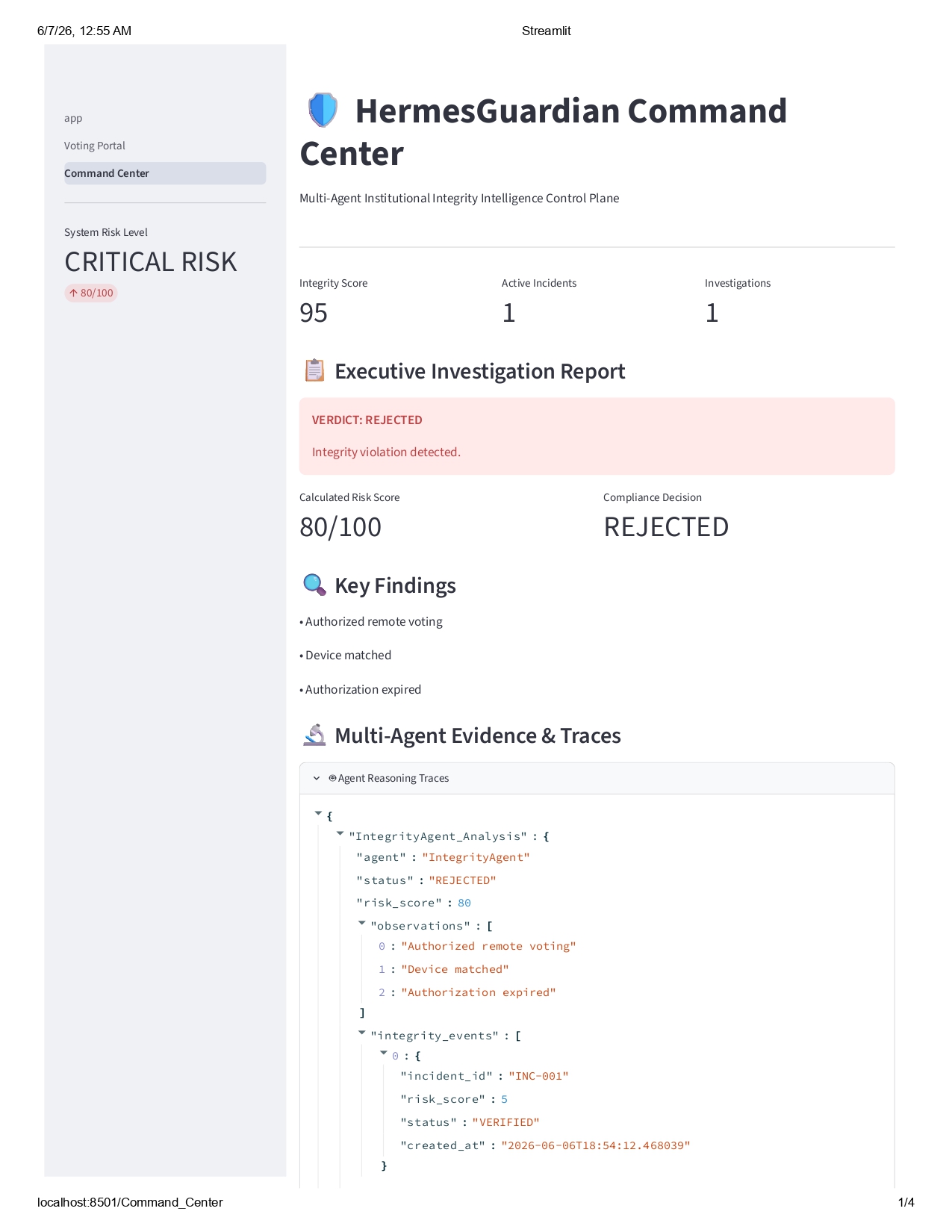
Executive Investigation Report
Inspiration
Institutions occasionally face exceptional governance situations where standard procedures must be temporarily bypassed. Emergency remote voting, device verification issues, and authorization exceptions can introduce uncertainty, reduce transparency, and make post-event investigations difficult.
Traditional systems often either block these exceptions entirely or allow them to proceed with limited visibility and accountability. We wanted to explore how AI could help institutions investigate these events transparently without replacing human oversight.
Our goal was to build a platform that correlates evidence from multiple sources, evaluates integrity risks, provides explainable reasoning, and improves trust in institutional decision-making.
HermesGuardian was created to demonstrate how Google Gemini, multi-agent workflows, MCP-powered telemetry, and Dynatrace observability can work together to support governance integrity investigations.
What it does
HermesGuardian is an AI-powered Governance Integrity Intelligence Platform that investigates exceptional voting events and generates transparent institutional assessments.
The platform supports scenarios including:
- Authorized Remote Voting
- Device Mismatch Events
- Expired Authorization Events
For every investigation, HermesGuardian:
- Collects governance telemetry
- Correlates multi-source evidence across voting and authorization systems
- Evaluates integrity risks using deterministic rules
- Coordinates specialized investigation agents
- Generates executive governance assessments using Google Gemini 2.5 Flash
- Exposes telemetry through an MCP server
- Publishes observability events to Dynatrace
- Presents findings through an interactive command center dashboard
The result is a transparent and auditable investigation workflow that helps institutions understand not only what decision was made, but why it was made.
How we built it
HermesGuardian was built using a modular multi-agent architecture.
The investigation workflow begins when a governance event is submitted through the FastAPI backend and Streamlit dashboard.
The SupervisorAgent orchestrates the investigation lifecycle and coordinates specialized agents.
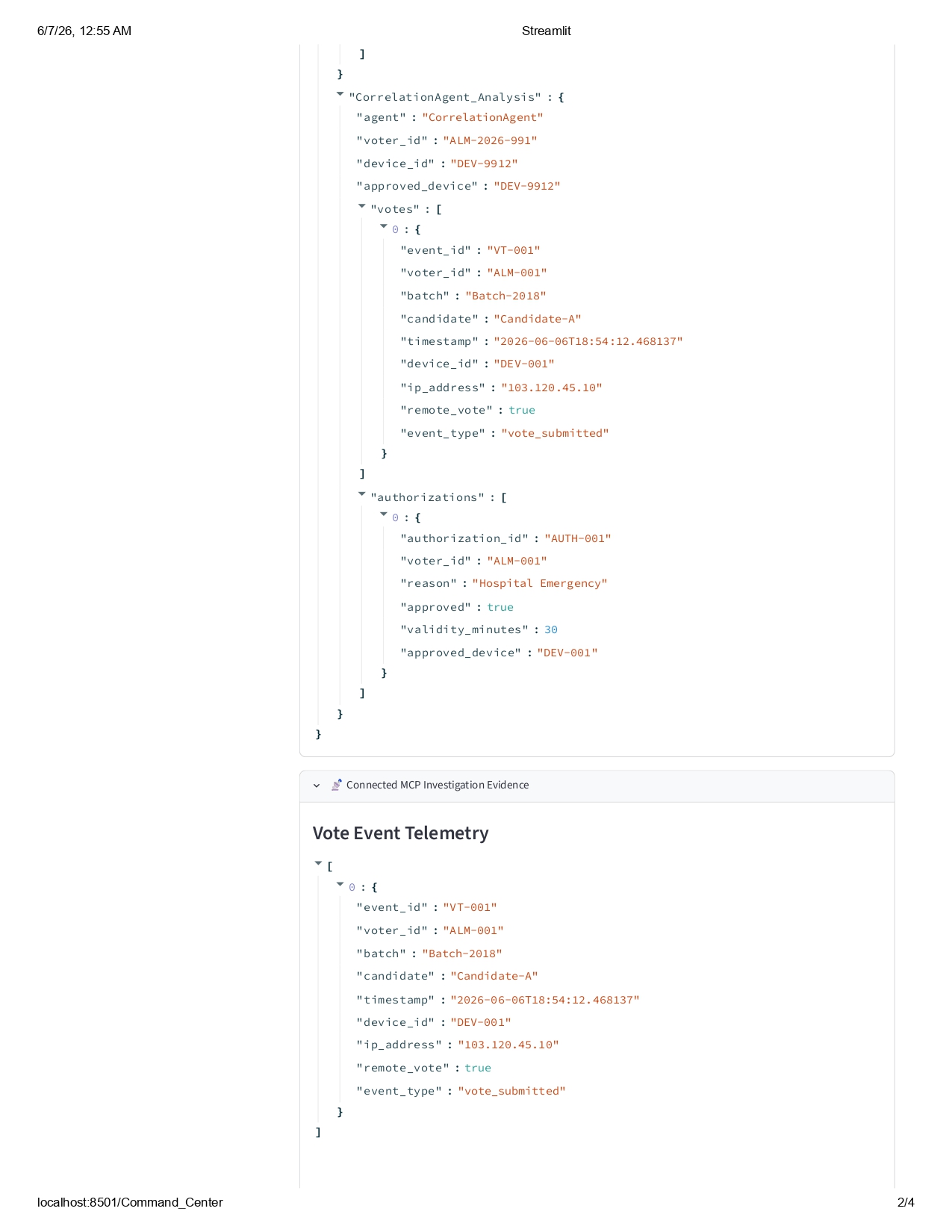
The CorrelationAgent gathers governance telemetry, voting records, and authorization evidence.
The IntegrityAgent evaluates policy compliance and calculates deterministic risk scores based on governance rules.
The ReportingAgent transforms investigation findings into executive governance assessments using Google Gemini 2.5 Flash.
To support interoperability, we implemented an MCP server using FastMCP. This exposes governance telemetry, authorization records, integrity incidents, and investigation traces through standardized tools that can be consumed by AI agents and external systems.
To demonstrate observability, HermesGuardian transforms governance investigations into Dynatrace-compatible business events, risk indicators, and investigation traces. These events are published through the Dynatrace Events API, providing operational visibility into governance workflows.
The frontend was built with Streamlit and provides a Governance Command Center for reviewing investigations, evidence, telemetry, observability data, and executive reports.
Challenges we ran into
One of the biggest challenges was balancing deterministic governance logic with AI-generated reasoning.
In governance and compliance environments, allowing an AI model to directly determine risk scores or investigation outcomes would reduce explainability and trust. We wanted investigation results to remain transparent, predictable, and auditable.
To solve this, we separated decision-making from narrative generation. Deterministic rules calculate risk scores and outcomes, while Google Gemini focuses on transforming investigation evidence into professional executive assessments.
Another challenge was designing an architecture that could meaningfully demonstrate MCP interoperability, multi-agent workflows, and Dynatrace observability within a hackathon timeframe while keeping the platform understandable and maintainable.
We also spent significant effort ensuring that every investigation remained explainable rather than functioning as a black-box AI system.
Accomplishments that we're proud of
- Built a complete multi-agent governance investigation platform
- Integrated Google Gemini 2.5 Flash for executive governance reasoning
- Implemented an MCP telemetry server using FastMCP
- Integrated Dynatrace observability event ingestion
- Created a governance command center for investigations and evidence review
- Developed transparent and explainable decision workflows
- Successfully demonstrated multiple governance investigation scenarios
- Connected AI reasoning, telemetry correlation, and observability into a unified platform
What we learned
This project taught us how to combine deterministic systems and AI reasoning while preserving transparency and trust.
We gained practical experience with:
- Multi-agent workflow orchestration
- Google Gemini tool-assisted reasoning
- MCP server design and telemetry exposure
- Dynatrace event ingestion and observability concepts
- Governance-focused AI system design
- Building explainable AI workflows for institutional environments
Most importantly, we learned that AI is most effective when it augments human decision-making rather than replacing it.
What's next for HermesGuardian
Our vision is to evolve HermesGuardian into a broader Governance Integrity Intelligence Platform.
Future enhancements include:
- Real-time governance monitoring
- Historical investigation analytics
- Expanded Dynatrace observability and OpenTelemetry support
- Additional governance workflows beyond voting scenarios
- Advanced anomaly detection using Gemini-powered investigations
- Enterprise audit trails and compliance reporting
- Multi-tenant deployments for institutions and public organizations
Ultimately, we envision HermesGuardian helping institutions make critical decisions with greater transparency, accountability, and trust.


Log in or sign up for Devpost to join the conversation.