





Hackers:
Olivia Taylor (‘23) and Diego Pasini (‘23), both currently juniors in high school.
Inspiration:
In neighborhoods across the globe, safety is a priority while commuting and fulfilling everyday tasks. The problem is getting information on crimes in one’s area can be difficult and inconsistent, as district crimes rates can encompass too many people or territory to be useful and local police force blog posts exist but are not centralized and cannot provide data outside of their own towns. For this, we introduce Hermes. Named after the Greek god of safety and travel, Hermes is a global safety application that provides data on crimes in your area and extra safety features to help you in case of an emergency. In order to help people determine the safety of their areas and navigate safely, Hermes stores crime data provided both by trustworthy organizations such as local police forces and neighborhood watches with crowd sourced data from anonymous users. The two data sources provide a centralized system where users can see crimes in their area and get notified if a crime occurs within a certain radius from their location. Hermes also contains several safety features, which will send messages to your emergency contacts and 911 in case of an emergency.
What it does:
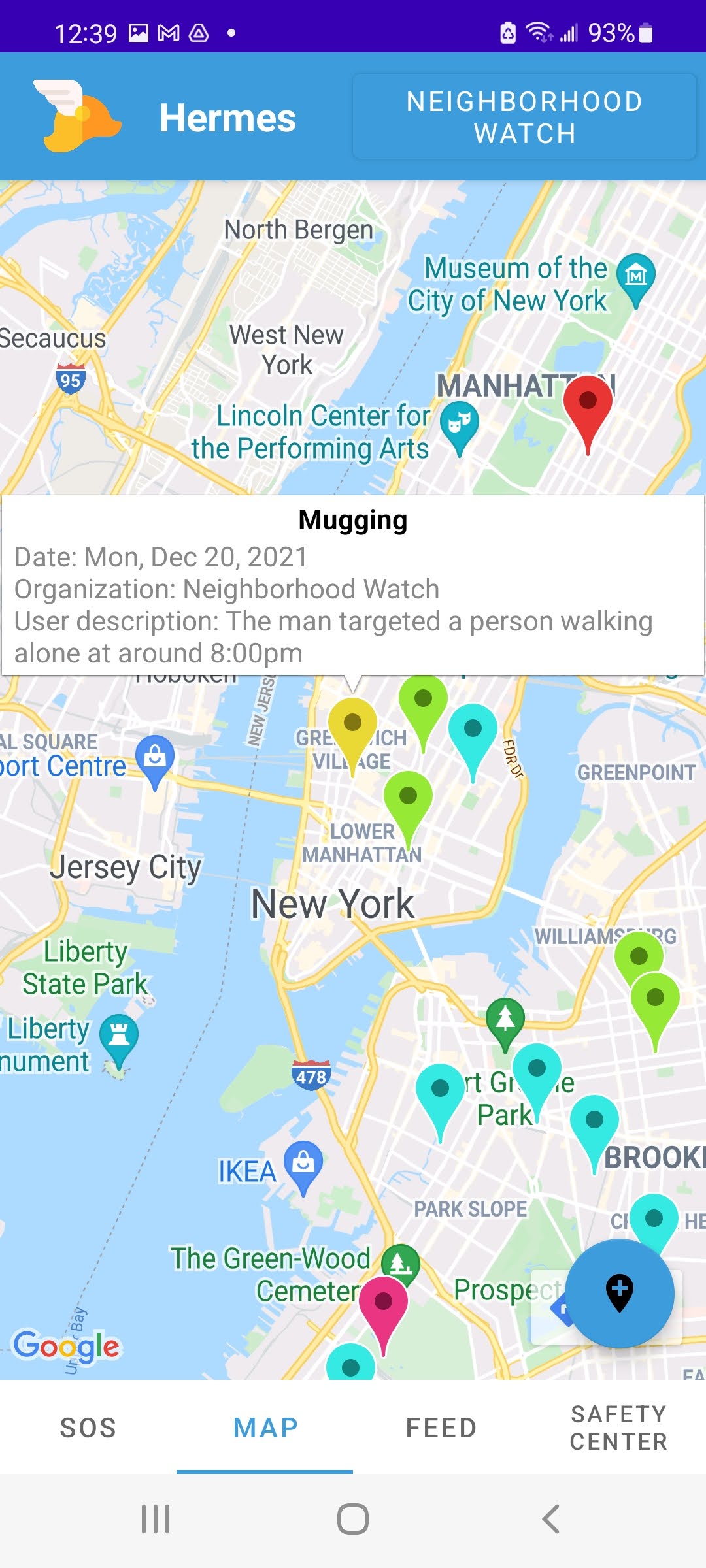
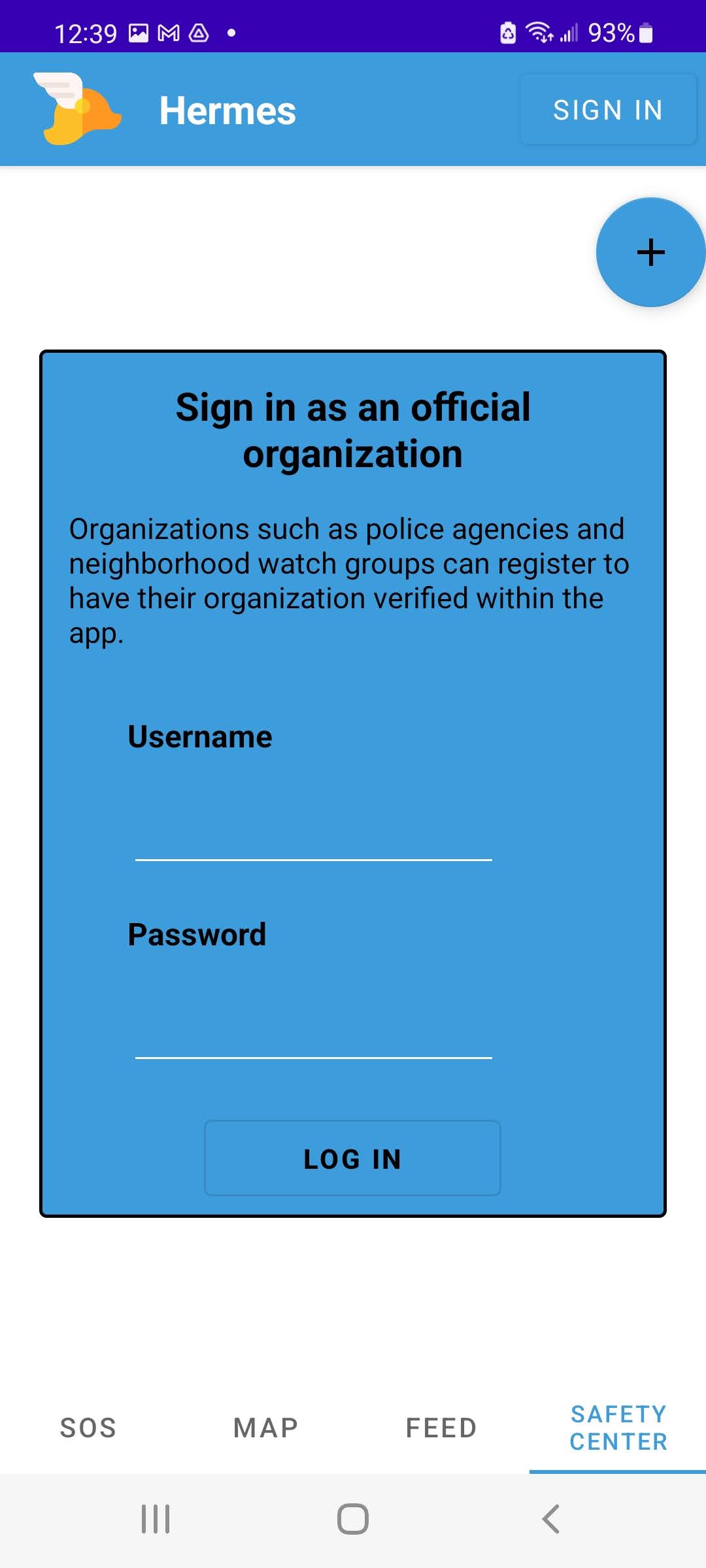
Hermes is an Android app which allows for users and organizations to report local crimes. When opening the app, the user is greeted with the map of crimes. Each crime has a date, a type, and a description. This allows users to access a central database with crimes in a user’s area and receive notifications when crimes are reported. Reporting a crime is simple, just press the report crime button, drag the marker, set a date, type and description, and the crime will be created in our firebase database for all users to see. Organizations can also sign in using our organization sign in feature and report crimes with special markers that state the organization to improve the marker’s validity.
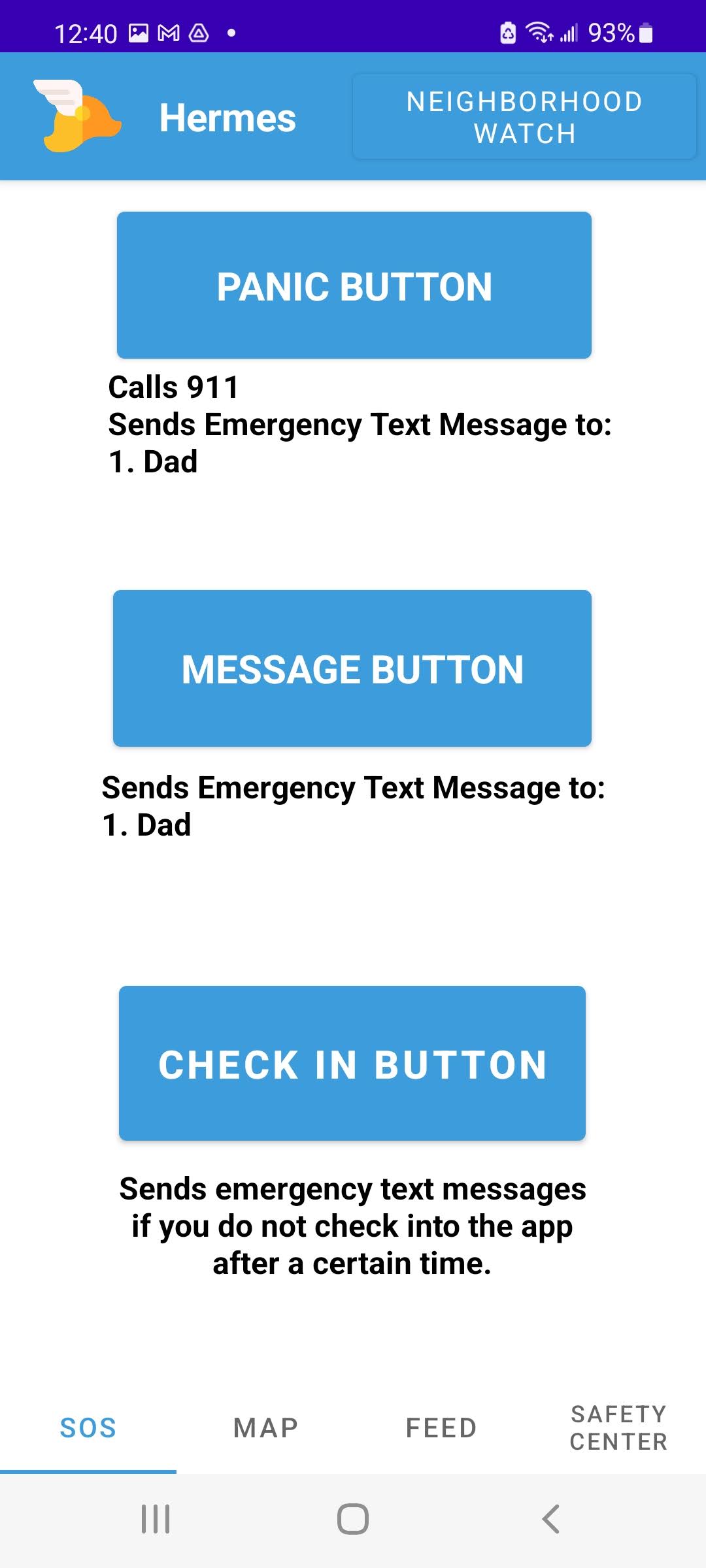
Hermes also provides a variety of safety features to help in case of emergencies. Under the safety center tab, a user’s contacts can be changed. Each contact contains a name, phone number, and emergency message. These contacts can be both edited and deleted. After creating one’s contacts, in case of an emergency, a user can go to the SOS page, and use the panic button, emergency message button, or check in button. The panic button will call 911 and send all respective emergency messages to the user’s contacts. The emergency button will send all respective emergency messages to the user’s contacts. After pressing the check in button, the user will put in an amount of time before which they must check in. If they do not enter the app and check in before the timer has ended, Hermes will send emergency messages to the user’s contacts.
How we built it:
We first used balsamiq to wireframe and design the basic layout of the app which made development a lot faster. In order to develop the application, we used Android Studio, since nearly 70% of the mobile operating system users in the world use Android. To store data on the crime markers, we used firebase as a way to store each crime and login information for organizations.
Challenges we ran into:
This was our first time using Android Studio for a project of this scale, so we did run into some trouble integrating the google maps api and storing user information in a json file. We were initially going to use Android Room to store user contact information, but instead decided to use the in-built shared preferences.
Accomplishments that we’re proud of:
Going into this hackathon, we both had practically no experience in making Android applications. However, in just four days, we were able to create an app that we’re very proud of and genuinely believe can benefit people around the world. We were able to integrate Firebase into our application, which we had never used before, to create a database of crimes that updates in real time.
What we learned:
On the soft-skills side, this was one of our first hackathons! Collaborating on code is definitely a new skill, and we are so glad to have been able to hone our skills in that regard. But on the technical side, we’ve learned even more! We learned how to use Android Studio and about databases such as Firebase.
What’s next for Hermes:
In the future, we hope to integrate known crime rates to the map so as users zoom out they can see district and regional crime rates posted on their state. We would also love to expand this idea globally as well to implement regional crime rates for countries around the world. We also plan on creating a verification feature for organizations, and more buttons to the SOS section. Finally, something we initially planned on developing was a validate feature for crimes, so users could up vote certain reports if they witnessed the event.
In the next few days, we will be uploading Hermes to the Google Play store exactly as it is at the end of the hackathon so anyone interested can try it for themselves. Once the hackathon is complete, we'll continue to improve the app and implement the features didn't have time to add during the competition.


Log in or sign up for Devpost to join the conversation.