-
-
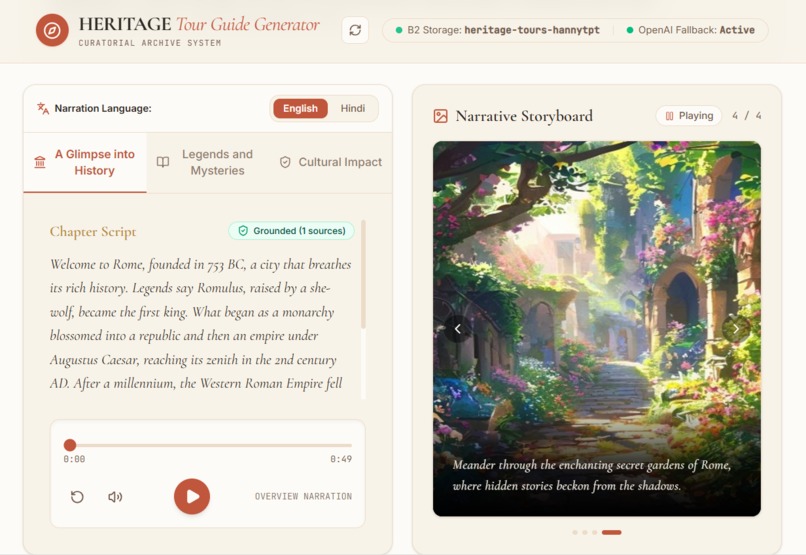
-
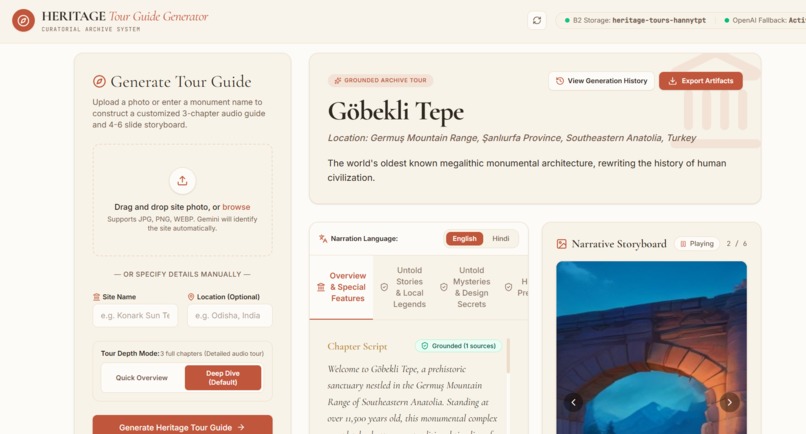
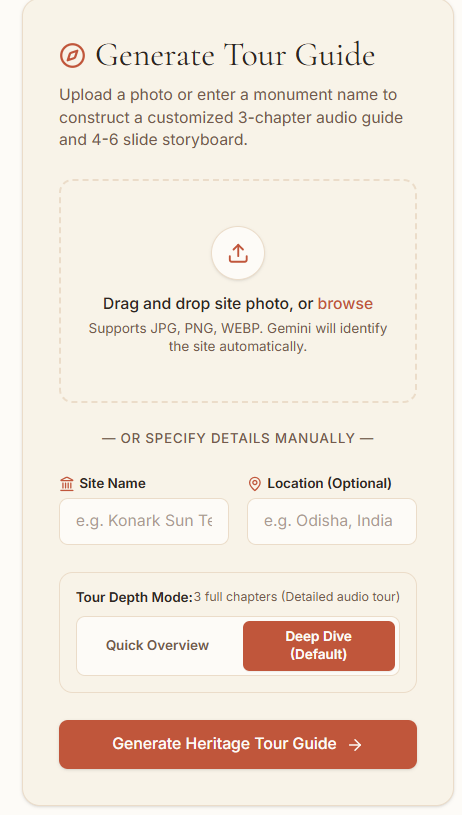
Generate any landmark
-
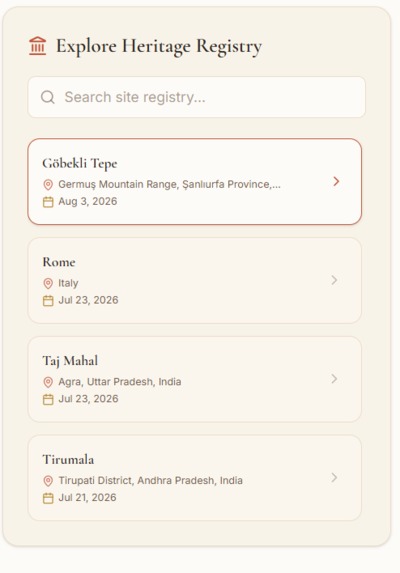
All the generated artifacts stored and managed via B2 buckets
-
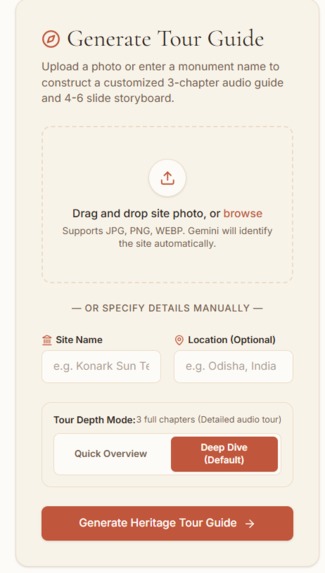
Give a name or location of any tourist place
-
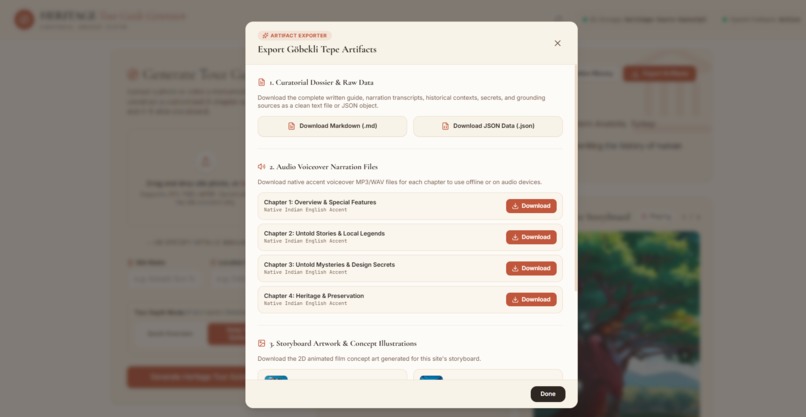
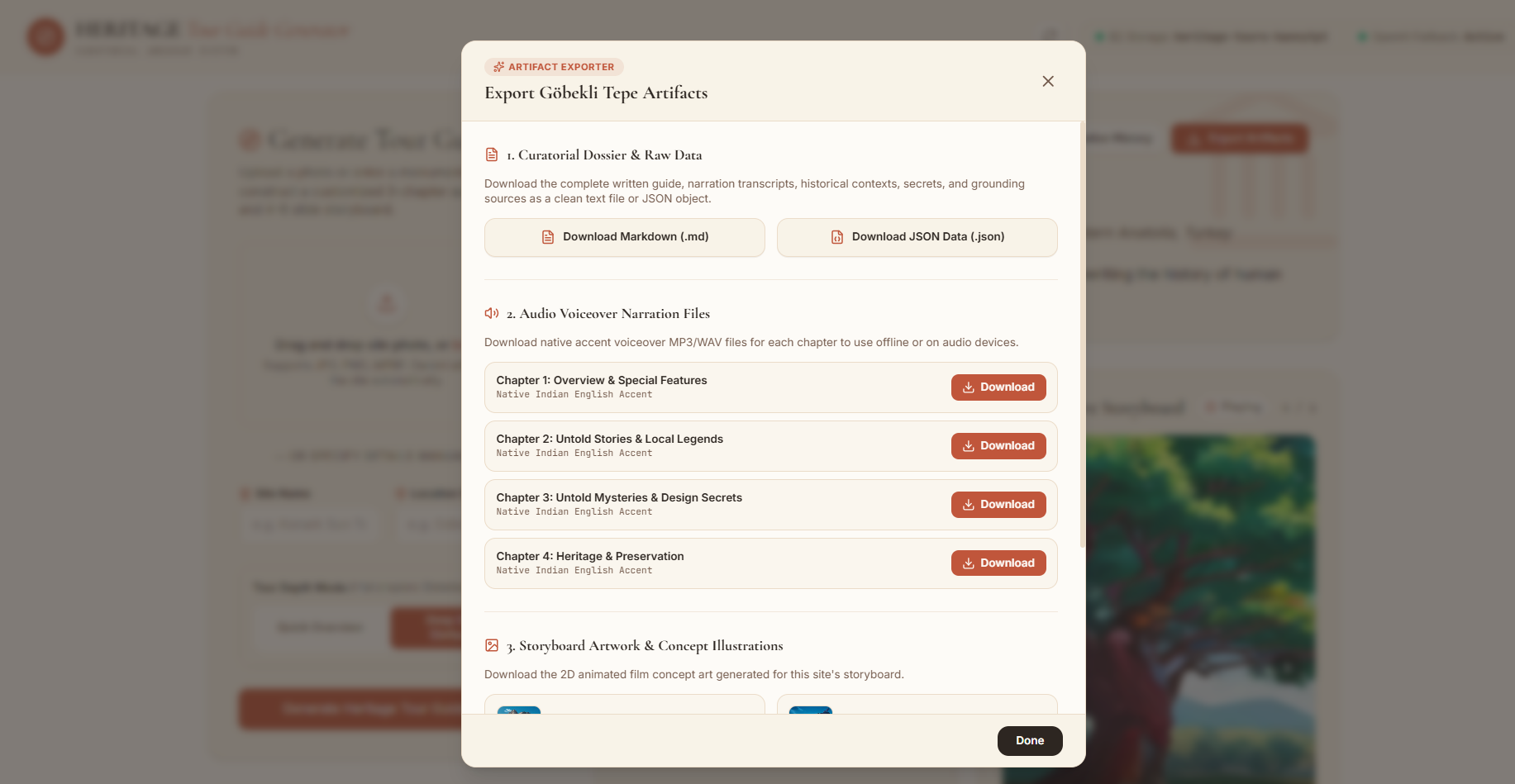
Export the artifacts
The Inspiration
I've stood in front of ancient ruins with nothing but a faded plaque and a Wikipedia article that felt like reading a textbook. The Taj Mahal deserves better than three sentences on a sign. Göbekli Tepe — a site that rewrites the entire history of human civilization — gets a paragraph. That felt wrong.
I built Heritage AI because history is the greatest story ever told, and nobody is telling it right.
What It Does
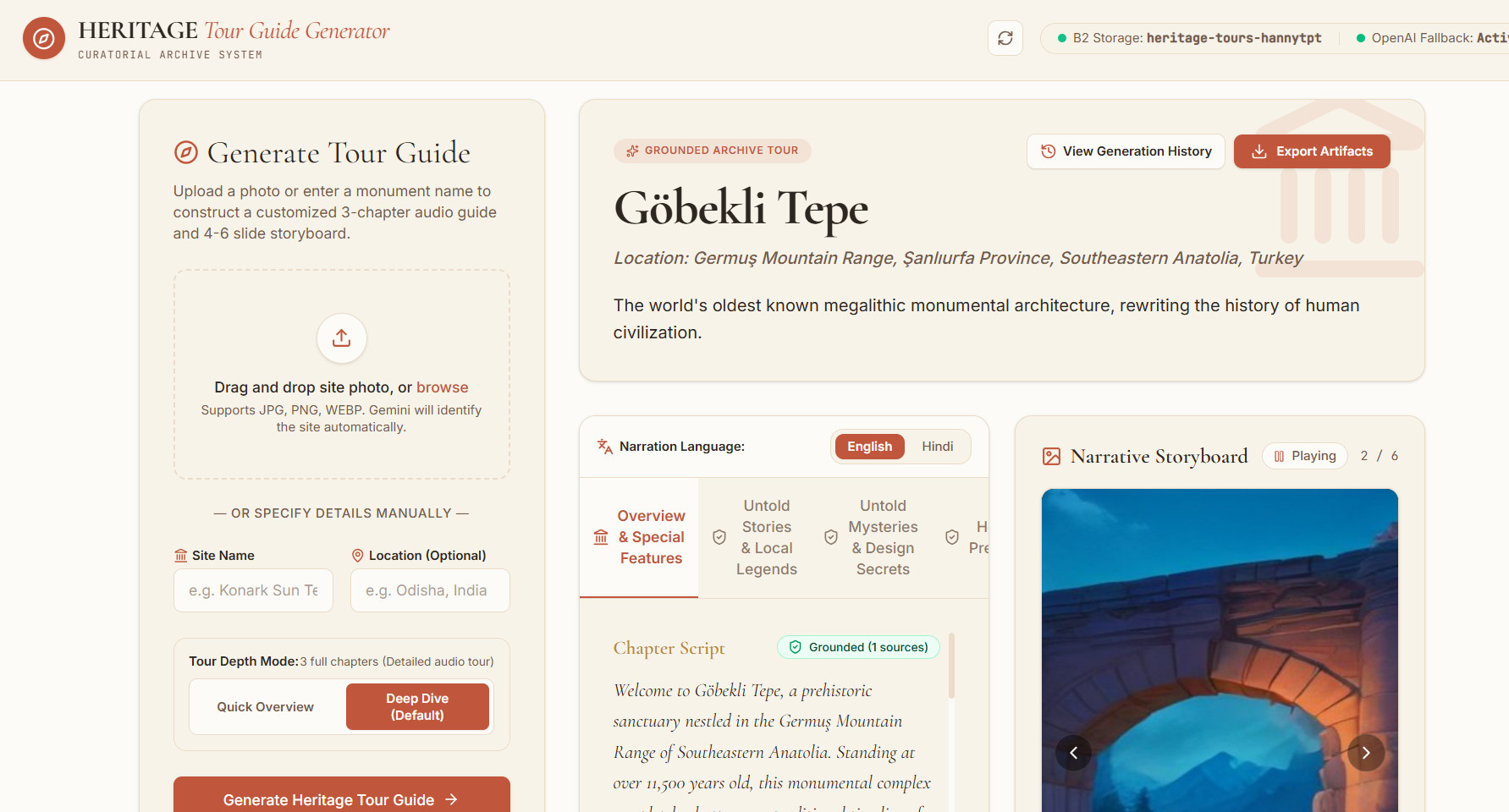
Heritage AI transforms any heritage site or monument in the world into a rich, multi-chapter audio-visual tour guide — in seconds.
Enter a site name or upload a photo. Heritage AI:
- Identifies the site using Google Gemini's multimodal vision
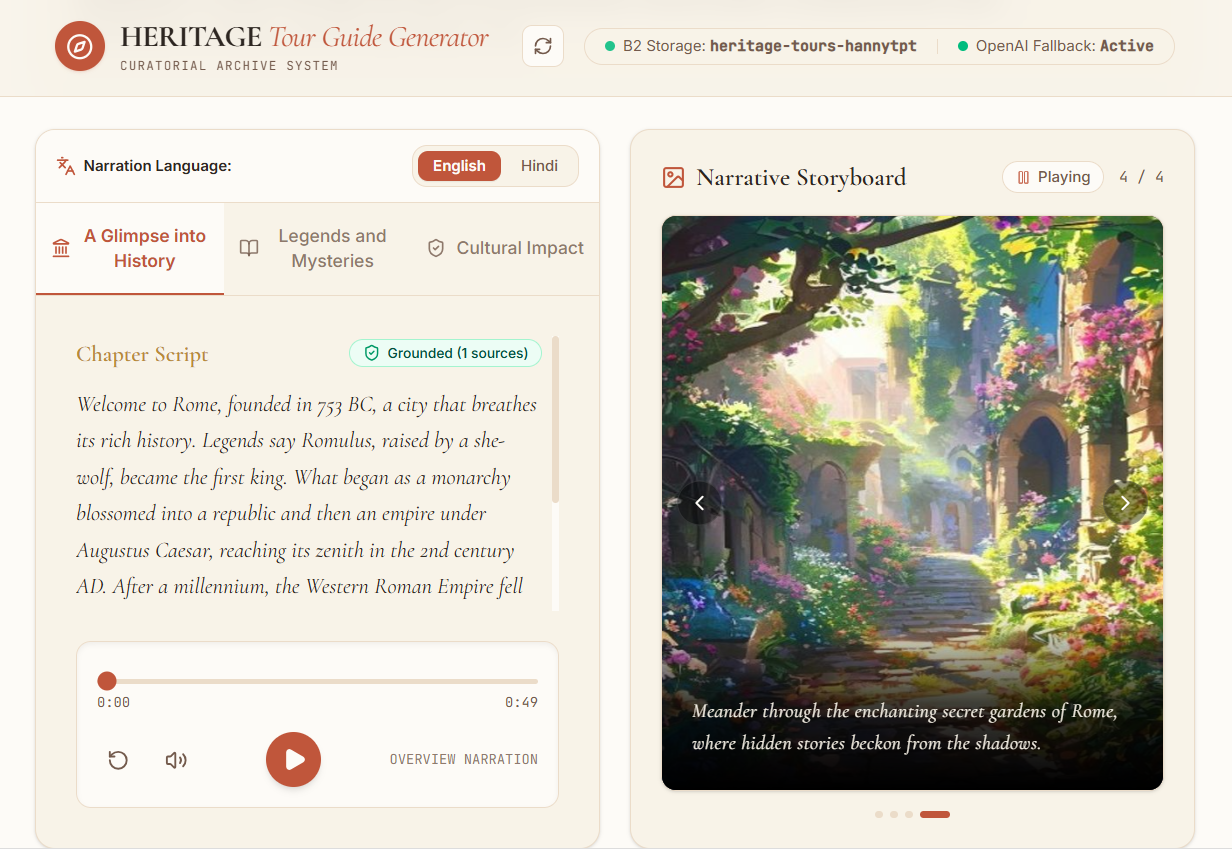
- Generates a structured 4-chapter deep-dive — Overview, Untold Stories, Mysteries & Design Secrets, Cultural Impact
- Produces AI storyboard illustrations for each chapter
- Narrates every chapter with native-accent voiceover audio
- Grounds every single claim in Wikipedia and live Google Search — no hallucinations
- Exports everything as a downloadable artifact bundle — Markdown, JSON, and MP3s
How I Built It
The entire pipeline runs on Google Gemini at its core, with a layered fallback architecture for image generation:
User Input → Gemini (site ID + script generation)
           → Google Search Grounding (fact verification)
           → Imagen 3 → DALL-E fallback → Pollinations AI (storyboard art)
           → Backblaze B2 (storage + curatorial archive)
           → Google AI Studio (deployment)
The hardest engineering challenge was the grounding pipeline — making sure every historical claim is sourced and verified in real time, not hallucinated. I built a live grounding layer that cross-references Google Search and Wikipedia before any narration is finalized, with visible source citations baked into the UI so users can trust what they're hearing.
The storyboard generation required a triple-fallback image pipeline — Imagen 3 as primary, DALL-E as secondary, and Pollinations AI (Flux) as tertiary — because heritage imagery pushed the content filters of every model in different ways. Reliability across all sites required all three.
Challenges
Hallucination suppression at scale was the biggest challenge. Historical content is exactly where LLMs are most confidently wrong — dates, names, attributions. Building a grounding architecture that actually catches and corrects these in real time, without slowing the pipeline to a crawl, took most of the hackathon.
Image generation consistency was brutal. Generating historically accurate, non-generic storyboard art for a 12,000-year-old megalithic site looks completely different from generating art for the Vatican. Every site needed a different prompting strategy, and every image model had different blind spots.
Audio pipeline reliability — generating natural, accent-correct narration that feels like a real guide and not a robot reading a Wikipedia article required significant prompt engineering to get the tone, pacing, and storytelling voice right.
What I Learned
- Grounding is not optional for historical AI — it is the product
- Multi-model fallback architectures are underrated and essential for production reliability
- The best demo is one where the AI surprises even you — Heritage AI did that, repeatedly
What's Next
- 10+ language support
- AR overlay mode for on-site guided tours
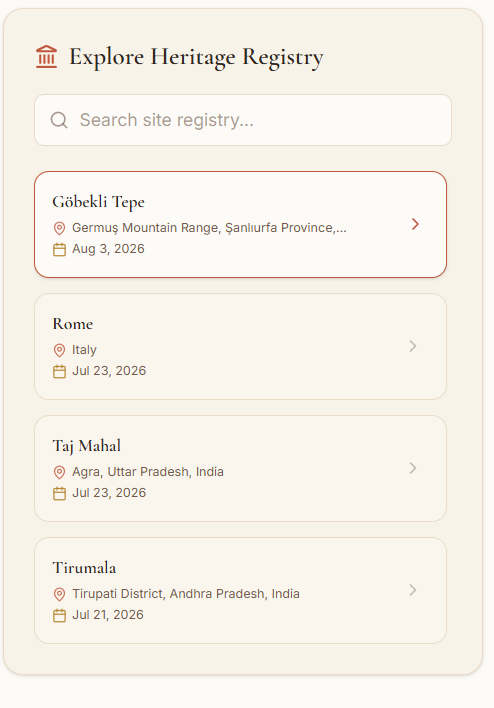
- Community-submitted heritage sites
- Offline cached guides for areas with no connectivity
- Google Maps integration
Thousands of years of history. Unlocked in seconds.
Built With
- ai-image-generation
- audio-generation
- backblaze-b2
- css
- cultural-ai
- dall-e
- gemini-flash
- gemini-pro
- generative-ai
- google-ai-studio
- google-gemini
- google-imagen-3
- google-search-grounding
- heritage
- html
- javascript
- multimodal-ai
- natural-language-processing
- openai
- pollinations-ai
- rest-api
- text-to-speech
- web-app
- wikipedia-api

Log in or sign up for Devpost to join the conversation.